
The Springbank homeowner’s 6-yard driveway pour was quoted at $9,800. Pour day cost $11,375. The extra $1,575 wasn’t concrete — it was the waiting-time clock: truck standby, pump standby, drum cleanout, a short-load fee. Nobody mentioned the clock, because he was the one being billed for it.
That clock is the part of a concrete order nobody quotes you and almost nobody explains. The per-yard price covers the material and a normal discharge window. Everything outside that window — the truck idling while your forms aren’t ready, the pump on the clock while a short-handed crew catches up, the partial load that has to be washed out and trucked away — gets metered separately and lands on the final invoice. You don’t see it coming because the person who controls most of these triggers is you, the buyer coordinating the pour, not the supplier.
This article walks the 7 pour-day mistakes that start that clock, what each typically costs in the Calgary market in 2026, and the prep that keeps the meter off. You are the buyer and logistics planner here, not the person finishing the slab — the crew does the placing. Your job is to hand them a site, an access route, and an order that let the concrete go where it’s going without anyone billed for the wait. Treat every dollar figure as an industry-survey range and validate it against your current Calgary quotes; every supplier’s rate card is different.
One model note up front, because it changes which of these seven even apply to you. Drum-mix delivery (concrete batched at a plant and trucked to you in a rotating drum) and on-site volumetric delivery (concrete batched at the truck and metered as it discharges) are both legitimate, and both produced to the same ASTM C685/C685M-25a and CSA A23.1:24 standards. Neither is stronger — the difference is the delivery-and-billing model. Three of the triggers below (the short-load fee, the partial-load drum cleanout, the idle-drum clock) are structural to how a drum gets billed, and a volumetric truck removes them by design, because it mixes on demand and bills per cubic yard actually placed. We’ll flag those honestly as we go, including where drum-mix is the right call and where a volumetric truck still bills you for on-site time. The point isn’t that one model wins; it’s that you should know which clock you’re on before the truck shows up.
1. Site not prepped before the truck arrives
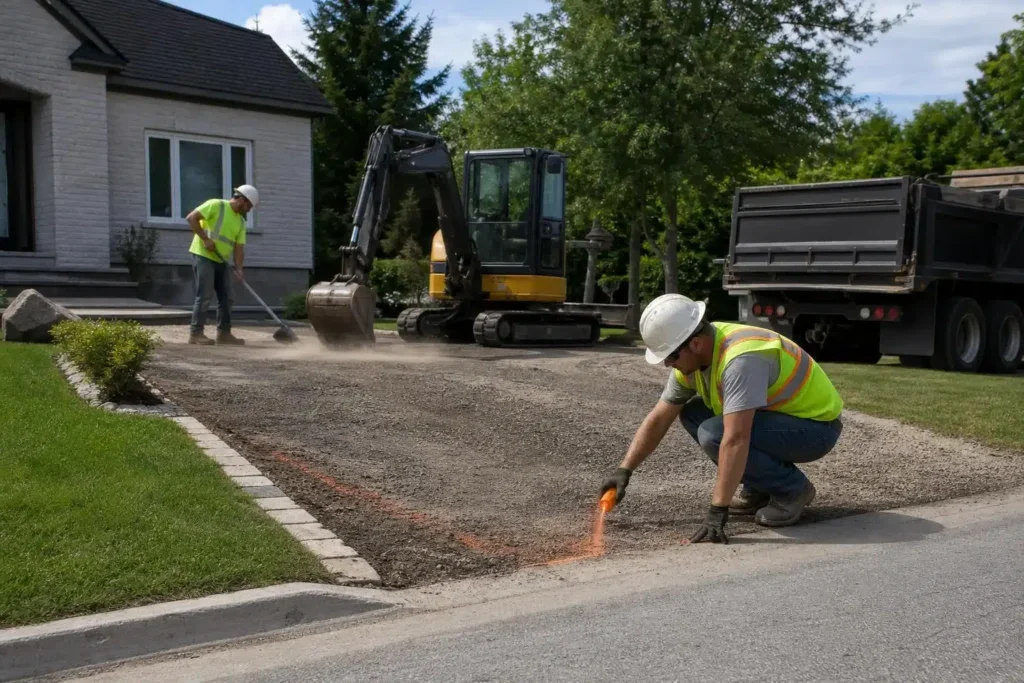
A homeowner in Cranston books a 7 AM driveway pour for a Tuesday in June 2026. The truck rolls up at 6:58. The forms aren’t fully staked, the last third of the gravel base isn’t compacted, and the rebar mesh is still in a roll by the garage. The driver does the only thing he can — he waits. Forty minutes later the forms are ready and the concrete discharges fine, but the invoice now carries 40 minutes of standby the homeowner never planned for.
Standby time (also called demurrage or waiting time) is the charge a supplier applies when a truck is held beyond the free unloading window. In the Calgary market in 2026, drum-mix standby commonly runs $2–5 per minute — roughly $120–300 per hour — after a free window often built in at around 5–7 minutes per cubic yard. (Validate the rate and window against your quote.) The clock typically starts at the truck’s scheduled arrival, not when you’re finally ready, which makes an unprepared site the single most common reason a residential invoice runs over quote.
The supplier meters it for the same reason the concrete can’t wait: the CSA A23.1:24 discharge clock. Drum-mix concrete must be discharged within 2 hours of when water first contacts the cement at the plant — never 90 minutes, but not unlimited either. Every idle minute burns off that window, and if the wait pushes the load past the limit, the supplier can’t legally place it. The standby charge is the price of a perishable product sitting still, not a cash grab.
The prep is entirely yours as the buyer, and it’s unglamorous: before the booked slot, confirm the forms are built and staked, the sub-base graded and compacted, the reinforcement placed and tied, the vapour barrier down if specified, and any embeds set. Walk the site the evening before, not the morning of. ACI 304R treats site readiness as a precondition for placement, not a pour-day improvisation. If a contractor is running your pour, ask them the day before: “Is the site pour-ready, or are we finishing prep in the morning?” The answer tells you whether you’re about to pay for an idling truck. A volumetric truck softens this — batching on demand means a short delay doesn’t age a pre-mixed load, since there’s nothing in the drum to spoil — but the operator’s on-site time is still billed, so a prepped site is the lowest-cost insurance on the invoice either way.
Most hidden pour-day costs come from logistics. The long-term damage comes from what happens during placement and curing. See 7 driveway pour mistakes Calgary homeowners notice in year 3 to learn how decisions made in the first few hours create cracks, scaling, and settlement years later.
2. Truck access blocked or unclear
A homeowner in Bridgeland schedules a back-yard patio pour for an August morning in 2026. The truck arrives to a half-blocked alley — a neighbour’s trailer on one side, the homeowner’s own vehicles still in the driveway — and no clear line for the driver to position the chute. Twenty-five minutes evaporate while cars get moved and someone figures out where the truck is actually supposed to sit. The meter runs the whole time.
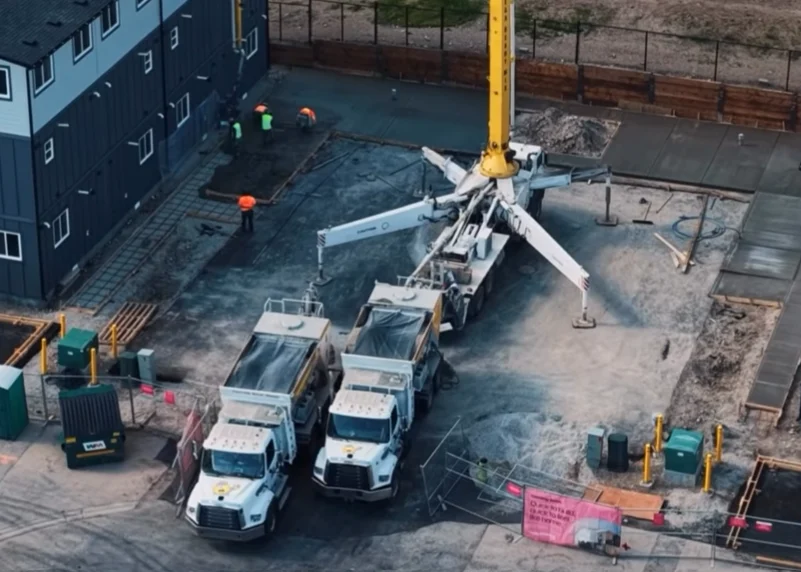
A fully loaded drum-mix truck is long and heavy and needs a clear approach to a position where its chute can reach the forms, or a clear pad for a pump if the pour is out of chute range. When that approach is blocked or improvised on the spot, the truck waits — standby at the same $2–5 per minute. Access confusion is doubly expensive because it stacks: the truck idles, the crew stands idle, and on a pumped pour the pump meter runs too. One unmoved vehicle can put three clocks in motion at once.
The 2-hour CSA A23.1:24 window applies here as well — time spent hunting for access is time off the clock for a perishable load. On a tight Calgary infill lot, access geometry isn’t a detail; it’s the whole pour-day plan. The truck that can’t get close enough either waits or triggers a pump rental that wasn’t in the quote.
The prep is pure buyer-side logistics. Before pour day, confirm with the dispatcher exactly where the truck will park and discharge from. Clear your driveway and the approach, and if the pour is down an alley or in a back yard, walk the route and measure the tightest pinch point. Tell neighbours the morning is spoken for. If the placement point is more than roughly 20–30 feet from where a truck can sit, you likely need a pump — price it into the quote rather than discovering it at 7 AM. Concrete Alberta’s placement guidance treats a planned discharge position as part of readiness, not a surprise. Here a volumetric truck has a real, structural edge worth naming as a delivery-model fact, not a quality one: it’s typically a shorter, more maneuverable wheelbase and batches as it discharges, so it can often position closer to a tight placement point. It still bills on-site time — but the truck that simply gets closer spends fewer minutes on the standby meter.
3. An under-staffed pour crew
A homeowner in Mahogany hires a two-person crew to place and finish a 6-yard driveway slab on a warm Saturday in 2026. Six yards arrives in one truck, ready to discharge in a continuous run — and two people can’t place, screed, and edge 6 yards fast enough to keep up. The pour bogs down, the truck sits between chute discharges waiting for room, and a 30–40 minute discharge stretches past the free window. Standby starts ticking, on top of the rising risk that a warm-weather mix begins going off before it’s all placed.
Crew size is a placement-rate problem, and placement rate is what keeps the truck moving. Placement-rate benchmarks documented by the PCA and ACI 304R tie the cubic yards a crew can responsibly place per hour to the number of hands, the method, and the conditions. Too few hands for the volume, and concrete arrives faster than it can be placed — you pay for the gap. An under-staffed crew costs you twice: standby on the truck plus a higher chance of cold joints or a poor finish because placement fell behind the set.
The 2-hour CSA A23.1:24 clock makes crew sizing a hard constraint. The full load must be discharged inside the window, and a crew that can’t keep pace risks the back of the load aging past the limit, especially in summer heat that speeds the set. Crew-sizing guidance exists for exactly this reason — not comfort, but getting concrete placed before it’s no longer placeable.
The prep is a question you ask before booking the truck. If a contractor runs the job, ask how many people will be on the placing crew for the volume ordered and whether that’s enough to keep pace with a continuous discharge. If the honest answer is “two of us for 6 yards on a hot day,” that’s a flag — the crew grows or the pour gets staged differently. As the buyer, you’re allowed to make crew adequacy a condition of the booking; Concrete Alberta publishes crew-sizing guidance precisely so the person paying can sanity-check the plan. A volumetric truck’s metered, on-demand discharge gives a small crew a little more control over pace, but it doesn’t substitute for enough hands and still bills on-site time. Right-size the crew regardless of who delivers — a truck held because the crew couldn’t keep up is the most avoidable charge on this list.
A slow crew doesn’t just increase standby charges. It can also delay control-joint cutting beyond the proper window. Our guide on 6 reasons a new Calgary driveway spalls in year 1 explains why the 25%-depth rule and cutting within the correct time window matter more than most homeowners realize.
4. Wrong order quan tity (the short-load trigger)
A homeowner in Auburn Bay measures a driveway slab himself, orders 4 yards to be safe, and finds on pour day that the job needed 5.5. The crew runs short mid-pour, the supplier dispatches a second truck for the missing 1.5 yards, and that small partial delivery on its own trip carries a short-load fee. The “safe” round-down turned into two trucks, two trips, and a fee that nearly erased the saving.
A short-load fee (or small-load / minimum-load fee) is what a drum-mix supplier charges when a delivery is well below a full truck — typically anything meaningfully under the ~9–10 yard capacity. In the Calgary market in 2026 it commonly runs $40–85 per yard short of the minimum, or a flat surcharge, because the supplier still has to dispatch, drive, and clean a whole mixer for a partial load. (Validate the figure and threshold against your quote.) Order too little and you trigger a second partial delivery with its own fee; split one job into two undersized loads and you can pay the fee twice. It’s the classic “cost more than the quote” surprise, and it traces straight to an order-quantity miss.
The fee exists because a truck dispatched for 2 yards costs nearly as much to run and wash as one dispatched for 9 — it recovers the fixed cost of a trip the partial load doesn’t cover. The prep is to get the yardage right with a margin built in: calculate length × width × thickness in cubic yards, add an allowance for sub-grade irregularity and over-excavation, and order slightly over rather than under, because a little leftover is far cheaper than a second short-load delivery. If you’re unsure of the take-off, have the supplier or your contractor check your numbers against the drawings before the order is placed.
This is the trigger where the delivery-and-billing model matters most, and it’s fair to state plainly. A volumetric truck meters concrete as it discharges and bills per cubic yard actually placed, so there is no fixed-capacity drum to fall short of and no short-load fee in the drum-mix sense — if the job needs 5.5 instead of 4, the operator simply keeps batching to 5.5. That structurally removes the “ordered-too-little, pay-for-a-second-trip” trap. It’s an honest advantage of the metered model, produced to the same ASTM C685/C685M-25a and CSA A23.1:24 standards as plant-batched ready-mix — not a claim the concrete is stronger, and not a reason to skip your own volume check. Drum-mix still has its place on large, single-mix, plant-economical pours; the short-load math just hits hardest on the small residential orders where guessing the quantity is easy to get wrong.
5. Pump rental ends before the pour completes
A homeowner on a heritage Inglewood lot needs a concrete pump to reach a back-yard pour the truck can’t approach. The pump is booked for a half-day block. The pour starts late because of a site-prep delay, then runs slow because of a crew shortage. By the time the last yard is placed, the pump has run past its block — and the homeowner pays pump overtime on top of the truck standby the same delays caused. One cascade, three meters.
A concrete pump is a separate rental with its own clock. In the Calgary market in 2026, a residential pump mobilization commonly runs $400–700 for a booked block, with overtime beyond it around $75–150 per hour. (Validate against current Calgary pump quotes.) The operator bills time the way the truck does, so anything that stretches the pour runs the pump meter too. It’s the trigger most likely to cascade: the delays that cause truck standby in Sections 1–3 are the same delays that push the pump into overtime, so a single root cause can appear as three separate line items.
There’s no special standard here — just rental-clock economics layered on the 2-hour CSA A23.1:24 window. When both clocks run at once, the cost of a slow pour roughly doubles. The prep is to attack the root causes, then buffer the time. If your pour needs a pump, be extra disciplined about Sections 1–4: a prepped site, clear access, an adequate crew, and the right quantity are what keep the pump inside its block. Ask the pump supplier what the block actually covers and what a realistic placement time is for your volume and crew, then book with margin rather than betting on a flawless morning. The buyer’s leverage is sequencing — confirm the day before that nothing upstream will make the pump wait. One honest note: needing a pump is often an access problem, and a more maneuverable volumetric truck can sometimes reach a placement point that would have forced a pump for a long drum-mix truck, removing that line item on some tight sites. Sometimes. Plenty of pours genuinely need a pump regardless of delivery model, and a volumetric truck still bills its own on-site time — so price the pour honestly for the site you actually have.
6. Pouring through rain without protection

A homeowner in Tuscany has a driveway pour booked for a September morning in 2026. A line of showers moves through Calgary right at the slot. The forms are ready and the truck is on site, but the crew can’t responsibly place and finish a flatwork surface into driving rain — surface water ruins the finish and weakens the top layer. So everyone waits for the cell to pass: the truck on standby, the crew idle, the load aging against the discharge clock. Twenty minutes of waiting, and the morning’s margin is gone.
Rain is the one trigger you don’t fully control, but how you plan for it is entirely yours — and that’s where the cost lives. Rain on fresh flatwork raises the surface water-to-cement ratio, weakens the wearing surface, and can ruin the finish, so a responsible crew pauses rather than pour a compromised slab. That pause is standby on the truck (and the pump, if one’s on site) while the load burns off the 2-hour CSA A23.1:24 window. ACI 304R and Concrete Alberta both treat weather as a placement condition to plan around, not push through. The compounding risk: a long enough delay can push the drum load past its discharge limit, forcing the supplier to reject it — turning a 20-minute wait into a scrapped delivery and a re-pour.
The prep is twofold, and both halves are the buyer’s call. First, watch the forecast and don’t be precious about the booked slot — a pour moved a day to dodge a wet morning costs nothing, while a pour held in the rain costs the meter and risks the slab. Build that flexibility into the booking conversation and ask the supplier about the reschedule policy and notice needed. Second, stage protection on site regardless: poly sheeting, tarps, and a plan to cover finished sections fast if a cell sneaks in. A crew that can cover and resume loses far less of the clock than one caught flat. Because a volumetric truck batches on demand, a weather pause doesn’t age a pre-mixed load the way it ages a drum — the operator stops batching and resumes when the cell passes, which lowers the “rejected load” risk in a stop-start window. It does not stop the on-site-time meter, and it doesn’t make it safe to finish flatwork in the rain. Weather discipline applies to either delivery model.
7. Drum cleanout on the partial-load return
A homeowner in Okotoks orders 5 yards for a slab and the job comes in at 3.8. The extra 1.2 yards rides back to the plant in the drum, where it can’t be reused — it’s a partial load that has to be washed out, and the invoice carries a drum cleanout fee for disposing of concrete he ordered, paid for, and never placed. The “order extra to be safe” instinct from Section 4, taken too far, lands here: under-order and you pay for a second short-load truck; badly over-order and you pay the cleanout fee. The drum-mix model bills you at both ends of a bad estimate.
A drum cleanout fee (or returned-concrete / washout fee) is what a drum-mix supplier charges to dispose of unused concrete returned in the drum and wash the drum itself. In the Calgary market in 2026 it commonly runs $200–400 for a meaningful returned quantity, reflecting the disposal cost and cleanout time before the next load. (Validate against your quote.) It’s the mirror image of the short-load fee — both are order-quantity misses, billed by the drum. The fee exists because returned plastic concrete is a controlled waste and a drum carrying set residue can’t take its next load; it covers responsible disposal and the labour.
The prep is the same disciplined take-off from Section 4, with the emphasis flipped: order with a sensible margin, not a huge one. A small over-order — enough to cover sub-grade irregularity without a wheelbarrow’s worth left over — is the sweet spot. Aim for a load that returns nearly empty, not one a yard heavy. If your take-off is uncertain enough that you’re tempted to over-order by a yard “just in case,” that’s the signal to have the quantity checked against the drawings rather than buying insurance you’ll pay to throw away.
This is the second trigger the delivery-and-billing model removes by design, and it’s worth stating as plainly as the short-load point. A volumetric truck batches only what it discharges and bills per cubic yard actually placed, so there is no leftover load returning in a drum and no partial-load cleanout fee — you stop the meter when the forms are full. That removes both ends of the order-quantity trap at once: no short-load fee for under-ordering, no cleanout for over-ordering. It’s an honest consequence of the metered model, produced to the same ASTM C685/C685M-25a and CSA A23.1:24 standards as plant-batched ready-mix — not a strength claim, and not a reason to stop estimating carefully. Drum-mix remains the economical choice on large, single-mix pours where a full truck runs nearly empty anyway. On the small residential pour where the estimate is hard to nail, the metered model is simply the one that doesn’t bill you for guessing.
Seven mistakes, one underlying truth: the waiting-time clock is a logistics problem you mostly control as the buyer, not a price the supplier sets after the fact. A prepped site, clear access, an adequate crew, an accurate order, a buffered pump block, a movable date for weather, and a sensible margin on quantity — that’s the whole defence. Get those right and the final invoice matches the quote. Get them wrong and the clock fills the gap, in $2–5-per-minute increments you’ll wish someone had named before 7 AM.
FAQ
Q1: How much is a concrete truck standby fee in Calgary? In the Calgary market in 2026, drum-mix truck standby (also called demurrage or waiting time) commonly runs in the range of $2–5 per minute, or roughly $120–300 per hour, charged after a free unloading window that is often built in at around 5–7 minutes per cubic yard. The clock typically starts at the truck’s scheduled arrival, not when you’re ready for it. These are industry-survey ranges — validate the exact rate and free window against your current Calgary quote, because they vary by supplier and season.
Q2: What is a drum cleanout fee? A drum cleanout fee (also called a returned-concrete or washout fee) is what a drum-mix supplier charges to dispose of unused concrete returned in the drum and to wash the drum before its next load. In the Calgary market in 2026 it commonly runs in the range of $200–400 for a meaningful returned quantity. It’s triggered by over-ordering: concrete you paid for but didn’t place rides back to the plant as a controlled waste that costs money to dispose of. A volumetric truck avoids it structurally, because it meters per cubic yard placed and leaves no returned load.
Q3: How long should a 6-yard residential pour take? For a typical 6-yard residential slab with an adequately sized crew and clear access, discharge and placement often run in the range of 30–45 minutes, with the truck on site under about an hour including setup. The actual time depends on crew size, placement method, access, and conditions — placement-rate benchmarks from the PCA and ACI 304R tie the achievable yards-per-hour to the number of hands and the method. An under-sized crew is the most common reason a 6-yard pour overruns and starts the standby clock. The full load must be discharged inside the CSA A23.1:24 2-hour window regardless.
Q4: Does volumetric concrete have waiting-time fees? A volumetric supplier still bills for on-site time over a typical pour duration, so yes — there is still a clock on the operator’s time, and a slow pour is still a metered pour. What the volumetric model removes is a different set of triggers: because it batches on demand and bills per cubic yard actually placed, there’s no idle pre-mixed drum racing the discharge clock, no short-load fee for under-ordering, and no partial-load drum cleanout for over-ordering. It’s produced to the same ASTM C685/C685M-25a and CSA A23.1:24 standards as plant-batched ready-mix — the difference is the delivery-and-billing model, not the concrete.
Q5: Why did my Calgary concrete pour cost more than the quote? Almost always because of the waiting-time clock the quote didn’t itemize. The per-yard price covers the material and a normal discharge window; charges outside that window — truck standby at $2–5/minute, pump overtime at $75–150/hour, a short-load fee of $40–85/yard short, or a $200–400 drum cleanout — get metered separately and land on the final invoice. The triggers are mostly logistics you control as the buyer: an unprepared site, blocked access, an under-staffed crew, a wrong order quantity, a pump that ran long, or a rain delay. Ask any supplier to spell out the standby rate, free window, short-load threshold, and cleanout fee before you book.
Q6: How do I avoid waiting-time fees on a Calgary concrete pour? Control the seven triggers, all of which sit on the buyer’s side of the pour. Have the site fully pour-ready at the booked slot (forms, base, rebar, embeds). Clear and confirm truck access and the discharge position in advance. Make sure the placing crew is large enough to keep pace with the volume. Get the order quantity right with a sensible margin — over-order a little, not a lot. If a pump is needed, fix the upstream delays and book the block with a buffer. Watch the weather and treat the date as movable, with tarps staged just in case. Order a sensible margin so the load returns nearly empty. A volumetric delivery removes the short-load, partial-load-cleanout, and idle-drum triggers by design, but right-sizing the crew and prepping the site still matter on any pour.
Sources
- Concrete Alberta — Placement and crew-sizing guidance for Alberta concrete work — https://concretealberta.ca
- ACI 304R — Guide for Measuring, Mixing, Transporting, and Placing Concrete — site readiness, placement rate, and weather as placement conditions — https://www.concrete.org
- PCA (Portland Cement Association) — Placement-rate benchmarks for concrete construction — https://www.cement.org
- ASTM C685/C685M-25a — Standard Specification for Concrete Made by Volumetric Batching and Continuous Mixing — the governing specification for volumetric (metered, on-site) concrete production — https://www.astm.org
- CSA A23.1:24 — Concrete materials and methods of concrete construction (14th edition) — the 2-hour discharge clock and placement requirements — https://www.csagroup.org
- HomeGuide / Angi / Fixr — Calgary regional concrete pricing surveys, 2026 — standby, short-load, pump, and cleanout fee ranges — validate against current local quotes
About Omega Ready Mix
Omega Ready Mix (est. 2023) is a Calgary-based volumetric concrete supplier serving homeowners, contractors, and builders across the Calgary region, batching CSA A23.1:24-compliant mixes to ASTM C685/C685M-25a — and explaining the pour-day clock plainly, including where drum-mix delivery is the better call.
Before You Book Your Calgary Concrete Pour, Know What Actually Starts the Meter
CTA Copy
A low price per cubic yard doesn’t guarantee a low final invoice. Truck standby, pump overtime, short-load fees, and drum cleanout charges are all driven by site logistics—and most of those decisions happen before the truck leaves the plant.
Omega Ready Mix helps homeowners, contractors, and builders plan pours that avoid unnecessary waiting-time charges. We’ll review your project, confirm the concrete quantity, discuss truck access, determine whether a pump is actually needed, and explain exactly how your delivery will be billed before pour day.
Request your Calgary concrete quote today to know what is and isn’t included before the truck arrives.