
Year 1 hides almost everything. Year 3 reveals almost everything. The cracks, the scaling, the step at the curb edge a Calgary homeowner notices around year 3 almost never trace to “Calgary weather” — they trace to seven specific decisions made in the four hours around the pour, and the same seven failures have repeated in the same Calgary neighbourhoods for three decades.
A Bearspaw acreage owner walked his eight-year-old driveway in April 2026 with the neighbour who was about to pour his own. The first run was 80 feet, 5 inches thick, placed by a now-defunct contractor in October 2018. By year 3 it had shown four problems; by year 8, seven. Joint-to-joint hairline cracks on the south-facing slope. A two-metre spider crack at the apron where the slab meets the garage.
Light scaling at the curb edge. A 4 mm step at one of the control joints. The neighbour, about to pay roughly $14,000 for the same kind of work, wanted to know what to ask the new contractor to do differently. This article is the answer — seven year-3 failure patterns, the seven pour-day decisions behind them, and why an operator who has watched the same neighbourhoods for three decades can name most of them on sight.
That last part is worth being precise about. Omega Ready Mix is the newer arm of the Omega family (est. 2023); the three-decade Calgary photo record of year-3 driveway failures belongs to its sister company, Omega 2000 Cribbing, the family’s foundation business operating in these neighbourhoods since 1988.
The mixes and the standards below are current CSA A23.1:24; the pattern recognition is borrowed from 38 years of watching the same soils, the same Chinook freeze-thaw cycle, and the same shortcuts produce the same cracks.
1. Hairline cracks joint-to-joint (the late-cut control joint problem)
The Bearspaw driveway has saw cuts roughly 6 mm deep at 15-foot spacing. By year 3, random hairline cracks were running between the cuts — not at them. The homeowner read that as soil movement. It is geometry. The joints are both too shallow and too far apart to do their job, so the slab cracked where it wanted to instead of where the saw told it to.
A control joint is a deliberate line of weakness: concrete shrinks as it cures and contracts as it cools, and a control joint gives the inevitable crack a straight, pre-chosen place to form in a tooled or sawn line. CSA A23.1:24 and Concrete Alberta’s flatwork guidance set the two numbers that make a joint work.
Depth: the cut must reach 25% of the slab thickness — 1.25 inches on a 5-inch driveway, not 6 mm. Spacing: roughly 24 to 36 times the slab thickness, about 10 to 15 feet on a 5-inch slab. Miss either and the joint stops controlling the crack.
The 25%-depth rule is, in our sister company’s three-decade Calgary record, the single most-violated joint spec in residential work. A 6 mm cut photographs like a finished joint at handover but barely scores the surface — it never reaches deep enough to force the crack down into it, so shrinkage stress finds its own path and a hairline wanders between the joints.
By year 3 those cracks are visible across a meaningful share of the slab, and the homeowner is standing on a geometry failure that looks exactly like a soil problem.
Why this matters to you as a buyer: a crack that runs between the control joints, rather than at them, is the signature of a joint cut too shallow or spaced too wide — not proof your soil moved. Before you pay for a geotechnical investigation, look at where the cracks sit relative to the joints. On your next pour, joint depth is a question you can ask before the saw comes out.
And the timing of that cut matters as much as the depth.
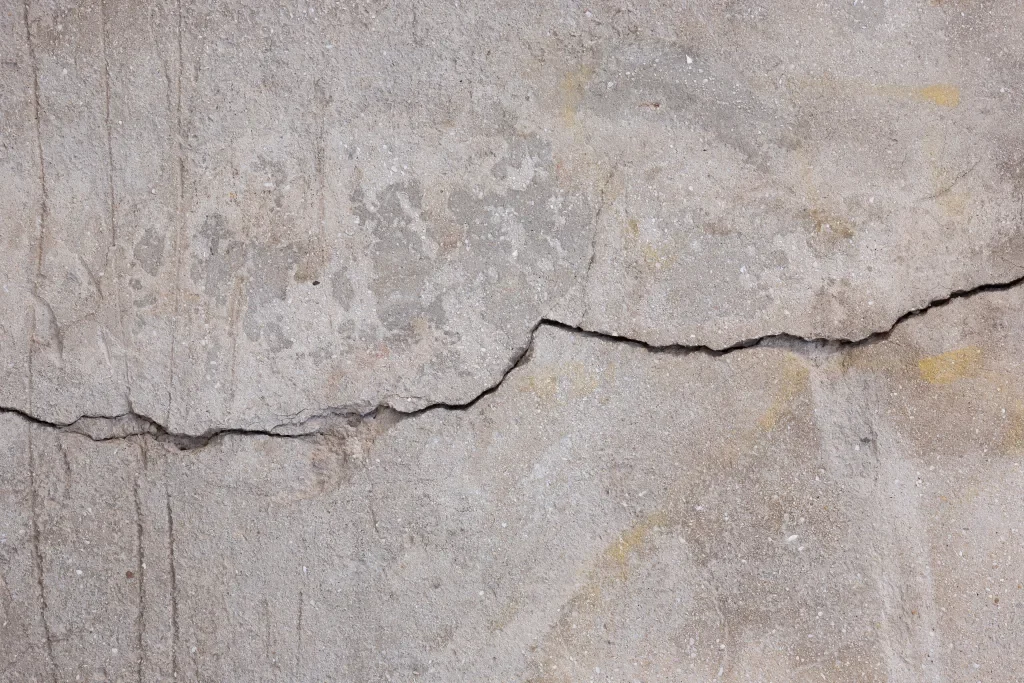
2. Late control joint cuts (the 4–12 hour Calgary summer window)
The Bearspaw joints were cut at hour 18 — the morning after, once the crew came back. By then the slab had already relieved its early shrinkage on its own. The saw cuts that were supposed to prevent cracks were now just decorating cracks that had formed overnight.
The homeowner never saw the difference, because a hairline that opened at hour 10 and a saw cut made at hour 18 look identical from a standing height three years later.
The fact: CSA A23.1:24 and Concrete Alberta finishing guidance call for control joints to be cut within roughly 4 to 12 hours after placement — late enough that the concrete saws cleanly without ravelling, but before it builds enough tensile strength to crack on its own.
In Calgary’s summer that window collapses. Low humidity, frequent 20 °C-plus afternoons, and a dry Chinook-influenced wind can shrink the cutting window to a couple of hours, so a crew working a same-day-pour, next-morning-cut habit is cutting far too late for a July driveway.
This is why two driveways from the identical truckload can age completely differently. The mix is the same; the timing is not. A slab cut inside the window cracks neatly down the joints, where the eye never finds it. A slab cut at hour 18 has already cracked along its own line of least resistance, and the late cut just sits beside the real crack — decorative and useless. By year 3 that random pattern is permanent.
Why this matters to you: late jointing is invisible at handover and undeniable by year 3, and you cannot test for it after the fact. On a future pour you can ask when the joints will be cut — “first thing tomorrow morning” is a real flag on a hot Calgary day. Our companion piece on the five control-joint mistakes that crack Calgary driveways in year 1 covers the timing window in more detail.
And the next year-3 failure is the one that looks worst on a stamped or coloured driveway.
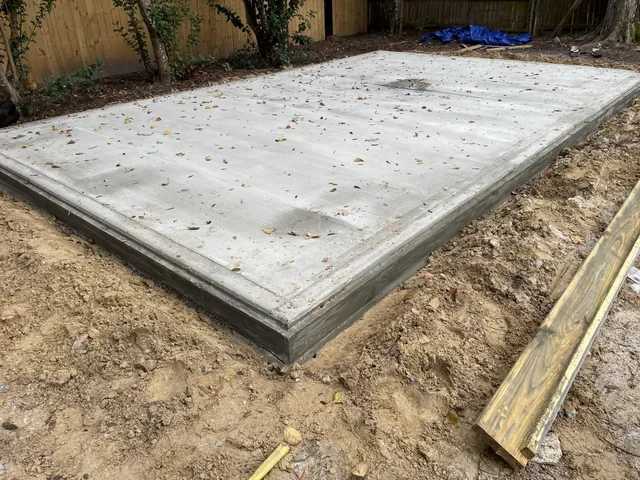
3. Joint-to-joint surface scaling (the C-2 vs F-1 downgrade revisited)
The Bearspaw slab shows light scaling on the south-facing slope — the exact area that gets the most sun-driven melting, the most refreezing, and the most de-icing salt tracked off boots and tires. The homeowner reads it as weather.
It traces to a mix class chosen at the quote stage. The driveway was specified as F-1 when a salted Calgary driveway calls for C-2, and the difference between those two classes is precisely the difference between a surface that resists de-icing chemicals and one that does not.
Here is the distinction CSA A23.1:24 draws. A Calgary residential driveway sees both freeze-thaw cycling and de-icing chemicals — salt off the road, off vehicles, sometimes off the bag in the garage. That combination is Exposure Class C-2: minimum 32 MPa at 28 days, 5 to 8 percent entrained air, and a water-to-cement ratio of 0.45 or lower, with the detailing that goes to chemical scaling resistance.
Class F-1 is for freeze-thaw without de-icing chemicals — also 32 MPa and 5 to 8 percent air, but it permits a looser water-to-cement ratio of up to 0.55 and is not detailed for the de-icing-chemical environment. F-1 is legitimate for the right application. A salted driveway is not that application.
The downgrade is easy to make and hard to catch, because on paper F-1 and C-2 share the same headline strength number. The buyer sees “32 MPa” and assumes the mix is right. The variable that actually governs surface scaling — the water-to-cement ratio and the chemical-exposure detailing — sits one line lower, where it is rarely read.
A driveway placed at 0.55 has a more permeable surface paste than one at 0.45; run de-icing chemicals across it through three Calgary winters and it scales. The homeowner blames the salt; the class was the decision.
Why this matters to you: scaling across whole panels — fine flaking of the top layer, worst where sun and salt concentrate — is the fingerprint of a mix not detailed for de-icing chemicals, not a sign your concrete was simply “cheap.” On a quote, the line that protects you is the exposure class and the water-to-cement ratio, not the strength alone. Ask which exposure class your driveway is being supplied to, and confirm it reads C-2.
Year 3 is also when the apron crack stops being cosmetic.
If you’re already seeing flaking instead of cracking, read our guide on 6 reasons a new Calgary driveway spalls in year 1 (and what the sealer won’t fix).
4. Apron cracking at the garage interface (the cold-joint and slope problem)
The two-metre spider crack on the Bearspaw driveway forms exactly where the driveway slab meets the garage slab. The two pours were never isolated from each other — no isolation joint, no compressible filler between them.
The garage slab lives in a heated, dimensionally stable space; the driveway slab lives outside, expanding and contracting through every freeze-thaw swing. Tie two slabs that move differently rigidly together and the connection is where they tear.
The fact: Concrete Alberta residential guidance, consistent with CSA A23.1:24 detailing, calls for a compressible isolation joint at every interface between independently moving elements — driveway to garage slab, to house, to sidewalk, to step. An isolation joint is not a control joint.
A control joint manages shrinkage within one slab; an isolation joint is a full-depth separation with a compressible filler that lets two adjacent slabs move independently without loading each other. The garage interface is the most demanding one on the job, joining the most dimensionally stable slab on the property to the least stable.
In our sister company’s Calgary record, a skipped isolation joint at the garage door is the most common origin of year-3 cracking at that interface — and the crack does not stay still. It admits water; the water freezes in Calgary’s roughly 128 freeze-thaw cycles a year; the freezing works the crack wider each winter.
A hairline at the apron in year 3 becomes an open crack by year 5 and, often, a lifted lip and trip hazard by year 8. What started as a missing $20 of joint filler ends as a section that has to be cut out and re-poured.
Why this matters to you: a crack that starts at the garage door and spiders outward is rarely random — it is usually the absence of an isolation joint where two slabs that move differently were locked together. On a future pour, ask specifically how the driveway will be isolated from the garage slab and the house. It is one of the cheapest details on the job and one of the most expensive to retrofit.
Year 3 is also when the base under the slab announces whether it was prepped properly.
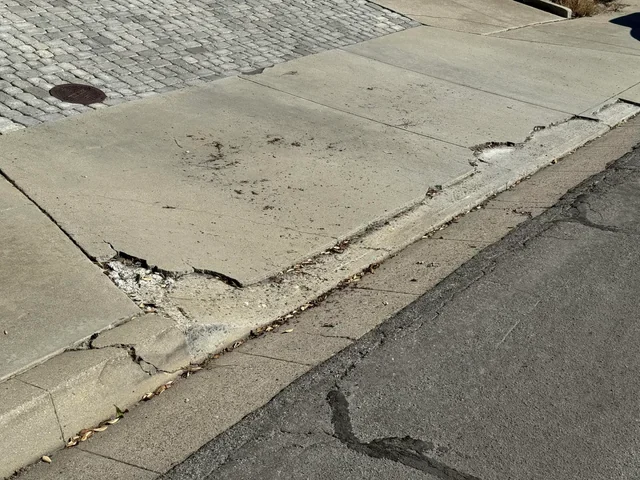
5. Subgrade settlement at the curb edge (the inadequate base prep problem)
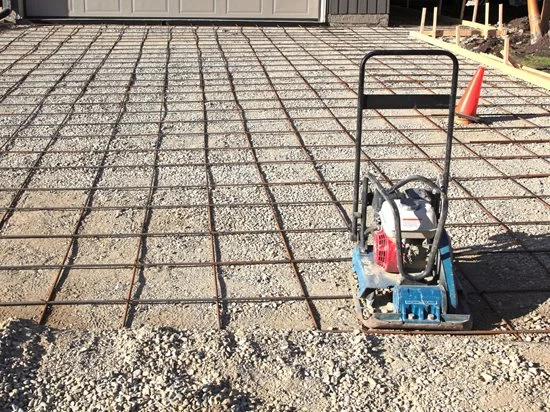
The Bearspaw driveway has a 4 mm step down at the curb edge — one panel has settled relative to its neighbour. The base under it was 4 inches of compacted gravel. Calgary residential practice on these clay subgrades calls for more: a deeper, properly compacted granular base, placed and compacted in lifts, often over a geotextile separation fabric so the clay below cannot pump up into the gravel.
The slab did not fail. The ground under one edge did, and the slab followed it down.
The fact: City of Calgary construction specifications and Concrete Alberta residential guidance put the granular base for residential flatwork at roughly 100 to 200 mm (4 to 8 inches) of compacted granular material, with the depth driven by the subgrade.
On Calgary’s expansive and lacustrine clays — including the Bearpaw clay underlying much of the west and northwest — the upper end is the prudent target, placed in compacted lifts rather than dumped and graded. The base spreads the slab’s load and the soil’s freeze-thaw movement; a thin or under-compacted base lets one area settle while the rest holds, and the slab cracks or steps at the boundary.
This hides until year 3 because compaction failures are progressive. A base that was a little thin or under-compacted does not fail on day one — it consolidates slowly under traffic and freeze-thaw heave, becoming visible only once it has stepped a joint or cracked a panel.
Settlement cracking mimics shrinkage cracking to the untrained eye, but it behaves differently: it is structural, it tracks the soft spot, and it keeps moving. A 4 mm step in year 3 commonly becomes a 15 mm step by year 8 and a candidate for slab replacement by year 12.
Why this matters to you: a step at a joint, or cracking concentrated at one edge rather than spread evenly, points down — to the base and subgrade — not to the concrete. You will not see the base after the pour, but before a future pour you can ask how deep the granular base will be, whether it is compacted in lifts, and whether a geotextile fabric is going over the clay.
Our piece on the six Calgary soils that crack foundations in five years covers how these same clays behave under structures across the city.
Year 3 is also when an admixture decision made on a cold pour day starts to show.
6. Year-3 reinforcement corrosion (the calcium chloride accelerator decision)
The Bearspaw pour went in during the second week of October 2018, with the air cooling. To get the slab to set before the cold, the plant added a calcium chloride accelerator to the mix. The driveway also carried wire-mesh reinforcement. By year 3, faint rust staining had begun bleeding to the surface in a grid pattern that matched the mesh below. The homeowner thought the surface was just dirty. It was the steel beneath it, starting to corrode.
The fact: calcium chloride is an effective, inexpensive set accelerator — which is exactly why it gets reached for on late-season Calgary pours. But chloride ions are also what drive corrosion of embedded steel.
CSA A23.1:24 restricts the use of chloride-based accelerators in concrete containing embedded steel, and for good reason: chloride accelerates the corrosion of reinforcement, and corrosion is an expansion reaction — rusting steel occupies several times the volume of the original metal, and that expansion pressure cracks the concrete from the inside out.
Add a chloride accelerator to a slab with mesh near the surface, then expose it to a freeze-thaw-plus-salt environment, and you have stacked an internal chloride source on top of the external one the road already supplies.
This is a slow-motion failure by design, which is why year 3 is when it surfaces rather than year 1. The chloride does not corrode the steel overnight; it lowers the threshold and speeds the clock. Surface rust staining in year 3 is the cosmetic early warning.
The structural problem — section loss in the reinforcement, and internal cracking driven by the expanding corrosion product — develops behind it over the following years, until the mesh that was supposed to hold the slab together is doing less and less of that job.
Why this matters to you: rust staining that appears in a regular grid pattern is the reinforcement telling you chloride has reached it. It is not a stain to be scrubbed; it is a signal. On a cold-season pour, ask what the contractor is using to accelerate set and whether it is chloride-based — non-chloride accelerators and other cold-weather methods exist precisely for slabs that contain steel.
And the seventh year-3 failure is the one that is almost always blamed on the wrong thing entirely.
7. The 30-foot crack blamed on Bearpaw clay (that’s actually a curing failure)
The Bearspaw driveway has a single, long crack — roughly 30 feet — running diagonally from the curb toward the garage door. The homeowner is certain it is the soil. Bearpaw clay is real, it is famously expansive, and it underlies much of the area; the Alberta Geological Survey’s Bulletin 053 documents the formation in detail.
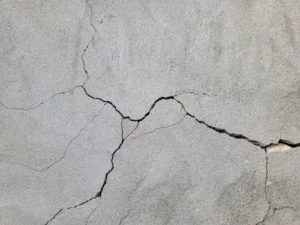
So the explanation feels obvious. But the crack runs at about 45 degrees across the joint pattern, which is the signature of thermal contraction during early curing — not the heaving and settling pattern that expansive clay produces. The homeowner is blaming the right villain for the wrong crime.
The fact: Concrete Alberta’s cold-weather guidance is specific about what happens when a slab is placed as the air temperature is dropping and is left unprotected. A typical late-September or early-October Calgary pour that is not protected with insulating blankets loses surface heat fast; the surface contracts against a warmer, slower-cooling core, and the resulting tensile stress can crack the slab within the first 24 to 72 hours — before the concrete has reached the 7 MPa it needs to resist early frost damage.
CSA A23.1:24 treats roughly 7 MPa as the compressive strength a slab must reach before it can safely be left exposed to freezing; below that threshold, an uninsulated slab in dropping Calgary temperatures is vulnerable, and a thermal crack that forms in those first hours is locked in for the life of the driveway. From a standing height three years later, that early thermal crack is indistinguishable from a settlement crack.
This is the honest reframe the whole article has been building toward. Bearpaw clay does crack Calgary structures, and our soils piece does not soft-pedal that. But a single long diagonal crack that was present, in hindsight, very early in the driveway’s life — and that runs across the joints rather than tracking a soft spot — is far more often a thermal-shock event from an unprotected cold-weather pour than it is the clay.
In the Bearspaw case the owner spent roughly $4,000 on a geotechnical investigation that found nothing wrong with the soil, because the crack was a curing-day failure from October 2018, set in the first 36 hours and misread as ground movement ever since.
Why this matters to you: before you accept “it’s the clay” and pay for a soil investigation, look at the crack itself. A crack that runs diagonally across the control joints, that was effectively there from the first year, and that is not accompanied by a stepped or heaving pattern, points back to the pour day and the cure — not down to the subgrade.
And on a future pour, a cold-season placement protected with blankets until it reaches 7 MPa is how you keep this crack from ever forming. The neighbour’s pour, scheduled for that spring, can avoid all seven of these — if the contractor answers the right seven questions at the quote stage.
FAQ
Q1: Why did my concrete driveway crack after 3 years? Year 3 is when year-1 pour decisions become visible. The most common causes in Calgary are control joints cut too shallow (under the 25%-of-thickness rule) or too late (outside the 4-to-12-hour window).
A missing isolation joint where the driveway meets the garage, an undersized or poorly compacted granular base, a chloride accelerator corroding embedded steel, and thermal cracking from an unprotected cold-weather pour. Calgary’s roughly 128 freeze-thaw cycles a year expose all of them — but the weather is rarely the root cause by itself.
Q2: What causes late control joint cracking? Control joints have to be cut within roughly 4 to 12 hours of placement — early enough to saw cleanly, but before the slab builds enough tensile strength to crack on its own.
In Calgary’s dry, warm summer air that window can shrink to a couple of hours. A joint cut too late doesn’t control the crack; the slab has already cracked along its own path, and the late saw cut just sits beside the real crack. By year 3 that random pattern is permanent.
Q3: Why is my driveway apron cracking at the garage? Almost always a missing isolation joint. The garage slab sits in a heated, stable space and the driveway slab moves with every freeze-thaw cycle outside; if the two were poured tight together without a compressible isolation joint between them, the interface tears.
The crack then admits water, which freezes and works it wider each winter — so a hairline at the apron in year 3 often becomes a lifted, cracked lip by year 8.
Q4: Is my driveway crack from Bearpaw clay or bad curing? Look at the crack’s direction and age. Bearpaw clay is real and expansive (documented in Alberta Geological Survey Bulletin 053), but clay movement tends to produce stepped, heaving patterns that track a soft spot.
A single long crack running diagonally across the control joints, present effectively from the first year, is more often thermal-shock cracking from an unprotected cold-weather pour — the surface contracted and cracked in the first 24 to 72 hours, before the concrete reached 7 MPa. The two look identical years later but have different causes and different fixes.
Q5: What causes concrete surface scaling years later? Scaling — fine flaking of the top surface, worst where sun and salt concentrate — usually traces to the mix class chosen at the quote stage. A salted Calgary driveway needs Exposure Class C-2 (32 MPa, 5–8% air, water-to-cement ratio ≤ 0.45, detailed for de-icing chemicals).
If it was supplied as F-1 instead, that class permits a looser water-to-cement ratio (up to 0.55) and is not detailed for de-icing chemicals, so the more-permeable surface scales after a few winters of salt exposure. The headline strength number can look the same; the exposure class and water-to-cement ratio are what differ.
Q6: Can a contractor still warranty my driveway in year 3? Usually not. Most Calgary flatwork warranties run about one year, and Alberta’s new-home warranty program covers the home’s foundation, not the driveway. After the first year, a year-3 crack or scale is generally the homeowner’s to absorb — which is exactly why the seven decisions in this article matter most before the pour, not after.
Volumetric concrete, where water is metered at the auger on site, is produced to the same ASTM C685/C685M-25a and CSA A23.1 standards as plant-batched ready-mix — not stronger, the same standards — but no delivery method substitutes for correct jointing, base prep, mix class, and curing.
Sources
- CSA A23.1:24 (14th edition) — control joint geometry, Exposure Classes C-2 and F-1, chloride-accelerator limits, and the ~7 MPa early-frost threshold — https://www.csagroup.org
- Concrete Alberta — finishing, jointing, cold-weather, and curing best practices for Alberta flatwork — https://www.concretealberta.com
- Alberta Geological Survey — Bulletin 053 (Bearpaw Formation / Bearpaw clay characterization) — https://ags.aer.ca
- City of Calgary — Climate Hazards Report (freeze-thaw cycle data, ~128 crossings, 30-year average) and residential construction specifications (granular base depth) — https://www.calgary.ca
All spec values reflect current CSA A23.1:24 requirements; confirm against the published standard and your own site documentation before relying on them. Exposure-class selection for a specific driveway should be confirmed with your supplier against its actual salt and freeze-thaw exposure.
About Omega Ready Mix
Omega Ready Mix (est. 2023) supplies ready-mix and volumetric concrete to the Calgary area, produced to CSA A23.1:24 and ASTM standards. We share a family with Omega 2000 Cribbing, the foundation business that has worked Calgary’s soils since 1988 — and we believe a homeowner who can read a crack and a mix class is a better buyer, with a driveway that survives Calgary winters.
Before You Pour Your Driveway, Ask These Seven Questions
Most driveway failures don’t start three years later—they start on pour day.
If you’re comparing concrete contractors, we’ll walk you through:
- the correct CSA exposure class
- control-joint spacing and timing
- granular base preparation
- curing methods
- cold-weather protection
- reinforcement options
- concrete supply for your project
Get the details right before the truck arrives.
Request a Driveway Quote with Omega Ready Mix today.