
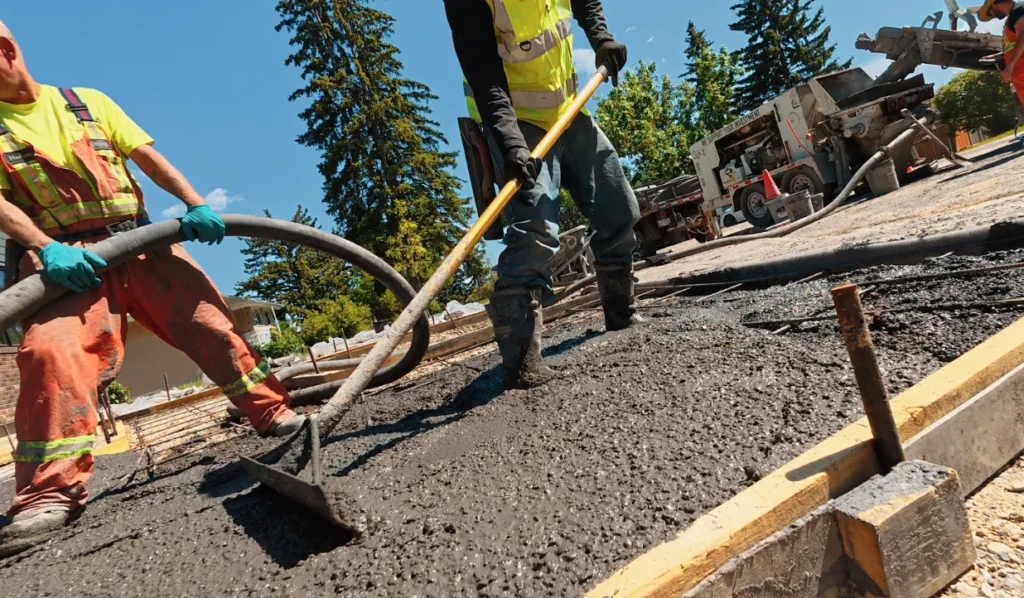
On a phased project, footing one week, foundation wall the next, slab and flatwork later, a volumetric (mobile-mixer) supplier can return for each stage and batch the exact specified mix on site each time, instead of the job being re-sourced to whichever plant has an open slot that day. That matters because consistency across every pour, not just the grade written on the order, is what protects the joints where one element bonds to the next.
Inconsistent concrete between phases can weaken those joints and a structure’s load-bearing behaviour. A volumetric truck meters cement, sand, stone, and water to a stored mix design and records the quantities used on each pour, so the same Calgary-spec mix (Type HS or HSb to CSA A23.1 for our sulphate soils) gets reproduced footing to wall to slab from a single accountable source, and you pay only for the cubic metres each phase needs.
This article is about consistency across weeks: the same supplier, the same recorded mix, returning per phase. For the general method comparison and the discharge-clock physics, see Volumetric vs ready mix: the honest Calgary answer; we link those rather than repeat them here.
What “phased pour” really means on a small build
Most concrete content treats “phased pour” as a within-one-pour problem: the cold joint that forms when a second lift goes on top of a first that has already started to set. That’s a real thing, and it’s covered elsewhere.
This page is about the other kind of phasing, the one that runs your actual project calendar. A detached garage, a garden suite, a workshop, or a foundation gets built in stages over days or weeks:
- Week 1: strip footings poured to the 1.2 m frost depth.
- Week 2: foundation walls formed and poured on top of the footings.
- Later: the slab-on-grade, then exterior flatwork, walks, and a patio.
Each of those is a separate pour, often a separate week, sometimes a separate month if weather or trades intervene. And here’s the quiet risk: if each phase gets re-sourced to a different plant, or the same plant on a different day with a different batch of materials, you can end up with concrete that varies pour to pour, exactly where the elements have to bond and act as one structure.
Why same-mix-every-phase is structural, not cosmetic
This isn’t about colour matching. The supplier-engineering literature is blunt about why consistency between pours matters. As one ready-mix producer puts it, “on large-scale pours or phased developments, consistency is everything,” because structural strength “depends not just on concrete grade, but on consistency across every pour, since inconsistent concrete can weaken joints, reduce load-bearing capacity, and shorten a building’s lifespan.”
(Source: Aparna RMC, “Why Consistent Concrete Supply Is Critical for Structural Strength”.)
Read that again with a footing-to-wall build in mind. The grade on your order, say 32 MPa, is a target. Two different batches can both claim that target and still differ in workability, air content, and the small things that govern how cleanly the wall bonds to the footing it sits on. The joint between elements is where variability does its damage.
The second half of the fix is single-source accountability. Sourcing from one trusted supplier gives you “tight quality control and cross-site consistency, so no matter where your delivery comes from, it performs as expected,” with centralised mix-design protocols that “ensure the same grade performs identically.”
(Source: Armstrongs Group, “Why Aggregate Quality Matters”.)
That’s written for big commercial multi-plant jobs. On a small Calgary build, a volumetric supplier returning for each phase is that single source, with no hand-off to a different plant between footing and wall.
How a volumetric truck reproduces the exact mix weeks apart
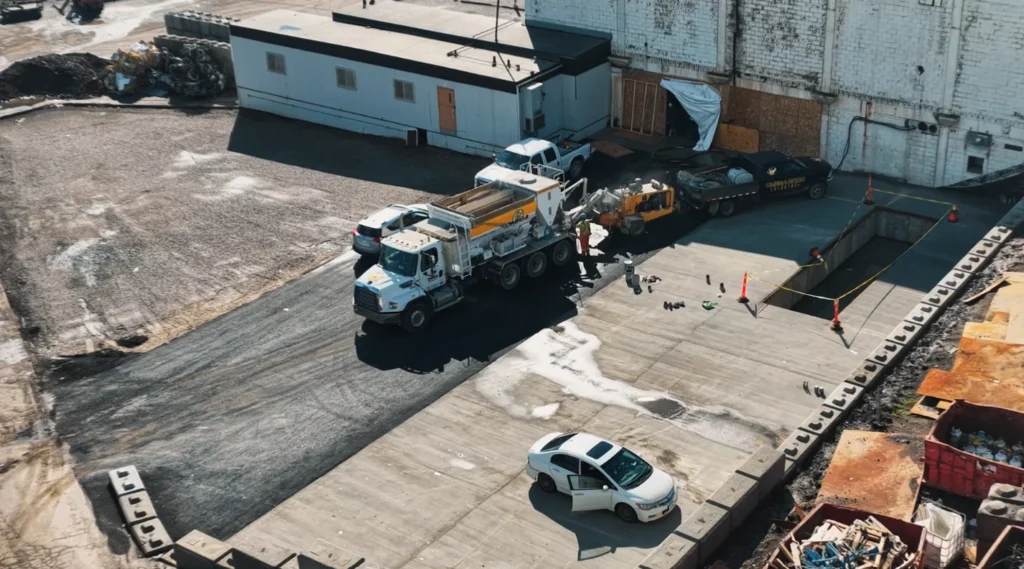
A drum truck shows up with concrete that was batched at a plant for that day’s order. A volumetric truck shows up with the raw materials, cement, sand, stone, water, and admixtures in separate compartments, and an onboard control system that batches and mixes on site to a programmed mix design.
That stored-and-recorded capability is what makes “exact mix each time” real. Modern volumetric mixers store a mix design and record the materials used on each pour. The manufacturer Cemen Tech describes its control system this way: it “allows for consistently accurate mix designs,” operators “change their concrete mix design with the touch of a button,” “information is stored electronically for each job and mix,” and “the exact use rate of aggregate, sand, water, and cement is displayed on a digital readout for on-site quality control.”
(Source: Cemen Tech / Equipment Journal; RER.)
To be clear, that’s the manufacturer’s description of one proprietary control system, named here to illustrate the category capability, not an Omega product claim. The point that transfers is the principle: a stored, repeatable, recorded mix design means week 2’s wall can be batched to the same specification as week 1’s footing, with the exact quantities on record.
Cemen Tech’s leadership frames the phased use case directly. When a job needs more than one mix design, volumetric “eliminate[s] fuel used when driving back and forth to the yard,” supporting contractors on “larger, phased projects with varying concrete requirements.”
(Source: Cemen Tech.)
Is it as consistent as plant concrete?
Yes. The Volumetric Mixer Manufacturers Bureau reports that volumetric-mixer concrete is “equal, if not more consistent in quality (due to no delay in placing the material)” than plant ready-mix, a position cited in a peer-reviewed construction-management study.
(Source: VMMB 2005, via Graham, Tommelein & Smith, ARCOM 2005, p.1009.) That supports “as consistent,” not “stronger.”
The Calgary spec, every phase
A phased build never means the second pour gets a different or weaker mix. Roughly 95% of Calgary-area lots sit on S-2 sulphate soils, so the concrete in the ground has to be sulphate-resistant on every phase, not just the first.
| Phase | Element | Calgary spec (each phase, to CSA A23.1:24) |
|---|---|---|
| 1 | Strip footing | Type HS/HSb, 32 MPa @ 56d (35 premium), 5–7% air, to 1.2 m frost depth |
| 2 | Foundation wall | Same Type HS/HSb sulphate-resistant mix, batched on return |
| 3 | Slab-on-grade | Sulphate-resistant, air-entrained, mix dialled for flatwork finishing |
| Later | Exterior flatwork / patio | Air-entrained for freeze-thaw, same accountable source |
(Spec values per the Calgary Concrete Master Knowledge Base; standards proof in the strength article.)
The footing and the wall must be the same sulphate-resistant mix, so the consistency argument has real Calgary teeth. A volumetric supplier batches that exact Type HS/HSb spec on every return visit.
The cost side: pay per phase, not per minimum
Because a volumetric mixer meters to the quarter-cubic-metre and batches on demand, each phase is billed for the concrete actually placed. No over-ordering “just in case,” no leftover pile setting up on a client’s new lawn, and no separate short-load minimum stacked onto every small phase.
When a single big plant pour is the right call
Honest triage, because phased-volumetric isn’t always the answer:
- One large single-spec pour, short city haul. If your whole foundation goes in one continuous pour of one mix on an accessible inner-city site, a drum truck (or a string of them) usually moves that volume faster, and the consistency-across-phases problem doesn’t arise because there’s only one phase.
- High-volume commercial work with on-site QC. Large jobs that already run a plant relationship with documented batch tickets and field testing get their consistency a different way.
- Phases months apart with spec changes anyway. If an engineer revises the mix between phases for a real design reason, “same mix every time” isn’t the goal, the correct mix each time is, which any competent supplier provides.
The phased-volumetric case is strongest where it usually lives: a small-to-mid Calgary build that pours in stages, on the same S-2 spec, where one accountable source batching the recorded mix each visit protects the joints and the budget at once.
FAQ
Can the same concrete supplier come back for each phase of my build? Yes. A volumetric (mobile-mixer) supplier can return for the footing, then the foundation wall, then the slab and flatwork, and batch the specified mix on site each time. Because the mix design is stored and the materials are batched on arrival, each phase gets the same Calgary specification from one accountable source.
Why does it matter if the concrete is the same mix across every phase? Structural strength depends on consistency across every pour, not just the grade on the order. Inconsistent concrete between phases can weaken the joints where one element bonds to the next, reduce load-bearing capacity, and shorten the structure’s lifespan. Same mix, every phase, protects those joints.
How does a volumetric mixer reproduce the exact same mix weeks apart? It meters cement, sand, stone, and water to a stored mix design and batches on site, and modern units record the exact materials used on each pour for on-site quality control. So week 2’s wall can be batched to the same specification as week 1’s footing, with the quantities on record.
Is volumetric concrete as consistent as plant concrete across phases? The Volumetric Mixer Manufacturers Bureau reports it is equal or more consistent, because there’s no delay between mixing and placing. That supports “as consistent,” not “stronger.” See the volumetric strength article for the full standards answer.
Do I have to pay a separate minimum and short-load fee for each phase? A volumetric truck meters per phase to the concrete you actually pour, so you’re billed for the cubic metres placed rather than ordering a full truck per small phase. See the short-load fee article for how the per-phase economics work.
Is the Calgary mix still sulphate-resistant on every phase? Yes. Calgary’s S-2 sulphate soils call for a Type HS or HSb sulphate-resistant mix to CSA A23.1:24 (32 MPa at 56 days, 35 MPa premium, 5–7% air), and a volumetric supplier batches that same spec on each return visit. The footing and the wall get the same sulphate-resistant concrete.
How is this different from getting three mixes in one delivery? That’s a single-visit situation, one truck batching different mixes for different elements on the same day, covered in the one-truck-three-mixes article. This page is about a project that pours in stages over weeks, where the same supplier returns per phase and reproduces the recorded mix each time.
Keep Every Pour Consistent—From Footing to Final Flatwork
Concrete projects rarely happen in a single day. Foundations, walls, slabs, sidewalks, patios, and site work are often completed over weeks as excavation, framing, inspections, and weather dictate the schedule.
Working with one accountable supplier across every phase helps maintain the same recorded mix design, reduces coordination between multiple suppliers, minimizes concrete waste, and ensures each pour is produced to the required Calgary specification.
Whether you’re building a custom home, garage, acreage shop, commercial foundation, or multi-stage development, Omega Ready Mix can return for each scheduled phase with fresh on-site batched concrete produced to the same project specification every time.
Planning a phased concrete project in Calgary? Contact Omega Ready Mix to coordinate your pours from footing through final flatwork with one consistent concrete supplier.