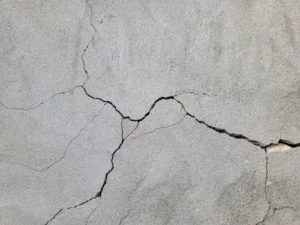

Your six-month-old driveway is flaking white in dinner-plate patches and the sealer is peeling like sunburn. Your contractor blames “Calgary salt and Chinooks.” That’s the answer almost every homeowner hears in March, and it’s almost never the real one. Spalling in year 1 traces to six decisions locked in before the first freeze — none of which a sealer can undo.
Calgary’s freeze-thaw load is a constant, not a variable. The City of Calgary’s Climate Hazards Report puts the 30-year average at roughly 128 freeze-thaw crossings a year, and a properly built driveway is engineered to survive exactly that. So when a new driveway spalls in its first winter and the one beside it from 1998 is fine, the weather is not the difference.
The difference is six things that happened in the four hours before, during, and after the pour — written on a batch ticket you never saw, in a finishing window nobody timed, and in a curing protocol almost no residential pour follows. This article walks all six, and explains why the sealer was never going to fix any of them.
1. Air content below 5% — the spec the truck never delivered
A Tuscany homeowner had a stamped driveway poured on the second Saturday of September 2025. The batch ticket said 5.8% air. Eleven months later, after the surface had bloomed white, he paid an engineering firm to cut a core and test it. The core came back at 3.2% air. The spec on paper and the concrete in the ground were two different materials.
Here is the fact that decides a Calgary driveway’s life. CSA A23.1:24 classifies a Calgary residential driveway as Exposure Class C-2 — concrete exposed to freeze-thaw cycling and de-icing chemicals. The C-2 requirement is 5 to 8 percent entrained air, 32 MPa compressive strength, and a water-to-cement ratio of 0.45 or lower.
The entrained air is the part that does the freeze-thaw work: it is a network of microscopic bubbles, deliberately whipped into the mix, that give freezing water somewhere to expand without cracking the cement paste. That void network is the freeze-thaw protection. Nothing else in the mix does that job.
The critical wording in CSA A23.1:24 is that air content is verified at discharge — measured at the chute as the concrete comes off the truck, not at the plant when the batch was mixed. Air can be lost between the plant and the pour, so the figure that matters is the one at the chute. The Tuscany ticket said 5.8% because that is what was batched; by the time the concrete hit the ground — after a long agitation and a slug of site water, which we will get to — the actual air was a fraction of that.
Why this matters to you specifically: below roughly 4 to 5 percent entrained air, freeze-thaw protection collapses. The void network is no longer dense enough to relieve the pressure of freezing water, so each of Calgary’s ~128 annual freeze-thaw crossings pries a little more cement paste off the surface.
At 3.2% air, the Tuscany driveway was never going to last a Calgary winter. It was built to fail the moment the air dropped below spec — and no sealer applied on top can put entrained air back into concrete that doesn’t have it.
But why was the delivered air so far below the ticket, and why did nobody catch it? That is reason two.
2. No air-content test at discharge — the $40 test that almost never happens
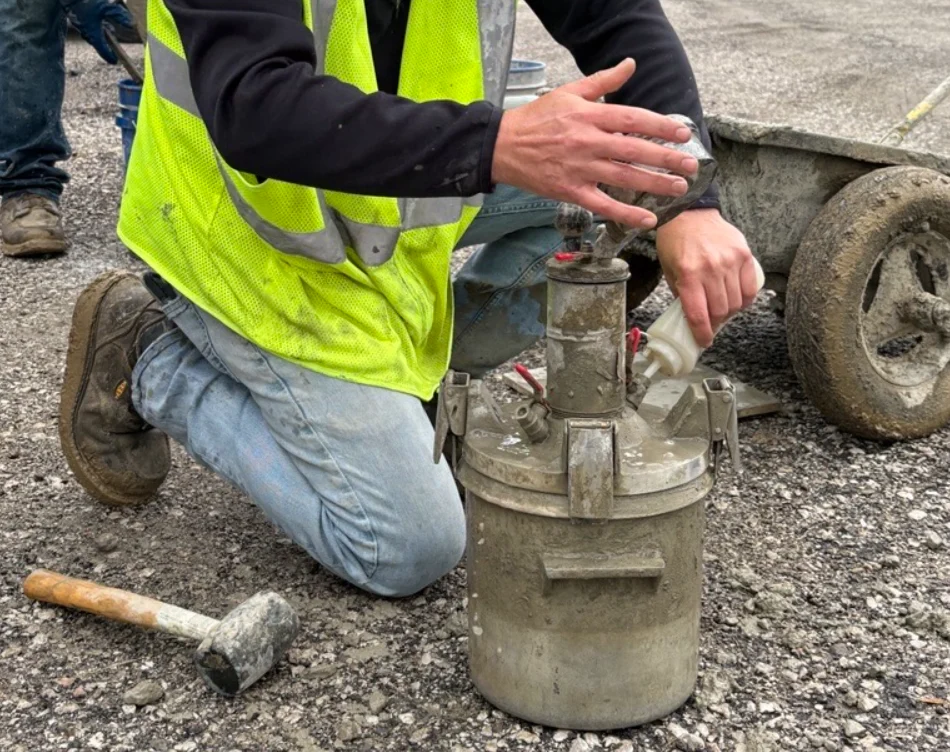
On a commercial pour in downtown Calgary, an inspector runs an air-content test at the chute on truck after truck. On a residential driveway in Tuscany, the homeowner does not know the test exists. The driver assumes the contractor will check. The contractor assumes the plant already did. Nobody runs it, and the only number anyone has is the one printed at the plant before the concrete ever moved.
The fact: the pressure-method air test (CSA A23.2-4C) takes four to six minutes and costs on the order of $40 in consumables per pour. It is the single tool that confirms the C-2 air spec was actually delivered to the chute. It is routine on commercial and municipal work because the inspection regime requires it.
On residential driveways, City of Calgary residential inspection does not require an at-discharge air test — the inspection is structural and reactive, and Concrete Alberta recommends the test for residential work but cannot compel it. So the one verification that would catch a sub-spec load is the one almost never performed on the pours where the homeowner is least equipped to ask for it.
This is the verification gap at the centre of most year-1 spalling. The air-content spec is only as good as the measurement that confirms it, and on a typical residential pour there is no measurement at all. The homeowner pays for 5-to-8% air, the ticket says 5.8%, and nobody ever holds a pressure meter to the concrete to find out what actually arrived. The failure does not become visible until year 2, by which point the only number on record is the plant figure that the concrete in the ground never matched.
Why this matters to you: if you are reading a quote or standing on a pour, the at-discharge air test is the cheapest insurance on the entire job, and it is yours to ask for. A supplier or contractor who tests air at the chute and writes the result down has given you a verifiable spec.
One who waves off the test has given you a number on paper and nothing behind it. (Our companion piece on the eight air-entrainment questions Calgary homeowners don’t know to ask walks through exactly how to raise this before the truck arrives.)
And the air can be destroyed at the chute by what happens next — water.
3. Water added at the site to make finishing easier — the moment the spec dies
The Tuscany concrete arrived at a 60 mm slump — stiff, correct for the C-2 mix, and harder to push into a stamped pattern. The finisher wanted it looser, around 95 mm, so the stamp would seat cleanly. He asked the driver to add about 25 litres of water. The driver added it. The slump went to 95 mm, the crew got an easier finish, and the water-to-cement ratio climbed from 0.42 to roughly 0.50. The ticket still read 0.42, because the water went in at the site and nobody amended the paperwork.
The fact: CSA A23.1:24 and ASTM C94/C94M both govern site water addition, and both are explicit that water added after batching must be documented and that the addition voids the original mix design unless slump and air content are re-verified at the chute. Adding water does two things at once, and both are bad for a driveway.
It raises the water-to-cement ratio, which is the master variable for concrete durability — more water means weaker, more permeable cement paste. And the agitation that mixes the water in shears the entrained-air void network, knocking the air content down. The 25 litres that bought the Tuscany crew an easier finish is, in all likelihood, why the cored air came back at 3.2% and why the surface is now permeable enough to spall.
In practice, almost no Calgary residential pour documents site water addition. The ticket records the spec that was batched; the concrete that gets placed is whatever the truck was tempered to once it arrived. A driveway placed at 0.50 water-to-cement instead of 0.45 or lower has materially less freeze-thaw durability — the void system that survives Calgary winters does not survive at 0.45-plus, and the surface that should have lasted decades starts shedding in months.
This is the moment the spec quietly dies, and it is also the clearest argument for how the concrete is delivered. A volumetric mixer meters water at the auger as the concrete is produced on site, so the water-to-cement ratio is set at the point of placement rather than adjusted by a tempering request after a truck arrives.
Volumetric concrete is produced to the same ASTM C685/C685M-25a and CSA A23.1 standards as plant-batched ready-mix — not stronger, the same standards — but the control point for water sits at the auger rather than in a hose at the chute. (Adding water on site is also one of the conditions our pour-day rejection guide tells homeowners to flag.)
Then the pour was placed, and the next failure happened on the surface itself.
A volumetric mixer controls water at the point of placement instead of relying on site tempering. We explain exactly how that changes mix consistency in our guide to 5 reasons a volumetric truck beats bagged concrete.
4. Finishing started too early — the bleed-water window that ruined the surface
The Tuscany slab went down at 11:00 a.m. The crew started broom-finishing at 11:50 — before the bleed water had risen to the surface and evaporated off. By working the surface while the bleed water was still there, the finisher folded that water back down into the top three to five millimetres of the slab. That created a thin, water-rich cap on a slab that was otherwise close to spec. That cap is now the layer that is spalling.
The fact: established finishing guidance, echoed in Concrete Alberta’s finishing practices, is that no finishing operation begins until all bleed water has risen and dissipated. Bleed water is the water that naturally migrates to the top of fresh concrete as the heavier solids settle. Trowel or float it back into the surface and you locally spike the water-to-cement ratio of the top few millimetres — exactly the wrong place, because the surface is what meets the freeze-thaw and the salt.
In Calgary’s dry, often Chinook-influenced fall air, the bleed window can be short, sometimes 30 to 60 minutes, which makes premature finishing easy to do and hard to see. The slab looks finished. Mechanically, the wearing surface is the weakest concrete on the job.
This is why a driveway can spall in sheets across the top while a core taken from the middle of the slab tests respectably. Spalling is overwhelmingly a surface failure, and the surface is built in the last hour of the pour. A crew that waits out the bleed water and a crew that doesn’t can place the identical truckload and get a driveway that lasts thirty years or one that flakes in six months. The mix is the same; the timing is not.
Why this matters to you: as the buyer, you will not see this happen and you cannot test for it afterward without a core. What you can do is recognize the pattern — a surface that fails uniformly across the top, peeling in thin layers rather than cracking through — as the signature of a finishing failure, not a concrete-strength failure. That distinction matters because it changes what, if anything, a repair can fix.
And then the curing window is where the contractor sealed the failure in.
5. No moist-curing for 7 days — the cure protocol almost no residential pour follows
The Tuscany pour finished at 2:00 p.m. on a Saturday. The crew sprayed a curing compound at 4:00 and left. No plastic, no water, no return visit. Sunday hit 24°C with wind; Monday was 19°C. The fresh concrete lost moisture to the air faster than it could use it, and hydration — the chemical reaction that builds strength — effectively stalled around day three instead of running toward day 28.
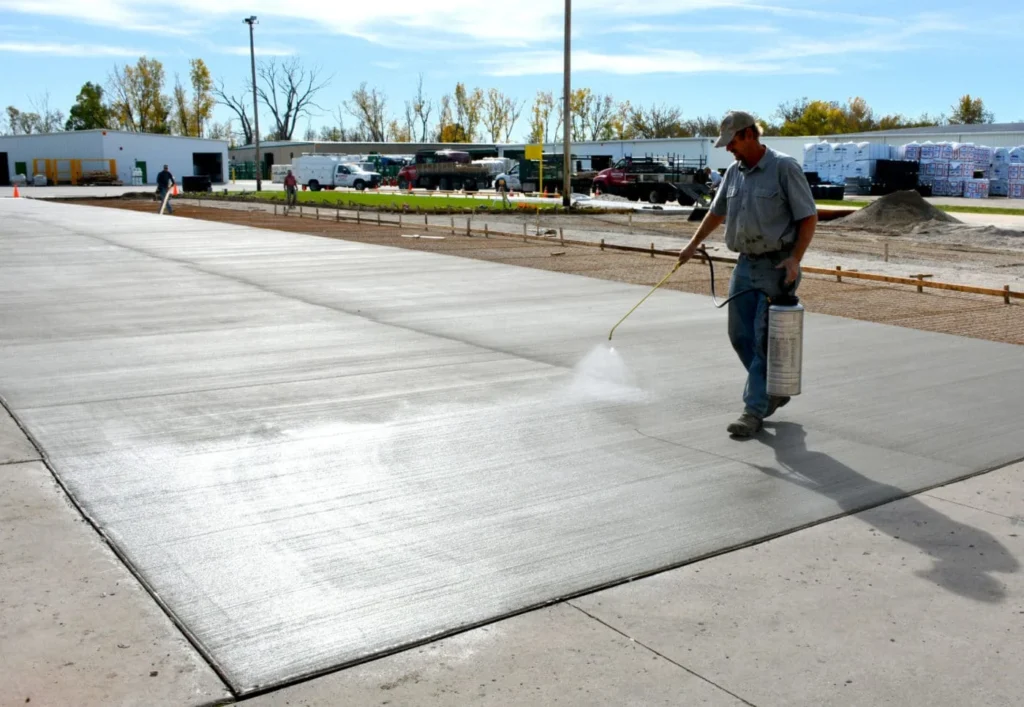
The fact: CSA A23.1:24 requires seven days of moist curing, or an accepted equivalent, for C-2 concrete. Curing is not “drying” — concrete gains strength by keeping water in to hydrate the cement, and a slab allowed to dry out early simply stops gaining strength. Membrane-forming curing compounds are permitted when applied per their standard, but in Calgary’s dry, windy fall conditions, continuous methods — plastic sheeting, wet burlap, or repeated wetting — hold moisture far more reliably.
Concrete Alberta’s curing guidance is blunt about the cost of getting this wrong in Calgary’s climate: incomplete curing in typical local fall conditions can cut 28-day strength by roughly 10 to 25 percent. A slab specified at 32 MPa can finish nearer 28.
The freeze-thaw consequence runs deeper than the strength number. The dense, low-permeability surface matrix that resists freeze-thaw and salt is built during those first several days of hydration. When hydration stalls at day three, that matrix never fully forms — even if a test cylinder cured in a lab still passes, the surface left to dry in the wind is permanently more porous and more vulnerable.
The driveway can hold a passing strength on paper and still spall, because the part that failed is the surface, and the surface is what curing protects.
Why this matters to you: curing is invisible, free or nearly so, and skipped constantly because the crew is gone by the time it matters. A contractor’s curing plan — what they apply, whether they come back, how long the slab stays protected — is a fair question to ask before you sign, and a thin answer is a real signal.
Then the homeowner did the one thing that locked the failure in.
6. De-icing chemicals applied in year 1 — the 30-day dry rule almost no homeowner knows
That first November, a cold snap glazed the new driveway and the Tuscany homeowner reached for the bag of rock salt in the garage. The driveway was nine weeks old. He had no idea he had just violated two separate rules — the 30-day air-dry minimum before any de-icer or sealer touches new concrete, and the year-one convention that says keep de-icing chemicals off a new driveway through its first full winter entirely.
The fact: Concrete Alberta and Alberta New Home Warranty consumer guidance both advise no de-icing chemicals on new concrete for the first winter — a minimum of around 12 months, with some sources extending the caution to 18 or 24 months. Separately, new concrete needs roughly 30 days of post-cure air-drying before sealing.
De-icing salts attack concrete two ways: they drive more freeze-thaw cycles by repeatedly melting and refreezing water at the surface, and the chloride ions accelerate surface scaling on concrete that has not fully matured.
Apply them in year one, before the surface matrix has finished developing, and you are stacking a chemical assault on top of a surface that — in the Tuscany case — was already compromised by low air, high water, early finishing, and a stalled cure.
That is the full sequence. Low delivered air, no test to catch it, site water that pushed the ratio up and the air down, a surface finished into its bleed water, a cure that stopped at day three, and then salt in the first winter. Each one alone hurts a driveway. Stacked, they produced dinner-plate spalling by the following March. And the penetrating sealer the homeowner dutifully applied that October? It is peeling now precisely because it bonded to a surface that was already failing underneath it.
Why this matters to you: of the six causes, this is the only one fully inside the homeowner’s control after the pour. Keep salt and de-icers off the new slab through the first winter, clear snow mechanically, and use sand for traction if you must. It will not rescue a driveway that was under-aired and over-watered at the chute — but on a sound driveway, year-one salt is the difference between a surface that ages gracefully and one that starts scaling before it ever had a chance.
The sealer is doing exactly what a sealer can do: slow the weathering of sound concrete. It is doing exactly nothing about the six root causes, because all six were locked in before the first freeze — and none of them live on the surface where a sealer can reach.
Planning a backyard suite, garage, or new driveway? Read 10 Hidden Costs of the Calgary Backyard Suite Incentive Most Homeowners Don’t See before budgeting your concrete work.
FAQ
Q1: Why did my new driveway spall the first winter? Almost always one of six reasons, and usually several stacked together: entrained air delivered below the 5-to-8% the spec required, no air-content test at the chute to catch it, water added at the site that raised the water-to-cement ratio and knocked the air down, finishing started before the bleed water dissipated, no proper 7-day moist cure, or de-icing salt applied in the first winter. Calgary’s freeze-thaw load (about 128 cycles a year) is the constant that exposes all six — it is rarely the cause by itself.
Q2: Will sealer fix a spalling driveway? No. A sealer can slow surface weathering on sound concrete, but it cannot reverse spalling caused by low air content, a high water-to-cement ratio, or a chemically compromised surface. It bonds to the top layer, and if that layer is already failing, the sealer peels off with it. The damage that produces year-1 spalling sits inside the concrete, below where any topical product can reach.
Q3: What air content prevents concrete spalling on a Calgary driveway? A Calgary driveway is CSA A23.1:24 Exposure Class C-2, which requires 5 to 8 percent entrained air, verified at discharge — measured at the chute, not just on the plant ticket. Below roughly 4 to 5 percent, the air-void network is too sparse to relieve freeze-thaw pressure and the freeze-thaw protection collapses. The entrained air is the freeze-thaw protection; the strength number alone does not provide it.
Q4: Can you use de-icing salt on a new concrete driveway? Not in the first winter. Concrete Alberta and Alberta New Home Warranty guidance advise keeping de-icing chemicals off new concrete for at least the first 12 months, with some sources extending to 18–24 months. Clear snow mechanically and use sand for traction instead. (A separate rule — about 30 days of air-drying after curing — applies to when you can seal, not to de-icing.)
Q5: My driveway spalled but the contractor says the concrete passed. How? Spalling is a surface failure, so a core or cylinder taken from the body of the slab can hit the specified strength while the top few millimetres are mechanically compromised. That happens when bleed water was troweled back into the surface, when the slab wasn’t cured properly, or when de-icers attacked an immature surface. A passing 28-day strength does not certify the wearing surface — it certifies the interior, which is not where spalling lives.
Q6: Does volumetric concrete prevent the water-addition problem? A volumetric mixer meters water at the auger as the concrete is produced on site, so the water-to-cement ratio is set at the point of placement rather than adjusted by a tempering request after a truck arrives. Volumetric concrete is produced to the same ASTM C685/C685M-25a and CSA A23.1 standards as plant-batched ready-mix — not stronger, the same standards — but it moves the water-control point to the auger. The air-content discipline and the at-discharge testing still matter regardless of how the concrete is delivered.
Sources
- CSA A23.1:24 (14th edition) — Exposure Class C-2, air content, water-to-cement ratio, and curing requirements — https://www.csagroup.org
- ASTM C685/C685M-25a — Standard Specification for Concrete Made by Volumetric Batching and Continuous Mixing — https://www.astm.org
- ASTM C94/C94M — Standard Specification for Ready-Mixed Concrete (site water-addition provisions) — https://www.astm.org
- ASTM C672 — Scaling Resistance of Concrete Surfaces Exposed to Deicing Chemicals — WITHDRAWN 2021 (cited as historical reference only; WK76964 is the pending reinstatement) — https://www.astm.org
- Concrete Alberta — cold-weather, finishing, and curing best practices — https://www.concretealberta.com
- City of Calgary — Climate Hazards Report (freeze-thaw cycle data, ~128 crossings, 30-year average) — https://www.calgary.ca
All spec values reflect current CSA A23.1:24 Exposure Class C-2 requirements; confirm against the published standard and your own site documentation before relying on them. ASTM C672 was withdrawn in 2021 and is referenced here only for historical context — it is not an active standard.
About Omega Ready Mix
Omega Ready Mix (est. 2023) supplies ready-mix and volumetric concrete to the Calgary area, produced to CSA A23.1:24 and ASTM standards. We believe a homeowner who understands air content, water-to-cement ratio, and curing is a better buyer — and gets a driveway that survives Calgary winters.
Not Sure Why Your Driveway Is Spalling?
If your driveway is flaking after its first winter, don’t assume it’s just “Calgary weather.” The real cause is usually locked into the concrete long before the first freeze.
Omega Ready Mix can review your project, explain what likely happened, and help you determine whether the issue points to air content, water addition, finishing, curing, or another placement problem. If you’re planning a replacement, we’ll help specify the right CSA A23.1:24 C-2 mix and placement practices from day one.
Talk to Omega Ready Mix before you replace a driveway that may fail for the same reason again.