
Shotcrete is “mortar or concrete pneumatically projected at high velocity onto a surface” (ACI 506R). It’s placed two ways: dry-process (gunite), where “most of the mixing water is added at the nozzle” and the nozzleman controls the water-cement ratio in real time, and wet-process, where “all of the ingredients, including water, are mixed before introduction into the delivery hose.” Both depend on a continuous supply of correctly proportioned fresh material, and a stop-and-start job is exactly where a single fixed ready-mix load struggles, because “the entire truck must be used at once if using ready mix.”
A volumetric (mobile-mixer) supply feeds the operation on demand: it batches fresh on site, holds the mix proportions, and can adjust on the fly, so the feed matches the nozzleman’s pace without committing a whole drum load. The shotcrete work itself is governed by ACI 506R / ACI 506.2, and volumetric concrete by ASTM C685, ACI 304.6R, and AASHTO M241.
This article is about supply, how fresh, correctly proportioned material reaches a shotcrete operation, and why continuous feed and on-site ratio control matter. Wondering where shotcrete is most commonly used? Read Shotcrete for Slope Stabilization and Retaining Walls to see how sprayed concrete is used for retaining walls, unstable slopes, excavation support, and structural stabilization throughout Calgary.
What shotcrete is, and the two ways it’s placed
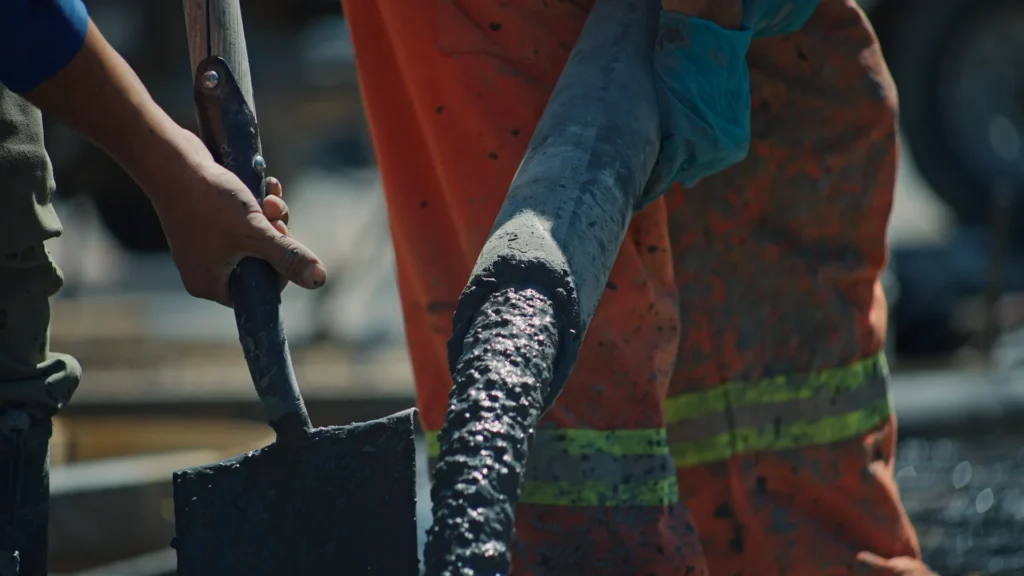
Shotcrete is concrete or mortar sprayed at high velocity through a hose onto a surface, used for pool shells, below-grade and retaining walls, slope stabilization, tunnels, and structural repair. The authoritative definition comes from ACI 506R, the Guide to Shotcrete, quoted here by a dual-credentialed industry author.
Dennis Bittner, a construction-products representative who sits on the Board of Direction of the American Shotcrete Association and on an ICRI chapter board, lays out the two processes. “ACI 506R defines shotcrete as ‘mortar or concrete pneumatically projected at high velocity onto a surface.’” The split is about where the water meets the cement:
- Dry-process (gunite): “shotcrete in which most of the mixing water is added at the nozzle.” The nozzleman “controls the addition of water manually at the nozzle.”
- Wet-process: “shotcrete in which all of the ingredients, including water, are mixed before introduction into the delivery hose and compressed air is introduced to the material flow at the nozzle.”
As Bittner puts it, “the main difference between the two processes is the point at which the water is added.”
The American Shotcrete Association gives the same wet-mix definition from the category body: “All concrete materials, including water, are thoroughly mixed and introduced into the delivery equipment. The wet concrete is pumped to the nozzle where compressed air is added to provide high velocity for placement and consolidation.”
(Source: American Shotcrete Association.)
That dry-process nozzle control, the nozzleman dialing water at the nozzle, is the literal “real-time ratio control” the heading names. On the supply side, on-site batching lets the mix itself be dialled to spec too, before it ever reaches the hose.
Why continuous feed is the whole game
A shotcrete crew rarely sprays in one unbroken run. There are moving and resetting, rebound cleanup, rebar checks, and on a repair, working pocket by pocket. That stop-start rhythm is where a single fixed ready-mix load runs into trouble.
Bittner is direct about it. Wet-process shotcrete “is not conducive to stop-and-start repairs, as each time the shooting process is stopped, the hose must be cleaned out to remove already mixed shotcrete. In addition, the entire truck must be used at once if using ready mix. Using the dry process, the equipment can be turned off with minimal material waste as the water has yet to be added.”
(Source: Bittner, ICRI Concrete Repair Bulletin.)
Read that middle sentence again: a fixed ready-mix load forces whole-truck-at-once. If the job pauses, the clock is still running on concrete you committed to all at one time. That’s the supply problem most shotcrete content skips past, and it’s exactly what on-site batching answers.
A volumetric mixer meters and mixes on demand, so it can stop and start without dumping a load. The crew sprays at its own pace, and fresh material is there when shooting resumes. ProAll, which builds dedicated gunite/shotcrete volumetric units, frames the supply behaviour this way: it’s “always delivering the perfect mix of fresh cement to your shotcrete pump,” lets a crew “pour slow or fast depending on the specific requirements of the job,” and can “sit on the jobsite all day long with no return mud.”
(Source: ProAll Gunite & Pool Building and ProAll G95 Gunite Mixer.)
That’s the manufacturer’s claim, cited for the continuous-feed-matched-to-pace mechanism, not as a strength claim.
The fact that the industry purpose-builds volumetric gunite units (ProAll’s G95, Cemen Tech’s G30X) is itself the proof that volumetric is a recognized way to supply shotcrete.
Sourcing material close to the job
There’s a supply-proximity angle too. Bittner notes that “the rising cost of trucking has made it important for contractors to source materials as close to the jobsite as possible,” and that pre-blended bulk material gets used “on remote sites and nightshift work for wet process applications where ready mix is not available or practical.”
(Source: Bittner, ICRI.)
On-site volumetric batching is the cleanest version of “source close to the job”, it brings the batching to the shotcrete site.
The standards: what’s active, and one that isn’t
Shotcrete supply sits on top of two standards stacks, the one governing the shotcrete work and the one governing volumetric concrete. Getting the editions right matters.
The shotcrete work (active):
| Standard | Title | Status |
|---|---|---|
| ACI 506R-16 | Guide to Shotcrete | Active (June 2016; supersedes 506R-05) |
| ACI 506.2-13(18) | Specification for Shotcrete | Active (reapproved 2018) |
| ACI 506.5R-09 | Guide for Specifying Underground Shotcrete | Active |
(Sources: ACI 506R-16 preview; ACI 506.2-13(18) preview.)
The volumetric concrete supply (active):
- ASTM C685/C685M-25a, Concrete Made by Volumetric Batching and Continuous Mixing (the current active edition). (Source: ASTM store.)
- ACI 304.6R-09 (Reapproved 2019), the Guide for Use of Volumetric-Measuring and Continuous-Mixing Concrete Equipment, which covers “mobile mixers” producing concrete by “volumetric measurement and continuous mixing (VMCM).” This is the ACI document confirming that on-site continuous mixing is a standards-recognized production method. (Source: ACI store.)
- AASHTO M 241, the DOT-side volumetric specification, cited alongside C685.
One standard that’s no longer active: ASTM C1436, Standard Specification for Materials for Shotcrete, was withdrawn on July 20, 2022, with no replacement. (Source: ASTM store.)
You’ll still see it referenced in older material, so it’s worth naming, but only as the historical materials reference. The now-withdrawn ASTM C1436 once covered shotcrete materials; the active standards to specify against today are ACI 506R-16 and ACI 506.2-13(18), with the volumetric supply governed by ASTM C685-25a, ACI 304.6R, and AASHTO M241.
The Calgary shotcrete mix
A structural shotcrete mix in Calgary carries the same local requirements as any pour here. Where the ground is S-2 sulphate, the mix is Type HS or HSb sulphate-resistant; freeze-thaw exposure calls for air-entrainment. Microsilica is commonly added, Bittner notes “both processes can and generally should be microsilica-enhanced”, to improve adhesion and strength. (Microsilica per Bittner, ICRI; local spec per the Calgary Concrete Master Knowledge Base.)
A volumetric truck can batch and hold that specific mix on site.
Calgary weather, and shotcrete
Calgary’s climate touches shotcrete on both ends. In the cold, Bittner observes, “shotcrete does not hang as well, especially in overhead applications,” and “rebound increases at lower temperatures”, which ties to the city’s long cold season; see cold-weather discharge temperature. In the heat, “the material may require more extensive curing to prevent cracking”; see the hot Chinook fix. Fresh, on-site, temperature-managed supply matters in both, and the local pro market is real, Calgary has ACI-certified-nozzleman shotcrete contractors doing structural work and repairs.
When a plant or pre-bagged supply is the right call
Honest triage:
- One large continuous wet-mix shoot near a plant. If the job is a single uninterrupted run, the site is an easy haul from a plant, and there’s high volume to move, a ready-mix delivery feeding the pump can be the simple, fast choice.
- Small patch repairs. For a small dry-process patch, a few bags of pre-blended material and a portable gun can be the practical answer, no truck needed.
- Spec mandates a pre-qualified bagged material. Some repair specs require a specific pre-blended product with documented test data; follow the spec.
Volumetric supply is strongest where shotcrete usually lives: stop-and-start work, a dialled mix you need held and reproduced, a site where committing a whole drum load at once is wasteful, or a remote location where ready-mix “is not available or practical.”
FAQ
What is shotcrete, and what’s the difference between wet-mix and dry-mix? Shotcrete is concrete or mortar pneumatically projected at high velocity onto a surface (ACI 506R). In dry-process (gunite), most of the mixing water is added at the nozzle and the nozzleman controls the water-cement ratio in real time. In wet-process, all the ingredients including water are mixed before the hose, and compressed air is added at the nozzle. The difference is where the water is added.
What is “real-time ratio control” in shotcrete? In the dry process, the nozzleman controls the addition of water at the nozzle, adjusting the water-cement ratio as they shoot. On the supply side, on-site volumetric batching lets the mix proportions be dialled to spec before the material reaches the hose, so the feed is correctly proportioned and can be adjusted on the fly.
Why does continuous feed matter for shotcrete? A shotcrete job is rarely one unbroken run, and a fixed ready-mix load forces whole-truck-at-once: as one industry author puts it, “the entire truck must be used at once if using ready mix.” On-site batching meters fresh material on demand and can stop and start without dumping a load, so the feed matches the nozzleman’s pace.
Can a volumetric mixer supply shotcrete or gunite? Yes. The industry purpose-builds dedicated gunite/shotcrete volumetric units (for example ProAll’s G95 and Cemen Tech’s G30X). A volumetric mixer feeds fresh, dialled mix on demand, can pour slow or fast to match the crew, and can stop and start without committing a whole drum load.
What standards govern shotcrete and volumetric supply? The shotcrete work is governed by ACI 506R-16 (Guide to Shotcrete) and ACI 506.2-13(18) (Specification for Shotcrete). Volumetric concrete is governed by ASTM C685-25a, ACI 304.6R, and AASHTO M241. Note that ASTM C1436, which covered shotcrete materials, was withdrawn in July 2022 and is only a historical reference now.
What shotcrete mix does Calgary need? Typically a sulphate-resistant Type HS or HSb mix where the ground is S-2, air-entrained for freeze-thaw exposure, and commonly microsilica-enhanced for adhesion and strength. A volumetric truck can batch and hold that specific mix on site.