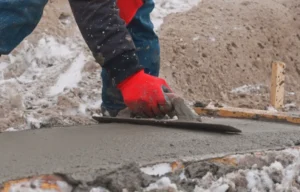
In Calgary, a garage floor is far more than a simple slab of concrete. It must withstand extreme freeze–thaw cycles, heavy vehicle loads, road salts, moisture intrusion, and long winters that test the durability of any building material. Homeowners who underestimate these factors often face cracked, spalled, or uneven garage floors within just a few years. Understanding the proper garage floor concrete requirements in Calgary is the first step toward building a slab that lasts decades instead of seasons.
This guide explains the structural standards, material specifications, and best practices that apply to garage floor concrete in Calgary. Drawing on real-world experience from local projects and industry standards, it is designed to help homeowners, builders, and renovators make informed decisions before pouring concrete.
Why Garage Floor Concrete Standards Matter in Calgary
Concrete performance is highly dependent on environment. What works in milder climates often fails in southern Alberta. Garage floor concrete standards exist to reduce long-term maintenance costs, prevent premature failure, and ensure structural safety.
Calgary’s Climate Challenges
Calgary experiences some of the most demanding conditions for residential concrete in Canada. According to Environment and Climate Change Canada, the city regularly sees over 100 freeze–thaw cycles per year. Each cycle allows moisture to penetrate the concrete surface, expand as it freezes, and gradually weaken the slab from within.
In garages, this problem is amplified by:
- Snow and ice melting off vehicles
- De-icing salts carried in from roads
- Temperature swings between heated interiors and sub-zero exteriors
Without the correct concrete strength, thickness, and curing practices, garage floors in Calgary are especially vulnerable to surface scaling and structural cracking.
Structural vs. Cosmetic Failures
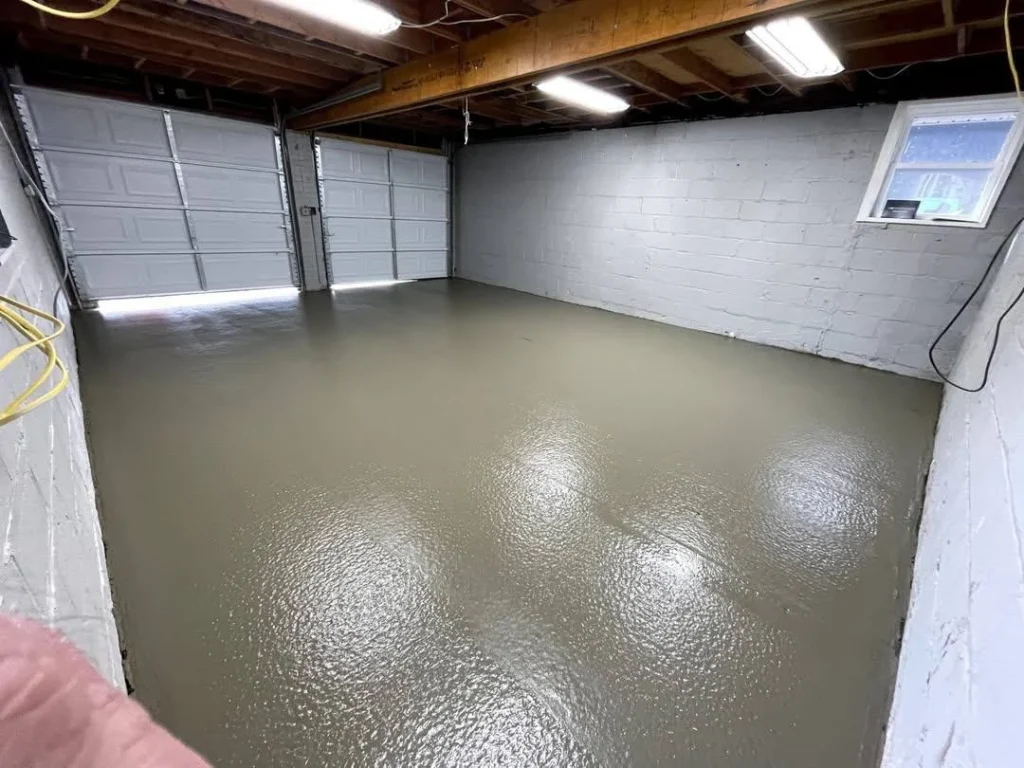
Not all garage floor damage is equal. Cosmetic issues such as hairline cracks or minor discoloration are common and often unavoidable. Structural failures, however, are a different matter. These include wide cracks, slab settlement, and edge deterioration that compromise usability and safety.
Meeting Calgary-specific concrete standards helps ensure that inevitable cosmetic wear does not turn into costly structural repairs.
Alberta and Calgary Garage Floor Concrete Code Requirements
Garage floor concrete in Calgary must comply with provincial and municipal guidelines. While the Alberta Building Code does not prescribe every detail of residential garage slabs, it establishes minimum performance expectations that municipalities and inspectors rely on.
Alberta Building Code Overview
Under the Alberta Building Code, residential garage slabs are classified as structural slabs-on-grade. This means they must be designed to safely transfer loads from vehicles and building elements to the ground without excessive movement or cracking.
Key principles include:
- Proper load-bearing capacity
- Adequate resistance to moisture and frost
- Durable materials suitable for local climate conditions
While the Alberta Building Code allows some flexibility, experienced concrete professionals typically exceed minimum requirements to account for Calgary’s harsh environment. Working with professional concrete flatwork contractors in Calgary who understand both provincial building codes and local climate challenges ensures garage floor slabs are designed not just to meet minimum standards, but to deliver decades of reliable performance under real-world conditions.
City of Calgary Garage Slab Expectations
The City of Calgary does not publish a single prescriptive standard for garage slabs, but building inspectors commonly expect garage floors to meet recognized industry best practices. In practice, this means inspectors look for proper base preparation, sufficient slab thickness, and visible reinforcement where applicable.
Common issues flagged during inspections include inadequate gravel base depth, poor drainage slopes, and insufficient slab thickness at edges and door openings.
Garage Floor Concrete Thickness Requirements
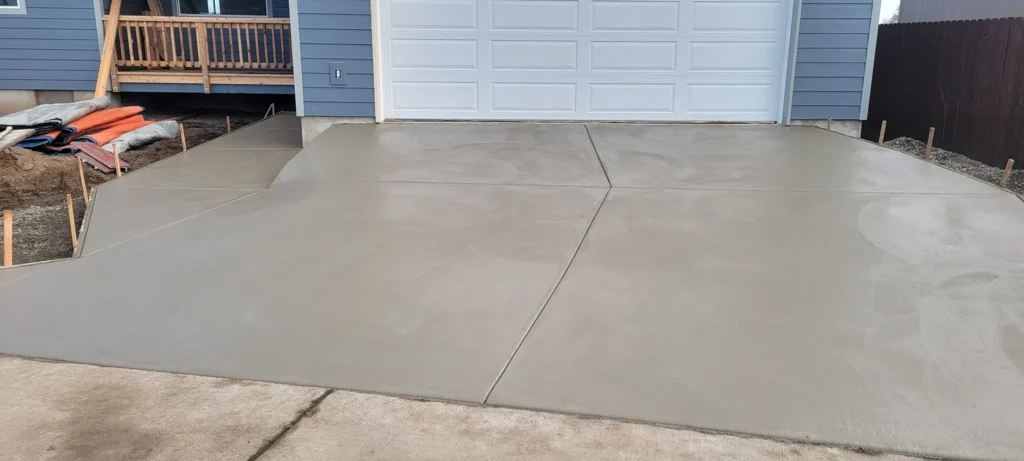
Concrete thickness plays a critical role in the long-term performance of a garage floor. Too thin, and the slab is prone to cracking under vehicle loads. Too thick, and costs increase without meaningful performance gains.
Standard Residential Garage Slab Thickness
For most residential garages in Calgary, industry practice calls for a slab thickness of approximately 4 inches. This thickness balances structural performance with material efficiency when paired with proper base preparation and reinforcement. A standard double-car garage supporting passenger vehicles typically performs well at this thickness when constructed correctly. For detailed specifications on garage slab thickness standards based on vehicle type, usage patterns, and load distribution requirements, understanding how thickness relates to reinforcement design and base preparation helps prevent under-design or unnecessary over-engineering.
Heavy-Duty and Oversized Garages
Not all garages are used the same way. Oversized garages, workshops, and garages designed for trucks or recreational vehicles place significantly higher loads on the slab.
In these cases, increasing slab thickness to 5 or 6 inches is often recommended. This added depth improves load distribution and reduces the risk of cracking under concentrated wheel loads.
What Happens If the Slab Is Too Thin
Thin garage slabs are one of the most common causes of premature concrete failure in Calgary. Insufficient thickness can lead to:
- Load-induced cracking beneath tires
- Edge curling near garage doors
- Accelerated surface wear
Once these issues develop, repairs are often more expensive than doing the job correctly from the start.
Concrete Strength (PSI) Requirements for Garage Floors
Concrete strength, measured in pounds per square inch (PSI), determines how well a garage floor resists compression and surface wear. In Calgary’s climate, strength selection is closely tied to durability.
Minimum PSI for Calgary Garage Slabs
Most residential garage floors in Calgary are poured using concrete with a compressive strength of at least 32 MPa (approximately 4,600 PSI). This level of strength provides a good balance of durability, workability, and resistance to freeze–thaw damage.
Lower-strength mixes may be acceptable in milder regions, but they often struggle under Calgary’s repeated temperature fluctuations.
When Higher PSI Is Recommended
Certain garage applications benefit from higher-strength concrete. Heated garages, home workshops, and garages exposed to frequent moisture or chemicals often perform better with higher PSI mixes.
Higher-strength concrete offers:
- Improved abrasion resistance
- Lower permeability to moisture
- Better long-term durability
While higher PSI concrete can cost slightly more upfront, it often reduces maintenance and repair costs over the life of the garage floor.
Summary of Key Takeaways (So Far)
Garage floor concrete in Calgary must be designed with local climate and usage in mind. Proper standards for thickness, strength, and base preparation are essential to long-term performance. By understanding these requirements before construction begins, homeowners and builders can avoid common failures and build garage slabs that stand up to Calgary’s demanding conditions.
In the next section of this guide, we will explore reinforcement standards, subgrade preparation, crack control, finishing options, and cost considerations in greater detail.
Reinforcement Standards for Garage Floor Concrete
Reinforcement is one of the most misunderstood aspects of garage floor concrete in Calgary. While concrete has excellent compressive strength, it is relatively weak in tension. Reinforcement helps control cracking, distribute loads, and improve the overall performance of the slab over time.
Rebar vs. Wire Mesh
The two most common reinforcement options for residential garage floors are steel rebar and welded wire mesh. Each has advantages, but placement and execution matter more than the material itself. Rebar typically placed in a grid pattern provides strong structural support and load distribution when properly positioned within the slab, while wire mesh helps control shrinkage cracking but must be supported correctly to be effective.
In Calgary, many experienced concrete contractors prefer rebar for garages due to its reliability under heavier loads and freeze-thaw stress. Understanding proper reinforcement selection is equally important for concrete driveway construction in Calgary, where vehicle loads, thermal cycling, and edge stress create similar structural demands that require coordinated thickness and reinforcement design.
Fiber-Reinforced Concrete
Fiber reinforcement is increasingly used in garage floor concrete mixes. Synthetic or steel fibers are mixed directly into the concrete to help reduce plastic shrinkage cracking and improve surface durability.
It is important to note that fiber reinforcement is not a replacement for structural reinforcement such as rebar. Instead, it acts as a complementary system that improves crack control during curing and early use.
Common Reinforcement Mistakes to Avoid
Even the best reinforcement design can fail if installed incorrectly. Common issues seen on Calgary job sites include:
- Rebar or mesh resting on the ground instead of being elevated
- Improper spacing or inconsistent grid layouts
- Insufficient coverage near slab edges and door openings
Proper reinforcement placement is essential to meeting garage floor concrete standards and achieving long-term durability.
Subgrade and Base Preparation Requirements
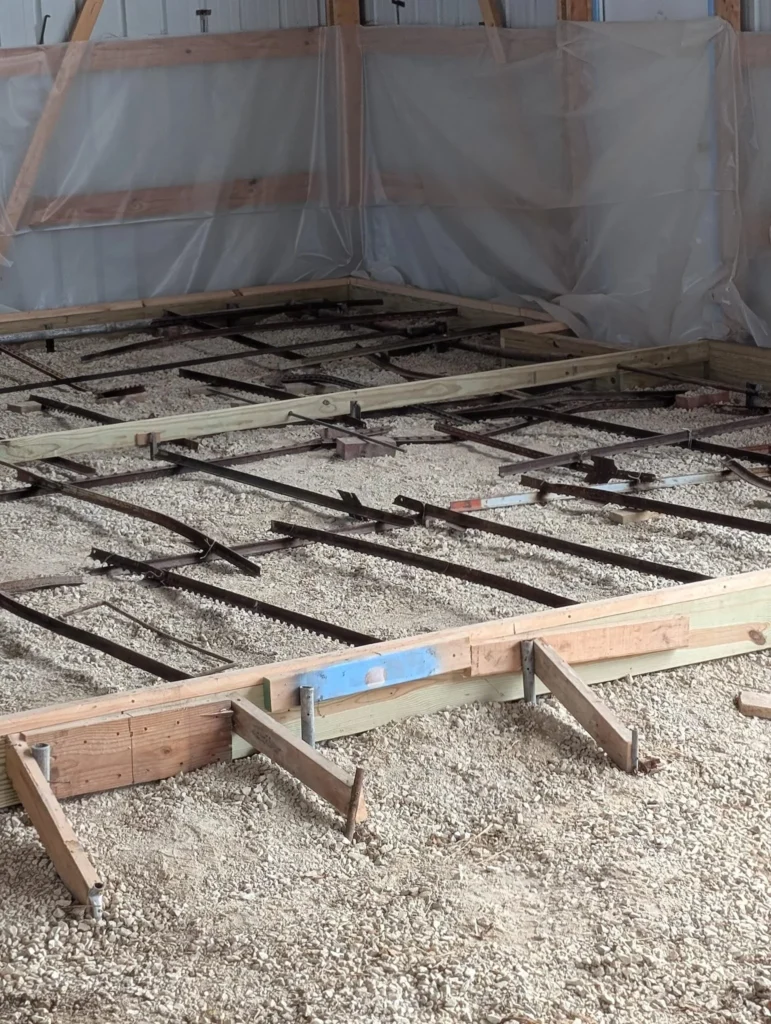
A garage floor slab is only as strong as the base beneath it. Poor subgrade preparation is a leading cause of cracking and settlement in Calgary garage floors.
Compacted Gravel Base
Industry best practices call for a well-compacted granular base beneath garage slabs. This base provides uniform support, improves drainage, and reduces movement caused by frost.
In Calgary, a gravel base of approximately 4 to 6 inches is commonly recommended, depending on soil conditions and expected loads. Proper compaction is critical; loose base material can lead to uneven settlement and slab failure.
Vapor Barriers and Moisture Control
Moisture migration from the ground into the concrete slab can lead to surface deterioration and issues with coatings or finishes. A polyethylene vapor barrier installed beneath the slab helps limit moisture intrusion. Vapor barriers are especially important for heated garages, where temperature differences can drive moisture upward through the slab. Similar moisture control principles apply to basement concrete slab construction, where preventing ground moisture from entering living spaces is critical for indoor air quality and preventing mold growth in finished areas.
Control Joints and Crack Management
Concrete naturally cracks as it cures and shrinks. Control joints are intentional weak points that encourage cracks to form in predetermined locations, reducing random cracking across the slab surface.
Purpose of Control Joints
Control joints do not prevent cracking; they manage it. By planning joint locations carefully, contractors can maintain both structural performance and visual appearance.
Joint Spacing Guidelines
For residential garage floors in Calgary, control joints are typically spaced to create square or nearly square panels. Joints may be saw-cut after finishing or tooled during placement, depending on project conditions.
Improper joint spacing is a common cause of uncontrolled cracking in garage slabs.
Garage Floor Finishing Standards and Options
The finish applied to a garage floor affects traction, appearance, and long-term maintenance. Choosing the right finish depends on how the garage will be used.
Broom Finish
A broom finish is the most common option for Calgary garage floors. It provides slip resistance, performs well in wet conditions, and is cost-effective.
Trowel Finish
Trowel finishes create a smoother surface that is easier to clean but may be slippery when wet. This finish is often paired with sealers or coatings to improve performance.
Coatings and Sealers
Many homeowners choose to apply epoxy or polyaspartic coatings after the concrete has fully cured. These systems improve chemical resistance, appearance, and ease of cleaning.
Timing is critical. Applying coatings before the concrete has cured properly can lead to adhesion failures.
Heated Garage Slabs in Calgary
Heated garages are increasingly popular in Calgary, but they require additional planning during concrete placement.
Radiant Heating Considerations
Radiant heating systems embedded in garage slabs must be installed carefully to avoid thermal cracking. Concrete mix design, joint placement, and curing practices all play a role in long-term performance.
Insulation and Thermal Breaks
Insulating beneath and around the slab reduces heat loss and helps maintain consistent temperatures. Proper insulation also minimizes thermal stress within the concrete.
Cold-Weather Pouring and Curing Standards
Calgary’s construction season is often limited by temperature. Cold-weather concrete placement requires special precautions to ensure strength development and durability.
Seasonal Pouring Challenges
Concrete poured in cold conditions may require heated materials, accelerators, or insulated blankets to maintain proper curing temperatures.
Proper Curing Techniques
Curing is one of the most important factors in concrete performance. Maintaining adequate moisture and temperature during the curing period helps concrete achieve its intended strength and durability.
Common Garage Floor Concrete Mistakes in Calgary
- Skipping reinforcement to reduce upfront cost
- Inadequate base preparation
- Ignoring drainage and slope requirements
- Allowing traffic on the slab too early
Avoiding these mistakes significantly improves the lifespan of a garage floor.
Garage Floor Concrete Cost in Calgary
The cost of a garage floor concrete slab in Calgary varies depending on thickness, strength, reinforcement, and finishing options.
Key Cost Factors
- Concrete strength (PSI / MPa)
- Slab thickness
- Reinforcement type
- Site preparation and access
Value of Doing It Right the First Time
While higher-quality concrete and proper preparation may increase initial costs, they often result in lower lifetime costs due to reduced repairs and maintenance.
Why Professional Concrete Supply Matters
Consistent mix design, reliable delivery, and local experience are essential for meeting Calgary’s garage floor concrete standards. Working with an experienced concrete supplier helps ensure that the material delivered to site matches project requirements.
Why Choose Omega Ready Mix for Garage Floor Concrete
Omega Ready Mix provides Calgary homeowners and builders with high-quality concrete designed for local conditions. With modern equipment, experienced technicians, and a focus on reliability, Omega Ready Mix supports garage floor projects of all sizes.
Frequently Asked Questions
What is the minimum thickness for a garage slab in Calgary?
Most residential garages use a slab thickness of approximately 4 inches, with thicker slabs recommended for heavier use.
Do I need rebar in a residential garage?
Rebar is strongly recommended for garages to improve load distribution and crack control.
How long before I can park on new concrete?
Light foot traffic is typically allowed after 24–48 hours, but vehicles should wait at least 7 days, with full strength reached at 28 days.
Conclusion and Next Steps
Building a durable garage floor in Calgary requires more than pouring concrete. By following proper thickness, strength, reinforcement, and curing standards, homeowners and builders can create garage slabs that perform reliably for decades.
If you are planning a garage floor project and want expert guidance and dependable concrete supply, contact Omega Ready Mix today to request a quote or consultation.