Brand: Omega Ready Mix
Word count: ~2,300
Publish week: Week 12
Schema: Article + FAQPage + DefinedTerm (volumetric, drum-mix)
Stage: First draft (publishable, leaves runway for editor to expand toward 4,000-word brief target)
Define both methods
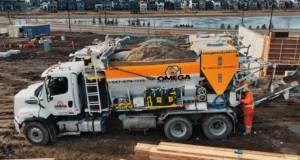
Volumetric concrete stores cement, sand, aggregate, water, and admixtures in separate compartments on the truck. The truck batches and mixes concrete on-site continuously as you pour. The mix design can change between pours on the same job. ASTM C685 / C685M is the governing standard.
Drum-mix concrete is pre-mixed at a plant. A rotating drum on the delivery truck keeps it agitated in transit. CSA A23.1:24 sets the maximum discharge limit at 2 hours from batching, with mandatory air-content retesting at 90 minutes for freeze-thaw exposure classes — after that the concrete starts to cure past spec and is no longer compliant.
Both methods are CSA A23.1 + ASTM-compliant. Both produce real spec concrete. The choice between them is about job profile, not quality.
This piece walks through how to pick — based on volume, spec count, distance, schedule, and decorative requirement — using the same decision tree we use internally to recommend volumetric vs drum to Calgary builders. We do this honestly: when drum is the right answer, we’ll tell you. We just happen to operate the only city-based volumetric fleet, so we know both sides of the comparison cold.
The transit problem (drum starts curing in the truck)
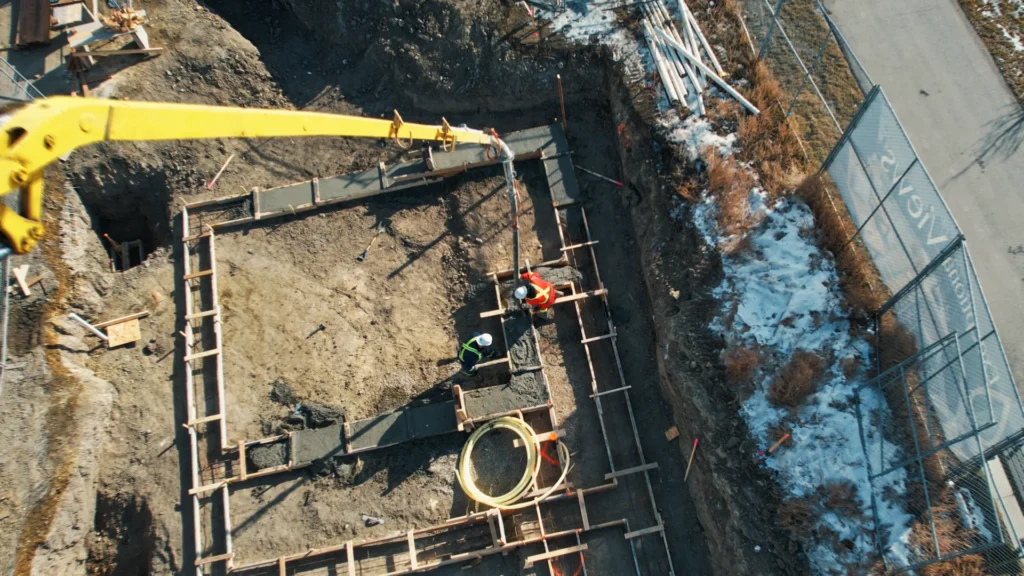
Drum-mix concrete has an immutable physics constraint: it starts curing the moment it’s batched at the plant. CSA A23.1 caps the maximum discharge limit at 2 hours from batching, with air-content retesting required at the 90-minute mark for freeze-thaw exposure classes. Hot Calgary summer days above 25°C shrink the practical window further. Cold-weather pours introduce additional constraints (Pillar 6 — Cold-Weather Volumetric Operating Manual).
Practical implication: a Calgary plant in NE quadrant servicing an acreage build in Cochrane outskirts, or a downtown Calgary infill site requiring cross-town drum delivery during traffic peak — the discharge clock starts ticking at batch time. The driver’s job becomes a race against curing rather than a delivery.
Volumetric eliminates the constraint entirely. The concrete is mixed at the truck on arrival. Drive time is irrelevant to the mix’s compliance window.
For the acreage corridor (Bragg Creek, Springbank, Priddis, De Winton, Bearspaw) and any Calgary site 30+ minutes from a barrel-truck plant, this isn’t a marginal difference. It’s the structural reason volumetric exists.
The waste problem — drum is structurally over-ordering
Drum trucks have an 8 m³ standard fixed capacity. Most Calgary drum suppliers run minimums of 6–8 m³ per delivery. If your pour is smaller than full-truck — anything from a 1 m³ DIY pad to a 5 m³ patio — the truck still arrives with 8 m³ loaded. Whatever you don’t pour either stays in the drum (and gets disposed of at the plant) or gets discharged on-site as waste.
Either way, you ordered concrete you didn’t use. That over-ordered material has to go somewhere — and the environmental footprint of disposing of unused concrete is real.
This is the structural waste problem volumetric solves.
Cement, sand, aggregate, and water stay separate on the volumetric truck until the moment of pour. Mixing happens on-site, in real time, calibrated to the actual pour volume. When the pour ends, the mixing stops. There’s no excess concrete to dispose of, no leftover material to manage, no environmental footprint from dumping unused mix.
For a 5 m³ patio, a drum truck would still arrive with 8 m³ loaded. Volumetric eliminates that mismatch entirely — there’s no fixed-capacity truck loaded at the plant. The mixing happens on-site, calibrated to the actual pour.
For builders running multi-lot phases, the cumulative effect compounds. Every drum-truck pour that ended at 6.5 m³ (out of an 8 m³ load) generated 1.5 m³ of pad-the-bill or pad-the-disposal. Volumetric doesn’t generate either.
Above ~8 m³ on a single-spec, single-truckload pour with truck access, drum’s structural shape fits the job — the truck arrives, the pour matches the load, no waste. We tell builders this directly. If you’ve got a 30 m³ slab pour at one spec with truck access on a clean site, drum is the answer. We’ll quote it for you, but the recommendation will be drum.
Volumetric advantages (the structural wins)
Pay-only-for-what-you-pour. The biggest structural difference. No fixed-truckload over-ordering. No leftover concrete dumped at the end of the pour.
Fresh on arrival. No slump loss. No cure-clock pressure. Mix design tuned to ambient conditions at the site, not at the plant.
Multi-mix per truck. Footing pour at 25 MPa, then wall pour at 32 MPa, same truck, mix-change in roughly 5 minutes. Drum requires two trucks for the same job — and any leftover footing-spec concrete from the first truck would be wasted before the wall pour starts. (Cross-link RM-P5 — Multi-Mix per Truck for the full operational walkthrough.)
No minimum-order over-ordering. 0.25 m³ is the truck setup minimum. Below that, the truck setup itself wouldn’t be efficient — but anything from 0.25 m³ up gets exactly that volume.
Mid-pour mix changes. Slump can adjust between panels for stamped patios. Fibre or accelerator can do mid-job. Integral pigment can change colour between two adjacent zones (decorative work). No leftover pigmented concrete from a prior pour to dump.
Better for remote, acreage, variable-volume work. Anywhere the drum-truck fixed-load model creates over-ordering.
Drum advantages (the structural wins for big single-spec pours)
Best fit for full-truckload pours. Single-spec, 8+ m³, on-grade, accessible site → drum’s fixed-load shape matches the job.
Faster discharge per truck. Drum can pump roughly 1 m³/minute on a clean discharge. Volumetric is slightly slower because it’s batching as it pours.
Wider availability. Calgary has many drum suppliers (Lafarge, Inland, Burnco, Rocky Concrete, others). Only one volumetric (us). Capacity matters when scheduling tight pour days.
Established workflows for production builders. Production builders running predictable specs across multi-lot phases have built their schedules around drum delivery. Switching to a different delivery model takes effort.
When drum wins: large single-spec full-truckload pours (where the truck shape matches the pour shape), simple slabs, mass concrete pours on accessible commercial sites.
Decision tree — which to pick when
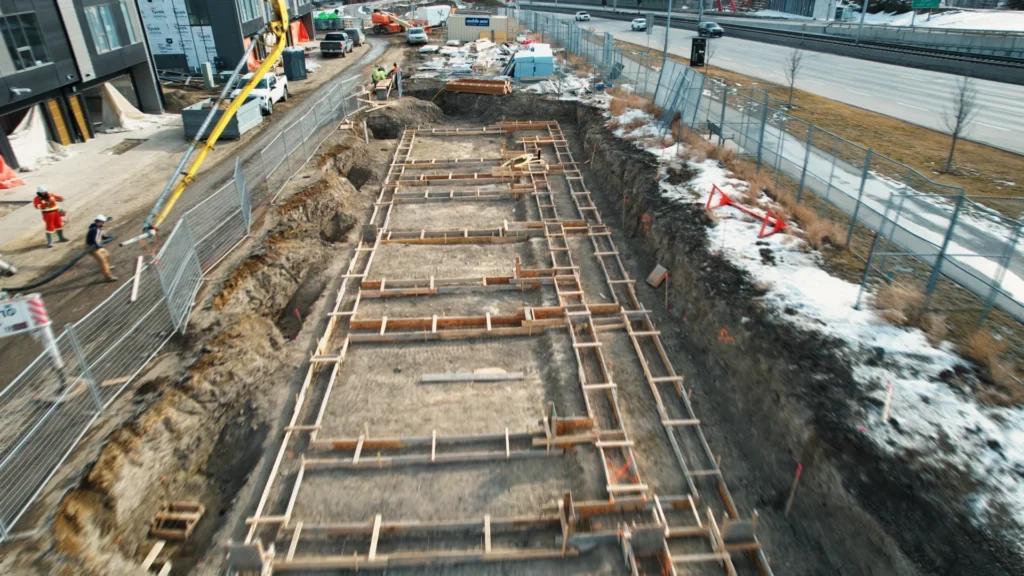
Apply this in order:
- Job under 3 m³? → Volumetric (drum-truck would over-order)
- Job 3–8 m³? → Volumetric (drum-truck would still over-order)
- Job over 8 m³, single spec, simple, accessible — full-truckload pour? → Drum (truck-shape matches pour-shape)
- Job over 8 m³ but multi-spec (e.g., footing + wall + slab)? → Volumetric (avoid 2 or 3 trucks for one job, plus leftover-spec waste between pours)
- Acreage / over 30 min from plant? → Volumetric (the transit problem)
- Variable / unknown volume? → Volumetric (zero over-ordering risk)
- Decorative — colour, fibre, accelerator, mid-pour mix change? → Volumetric (no pigmented-leftover waste)
- Cold-weather pour during shoulder seasons? → Volumetric (hot-mix on demand — see RM-H-ColdWeather)
The decision tree is structural. It applies regardless of who the supplier is. We use the same tree internally, and we route jobs to drum suppliers when drum is the right answer (it’s a small but real percentage of inquiries we handle).
Multi-mix scenario walkthrough (footing + wall, same day)
Cribbing-day reality on a typical Calgary single-family job:
- Morning pour: footing concrete at 25 MPa, low slump, HS sulphate-resistant cement (Calgary’s S-2 exposure mandate). Volume: 3–5 m³.
- Afternoon (after 24–48 hour cure): wall concrete at 32 MPa, moderate slump, HS cement. Volume: 18–25 m³.
Drum approach:
- Truck 1 delivers a footing mix in the morning, and returns to the plant.
- Wait 24–48 hours for cure.
- Truck 2 delivers wall mix two days later from the same plant.
- Two batches, two trips, two scheduling slots, plus the 2-hour discharge clock running on each delivery.
Volumetric approach:
- The same truck delivers a footing mix in the morning. Pour. Mix-change procedure (~5 min).
- The truck returns 24–48 hours later for the wall pour. Or stays on-site if conditions allow same-day pours of cure-permitting structural elements.
- Single supplier. Single coordinated calendar. Mix changes documented per pour in the QC paperwork.
The cribbing crew (sister company Omega 2000) uses Omega Ready Mix’s multi-mix capability daily. It’s not a marketing scenario; it’s the actual operational pattern across roughly 1,000 Calgary single-family foundations per year.
FAQ
Q: Does volumetric concrete meet CSA A23.1 / ASTM standards?
Yes. Volumetric is governed by ASTM C685 / C685M (the volumetric concrete standard) and is fully CSA A23.1:24 compliant. Each cubic metre delivered is logged via flow meter and documented in QC paperwork. Compliance documentation per pour is typically more granular than a drum-truck batch ticket.
Q: Is volumetric quality the same as drum-mix?
Same spec, same standard, same compliance audit trail. The difference is the batch location (truck vs plant) and the time-from-batching window (zero for volumetric vs the 2-hour CSA A23.1 limit for drum). Both produce real concrete to the same MPa, slump, and air content specifications.
Q: When is drum the right answer?
Single-spec pours over 8 m³ with truck access on simple, accessible sites. Production-builder slabs at scale. Mass concrete pours where one drum truck’s fixed-load shape matches the pour shape exactly. In those cases drum delivery doesn’t generate the over-ordering waste that volumetric is built to eliminate. Below the 8 m³ threshold, or for multi-spec jobs, volumetric structurally wins on the no-waste side.
Q: Why don’t more Calgary suppliers offer volumetric?
Capital investment per truck, certification (Concrete Alberta Mobile Mixer Facility Certification, 3-year term with annual audit), operator training (VMMB Operator Certification + Concrete Alberta training), and builder partnerships (it takes years to keep 5 trucks busy). The barriers compound. We had a 36-year residential foundation crew already on the spec sheets when we launched in 2023, which solved the “keeping the trucks busy” problem from day one.
Q: Can volumetric handle high-strength (35 MPa+) mixes?
Yes. Mix design is tuned per pour. We routinely batch 35 MPa HS for foundation walls and decorative work. Higher MPa specs (up to 50 MPa) are achievable with optimized mix designs for specialty applications.
Q: How do you book a volumetric pour?
Same-day where feasible (Calgary inner core within Stoney Trail). 1-day lead-time for outer Calgary. 1–2 day for surrounding markets. Email [email protected] or call 403-217-4888. Tell us volume, spec, location, and schedule, and we’ll quote — including telling you when drum is the right call.
Tell us the job profile — we’ll tell you the right delivery method.
Concrete delivery should match the structure of the job: volume, spec count, site access, schedule, and distance from the plant.
Sometimes the right answer is volumetric.
Sometimes it’s drum.
We’ll tell you honestly which one fits.
Omega Ready Mix operates Calgary’s only city-based volumetric concrete fleet, backed by a 36-year residential foundation operation that spent decades buying drum concrete before launching volumetric in 2023.
Call us at 403-217-4888 or email [email protected] to quote your next pour.
Last updated: May 2026 | Methodology: comparison framework derived from operating both modes (Omega Ready Mix volumetric fleet + 36-year cribbing-side experience purchasing drum concrete pre-2023). The decision tree is the same one we use internally to route jobs.