Brand: Omega Ready Mix
Word count: ~1,900
Publish week: Week 7
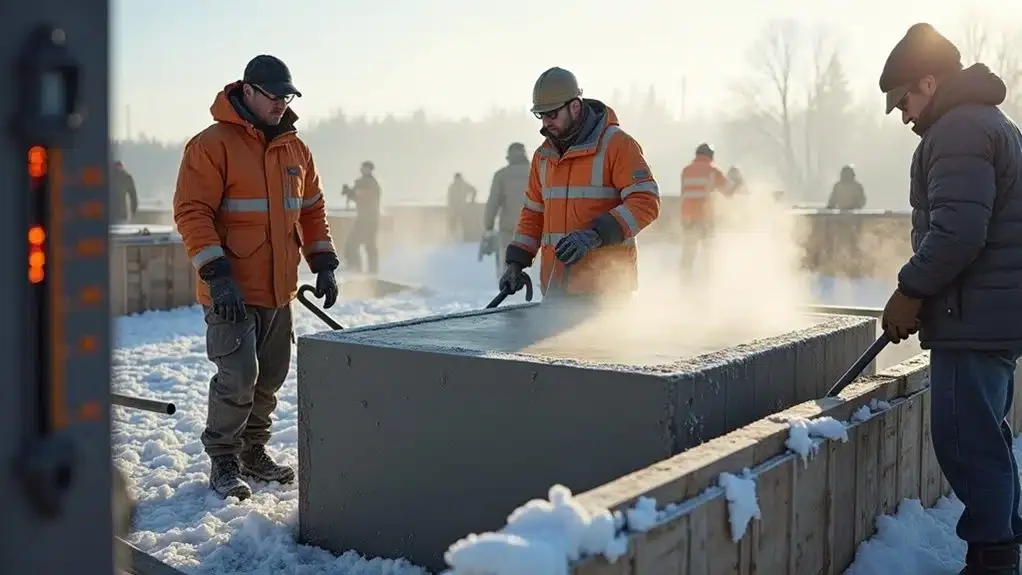
Calgary’s pouring season is shorter than most provinces realize.
CSA A23.1:24 cold-weather provisions mandates cold-weather concreting procedures whenever air or substrate temperature drops below 5°C — and Calgary hits that threshold on average from late September through mid-April. That’s roughly 6 months of operating-procedure pours every year. For most of the rest of Canada, cold-weather procedures are a 3–4 month affair. In Calgary they’re half the year.
Volumetric mixers structurally win cold-weather operations for two reasons:
- Hot-mix capability batches concrete from heated water + warmed aggregate at the moment of pour, eliminating the heat-loss-during-transit problem that limits barrel-truck cold-weather delivery.
- On-truck batching means mix design (accelerator, air content, water-cement ratio) can be tuned per pour to the actual ambient conditions at the site — not the conditions when the load was batched at the plant.
This piece is the operating manual. It walks through what changes when temperature drops below 5°C, how hot-mix volumetric works, and what cold-weather procedures actually mean across Calgary’s chinook + freeze-thaw climate (the City of Calgary Climate Hazards 2022 Year in Review reports a 30-year average of ~128 freeze-thaw cycles per year — among the highest in any major Canadian city).
Calgary’s actual pouring season
The City of Calgary Climate Hazards 2022 Year in Review documents the climate context:
- Average days below 5°C: late September through mid-April (~6 months)
- Average freeze-thaw cycles per year (30-year average): ~128
- 2022 recorded freeze-thaw cycles: 117
What “pouring season” means depends on how you define it:
- Without cold-weather procedures: roughly May through late September — 5 months of unconstrained pouring.
- With cold-weather procedures (CSA A23.1:24 cold-weather provisions): year-round — provided the procedure stack is fully applied: heated mix, accelerators, frost protection, continuous temperature monitoring, and the additional crew supervision the work demands.
Most production builders schedule around the 5°C trigger and concentrate work in the May–September window. Specialty trades, infrastructure contractors, and renovation builders push through the trigger because the alternative — losing 6 months of work each year — isn’t viable for their businesses.
Why barrel-truck cold-weather fails
Barrel-truck delivery has three structural weaknesses in Calgary cold-weather conditions:
1. Heat loss during transit. Concrete is batched at the plant at ambient + heated-water temperature. By the time the truck arrives 30–60 minutes later, the load has lost meaningful heat to the truck drum and the outside air. The 2-hour discharge limit (CSA A23.1:24) is even more constrained in cold weather because the load is racing both temperature and cure time.
2. Pre-batched mix can’t adapt. The mix was designed at plant temperature for plant conditions. If the site has dropped 8°C since batching, or if the wind picks up, the mix isn’t adjustable.
3. Accelerator dosing rigidity. An accelerator (calcium chloride or non-chloride) is dosed at the plant. If the actual site conditions need more accelerator than the plant batched, the truck has no adjustment capacity.
The result: barrel-truck cold-weather delivery lives at the edge of compliance even with experienced operators. One unexpected weather drop or one traffic delay can put the load past spec.
Hot-mix volumetric mechanism
Volumetric trucks have on-truck heating capability:
- Heated mix water stored in an insulated tank, typically maintained at 50–70°C
- Warmed aggregate in the aggregate compartments (heated air or steam options on some configurations)
- On-site batching at delivery, with mix design tuned to ambient site conditions in real time
What this means operationally: heat is delivered to the site, not lost during transit. Mix design can adjust to the site’s actual temperature, wind, and substrate conditions at the moment of pour.
For Calgary’s chinook climate — where temperature can swing 20°C in a single afternoon — adaptive mix design isn’t a marketing feature, it’s a compliance necessity.
For Alberta-specific technical guidance on concrete placement, curing procedures, and seasonal operating standards, Concrete Alberta remains one of the province’s leading industry resources. Their cold-weather recommendations are widely referenced across residential, commercial, and infrastructure construction projects.
Cold-weather mix-design tools
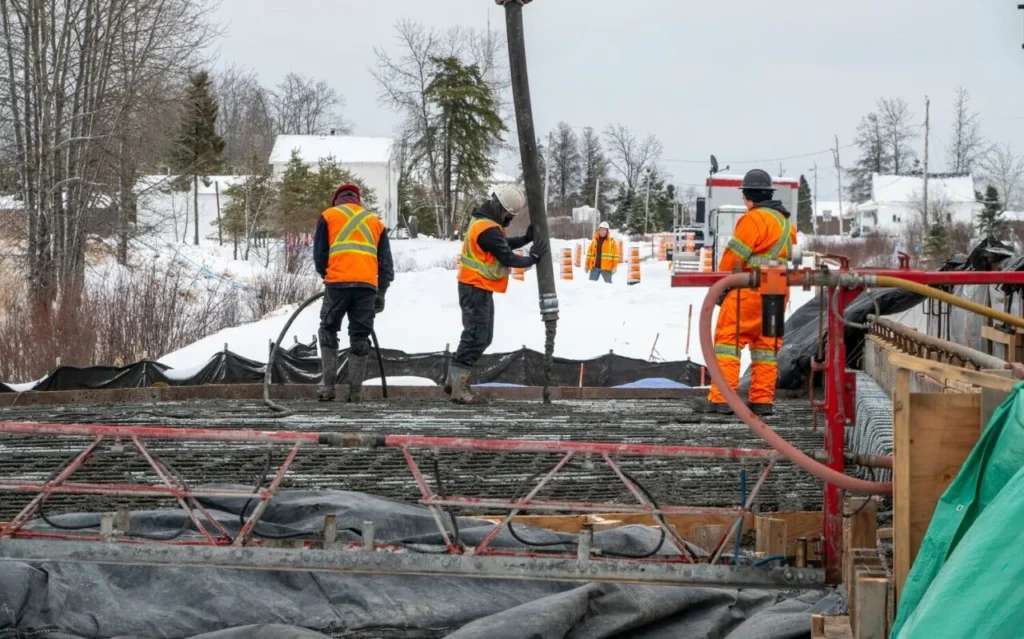
The cold-weather procedure stack that volumetric trucks deliver per pour:
Accelerators. Calcium chloride (faster set, common choice) or non-chloride options (avoiding chloride-induced rebar corrosion in HS-cement applications). Dose adjusted per pour.
Air-entrained mix. Calgary’s ~128 freeze-thaw cycles per year mandate entrained air at 5–7% per CSA A23.1:24. Air content can adjust per pour based on substrate moisture and ambient conditions.
Water-cement ratio adjustment. Cold-rate hydration runs slower than warm-rate. Adjusting the water-cement ratio per pour helps the concrete reach the 32 MPa minimum strength threshold (the strength target before frost exposure becomes acceptable per CSA A23.1:24 cold-weather provisions) faster.
HS cement. Calgary’s S-2 sulphate exposure mandate doesn’t go away in winter. HS sulphate-resistant cement (Type HS, originally branded Kalicrete in Alberta in 1930) is required across cold-weather pours just as in warm-weather pours. The 56-day strength spec (CSA A23.1:24 mandatory minimum for HS) means winter pours need extended strength-monitoring protocols.
Operating procedures: protection + cure
Mix-design tools alone don’t deliver compliance. The site procedures matter equally:
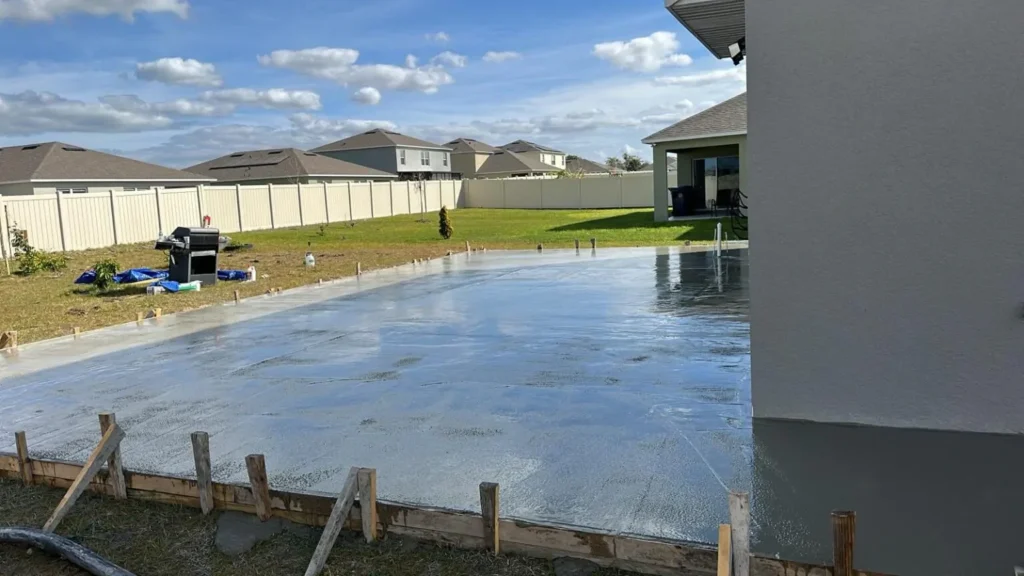
Insulating blankets + tarps placed immediately after pour to retain hydration heat.
Heated enclosures (hoarding) for sustained sub-zero work — typically polyethylene tents with propane or electric heaters maintaining the cure environment above 10°C for 3–7 days.
Maturity-method temperature monitoring. Continuous internal-concrete temperature logging via embedded sensors. The monitoring documents that the cure curve hit the maturity threshold required by CSA A23.1:24 cold-weather provisions for the spec strength.
When to abort vs when to proceed. Below approximately -10°C with high wind, the trade-off shifts: even hot-mix volumetrics with full hoarding may not deliver compliant cure under those conditions. Experienced operators abort and reschedule rather than fight conditions that won’t yield spec results.
Calgary climate-specific guidance
Calgary’s chinook + freeze-thaw cycle pattern creates conditions that are harder than continental-cold cities like Winnipeg or Edmonton, even though Calgary’s average winter temperature is technically warmer:
Chinook reversals. A pour at -15°C with stable cold can be managed. A pour at -5°C with chinook coming through (rapid swing to +10°C, then back to -10°C 24 hours later) is harder — the cure is forced through a freeze-thaw cycle on its first day.
Foothills wind-load. Wind-driven moisture loss is a major risk on Calgary cold-weather pours. Hoarding tents have to handle real wind, not just hypothetical calm conditions.
Why Calgary cold-weather is harder than continental-cold cities: the variability is the constraint, not the average temperature. Volumetric trucks adapt to per-pour conditions; barrel trucks deliver one batch designed for one set of conditions.
Real Calgary cold-weather projects
Where this matters in practice:
Production-builder shoulder-season pours. Builders running through October and November to clear lot inventory before winter shutdown. Hot-mix volumetric extends the workable window by 4–6 weeks vs barrel-truck capability.
Infrastructure repair winter work. Calgary infrastructure contractors who have winter-deadline projects (utility repair, bridge maintenance, emergency work) rely on volumetrics for compliant cold-weather delivery.
Renovation trades extending project schedules. Renovation contractors finishing basement extensions or rear additions through the shoulder season. Hot-mix lets them keep a schedule rather than pushing to spring.
For builders who want year-round foundation construction without the cold-weather procedure stack on the wall pour, the precast option is structurally cleaner: factory-cured walls arrive ready to install, eliminating the on-site cure-in-cold problem entirely.
The cold-weather operating-procedure paper trail
CSA A23.1:24 cold-weather provisions require documentation of cold-weather pour procedures: the batching temperatures, the in-place temperature monitoring, the protection method used, the strength-gain documentation per maturity method.
Volumetric on-truck batching (ASTM C685) simplifies the paper trail because every cubic metre is logged via flow meter at delivery. The QC documentation per pour exceeds what a typical barrel-truck batch ticket captures. For inspectors and engineers reviewing cold-weather work, that documentation density is what holds up under audit.
CTA
Calgary’s pouring season isn’t 6 months. With hot-mix volumetric, it’s 12.
Need Concrete Through Calgary’s Winter?
Cold weather doesn’t stop construction schedules — but the wrong concrete delivery system can.
Omega Ready Mix provides hot-mix volumetric concrete across Calgary and surrounding communities with per-pour mix adjustments, heated water systems, and CSA A23.1:24 cold-weather operating procedures designed for Alberta conditions.
Whether you’re pouring footings in October, handling emergency winter repairs, or trying to keep a production build moving through shoulder season, our fleet is built for cold-weather performance.
Talk to Omega Ready Mix about your next winter pour:
📧 [email protected]
📞 403-217-4888
Serving Calgary, Airdrie, Chestermere, Cochrane, Okotoks, Langdon, and surrounding Alberta construction markets.
[email protected] | 403-217-4888.
Last updated: May 2026 | Methodology: cold-weather procedure framework drawn from CSA A23.1:24 cold-weather provisions + Concrete Alberta + ACI 306R + 36-year cribbing-side cold-weather field experience.