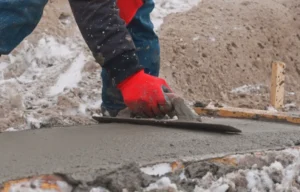

Pouring concrete may look straightforward, but one small decision can determine whether your slab lasts 40 years or starts cracking within the first winter: concrete thickness. Across Canada, many flatwork failures happen not because of poor concrete quality, but because the slab was poured too thin for its intended use. Driveways that crumble under vehicle weight, patios that heave after freeze–thaw cycles, and garage floors that crack prematurely all trace back to the same issue—incorrect thickness design.
This guide is built to help homeowners, builders, and contractors confidently choose the right concrete thickness for different flatwork applications. Drawing from real-world experience, Canadian climate considerations, and recognized engineering standards, we’ll break down exactly how thick your concrete should be—and why it matters.
Why Concrete Thickness Matters More Than You Think
Concrete thickness is not an arbitrary number. It directly affects load capacity, crack resistance, durability, and long-term performance. While thicker concrete costs slightly more upfront, it often prevents thousands of dollars in future repairs or replacement.
Load-Bearing vs Non-Load-Bearing Flatwork
The first question to ask is simple: what loads will this concrete support? A backyard walkway and a vehicle driveway experience vastly different stresses.
- Non-load-bearing flatwork: Sidewalks, garden paths, and patios mainly support foot traffic and light furniture.
- Load-bearing flatwork: Driveways, garage slabs, parking areas, and equipment pads must handle vehicle weight, point loads, and repeated stress.
For interior applications such as basement concrete slabs, thickness considerations extend beyond load-bearing capacity to include moisture control, thermal insulation, and compatibility with future flooring systems. While basement slabs typically follow similar thickness standards to garage floors, they require additional attention to vapor barriers, insulation placement, and curing methods to prevent moisture-related issues and ensure comfortable indoor environments
For example, a standard passenger vehicle can exert over 3,000–4,000 lbs on a driveway slab. Concentrated wheel loads amplify stress at slab edges, making thickness selection critical for preventing cracking.
Climate Considerations in Canada
Canadian weather is one of the biggest variables influencing concrete thickness requirements. Freeze–thaw cycles cause moisture in the soil to expand, lifting and stressing slabs from below. Thinner concrete has less structural mass to resist these forces.
In colder regions:
- Thicker slabs better resist frost heave
- Additional thickness helps distribute thermal stress
- Proper air-entrained concrete improves freeze–thaw durability
According to guidance referenced by the Cement Association of Canada, slab performance in cold climates depends on a combination of thickness, air content, and subgrade preparation—not just concrete strength.
Soil Conditions and Subgrade Preparation
Even the thickest concrete slab can fail if it’s placed on poor soil. Thickness works together with the subgrade to distribute loads evenly.
Common soil scenarios include:
- Clay soils: Expand and contract significantly—often require thicker slabs and granular base layers
- Sandy soils: Drain well but may lack uniform support
- Compacted gravel bases: Ideal for flatwork when properly installed
Experienced contractors often say, “Concrete doesn’t crack because it’s weak—it cracks because the ground moves.” Proper thickness paired with good base preparation dramatically improves slab longevity.
Standard Concrete Thickness Chart by Application
While every project should consider site-specific conditions, industry experience and engineering guidelines provide reliable thickness ranges for common flatwork. The table below summarizes typical recommendations used across residential and commercial projects in Canada.
| Application | Typical Thickness | Reinforcement Notes |
|---|---|---|
| Sidewalks & Walkways | 4 inches | Optional wire mesh or fiber |
| Concrete Patios | 4–5 inches | Fiber or light rebar recommended |
| Residential Driveways | 5–6 inches | Rebar grid or thickened edges |
| Garage Slabs | 5–6 inches | Rebar or mesh essential |
| Commercial Slabs | 6–8+ inches | Engineered reinforcement required |
These thicknesses assume proper subgrade preparation and quality concrete mixes. Reducing thickness below these ranges significantly increases the risk of cracking and early failure.
Concrete Thickness for Common Residential Applications
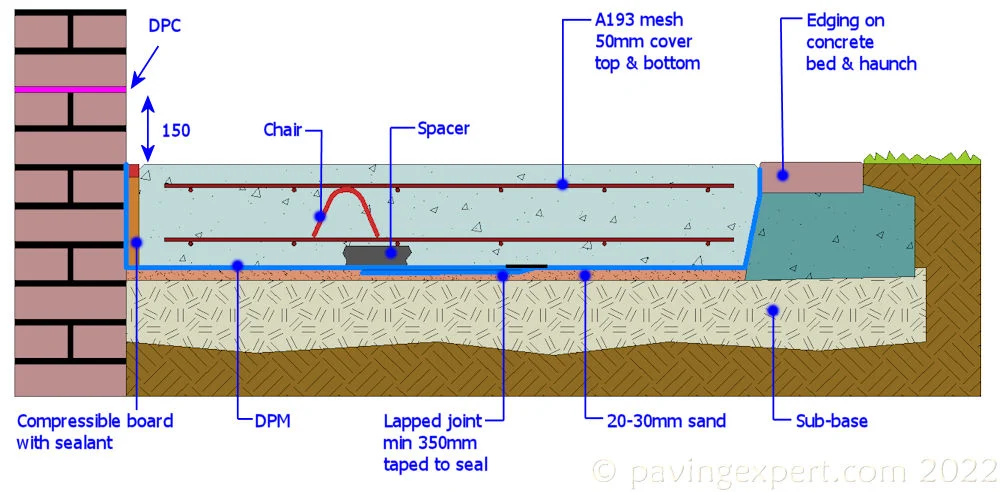
Residential flatwork accounts for the majority of concrete poured across Canada. While these projects may seem simple, they demand careful thickness selection to balance cost, durability, and performance.
Sidewalks & Walkways
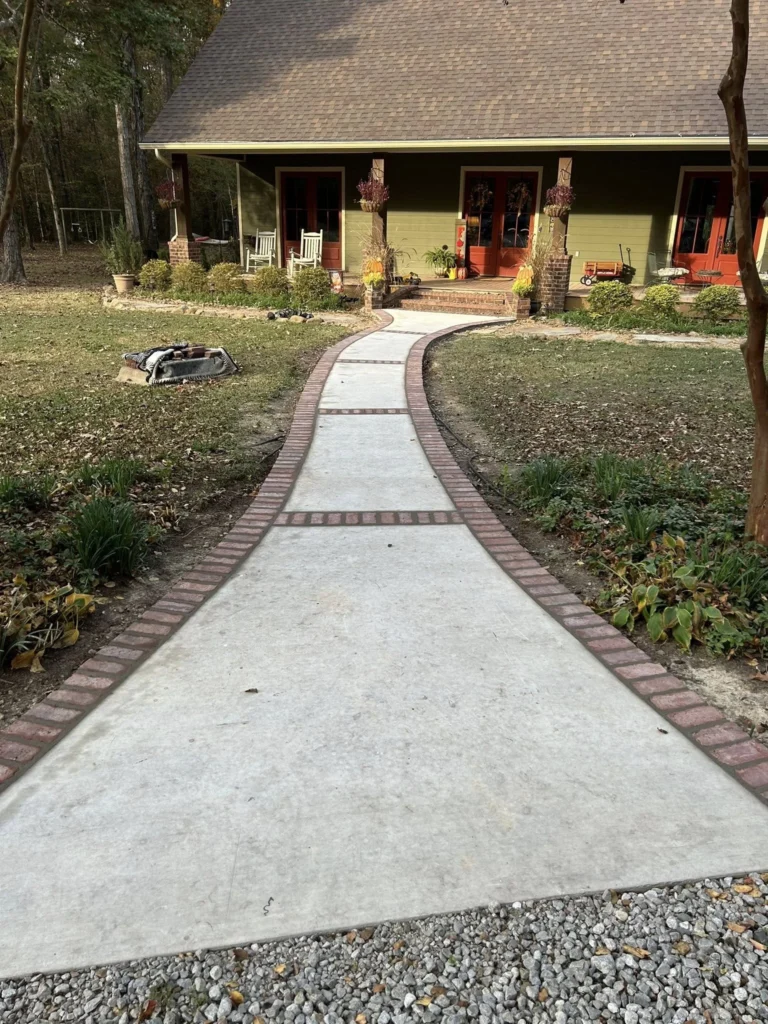
Sidewalks and walkways are typically poured at a standard thickness of 4 inches. This thickness is sufficient for pedestrian traffic, bicycles, and light landscaping equipment when placed on a properly compacted base. For comprehensive guidance on concrete sidewalks and walkways including municipal code compliance, accessibility standards, and proper drainage design, understanding thickness requirements is essential to creating safe, durable pedestrian surfaces that meet both functional and regulatory expectations.
Best practices include:
- Uniform 4-inch slab thickness throughout
- Control joints every 5–6 feet to manage cracking
- Optional fiber reinforcement for added crack control
Municipal sidewalks often follow similar standards, guided by local bylaws and engineering references such as CSA and ACI recommendations.
Concrete Patios
Concrete patios usually range from 4 to 5 inches thick, depending on usage. A basic seating patio may perform well at 4 inches, while patios supporting outdoor kitchens, pergolas, or hot tubs benefit from added thickness. For detailed information on concrete patio installation design considerations, finishing options, and Calgary-specific climate requirements, proper thickness selection works together with base preparation and reinforcement to create outdoor spaces that withstand freeze-thaw cycles and heavy seasonal use.
Real-world experience shows that increasing patio thickness by just one inch can significantly reduce surface cracking over time—especially in freeze–thaw environments.
Contractors often recommend:
- Minimum 4 inches for light use
- 5 inches for heavier furnishings or built-in features
- Fiber-reinforced concrete for enhanced durability
As structural engineer commentary frequently notes, “Thickness provides stiffness; reinforcement provides crack control.” Both play complementary roles in patio performance.
Residential Driveways
Driveways demand more attention than any other residential flatwork. While older homes may have 4-inch driveways, modern best practice recommends 5 to 6 inches for long-term durability. For comprehensive guidance on concrete driveway construction in Calgary and across Canada—including base preparation, reinforcement standards, and climate-appropriate installation techniques—understanding proper thickness is just the first step in ensuring decades of reliable performance.
Key considerations include:
- Vehicle weight (SUVs, trucks, RVs)
- Edge loading near sidewalks and curbs
- Snowplow and freeze–thaw exposure
Thickened edges—where slab edges are poured 1–2 inches thicker—are commonly used to improve performance without dramatically increasing material costs.
According to guidance aligned with American Concrete Institute principles, driveways should always prioritize thickness and base preparation over surface aesthetics.
(End of first half – continuation will cover garage slabs, commercial applications, reinforcement vs thickness, cost considerations, FAQs, and expert conclusions.)
Garage Slabs
Garage floors experience higher and more concentrated loads than most residential flatwork. Vehicles, tool chests, shelving systems, and even small machinery all apply repeated stress to the slab. For this reason, a minimum concrete thickness of 5 to 6 inches is widely recommended for residential garage slabs. For detailed specifications on garage floor concrete including reinforcement standards, vapor barrier requirements, and base preparation techniques, proper thickness selection must be paired with climate-appropriate installation methods to prevent cracking and ensure long-term durability under vehicle loads.
Key factors influencing garage slab thickness include:
- Vehicle weight and axle loads
- Point loads from jacks or hoists
- Long-term static loads from storage and equipment
In real-world practice, many experienced contractors increase thickness to 6 inches in high-use garages, especially where trucks or electric vehicles are common. Thicker slabs provide better load distribution and significantly reduce random cracking over time.
Best practices for garage slabs typically include a compacted granular base, vapor barrier, and steel reinforcement or fiber additives to control shrinkage cracking.
Concrete Thickness for Commercial & Heavy-Duty Applications
Commercial and industrial flatwork requires a higher level of planning and engineering than residential projects. These slabs are designed to withstand heavier loads, more frequent traffic, and longer service life expectations.
Parking Lots & Drive Aisles
Concrete parking areas and drive aisles usually range from 6 to 8 inches thick, depending on traffic type. Passenger-only parking may function well at the lower end of this range, while delivery lanes and fire access routes often require additional thickness.
Typical considerations include:
- Frequency of traffic
- Commercial vehicle access
- Joint spacing and load transfer
Many failures in commercial parking lots are traced back to slabs that were poured too thin for occasional heavy vehicles, such as delivery trucks or waste collection equipment.
Loading Docks & Equipment Pads
Loading docks, dumpster pads, and equipment bases experience extreme point loads. Concrete thickness in these applications often starts at 8 inches or more and is frequently engineered for site-specific conditions.
Forklifts, pallet jacks, and truck axles create concentrated stresses that thin slabs cannot handle. In these cases, thickness works together with rebar design to prevent structural failure.
Warehouse & Shop Floors
Warehouse floors demand both strength and flatness. Concrete thickness typically ranges from 6 to 10 inches, depending on racking systems, forklift traffic, and storage density.
Industrial slab design often focuses on:
- Flatness and levelness tolerances
- Joint layout and spacing
- Long-term abrasion resistance
These slabs are rarely designed by rule of thumb. Instead, thickness is calculated based on load modeling and operational requirements to ensure safety and longevity.
Reinforcement vs Thickness — What Really Matters?
A common misconception is that reinforcement can replace concrete thickness. In reality, the two serve different purposes and must work together.
Rebar, Wire Mesh, and Fiber Reinforcement
Reinforcement does not make concrete stronger in compression. Instead, it helps control cracking and improves load distribution once cracks inevitably occur.
- Rebar: Improves structural integrity and load transfer
- Wire mesh: Helps control shrinkage cracking
- Fiber reinforcement: Reduces micro-cracking and improves durability
Thickness provides stiffness, while reinforcement manages cracking behavior. Removing one to compensate for the other often leads to premature failure.
When Thicker Concrete Is Not Enough
Even thick slabs can fail if placed on poorly prepared subgrade or exposed to excessive moisture movement. Proper drainage, base compaction, and joint design are just as important as slab thickness.
Experienced concrete professionals consistently emphasize that slab performance is a system—not a single dimension.
Canadian Codes, Standards & Engineering Guidelines
Concrete thickness recommendations are influenced by recognized standards and best practices used across Canada.
CSA & ACI Design Guidance
Organizations such as the Canadian Standards Association and the American Concrete Institute provide widely referenced guidance for slab-on-grade construction. These standards help engineers and contractors determine appropriate thickness based on loading, soil conditions, and environmental exposure.
While residential flatwork may not always require stamped engineering, commercial projects often do—especially when public safety or heavy equipment is involved.
Municipal & Provincial Requirements
Local authorities may impose minimum thickness requirements for sidewalks, driveways, or commercial flatwork. These requirements vary by municipality and should always be confirmed before construction begins.
Cost Implications of Concrete Thickness
Thickness directly affects concrete volume and project cost, but cutting corners rarely saves money in the long run.
How Thickness Affects Material Cost
Increasing slab thickness by one inch can add material cost, but the increase is often marginal compared to the cost of demolition and replacement caused by slab failure.
Long-Term Value of Proper Thickness
Correct thickness reduces:
- Cracking and surface deterioration
- Maintenance and repair costs
- Risk of premature replacement
From a lifecycle perspective, thicker, well-designed slabs consistently outperform thinner alternatives.
Common Mistakes to Avoid When Choosing Concrete Thickness
- Pouring thinner slabs to reduce upfront cost
- Ignoring soil conditions and drainage
- Skipping reinforcement or control joints
- Using residential thickness for commercial loads
Most concrete failures are predictable—and preventable—with proper planning.
When to Consult a Concrete Expert or Engineer
Professional guidance is strongly recommended for commercial or industrial projects, poor or expansive soil conditions, heavy vehicle or equipment loading, and large slab areas with minimal joints. Working with experienced professional flatwork concrete services ensures that slab thickness, reinforcement, and base preparation work together effectively. Expert input from contractors who understand both engineering principles and regional climate challenges helps prevent costly design mistakes and ensures long-term performance.
Frequently Asked Questions (FAQ)
Is 4 inches of concrete thick enough for a driveway?
In most modern applications, 4 inches is considered insufficient for driveways. A minimum of 5 inches is recommended, with thicker edges for durability.
Can I replace rebar with thicker concrete?
No. Thickness and reinforcement serve different purposes. Removing reinforcement increases the risk of uncontrolled cracking.
What thickness is best for cold climates?
Cold climates benefit from increased thickness, proper air-entrained concrete, and well-prepared subgrades to resist freeze–thaw damage.
Does fiber reinforcement replace steel?
Fiber helps control micro-cracking but does not replace structural steel reinforcement in load-bearing slabs.
Conclusion: Choosing the Right Concrete Thickness
Selecting the correct concrete thickness is one of the most important decisions in any flatwork project. When thickness matches load demands, soil conditions, and climate, concrete performs reliably for decades.
By following proven guidelines and consulting experienced professionals, homeowners and contractors can avoid costly failures and build flatwork that truly lasts.
Need expert advice or a concrete quote? Contact Omega Ready Mix today to discuss your project requirements and get concrete solutions designed for long-term performance.