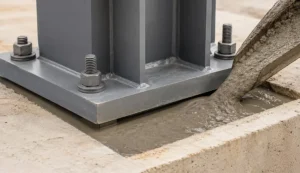

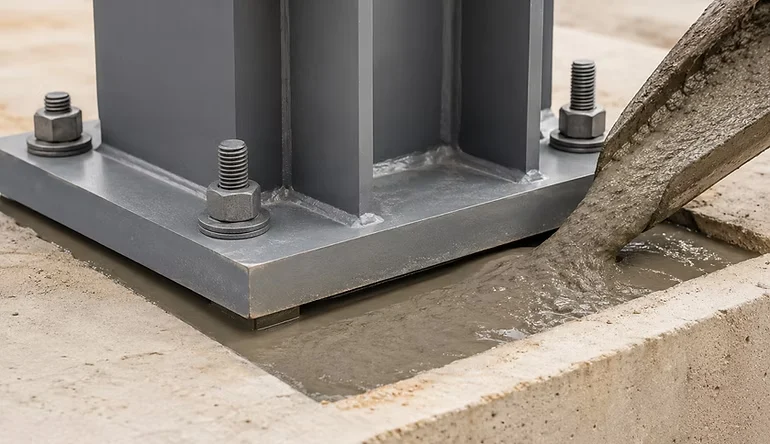
A base plate transfers a column load into concrete through a layer of grout 25 mm thick. Nothing else in the load path is specified in one line and bought by brand. “Non-shrink grout, ASTM C1107” is the whole instruction on a great many drawings, and it leaves four decisions open: which consistency, which strength at which age, how thick, and who places it.
Those decisions are where grout pads fail, and they fail quietly. A column bearing on 60 per cent of its pad does not announce the fact. It behaves perfectly until something cyclic, or something cold, finds the void.
What “non-shrink” is measured against, not what it promises
The term is a measurement, not a property. Non-shrink grout is a grout whose volume change has been tested and bounded in two separate states, using different standards for each.
In the plastic state — mixed, placed, not yet set — the grout is expected to expand slightly. Alberta’s material testing specification B387 sets early volume change by ASTM C827 at not less than 0.5 per cent and not more than 6.0 per cent. A railroad owner specification for the same product class requires zero shrinkage and a maximum of 4.0 per cent. The direction is the point: a grout that contracts while plastic pulls away from the underside of the plate, the one surface you cannot inspect afterward.
In the hardened state the allowance narrows sharply. B387 sets hardened volume change by CRD-C621 at not less than 0.03 per cent and not more than 0.4 per cent — a different test entirely from the drying shrinkage of ordinary concrete, which we covered in drying shrinkage and ASTM C157. The grout’s job is not to shrink less than concrete. It is to end up very slightly larger than the space it was poured into.
That expansion only works if it is restrained. Poured into an unformed, unconfined space, a gas-producing expansive grout can expand beyond its own capability and crack. Non-shrink grout is a confined product by design, which is why a grout pad has forms and a plate above it rather than a trowelled edge.
Why the flow window is 20 to 30 seconds
Two independent specifications written for different industries land on the same number, which makes it worth building a procedure around.
B387 requires flow greater than 20 seconds and less than 30 seconds by CAN/CSA A23.2-1B. The Union Pacific specification requires fluid consistency of 20 to 30 seconds by ASTM C939, the flow cone, measured between 7 °C and 32 °C. The test is simple: fill a standard cone, time the discharge. Read both ends of that window.
Faster than 20 seconds means too much water. Mixing liquid is the one field variable on a bagged product, and it is the one the specification closes: B387 states that only the mixing liquid specified by the manufacturer is to be added in the field, and requires the bag to be marked with the quantity, the mixing time or sequence, and the curing recommendation. A crew that adds a splash to make the grout move has not improved placement; it has moved the product outside the window it was approved against, and the strength and volume-change numbers no longer apply.
Slower than 30 seconds means the grout will not travel, and under a plate flow is what fills the far corner. This is the same bind as block fill, where the mix has to stay stable and still reach the bottom of a cell — a trade-off we worked through in block fill grout slump and lift heights.
B387 adds a bleeding limit of not more than 2.0 per cent, closing the obvious workaround: a grout wet enough to run freely and then release water under the plate leaves exactly the void the pour was meant to eliminate.
The strength numbers, at the ages that matter
Grout is specified at earlier ages than structural concrete, because the schedule reason for using it is speed.
B387 requires not less than 25 MPa at 7 days and not less than 35 MPa at 28 days, tested to CAN/CSA A23.2-1B. The Union Pacific specification sets its fluid classes considerably higher: 3,500 psi at 1 day, 6,500 psi at 3 days and 7,500 psi at 28 days — roughly 24, 45 and 52 MPa — with a 30-minute extended working time.
The spread between those two sets of numbers is not a contradiction; it is the practical lesson. A provincial bridge grout and a railroad equipment grout are qualified against different test regimes, so neither number is “the” strength of non-shrink grout, and a submittal that meets one does not automatically meet the other. Check which document your specification cites before accepting a data sheet.
Two sampling details carry over from concrete practice. B387 requires all specimens for the qualifying tests to come from one batch, and requires the lab report to state the water-to-dry-grout ratio. Both exist for the reason a low cylinder break turns into an argument on a concrete job: without the mix water and the specimen history, a number cannot be defended — the mechanism behind a low concrete cylinder break under CSA.
B387 also distinguishes two approval types by set time. A Type 1 product has initial set between 1.0 and 6.0 hours and final set within 10 hours. A Type 2 product meets all Type 1 requirements except that it is allowed longer set times — up to 6.5 hours initial and 13.0 hours final — because its set is verified at low temperature rather than standard laboratory temperature. If a pad is going in late in the season, that is the distinction to ask the supplier about.
Where the thickness comes from, and why 25 mm is a floor
The number almost everyone uses is 25 mm, and almost everyone treats it as a target. It is a minimum.
The commonly cited ACI minimum for structural grouting, repeated in manufacturers’ application guides, is 25 mm of clearance under the plate, with roughly 13 mm of annular space for grouting a dowel or anchor. The Union Pacific specification blocks the base concrete out for 25 mm unless the drawings say otherwise, and requires form tops to stand 25 mm above the surface being grouted.
Below that thickness the grout cannot flow or be consolidated. Above it, the limit becomes lift depth: a single lift of a neat bagged grout is generally capped around 75 mm, and deeper pours are extended with clean, saturated 10 mm peastone — a typical ratio is 25 lb of stone per 50 lb bag. Extending with aggregate changes the product’s properties, so it follows the manufacturer’s instruction, not field judgement.
Three preparation requirements decide whether any of those numbers mean anything:
- Clean, roughened concrete. Laitance, oil, curing compound and loose material come off, and the surface is lightly roughened for bond.
- Saturated surface dry. The concrete is saturated with clean water and the excess removed immediately before grouting. Dry concrete drinks the mixing water out of a 25 mm layer fast enough to change its properties.
- Base concrete at strength. The Union Pacific specification requires design strength before grouting unless the owner authorises otherwise.
Why the grout arrives from one side
A grout pad is placed in one direction, in one continuous operation, and the reason is air.
The published method is to pour from one side only until the grout rises at least 25 mm above the plate on the opposite side, with a head box to maintain pressure and air-relief holes through large plates. Pouring from two sides traps a pocket in the middle — directly under the column, in the part of the pad that carries the load. Nobody sees it.
Then the restrictions that follow:
- Grout that has begun to set is not used, and the Union Pacific specification puts a hard ceiling of one hour from initial mixing. Retempering a stiffening grout is the same error as adding water to reach the flow window.
- Levelling shims stay in place: the same specification requires at least 48 hours before removal.
- Edges are cut back at an angle rather than feathered. The two specifications differ on the angle — one calls for a 45-degree chamfer from the underside of the plate, the other for 60 degrees from horizontal unless the drawings say otherwise — a reminder that the project specification, not the habit, governs.
- Exposed grout surfaces are cured, as concrete is.
What Alberta adds: the product list
On provincial bridge work the choice of product is not open. Alberta Transportation maintains an approved list, Approved Non-Shrink Grouts for Bridges, dated 1 May 2024, which supersedes all previous lists and carried four approved products at that date. Everything on it has to meet B387, and the list directs that products be used per the department’s bridge construction specifications and the manufacturer’s recommendations, with conflicts resolved by the consultant or department.
Getting on the list is a pre-qualification paid for by the supplier: testing by an independent CSA-certified laboratory, a submission to the Technical Standards Branch, quality-control data on request within 30 days, retesting after any product change, and withdrawal of approval for poor field performance. B387 also bounds the packaging — a maximum bag weight of 25 kg, net weight and yield each within ±2 per cent of the printed value, and product not manufactured more than 30 days before shipping.
For a private commercial job none of that is binding. It is still the cheapest short list available when a submittal arrives and nobody wants to read a data sheet against a standard.
Where this article stops
This covers cementitious non-shrink grout for bearing applications: what the standards measure, what the published specifications require, and how a pad is placed. It does not cover epoxy grout, a different material with its own standards and the usual answer for dynamic machinery bases. It does not cover anchor bolt placement tolerances, grouted post-tensioning ducts, masonry grout design, or the structural design of the base plate and anchorage.
Talk to us about the concrete under the pad
The grout pad itself is a bagged product. The concrete it bears on is not — and on most jobs the pedestal, pier or pad underneath has to be at design strength, on grade and clean before the grout crew can start. That is the part we supply, and the part that sets the date.
Send us your project details — pour date, mix type, PSI, volume — and our team will get back to you within 1 business hour with a quote and delivery slot. For the pedestals and pads themselves, see custom mixed concrete in Calgary, or see block fill concrete if the same job has masonry cells.
FAQ
Is non-shrink grout the same as mortar or masonry grout? No. Non-shrink grout is a bearing product whose volume change is bounded in both the plastic and hardened states, placed in a confined space. Masonry grout fills cells around reinforcement; mortar is a bedding material. They are not interchangeable in a load path.
How thick should the grout under a base plate be? Treat 25 mm as the minimum clearance for structural grouting, and follow the drawings where they specify a blockout. Thinner will not flow or consolidate; much thicker moves you into multiple lifts or an aggregate-extended mix.
Can water be added on site to make grout flow better? No. B387 allows only the manufacturer’s specified mixing liquid to be added in the field, in the marked quantity. Extra water moves the product outside the conditions it was tested under, and the 2.0 per cent bleeding limit exists to catch exactly that.
Does grout have to be placed from one side? Yes, in one continuous operation, until it rises at least 25 mm above the plate on the far side, with a head box and air-relief holes on large plates. Placing from two sides traps air directly under the column.
Sources
- Alberta Transportation, B387 — Material Testing Specification for Non-Shrink Grout
- Alberta Transportation, Approved Non-Shrink Grouts for Bridges, 1 May 2024
- Union Pacific Railroad, Section 03 62 13 — Non-Metallic Grouting, February 2022
- Dayton Superior, Guide to Bearing Grouts — manufacturer application guide, cited here for the ACI clearance and lift-depth figures it reproduces
Figures above are quoted from the published specifications named. Imperial values converted to metric are approximate. Non-shrink grout requirements vary significantly between owners and product classes — confirm against the specification cited on your own project and the manufacturer’s current data sheet.