
A 28-day break that lands below the specified strength is not, by itself, a failed pour. Under CSA A23.1 a single result is allowed to sit below the specified strength by a defined margin — 3.5 MPa for mixes specified at 35 MPa or less — and the pour is still compliant. The number that decides the question is not the spec line on the drawing. It is the acceptable test result derived from it.
That distinction is worth getting straight before anyone books a coring rig, because the sequence that follows a low break has a cost attached at every step, and a surprising share of low breaks turn out to be a problem with the cylinder rather than a problem with the concrete.
What counts as a “test”, and what counts as low
Start with the definition, because it is the first place site conversations go wrong. Under Canadian practice a test is not one cylinder. It is the average compressive strength of the set of two cylinders broken at the specified age, normally 28 days. One low cylinder out of a pair does not produce a low test; it produces a lower average.
From there, two conditions have to be met:
- Each individual test result must equal or exceed the acceptable test result (ATR).
- The moving average of three consecutive strength tests in the same concrete must equal or exceed the specified strength.
The ATR is where the tolerance lives:
| Specified strength | Acceptable test result under CSA A23.1 | Worked example |
|---|---|---|
| 35 MPa or less | Specified strength − 3.5 MPa | 30 MPa specified → 26.5 MPa is still an acceptable single test |
| More than 35 MPa | 0.90 × specified strength | 45 MPa specified → 40.5 MPa is still an acceptable single test |
If you work from American documents as well — and many Alberta specifications reference both — ACI 318 sets an equivalent pair of conditions: no single test lower than the specified strength by more than 500 psi (roughly 3.4 MPa) where the specified strength is 5,000 psi or less, and the average of three consecutive tests equalling or exceeding the specified strength. The two standards are close but not identical, and it is CSA that governs work specified to CSA. If your spec is written to one and your lab reports against the other, sort that out before the first pour, not after the first low break.
For the background on what those specified numbers mean in the first place, our guide to CSA A23.1 exposure classes covers how the class, not the strength number alone, drives the mix.
One low test is not one failed pour
The moving-average condition exists precisely because concrete strength results scatter. A single test below the specified strength but above the ATR satisfies the standard on its own terms. A single test below the ATR is what triggers the investigation — and even then, the first question is not “what is wrong with the concrete.”
That ordering is not a supplier’s convenience. It is what the industry literature says to do. The American Concrete Institute’s guidance is that corrective steps follow a strength test that falls below the specified compressive strength by more than the limit allowed for acceptance — which means the limit has to be applied before anything is called a failure.
Before you core, the test is the first suspect
The NRMCA’s Concrete in Practice bulletin on low cylinder strength lists the causes that have nothing to do with the mix. Read this list the way a supplier reads it, because every item is a chain-of-custody question:
- Improper cylinder handling, curing and testing
- Initial curing at non-standard temperatures — the bulletin flags curing above 80 °F specifically
- Improperly finished cylinder surfaces
- Frozen cylinders
- Impact during transportation to the lab
- Delay in curing once the cylinders reach the lab
- Improper caps, worn neoprene pad caps, or incorrect cap thickness
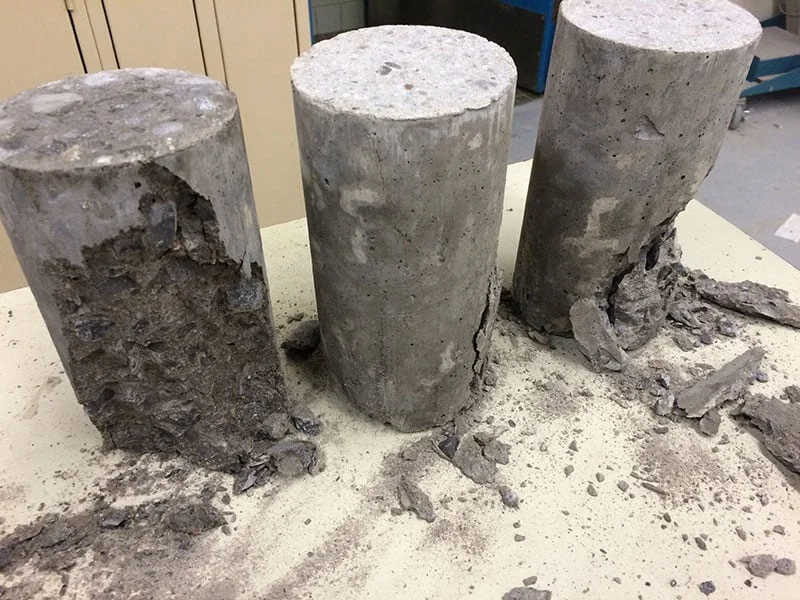
- Insufficient care in breaking the cylinders
In Alberta, two of those are not exotic edge cases. Frozen cylinders describes any set left in an unheated site box overnight in late October. Impact during transportation describes a milk crate of fresh cylinders riding a gravel lease road in the back of a half-ton. Concrete Atlantic’s technical bulletin on low breaks puts it bluntly: improper handling and testing contribute to the majority of low-strength investigations.
None of that is an argument for dismissing a low result. It is an argument for producing the field records first. Three documents answer most of the questions in an afternoon:
- The batch ticket, which tells you the mix, the water added, and the time. We break down what each line means in the numbers on a concrete batch ticket.
- The fresh property tests taken from the same load — slump, air content and concrete temperature. If those were inside spec, the concrete that went into the cylinder was the concrete that went into the structure. Our slump test guide covers the method and the tolerances.
- The initial curing record for the cylinders: where they sat, at what temperature, and for how long before pickup.
If the fresh properties were out of tolerance, the answer usually lies at the truck rather than at the lab — the same set of checks covered in reasons to reject a concrete truck and in the specs a Calgary inspector checks.
Field-cured and standard-cured cylinders answer different questions
This is the second place site conversations go wrong, and it costs real money in Alberta because of how often field cylinders get used in cold weather.
Standard-cured cylinders are cured under controlled laboratory conditions. They answer one question: was the concrete as delivered capable of the specified strength? Acceptance of the concrete is judged on these.
Field-cured cylinders are cured alongside the structure, in the same weather and under the same protection. They answer a different question: how is the concrete in the structure coming along right now? They are the right tool for deciding when to strip forms, when to post-tension, or when a slab can take load. They are not the right tool for rejecting a mix.
A field-cured cylinder that breaks low on a January pour is usually telling you about your curing and protection, not about the concrete that left the plant. Judging a supplier on field cylinders is the most common unforced error of an Alberta winter.
When cores settle it: ASTM C42 and the 85/75 rule
If the low result survives the paperwork review and the structural adequacy of the concrete in place is genuinely in question, the next step is to determine in-place strength — by coring, or by non-destructive methods, or both.
Coring is governed by ASTM C42. The acceptance thresholds most widely applied in North American practice, and carried in ACI 318, are these:
| Item | Requirement |
|---|---|
| Number of cores | Three, for each strength test that fell below the acceptance limit |
| Average of the three cores | At least 85% of the specified compressive strength |
| Any single core | Not less than 75% of the specified compressive strength |
| Preferred specimen length | 1.9 to 2.1 times the diameter |
| Shorter cores | Permitted, with ASTM C42 correction factors for length-to-diameter ratios between 1 and 2 |
| Moisture conditioning | Cores held in sealed plastic bags or non-absorbent containers for at least 5 days after last being wetted, before testing |
| Timing | Cores taken once the concrete is strong enough that removal does not disturb the bond between the mortar and the coarse aggregate |
Worked through on a common Alberta spec: at 30 MPa specified, three cores averaging 25.5 MPa with no single core below 22.5 MPa are considered structurally adequate for the area represented.
Two of those rows are the ones that get skipped and then argued about later. The five-day moisture conditioning is not optional housekeeping — a core tested wet from the drill reads differently from one conditioned to the standard, and a core rushed to the press has produced more than one unnecessary repair. The length-to-diameter correction matters on thin flatwork, where a full 2:1 core simply is not available and the raw number will mislead anyone who reads it without the correction applied.
What coring is not
Cores answer one narrow question: what is the compressive strength of the concrete in this specific location. They do not tell you where the reinforcement sits, whether cover is adequate, or whether the steel is corroding — those are different investigations with different tools, and drilling for strength while hoping to learn about reinforcement is how a core barrel finds a bar. Locate before you drill, every time.
The practical rule on a live job: use the paperwork to decide whether there is a question, use cores to answer a strength question, and keep the two investigations separate in the report so the engineer of record is not asked to draw one conclusion from two unrelated datasets.
Who decides, and who pays
The designer specified the strength. The testing agency produced the result. The supplier produced the concrete. The contractor cured and protected it. A low break implicates all four, and the order of investigation usually settles the bill:
- If the fresh properties were out of tolerance at discharge and were accepted anyway, the record points at the acceptance decision on site.
- If the cylinders were mishandled, frozen or cured off-standard, the record points at the testing chain.
- If the batch ticket shows water added at the truck beyond what the mix allows, the record points there.
- If all three records are clean and the cores confirm low in-place strength, the concrete is the honest answer.
The reason to run that sequence in order is that it is far cheaper than running it backwards. Most disputes we see started as a low number with no supporting record, and the missing record is what made it a dispute rather than a question.
FAQ
Is a single 28-day break below the specified strength a failure? Not automatically. Under CSA A23.1 a single test may sit up to 3.5 MPa below a specified strength of 35 MPa or less (or at 90% of it above 35 MPa) and still be an acceptable test result, provided the moving average of three consecutive tests meets the specified strength.
How many cores are taken after a low break? Three cores for each strength test that fell below the acceptance limit.
What core results are accepted? An average of the three cores of at least 85% of the specified strength, with no single core below 75%.
Can I use field-cured cylinders to reject a load? No. Field-cured cylinders report on the curing and protection of the structure. Acceptance of the concrete is judged on standard-cured cylinders.
How soon can cores be drilled? Once the concrete is strong enough to allow removal without disturbing the bond between the mortar and the coarse aggregate.
Do cores have to be dried before testing? They have to be conditioned, not dried. ASTM practice is to hold them in sealed bags or non-absorbent containers for at least five days after they were last wetted, then test.
Control the variables you can control
Most low-break investigations end with a record, not with a repair. The mixes that produce the fewest of them are the ones where the water content is known at discharge, the fresh properties are measured from the same load the cylinders came from, and nothing is added at the truck to make the pour easier.
That is the argument for batching at the site rather than in transit: the mix is proportioned where it is placed, the water is accounted for, and the batch record and the cylinders describe the same concrete. If you want that level of control on your next pour, see how our on-site production works, or call us with the spec before the mix is submitted.
Sources
- Concrete Atlantic, Concrete Tech-Tip #8: Low Cylinder Breaks — atlanticconcrete.ca
- American Concrete Institute, Low-strength cylinder test results (FAQ) — concrete.org
- American Society of Concrete Contractors, Technical Checklist: Concrete Core Testing — ascconline.org
- NRMCA, Concrete in Practice 9: Low Concrete Cylinder Strength — concreteanswers.org