

A line like this is turning up in more Calgary specifications every year:
Length change measured in accordance with ASTM C157: 500 microstrain (0.05%) after four weeks of drying.
It looks like one more acceptance test, sitting in the list beside strength and air. It is not. It is a laboratory commitment made months before the pour, it cannot be verified on site, and the number in it is governed by things a supplier chooses at the batch plant rather than anything a crew does with a trowel. Here is what it actually means, and where its honest limits are.
What ASTM C157 measures
ASTM C157 measures length change of hardened concrete — commonly called free shrinkage. Prisms are cast, stored in water, moved to a controlled drying environment, and measured at intervals against a reference bar. The difference, expressed in microstrain or as a percentage of the original gauge length, is the result.
Three details decide whether a result means anything:
- Geometry. Concrete prisms are 75 mm by 75 mm by 285 mm, cast in moulds fitted with gauge studs at each end. The studs, not the concrete face, are what the instrument reads.
- Environment. Specimens are stored in lime-saturated water, then dried in a room held at 23 ± 2 °C and 50 ± 4 percent relative humidity. Kansas DOT and South Dakota DOT describe the same conditions in their test programs.
- Instrument. A length comparator zeroed against a reference bar, per ASTM C490. Specimens are made under ASTM C192 and the moist room follows ASTM C511.
AASHTO T 160 is the equivalent method, and the two are run the same way. For autogenous shrinkage — volume change driven by hydration rather than by moisture leaving the member — the companion test is ASTM C1698, on paste and mortar.
Why the test cannot tell you whether your slab will crack
This is the part that gets skipped, and it is the most important thing on this page.
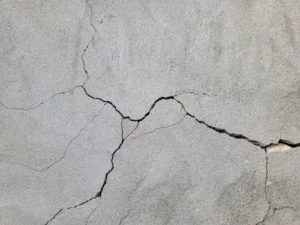
C157 measures shrinkage with nothing holding the specimen back. Real concrete is restrained: by subgrade friction, by a footing, by reinforcement, by the structure it was cast against. Restraint turns shrinkage into tensile stress, and tensile stress is what cracks concrete. Oregon DOT’s shrinkage study found exactly the gap you would expect — the mixtures with the lowest free shrinkage did not necessarily show the lowest strains when the same mixtures were tested under restraint.
That is why the restrained ring test exists: ASTM C1581, or AASHTO T334, where a concrete annulus is cast around a steel ring and the stress it develops is tracked to the point of cracking. A free shrinkage prism answers “how much does this mixture want to move.” The ring answers “how hard does it push when it cannot.”
If a specification carries a C157 limit and nothing else, it has bought a mixture property, not a crack-free floor.
How the limit is actually written
The typical clause sets 500 microstrain (0.05 percent), and limits of 400 microstrain (0.04 percent) or lower are common where dimensional stability matters. Agencies that have studied the question propose their own numbers: Oregon DOT recommended 450 microstrain measured four weeks from the start of drying for high-performance bridge deck mixtures, and South Dakota DOT proposed a maximum of 285 microstrain (0.029 percent), noting openly that this is stricter than most of its peers.
Two things about the wording deserve attention before anyone signs.
The storage schedule is usually modified. Specifications commonly call for one week of water storage followed by three or four weeks of air storage, which departs from the schedule written into the standard. Oregon’s study used a two-week cure in part of its program. The curing period changes the answer, so a limit without its schedule attached is not a specification — it is a number.
Shrinkage limits are aimed at specific work. They appear where shrinkage or the cracking that follows it would impair function or shorten service life: floor slabs, bridge members, structural members that must hold dimension, and water-retaining or environmental structures. They do not belong on a sidewalk, and they add cost and lead time wherever they land.
What a mix can do about it, and what it cannot
Shrinkage is a paste phenomenon. Aggregate does not shrink appreciably; it occupies most of the volume and restrains the paste around it. Everything that follows comes from that one fact:
| Lever | Effect on drying shrinkage |
|---|---|
| More paste in the mixture | More shrinkage — the clearest relationship in the literature |
| Larger maximum aggregate size | Less paste for the same workability, so less shrinkage |
| Higher coarse aggregate content | Lower shrinkage, and cracking delayed under restraint |
| Water added on site to recover slump | More paste water, which works against the limit |
| Aggregate stiffness and source | Real influence, and it is a property of the pit, not of the plant |
So when a specifier asks for a low length-change number, the plant’s answer is a leaner, coarser, better-graded mixture — not an admixture bolted onto whatever was already in the file. That is mix design work with trial batches behind it, which is why the request has to arrive early. It is the same conversation as choosing a CSA A23.1 exposure class: the spec sets a target, and the proportions are where it is won or lost.
One honest limitation: because readings do not begin until the prisms come out of their moulds, C157 never sees the autogenous component. In low-water mixtures, that is a real part of total shrinkage, and your prism result will not contain it.
The practical catch: who runs this test
A shrinkage limit obliges somebody to maintain a lime-saturated curing tank, a humidity-controlled room, calibrated moulds with gauge studs and a comparator, and to keep specimens on a reading schedule for weeks. Kansas DOT, after implementing the method in its own central laboratory, concluded that the equipment and conditions involved mean the test realistically belongs to private laboratories rather than to contractors. South Dakota’s review of available capacity found only a small number of firms performing it for agency work at all.
Two consequences for anyone planning a Calgary pour:
- Lead time is not negotiable. The result arrives weeks after batching. A limit in the specification means qualification happens during design, not acceptance during construction.
- Nobody can check it in the field. Unlike slump, temperature or air, there is no version of this test that lives in the back of a truck. What the field can verify is that the delivered mixture matches the qualified one, which is a question for the batch ticket.
Where Alberta conditions come in
Drying shrinkage is driven by moisture leaving hardened concrete, and the rate depends on the air around it. Calgary’s air is dry for most of the year, a chinook can drop ambient humidity sharply in a few hours, and a heated building in February is drier still. Lab prisms sit at 50 percent relative humidity. A slab in a heated warehouse through a Calgary winter may spend weeks well below that, and it will keep shrinking longer than the test schedule suggests.
That does not change the specified limit. It changes what you do with the result: treat the number as a mixture ranking, and handle the structure’s response through detailing, restraint and reinforcement — which is a design matter, and where reinforcement choices belong in the conversation.
Where this page stops
This page is about the hardened-concrete length change test and the specification clause built on it. It is not about plastic shrinkage, which happens before the concrete sets and is governed by surface evaporation; it is not about thermal volume change in thick sections; and it is not about joint layout, which is a flatwork detailing subject with its own rules. Those are separate mechanisms with separate numbers, and mixing them is how a shrinkage argument goes sideways.
FAQ
Is 500 microstrain the same as 0.05 percent? Yes. Microstrain is length change per million units of length, so 500 microstrain is 0.05 percent of the gauge length. Specifications use both forms interchangeably.
Can my concrete supplier guarantee a shrinkage limit? A supplier can qualify a mixture against a limit using the standard test, which is what the specification is actually asking for. What cannot be guaranteed is that a restrained member built from it will not crack — that depends on restraint, detailing and curing.
Does ASTM C157 predict cracking? Not on its own. It measures unrestrained movement. Cracking risk under restraint is assessed with a ring test such as ASTM C1581 or AASHTO T334.
Why does the spec schedule differ from the standard? Because agencies modify the water-storage and air-storage durations to suit their own concrete and their own experience. Always read the schedule attached to the limit.
Will a lower-shrinkage mixture cost more? Usually yes, in design time and in proportioning. Lower shrinkage generally means less paste and more carefully graded aggregate, plus trial batching to prove the result.
Specifying a mixture to a shrinkage limit
If a length-change clause has turned up in your specification, the time to deal with it is before the mix submittal, not after the first pour. Our custom mixed concrete work starts with the spec clause and the schedule attached to it, and we will tell you plainly what the proportions have to give up to meet the number — and when a limit is doing nothing for the structure it was written for.
Send us the specification section and the pour dates, and we will work back from there.
Sources
- NRMCA, TIP 17 — Drying Shrinkage of Concrete: https://www.nrmca.org/wp-content/uploads/2020/04/TIP17w.pdf
- Oregon Department of Transportation, SPR 728 — Development of Shrinkage Limits and Testing Protocols: https://www.oregon.gov/ODOT/Programs/ResearchDocuments/SPR728_ShrinkageLimits-Final.pdf
- Kansas Department of Transportation, Implementation of ASTM C157: Testing of Length Change of Hardened Concrete: https://rosap.ntl.bts.gov/view/dot/37035/dot_37035_DS1.pdf
- South Dakota Department of Transportation, SD2018-04 — final report on shrinkage testing and limits: https://rosap.ntl.bts.gov/view/dot/72480/dot_72480_DS1.pdf