
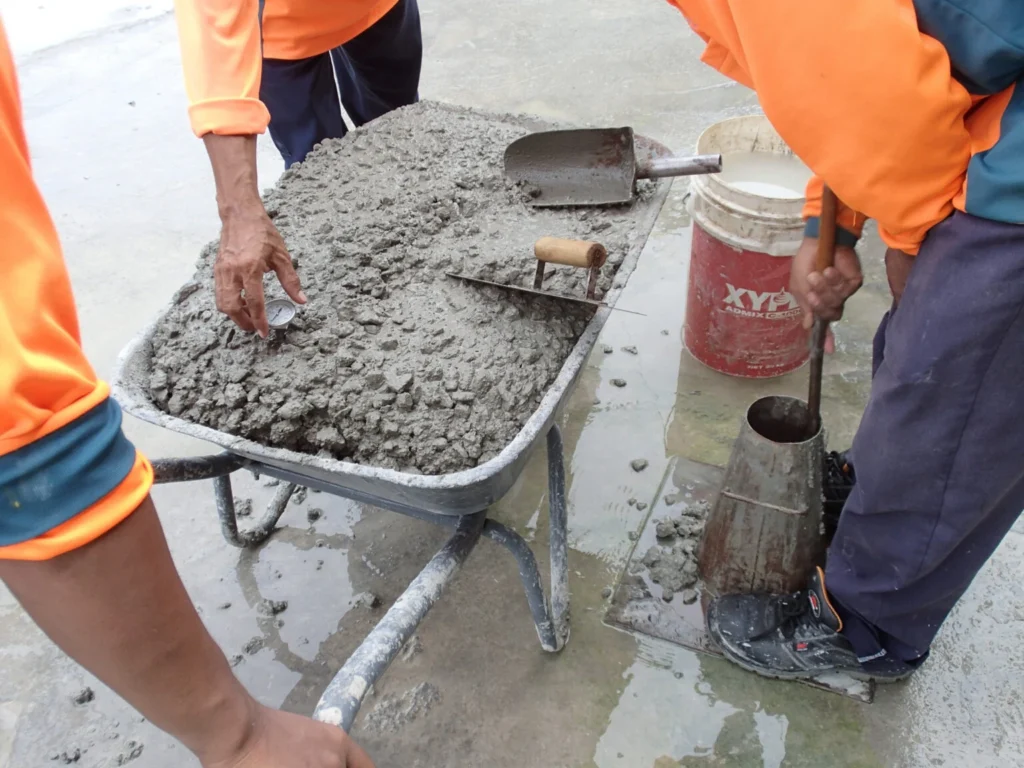
A test result is only as good as the scoop it came from. That sounds obvious until you watch someone fill a wheelbarrow from the first half metre of discharge, walk it twenty metres across a windy slab in March, and then wonder why the slump came back low on a mix that batched correctly.
Sampling has its own standard for a reason. In Canada the method is CSA A23.2-1C, Sampling plastic concrete; the ASTM equivalent, referenced by most field certification programs, is ASTM C172, Standard Practice for Sampling Freshly Mixed Concrete. Neither is long. Both are specific. And a sample taken outside their requirements does not describe the concrete you bought.
The short answer
Take a composite sample made up of two or more portions, collected at regularly spaced intervals from the middle portion of the load. Never sample the very first or very last of the discharge. Finish assembling that composite within 15 minutes. Remix it with a shovel, start the slump, air and temperature tests within 5 minutes of the last portion, and begin moulding strength specimens within 15 minutes. Keep at least 0.03 m³ (28 L, or one cubic foot) if strength specimens are being made.
Miss any of those and the number on the sheet belongs to the sample, not to the pour.
The three rules that decide whether a test is valid
| Rule | What the standard requires | What goes wrong on site |
|---|---|---|
| Where | Two or more portions at regularly spaced intervals, from the middle portion of the load; divert the full discharge stream into the container | A single scoop out of the leading edge of the chute |
| When | Composite assembled within 15 minutes; slump, air and temperature started within 5 minutes; strength specimens started within 15 minutes | The technician arrives, takes the sample, then goes to find a flat spot and a water source |
| How much | 1.5 times the volume needed for the specified tests, and never less than 0.03 m³ when strength specimens are involved | A sample too small to remix properly, so the second cylinder is not the same concrete as the first |
Why the first and last of the discharge are excluded
Both standards say the same thing in slightly different words. The WAQTC field procedure for sampling freshly mixed concrete puts it directly: use every precaution to obtain samples representative of the true nature and condition of the concrete being placed, “being careful not to obtain samples from the very first or very last portions of the batch.”
The physical reason is simple. The leading edge of the discharge has been in contact with the drum walls and the chute, and in a truck that was washed down it may carry extra moisture. The tail of the load has had the longest contact with the blades and the most opportunity to separate. Neither end is the mix. The middle is.
The National Ready Mixed Concrete Association puts the field technique the same way: do not sample from the first and last portions of discharge, and for truck mixers, divert the complete discharge stream into the sample container rather than catching part of it. A partial stream from the side of a chute is a sorted sample — coarse aggregate rides the outside, mortar runs the middle — and a sorted sample will give you an air content and a slump that nobody batched. This is also why a composite of two or more portions matters: one portion describes one instant of discharge, while several spaced across the middle describe the load.
The clock starts when the sample does
The time limits in the standard are the part most often broken, and they are broken with the best intentions: someone takes the sample first, then looks for somewhere to work.
The sequence the standard assumes is the reverse. The cone, the base plate, the rod, the air meter, the thermometer, the moulds and the strike-off are already set up and already shaded before the truck is signalled to discharge. Then:
- Portions are collected and the composite is completed within 15 minutes from the first portion
- The composite is combined and remixed with a shovel, the minimum amount necessary to ensure uniformity
- Temperature is completed and the slump and air content tests are started within 5 minutes of obtaining the sample
- Moulding of strength specimens is started within 15 minutes of assembling the composite
Three independent sources state the 15-minute and 5-minute figures — the WAQTC procedure, NICET’s performance checklist for the AASHTO sampling practice, and NRMCA’s field guidance — so there is no ambiguity to argue about on site.
The remix clause deserves a note of its own. “The minimum amount necessary” is a real instruction, not a hedge. Over-working a composite in a wheelbarrow drives out entrained air, and the air content you then measure is the air content you destroyed.
How much concrete you actually need
The volume rule is written as a multiplier, not a fixed number: the sample is 1.5 times the volume required for the specified testing, and in no case less than 0.03 m³ (one cubic foot) where strength specimens are being made. Smaller samples are permitted for a routine slump, air content or temperature check. The multiplier exists so there is enough material to remix and still fill everything.
What Alberta’s own specification asks for
Alberta Transportation’s Specification 5.5, Supply of Portland Cement Concrete is a useful reference point because it tells you which test methods the province works to and how often it expects them run. It cites CSA A23.2-1C for sampling concrete, together with CSA A23.2-5C for slump, A23.2-4C for entrained air, A23.2-3C for making and curing strength specimens, A23.2-9C for compressive strength and A23.2-17C for temperature.
On frequency, the specification sets a minimum of one per day for sampling, slump, entrained air, temperature and the making of strength specimens, and for larger placements it provides that a strength test will be taken on approximately each 30 m³ portion of the pour.
It also sets out what a strength test is, which is where many disputes start. Under that specification, a compressive strength test consists of four standard specimens: one is tested early as an indicator, and the acceptance result is the average of the remaining three at the specified age. One low cylinder out of four is not a failed test. It is one cylinder.
The split of responsibility is worth reading as well. The specification puts quality control testing on the contractor — who determines the type and frequency, and provides and pays for the equipment — while the Consultant takes samples and carries out quality assurance testing and inspection. Two sets of numbers, two purposes. Confusing them is how a QC slump check ends up being argued as an acceptance result.
Sampling from a volumetric mixer
“The middle portion of the load” is a drum-truck instruction. On a volumetric mixer the concrete is proportioned and mixed continuously as it discharges, so there is no leading slug that sat against the drum wall and no tail that has been riding the blades for half an hour.
What carries over is the principle rather than the wording: the sample still has to be representative of what is going into the forms, it still has to be a composite of portions taken across the discharge rather than a single scoop, and the same time limits still apply. Where the mix is being adjusted on site — the point of ordering custom mixed concrete — sample after the adjustment has been running long enough to be in the stream, not during the change.
Sampling from a pile or behind a paver
Where concrete is discharged onto grade before placement, the field procedure changes shape. The WAQTC method directs the technician to obtain material from at least five different locations in the pile and combine it into one test sample, while avoiding contamination with subgrade material or prolonged contact with an absorptive subgrade. That second warning matters on dry Alberta subgrade in summer: a sample sitting on thirsty gravel loses water to the ground and reads stiffer than the concrete placed a metre away.
Alberta weather, and the walk between the chute and the cone
Every sampling standard contains an instruction to protect the sample: shield it from direct sunlight, wind, rain and sources of contamination, and from rapid evaporation.
In Calgary that is not boilerplate. On a chinook afternoon with low humidity and a steady wind, an unshielded composite in an open wheelbarrow is losing surface water the entire time the technician is walking it to the test station — and every minute of that loss shows up as a lower slump than the load actually had. In hot mix concrete placed through July and August, the same wind plus a warmer sample accelerates stiffening inside the 5-minute window, which is exactly the window the standard is trying to protect.
In the cold months the error runs the other way. A composite left on frozen ground loses temperature fast, and a temperature reading taken late is not the temperature of the concrete going into the forms. The practical fix is unglamorous: set the test station where the truck can reach it, keep the sample covered, and do not use a sampling trip as an excuse to walk anywhere.
Who is allowed to take the sample
Sampling is a test method, and test methods are performed by certified technicians. NRMCA points to the requirements of ASTM C1077 for testing agencies: technicians maintain current certification for the tests they perform in the field and in the laboratory, and are trained and evaluated on performance of the test methods at least annually.
That annual re-evaluation is the quiet reason low-break investigations so often start with the sampling and the curing rather than with the mix. NRMCA’s guidance on investigating low strength results begins by verifying that sampling, moulding, standard curing and testing were carried out in accordance with the standards — before anyone opens the batch records.
Where this page stops
This page is about getting the sample. It does not cover the slump test procedure itself, which our guide to concrete slump tests walks through step by step. It does not cover choosing the specification in the first place — that is the job of the CSA A23.1 exposure classes. It does not cover reading the delivery documentation, which we handle in the numbers on your concrete batch ticket, or the decision to turn a load away, which belongs to the reasons to reject a concrete truck.
It also does not cover mixer condition, batching accuracy, or what to do with a strength result that comes back below specification. Those are separate questions with separate standards behind them.
FAQ
Can the test be taken from the first concrete out of the chute? No. Both the Canadian and ASTM practices exclude the very first and very last portions of the discharge. The sample comes from the middle portion of the load.
How many portions make a composite sample? Two or more, taken at regularly spaced intervals, combined and remixed with a shovel.
How long do I have before the sample is no longer valid? Complete the composite within 15 minutes of the first portion. Start slump, air and temperature within 5 minutes of the last portion, and start moulding strength specimens within 15 minutes.
How much concrete do I need for a full set of field tests? One and a half times the volume the specified tests require, and never less than 0.03 m³ — one cubic foot — when strength specimens are being made.
How often does concrete have to be sampled? That is set by the project specification. Alberta Transportation’s supply specification uses a minimum of one per day, with a strength test on approximately each 30 m³ portion of a larger pour.
Which sampling standard applies in Alberta? Alberta Transportation’s specification for supply of Portland cement concrete cites CSA A23.2-1C for sampling concrete. ASTM C172 is the closely equivalent practice and is the one most field certifications are written against.
Does a sample taken incorrectly have to be thrown out? It should be. A sample that breaks the location, timing or volume requirements is not a sample of the concrete in the forms, and defending a result taken that way is harder than taking a second one properly.
Sources
- Alberta Transportation, Specification 5.5 — Supply of Portland Cement Concrete: https://www.transportation.alberta.ca/Content/docType29/Production/5_5%20Supply%20of%20PCC.pdf
- NICET performance examination checklist, AASHTO R 60 (Sampling Freshly Mixed Concrete): https://www.nicet.org/nicetorg/assets/file/public/performance_examination_checklists/concrete/aashto_r_60-12.pdf
- Alaska DOT and PF Test Methods Manual, WAQTC FOP / ATM 501 Sampling Freshly Mixed Concrete: https://dot.alaska.gov/stwddes/desmaterials/mat_waqtc/assets/pdf/testman/2020/series_500.pdf
- National Ready Mixed Concrete Association, Frequently Asked Questions on Concrete Materials: https://www.nrmca.org/association-resources/research-and-engineering/frequently-asked-questions-on-concrete-materials/