
A compressive strength failure is an argument about one number from one truck. A flexural strength failure is an argument about the test itself. That is the difference nobody warns a specifier about, and it arrives the first time a job writes a modulus of rupture requirement into the acceptance clause and then tries to enforce it on a Calgary jobsite in October.
Flexural strength is a legitimate, well-defined property. It is also the single most testing-sensitive strength measurement in common use, and both the North American ready mixed concrete industry and the Canadian industry associations say so in writing. Specifying it is a decision with consequences that run all the way through sampling, curing, transport of the specimens, and who pays when a beam breaks low.
This is what the beam test measures, what the method you name does to the number, where the 10 to 15 percent rule of thumb comes from, and what Alberta agency work actually accepts.
What the beam test measures is tension, measured the hard way
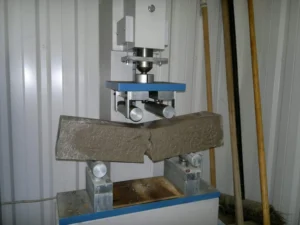
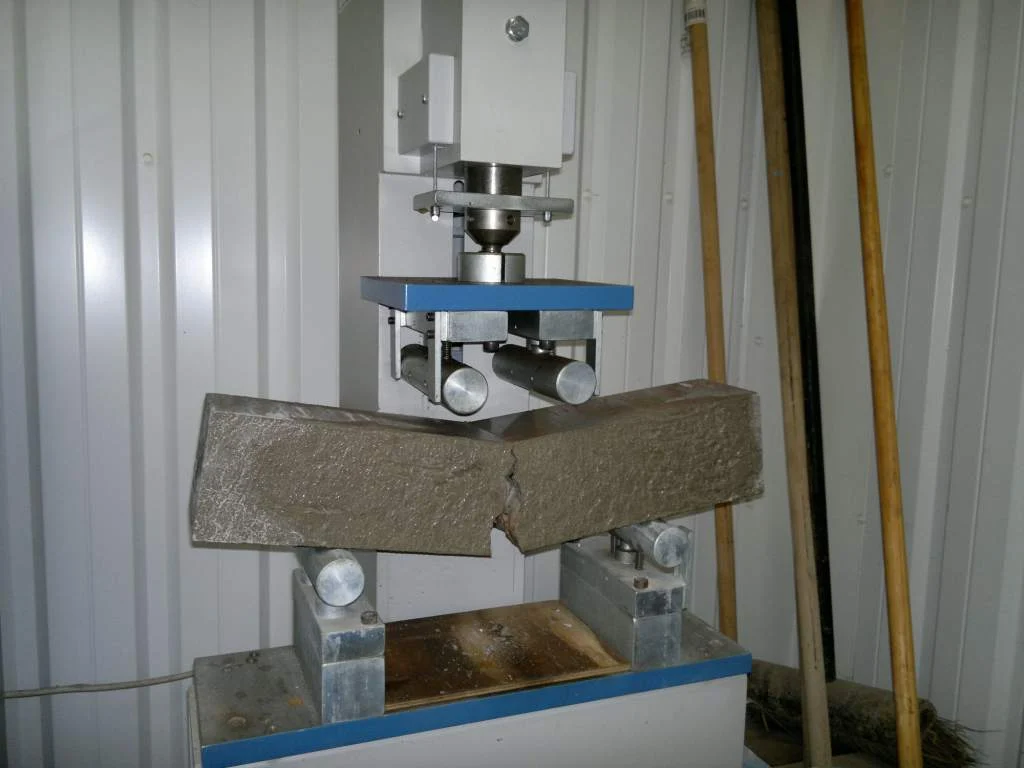
Concrete is strong in compression and weak in tension, and the tensile value is the one that governs an unreinforced slab or pavement carrying wheel loads. You cannot pull a concrete specimen apart cleanly in a lab, so the industry measures tension indirectly, by bending a beam until the tension face fails.
NRMCA puts it plainly: “Flexural strength is an indirect measure of the tensile strength of concrete. It is a measure of the maximum stress on the tension face of an unreinforced concrete beam or slab at the point of failure in bending.” The result is reported as modulus of rupture, MR, and expressed in MPa.
That is why rigid pavement design keys on it. Transport Canada’s advisory circular on airside pavement bearing strength describes a rigid pavement as a “rigid pavement structure that depends on the tensile beam strength of a Portland cement concrete slab for the support of traffic loads.” If your slab’s job is to span local soft spots in the subgrade rather than bear on it uniformly, the bending capacity of the slab is the design property, not its crushing capacity.
The method the spec names changes the number before anyone mixes anything
Two loading arrangements are in use, and they do not produce the same answer.
| Method | Loading | Effect on the reported number |
|---|---|---|
| ASTM C78 / CSA A23.2-8C | Third-point loading | The reference method in Canadian practice; produces the lower result |
| ASTM C293 | Center-point loading | Produces a higher result, roughly 15 percent above third-point loading |
Concrete Saskatchewan names “CSA A23.2-8C (third-point loading)” as the standard for measuring flexural strength, and NRMCA names the two ASTM alternatives, “ASTM C78 (third-point loading) or ASTM C293 (center-point loading),” noting that third-point loading typically reads about 15 percent lower.
Fifteen percent is larger than the margin most specifications are written with. A clause that says “minimum 4.0 MPa flexural strength” without naming the method is not a specification, it is a future dispute. Name the method in the same sentence as the value.
The specimen rules decide whether the result means anything
Beam size is not a detail. Both references agree on the standard and both flag that size matters.
- Standard specimen. “150mm x 150-mm concrete beams” with the span length at least three times the depth, in Concrete Saskatchewan’s wording. NRMCA gives the same as “6 x 6-inch (150 x 150-mm)” with the same span-to-depth rule.
- Smaller specimens are recognized, and they read differently. Concrete Saskatchewan permits beams “of cross-section of not less than 75mm x 75mm” as a standard size. NRMCA notes that 100 x 100-mm specimens are also recognized, and that larger specimens produce lower measured strengths.
So a job that switches beam size partway through a pour sequence has changed its own acceptance criterion without anyone writing a change. If beams are being cast, fix the size at the pre-construction meeting and keep it fixed. The sampling discipline behind the specimen matters just as much — a beam cast from an unrepresentative sample fails for reasons that have nothing to do with the mix, which is the same problem we work through in how to sample fresh concrete under ASTM C172 and CSA A23.2-1C.
A short period of drying will cost you the result
This is the sentence that should decide whether a Calgary project specifies flexural acceptance at all.
NRMCA: “Flexural tests are extremely sensitive to specimen preparation, handling, and curing procedures,” and “A short period of drying can produce a sharp drop in flexural strength.” Concrete Saskatchewan carries the same warning and adds the requirement that follows from it: specimens “must be cured in a standard manner and tested while moist.”
Think about what that means between October and April here. A beam is a heavy, awkward specimen. It gets cast on a deck, moved across a site, loaded into a vehicle, driven to a lab, and set up in a testing frame. Every one of those steps is an opportunity for the tension face to dry out or to take a knock, and the tension face is the only part of the specimen the test is actually measuring. A cylinder is far more forgiving of the same treatment.
The failure mode here is specific and worth naming: the beam reads low, the concrete is fine, and the testing agency, the supplier and the contractor spend two weeks establishing that nothing was wrong with the mix.
Flexural strength is about 10 to 15 percent of compressive strength, and that is a correlation, not a conversion
Both sources state the same range in nearly identical words. NRMCA: flexural strength is “about 10 to 15 percent of compressive strength depending on the mixture proportions and type, size and volume of coarse aggregate used.” Concrete Saskatchewan: “Flexural strength is about 10 to 15 percent of compressive strength, depending on the mixture proportions and type, size and volume of coarse aggregate used.”
Read the qualifier carefully, because it is where the money is. The ratio moves with coarse aggregate type, size and volume. Two mixes at the same compressive strength, batched with different aggregate, will not land at the same modulus of rupture. That is precisely why the relationship cannot be used as a conversion factor in an acceptance clause — you cannot take a cylinder break, multiply by 0.12, and declare the flexural requirement met.
What you can do is establish the correlation deliberately. NRMCA’s own guidance points at this route: “Where a correlation between flexural and compressive strength has been established in the laboratory, core strengths by ASTM C 42 can be used for compressive strength to check against the desired value.” Establish the relationship for the specific mix, with the specific aggregate, in the laboratory, and then run the job on compressive testing against the correlated value. It is the practical answer for almost every slab-on-ground project in this city.
That correlation work lives in the mix submittal stage, alongside the over-design the plant has to carry anyway — see required average compressive strength and why the plant proportions stronger than your spec.
What Alberta agency work actually accepts
The most useful evidence is what the agencies that could specify flexural strength actually do.
Alberta Transportation’s Supplemental Specification 5.5 for the supply of Portland cement concrete does not require flexural or modulus of rupture testing at all. It accepts on compressive strength: “Compressive Strength CSA-A23.2-9C Minimum of one per day,” with the detail that “A compressive strength test will consist of four standard test specimens. One cylinder will be tested at seven days. The 28 day test result will be the average of the remaining three specimens,” and acceptance keyed to 28-day minimums ranging from 20 to 35 MPa depending on the concrete class.
That is a provincial pavement and structures authority choosing cylinders for acceptance. If flexural acceptance were practical at scale in Alberta conditions, that is where you would expect to find it.
The recognized exception is airfield work. Concrete Saskatchewan states the general position and the carve-out together: “Flexural strength tests are useful in research and laboratory evaluation of mixtures, but the sensitivity to testing variations does not lend itself to be used as a basis for acceptance or rejection of concrete in the field,” except for airfield pavements, where it is commonly used for jobsite acceptance. NRMCA goes further, stating that “flexural strength testing is not used for structural concrete” and recommending compressive testing for jobsite acceptance instead.
What to write on the purchase order
If flexural strength is genuinely the design property on your project, the order has to carry enough information for the plant to proportion for it and for the testing agency to produce defensible numbers.
- The flexural value and the method in one line. For example, a stated MR in MPa at 28 days, by CSA A23.2-8C third-point loading. Never a bare number.
- Whether flexural is for acceptance or for information. State it. If it is for information and compressive governs acceptance, say so in the contract documents, not in a meeting.
- The correlated compressive value. The laboratory-established compressive strength that corresponds to the required MR for this specific mix.
- Beam size, fixed. 150 x 150 mm unless there is a reason to deviate, with the span-to-depth rule stated.
- Curing and transport protocol for beams. Who casts them, where they are stored on site, how fast they move, and the requirement that they are tested moist.
- Aggregate constraints. Because the flexural-to-compressive ratio depends on aggregate type, size and volume, a mid-job aggregate substitution is a change to the strength relationship, not just a supply change.
Those lines belong on the ticket and in the submittal, and they should match. The delivery record is the other half of the evidence package when a result is questioned, which is why it pays to know the numbers on your concrete batch ticket.
FAQ
Can I just convert my compressive strength result to a flexural value? No. The 10 to 15 percent relationship is a general range that shifts with coarse aggregate type, size and volume. A correlation established in the laboratory for your specific mix can be used; an assumed ratio cannot.
My beam broke below the specified MR. Is the concrete rejected? Not on that basis alone. Both NRMCA and Concrete Saskatchewan state that flexural testing is too sensitive to testing variation to serve as a basis for acceptance or rejection in the field, outside airfield pavement practice. Investigate specimen handling, curing and moisture condition before anything else — the same investigate-first approach that applies to a low concrete cylinder break under the Canadian standard.
Does fibre reinforcement raise flexural strength? Fibre affects post-crack behaviour, which is measured by different test methods than plain modulus of rupture. A flexural spec written for plain concrete does not automatically describe what a fibre-reinforced mix delivers, and the two should not be compared without agreeing on the test method first.
Why does my spec call for both flexural and compressive strength? Usually because the structural design used MR and the acceptance regime uses cylinders. That is a workable arrangement, provided the documents say which one governs acceptance.
Is flexural testing worth it on a Calgary slab-on-ground? In most cases, no. Establish the correlation in the laboratory, specify compressive strength for acceptance, and keep the beams for mix development.
Get the mix proportioned for the property your design actually uses
If your drawings carry a modulus of rupture requirement, the plant needs to know that before the mix is submitted, not on pour day. Aggregate selection and proportioning for flexural performance are decisions made upstream.
Send us your project details — pour date, mix type, PSI, volume — and our team will get back to you within 1 business hour with a quote and delivery slot. You can also see how custom mixed concrete in Calgary is proportioned to a submitted spec, or read how our volumetric mixers work when a job needs the mix adjusted at the pour.
Sources
- National Ready Mixed Concrete Association, CIP 16 — Flexural Strength of Concrete — https://www.nrmca.org/wp-content/uploads/2021/01/16pr.pdf
- Concrete Saskatchewan, Tech Tip 16 — Flexural Strength of Concrete — https://concretesask.org/images/techtips/Tech%20Tip%2016%20-%20Flexural%20Strength%20of%20Concrete.pdf
- Alberta Transportation, Supplemental Specification 5.5 — Supply of Portland Cement Concrete — https://www.transportation.alberta.ca/Content/docType29/Production/5_5%20Supply%20of%20PCC.pdf
- Transport Canada, Advisory Circular AC 302-011 — Airside Pavement Bearing Strength — https://tc.canada.ca/en/aviation/reference-centre/advisory-circulars/advisory-circular-ac-no-302-011