
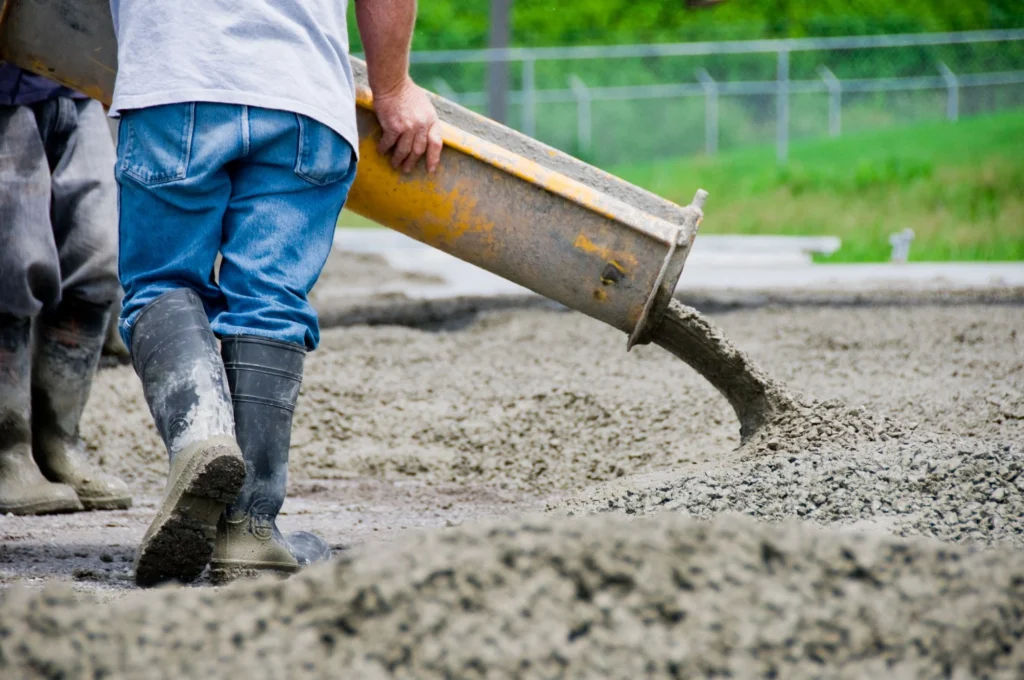
Wet concrete does not irritate skin — it dissolves it, slowly, and usually without pain while it is happening. That single sentence is the whole reason cement burns keep putting Alberta finishers in hospital. A thermal burn announces itself. An acid burn announces itself. A strong alkali does neither: it saponifies the fats in skin and keeps moving inward, and the worker often feels nothing for hours. By the time it hurts, the damage is deep.
This page sets out the chemistry, the published numbers, the first-aid protocol, the PPE that survives contact with fresh concrete, and the washing facilities the Alberta OHS Code requires where a harmful substance is in play. It is written for the person at the chute, not for a binder.
The chemistry in one paragraph
When portland cement hydrates, one of the products is calcium hydroxide, Ca(OH)₂ — a strong base. Its saturated solution is so reliably alkaline that the U.S. National Institute of Standards and Technology adopted it as a pH standard: about 0.0203 M, with a pH of 12.45 at 25 °C. That is the pore water sitting against the skin inside a boot.
For scale on what that means legally rather than chemically: Environment and Climate Change Canada’s risk evaluation for calcium hydroxide treats solutions at a pH of 11.5 or higher as meeting the criteria for a corrosive substance. Fresh concrete’s pore solution sits above that threshold.
So the correct mental model is not “dusty, slightly caustic building material.” It is “a corrosive alkaline solution carried in an abrasive slurry.”
Why the burn is late, painless, and worse than it looks
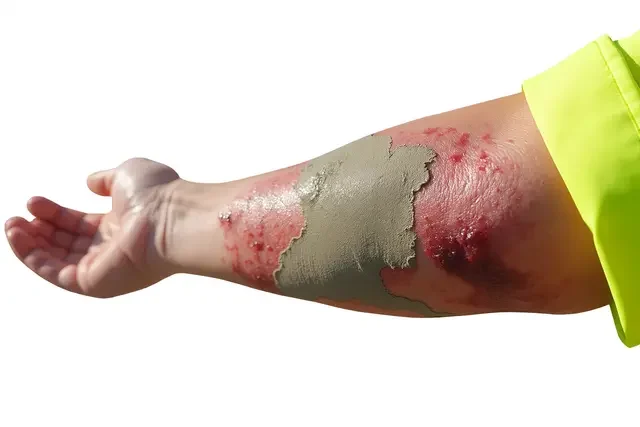
Three properties combine badly here.
Alkalis go deep. Alberta Health Services puts it plainly in its guidance on alkali burns: alkaline chemicals are able to penetrate and damage the deeper layers of tissue. An acid tends to coagulate protein at the surface and form its own barrier. A base does not — it keeps advancing as long as it is in contact.
There is no early pain signal. IHSA’s cement safety talk states it directly: the burns caused by cement may be slow, and you may not feel anything until several hours later. So workers do not self-rescue. Nobody takes a boot off because nothing hurts yet.
Contact time matters most. Severity depends on the chemical, its strength, and how long it stays on the skin. Of those three, the only one a crew controls in the moment is contact time — which is why the first-aid protocol is about removal and flushing, not neutralising.
A NIOSH injury investigation makes the point better than any diagram. A 24-year-old concrete finisher was pouring while wearing regular construction boots rather than liquid-proof footwear. Cement soaked through the boots and spread past his gloves at both wrists. He sustained second-degree burns to both feet and ankles, and both wrists above the glove line, was hospitalised for a week, and was off work for over a month. Nothing exotic happened. He wore the wrong boots on an ordinary pour.
The second hazard: allergic cement dermatitis
Burns are the acute problem; the chronic one is sensitisation. IHSA notes that cement usually contains hexavalent chromium, and that this metal causes allergic dermatitis.
The distinction matters because the two behave differently on a crew. Irritant contact dermatitis from repeated wet-concrete exposure improves when exposure stops. Allergic contact dermatitis to hexavalent chromium, once established, can be triggered by very small subsequent exposures — and it can end a finishing career. A worker who has developed it cannot simply “be more careful.”
That is the argument for treating routine, low-level contact as a real exposure rather than as part of the job. The finisher whose forearms are grey by 10:00 every morning is not burning today. He is accumulating.
First aid: the numbers, and the two sources that differ
Flush times are where published Canadian guidance is not unanimous, so here is each figure with its source.
Skin — Alberta Health Services (MyHealth Alberta), alkali burns:
- Rinse immediately with cool water, then flush the area for at least 20 minutes.
- If burning persists, flush again with flowing water for 10 to 15 minutes.
- Do not use a hard spray of water — it can damage the burned area.
- Call Poison Control when a chemical burn occurs.
Eyes — IHSA cement safety talk:
- Rinse with cold tap water for at least 15 minutes.
Skin, IHSA’s shorter version: wash with cold running water as soon as possible, flush out any open cuts, and get medical attention if the skin still feels like it is burning.
Read together: 15 minutes is the eye figure, 20 minutes is the skin figure from the Alberta health authority, and the instruction to keep flushing while burning continues is common to both. If your first-aid sheet says “rinse well,” it is not a protocol.
Two points follow from the chemistry rather than from a guideline. First, remove the contaminated clothing and footwear — a boot with slurry in it is a reservoir holding pH 12.45 solution against skin, and flushing around it accomplishes nothing. Second, do not try to neutralise with vinegar or any acid. The NIOSH recommendation to employers is plenty of clean running water, pH-neutral soap to help counter the caustic effect, and clean towels. Water and a neutral cleanser, in volume, for a long time.
PPE that actually survives fresh concrete
The NIOSH recommendations and IHSA’s guidance converge on the same short list, and every item on it exists because of a specific failure mode.
| Item | The failure it prevents |
|---|---|
| Forearm-length, snug-fitting alkali-resistant gloves | Slurry running down the wrist and pooling above the glove cuff — exactly the mechanism in the NIOSH case |
| Liquid-proof boots, high enough that concrete cannot enter | Slurry soaking through leather work boots and being held against the foot for hours |
| Long-sleeved shirt with sleeves pulled over gloves, taped at the wrist | The wrist gap, again |
| Full-length pants tucked inside boots, with the boot top taped | The boot gap |
| N95, R95 or P95 respirator when mixing or pouring dry cement | Inhalation of dry cement dust during batching and bag work |
| Eye protection for all mixing, pouring and dry-cement work | Splash into the eye, where the flush requirement is 15 minutes |
Note what is not on the list: ordinary leather gloves and ordinary work boots. Both are permeable to cement slurry and both hold it in place once wet. It is the most common gap on small pours.
The requirement most sites miss: washing facilities
You cannot flush for twenty minutes from a water bottle.
The Alberta OHS Code addresses this in two places, and the second gets overlooked:
- Part 24, sections 359 to 361 — hand cleaning facilities at or near work stations, with soap, clean towels and a waste receptacle, maintained in sanitary condition and in good repair.
- Part 4, section 24 — emergency baths, showers and eye wash equipment, required where a potential for worker exposure to a harmful substance exists.
Fresh concrete is a corrosive alkaline material. The practical consequence for a Calgary pour is that adequate clean water for prolonged flushing is a planned site resource, decided before the truck arrives — not something improvised from a cooler. On a serviced urban site that is straightforward. On an acreage or a rural footing pour, it is a line on the plan.
Our broader guide to concrete work safety procedures covers site-wide planning, PPE selection and equipment operation. This page goes deeper on one hazard: what the material does to skin, and the protocol that follows.
Why winter is the worst season for this in Alberta
Cold weather changes the exposure profile in three ways, and none of them is obvious.
More layers, more reservoirs. Winter clothing means cuffs, bunched sleeves, insulated boots and coveralls — more places for slurry to lodge and stay. An insulated boot holds more liquid and dries slower.
Less sensation, later discovery. Cold hands and feet report less, so the already-weak warning signal gets weaker. A worker who would have noticed dampness in July notices nothing in January.
Warmer concrete, faster reaction. Winter placement in Calgary routinely means hot mix concrete — heated water and heated aggregate to hold the mix within temperature at discharge. Warmer material against skin accelerates the reaction that produces the burn, and it also means the worker is less likely to register the contact as wrong, because warmth on a cold day feels like relief.
Put together: the pour where a finisher is most likely to take a serious cement burn in Alberta is a cold-weather pour with heated concrete, long cuffs, and nothing hurting. The practices in our Calgary cold weather pour guide are written around concrete quality; the skin-exposure consequences above are the other half of the same shift.
What the delivery paperwork has to do with it
If your site keeps safety data sheets for every other chemical on the job and none for the largest volume of corrosive material delivered all week, that is a documentation gap worth closing. The SDS for a cement-based product is where the hazard classification, the first-aid section and the exposure controls live, and it is the document a first-aid attendant will want.
The ticket itself carries the mix identity, water added, and the times that tie a load to a place on the job. Our breakdown of the numbers on a concrete batch ticket explains what each field is for; here, the ticket is simply the record of what material was on site when.
Where this page stops
This page is about wet concrete in contact with skin and eyes: the alkaline chemistry, the delayed burn, flushing protocol, sensitisation, PPE and washing facilities. It is not about respirable dust from cutting, grinding or breaking hardened concrete, which is a different hazard with a different control hierarchy. It is not about where washout water may legally be discharged, and not about mix design, strength acceptance or placement temperature limits — all covered elsewhere on this site. And it is not medical advice: a burn that is blistering, deep, large, or still painful after flushing needs a clinician, not a guide.
Ordering concrete for a crew that will be standing in it
Volumetric delivery changes the exposure picture in a small but real way: you take the concrete you need, when you need it, which means fewer rushed placements and less slurry sitting in a chute or a wheelbarrow while a crew catches up. To talk through volume, staging and discharge, see how our volumetric mixers work or send us the scope and we will walk the sequence with you.
FAQ
What is the pH of wet concrete? Its pore solution is calcium hydroxide. NIST established the saturated solution as a pH standard at 12.45 at 25 °C, and Environment and Climate Change Canada treats such solutions at pH 11.5 or higher as corrosive.
Why didn’t it hurt when it happened? Alkaline burns are slow. IHSA states that cement burns may be slow and that you may not feel anything until several hours later, while the alkali keeps penetrating deeper tissue.
How long should I flush a cement burn? Alberta Health Services guidance for alkali burns is to rinse immediately with cool water and then flush for at least 20 minutes, flushing again for 10 to 15 minutes if burning persists, without using a hard spray. For eyes, IHSA specifies at least 15 minutes of cold tap water.
Should I neutralise it with vinegar? No. Use large volumes of clean water and a pH-neutral soap. Never apply an acid to an alkali burn on skin.
What gloves and boots do I need? Forearm-length, snug-fitting alkali-resistant gloves and liquid-proof boots tall enough that concrete cannot get in, with sleeves pulled over gloves and pants tucked and taped at the boot. Ordinary leather gloves and standard work boots both absorb slurry and hold it against skin.
Do we need emergency washing equipment on a concrete site? The Alberta OHS Code requires hand cleaning facilities with soap, clean towels and a waste receptacle under Part 24, sections 359 to 361, and emergency baths, showers and eye wash equipment under Part 4, section 24 where a potential for exposure to a harmful substance exists.
What is cement dermatitis? Two things. Irritant dermatitis from repeated wet contact, which improves when exposure stops; and allergic contact dermatitis caused by hexavalent chromium in cement, which can persist and be re-triggered by small exposures.
Sources
- NIST, Journal of Research — calcium hydroxide as a highly alkaline pH standard — https://nvlpubs.nist.gov/nistpubs/jres/56/jresv56n6p305_A1b.pdf
- MyHealth Alberta (Alberta Health Services), Alkali Burns — https://myhealth.alberta.ca/Health/pages/conditions.aspx?hwid=not38390
- IHSA, Safety Talk 133 — Cement — https://www.ihsa.ca/pdfs/safety_talks/cement.pdf
- NIOSH / CDC, Worker Severely Burned by Wet Concrete — https://stacks.cdc.gov/view/cdc/228684