
Under CSA A23.1, cold-weather practice begins when the air is at or below 5 °C, or is forecast to fall below 5 °C within 24 hours of placing. The standard then sets a minimum concrete temperature at placement by section thickness: CSA A23.1:24 Table 14 requires at least 10 °C for sections under 1 m thick, the range almost every residential footing, foundation wall, slab, and ICF wall falls in.
The placed concrete must be held at a minimum of 10 °C through curing and reach at least 7 MPa before it can resist early frost damage. A drum-mix load batched at the plant loses heat on the drive; a volumetric truck batches on site and can heat the mix water to bring the concrete up to the required discharge temperature right at the chute, so a long, cold Calgary haul doesn’t drop the load below the placement minimum.
(Sources: CSA A23.1:24 Table 14, as reproduced by the RMCAO; Concrete Alberta.)
This article is about temperature: hitting the placement minimum on a cold day. For the related distance problem (the two-hour clock on a long haul), see Pouring concrete where there’s no batch plant for miles; the two are siblings, one about time, one about heat.
Why cold concrete is a problem, not just an inconvenience
Concrete gains strength through hydration, the chemical reaction between cement and water. That reaction is temperature-sensitive, and the relationship is steep. Cement hydration slows sharply below about 10 °C and very nearly stops below about 4 °C. As a rule of thumb, a 10 °C drop in concrete temperature roughly doubles the setting time.
(Sources: Concrete Network; Powerblanket.)
That’s the slow failure. The fast failure is worse. If fresh concrete freezes before it has set, the mix water expands as it turns to ice, pushing the still-soft paste apart and causing internal cracking that never heals. Freezing of the pore water halts hydration and stalls the curing process. The concrete you pour at 8 a.m. on a cold morning can be permanently compromised by lunchtime if nothing protects it.
There’s a separate cold-weather durability question that runs alongside this: entrained air. The 5–7% air bubbles in a Calgary mix give already-hardened concrete somewhere to push freezing water, which is what lets it survive repeated freeze-thaw cycling over the years. That air-entrainment and freeze-thaw mechanism is the focus of Dr. Tyler Ley’s research at Oklahoma State University, a widely cited public educator on concrete for freezing climates.
(Source: Oklahoma State University.)
Air-entrainment protects the cured concrete over decades; discharge temperature protects the fresh concrete in its first hours. You need both.
The numbers CSA A23.1:24 actually sets
Most cold-weather concrete content online is American, written in Fahrenheit, and doesn’t cite the Canadian standard. Here are the real figures.
The 5 °C trigger
Cold-weather practice kicks in earlier than most people expect. Per CSA A23.1, cold weather is “when there is a probability of the air temperature falling below 5 °C within 24 h of placing (as forecast by the nearest official meteorological office).”
(Source: RMCAO, reproducing CSA A23.1:24; corroborated by Concrete Alberta.) Not freezing, 5 °C and falling. In Calgary, that’s a lot of the calendar.
Minimum placement temperature, by section thickness
This is the centrepiece. CSA A23.1:24 Table 14 sets both a minimum and maximum concrete temperature at placing, and the minimum tightens as the section gets thinner:
| Section thickness | Min placing temp | Max placing temp |
|---|---|---|
| < 0.3 m | 10 °C | 32 °C |
| ≥ 0.3 – < 1 m | 10 °C | 30 °C |
| ≥ 1 – < 2 m | 5 °C | 25 °C |
| ≥ 2 m | 5 °C | 20 °C |
(Source: CSA A23.1:24 Table 14, as reproduced by the Ready Mixed Concrete Association of Ontario, with CSA Group’s written permission.)
Read the top two rows again, because they cover almost everything a residential or light-commercial crew pours. Footings, foundation walls, slabs, and ICF walls are nearly all under 1 m thick, which puts them squarely in the 10 °C minimum band, the strictest placement floor in the table. Thin concrete loses heat fast and has the least thermal mass to ride out a cold spell, so the standard demands it arrives warmest.
The 7 MPa frost threshold
Concrete must reach a minimum strength of 7 MPa to withstand early frost damage effectively.
(Source: RMCAO, reproducing CSA A23.1:24.)
Below that strength, a freeze can still ruin it; at or above it, the concrete has enough integrity to take a frost without the expanding pore water tearing it apart. (Older references sometimes quote 8 MPa; the current CSA A23.1:24 figure, per RMCAO’s authorized reproduction, is 7 MPa.)
Holding the heat through curing
Hitting the placement temperature is step one. The concrete then has to stay warm enough to keep gaining strength. CSA A23.1:24 protection regimes, reproduced by RMCAO and matched by Concrete Alberta:
- Maintain the concrete at a minimum of 10 °C for the duration of the curing period.
- Basic curing: 3 days at ≥10 °C, or until the concrete reaches 40% of its specified strength.
- Additional curing: 7 days total at ≥10 °C, and until the concrete reaches 70% of its specified strength.
(Sources: RMCAO, reproducing CSA A23.1:24 Table 19; Concrete Alberta.) For typical residential foundations, Concrete Alberta allows the basic 3-day / 40% regime, after which the work can sit dormant until conditions improve.
Why a long cold haul is the enemy of discharge temperature
Now connect the standard to the truck. A drum-mix load is batched at the plant, sometimes warm, then driven to the site. On the way, it sheds heat. The comparison article already puts a number on it: a winter drive can drop a load by roughly 8–15 °C before it arrives.
(Source: Volumetric vs ready mix: the honest Calgary answer; Calgary Concrete Master Knowledge Base, cold-weather regime.)
Do the arithmetic. If a load leaves the plant at the 10 °C placement minimum and sheds 8–15 °C on a 45–60 minute acreage haul, it can arrive below freezing at the chute, well under Table 14’s floor, before a finisher has touched it. The plant can batch it hotter to compensate, but there’s a ceiling: too hot and you get flash setting and the maximum-temperature rows in Table 14 come into play. The longer and colder the haul, the more guesswork sits between the plant’s batch temperature and what actually shows up.
How batching on site controls discharge temperature
The standard, practical way to raise concrete’s temperature is to heat the mix water. It’s the most economical method because water “can store almost five times as much heat as cement and aggregates of the same weight,” and as long as the aggregates are free of ice, warming the water works well. Industry practice cited for this: aggregates warmed to roughly 38 °C (about 100 °F), mix water capped around 60 °C (about 140 °F), landing a discharge temperature in the 13–18 °C band (about 55–65 °F).
(Sources: For Construction Pros / Euclid Chemical; Concrete Network. Figures converted from US units and presented as general industry practice.)
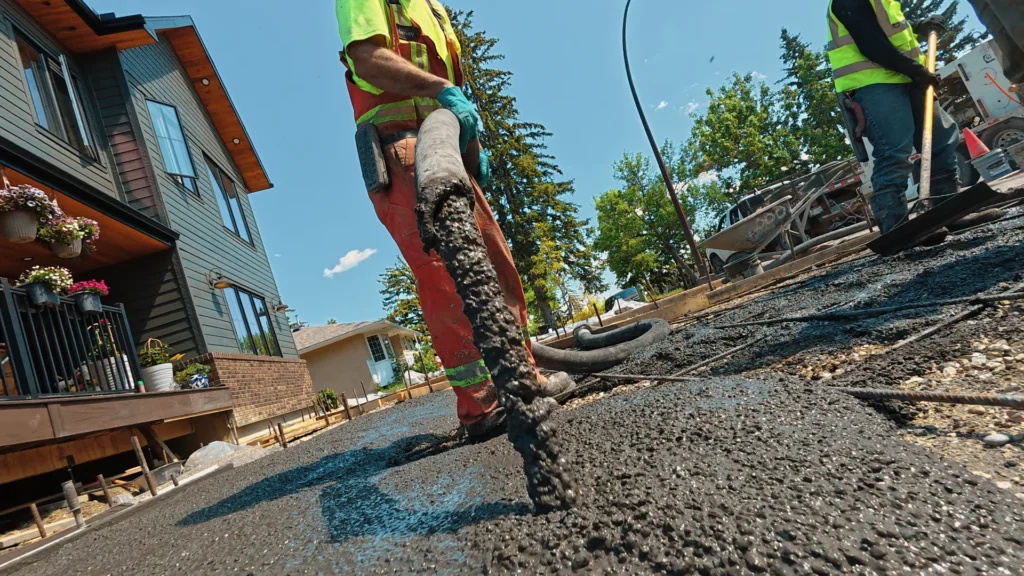
Here’s where on-site batching changes the equation. A volumetric truck carries its own water tank and batches the concrete at the chute. Instead of relying on heat surviving a long cold drive, the temperature is set at the site, at the moment of mixing. The water is heated, the mix is batched on arrival, and the concrete comes off the auger at the discharge temperature you need, whether the truck drove 15 minutes or an hour to get there.
It’s the same logic as the two-hour clock on a remote pour, applied to heat instead of time: a drum load’s temperature is decided at the plant and degrades en route, while a volumetric load’s temperature is decided where the concrete is actually placed. For the distance-and-clock version of this argument, see Pouring concrete where there’s no batch plant for miles.
To be clear about strength: heating the water and batching on site doesn’t make the concrete stronger. It meets the same ASTM C685 / CSA A23.1 standards as plant concrete. The cold-weather advantage is hitting the placement temperature, not exceeding the spec. For the standards answer, see Is volumetric concrete as strong as plant concrete?.
What “cold weather” means on a Calgary calendar
In a lot of cities, cold-weather concreting is an edge case for a few weeks a year. In Calgary it’s closer to a way of life. Under the 5 °C trigger, cold-weather practice typically runs from late September into mid-April, roughly six months. The city averages around 22 days a year below −20 °C, a handful below −30 °C, and well over 100 freeze-thaw cycles annually. (Source: Calgary Concrete Master Knowledge Base, climate and operational-calendar sections.)
A few local wrinkles:
- Thin sections, strictest rule. Because Calgary footings, foundation walls, slabs, and ICF walls are nearly all under 1 m, they live in Table 14’s 10 °C minimum band for half the year.
- Chinook whiplash. A mild Chinook pour day can flip to −15 °C overnight. Concrete Alberta’s guidance to re-tarp immediately after stripping forms in extreme cold (below about −15 °C) is a Calgary-specific protection step to avoid thermal-shock cracking. (Source: Concrete Alberta.)
- The durability spec doesn’t relax. A cold-weather mix is still Type HS/HSb sulphate-resistant cement with 5–7% entrained air for Calgary’s S-2 soils. Temperature control is added on top of the spec, it doesn’t replace it.
- No de-icing salts, no late curing compounds. Concrete Alberta advises against de-icing salts on concrete in its first winter and against curing compounds applied too late in the season.
Cold-weather success isn’t just about warm concrete—it depends on following the entire CSA A23.1 protection process from placement through curing. Our guide, 7 Cold-Weather Concrete Rules Every Calgary Pour Crew Should Cite, breaks down the practical checklist every contractor, builder, and inspector should know, including placement temperatures, curing requirements, frost protection, heated materials, insulation, and documentation. Read it before your next winter pour to make sure every crew member is working from the same standards.
When to lean on the plant, and when on-site batching earns its keep
Triage, honestly:
- Heated plant, short city haul, mild shoulder-season day. If the plant can batch warm, you’re 20 minutes away, and the air is just under the 5 °C trigger rather than deep cold, a drum truck with insulated blankets ready on site can land inside Table 14 fine.
- Long haul, deep cold, or both. A 45–60+ minute haul on a −10 °C morning is exactly where a drum load’s 8–15 °C heat loss can drop it below the placement floor. Batching on site, with the water heated at the chute, removes the haul from the temperature equation.
- Either way, protection is still on you. No supply method exempts you from CSA A23.1:24’s curing regime: maintain ≥10 °C, hit 7 MPa before frost, blanket or hoard as needed. Hitting discharge temperature gets the concrete in the ground warm; protection keeps it warm.
The placement-temperature argument for on-site batching is strongest where heat loss is worst: the long cold haul, the deep-freeze morning, the remote site.
FAQ
At what temperature do you have to start cold-weather concrete practice in Canada? At 5 °C and falling, or when the air is forecast to drop below 5 °C within 24 hours of placing, per CSA A23.1. It’s not tied to freezing; cold-weather measures begin while it’s still several degrees above zero.
What is the minimum temperature for placing concrete? CSA A23.1:24 Table 14 requires a minimum placing temperature of 10 °C for sections under 1 m thick, which covers most residential footings, walls, slabs, and ICF walls. Very thick sections (1–2 m and over) have a lower 5 °C minimum because they hold heat better.
How cold is too cold to pour concrete in Calgary? You can pour through Calgary’s roughly six-month cold season with the right measures. The mix must arrive at Table 14’s placement minimum (10 °C for thin sections), stay at or above 10 °C through curing, and reach 7 MPa before it’s exposed to frost. Below that, a freeze can cause permanent internal cracking.
How does on-site mixing help hit discharge temperature in cold weather? A volumetric truck carries its own water tank and batches the concrete at the site, so it can heat the mix water and bring the concrete to the required discharge temperature at the chute. A drum-mix load batched at the plant can shed 8–15 °C on a long cold drive and arrive below the placement floor.
What happens if concrete is placed too cold? Hydration slows sharply below about 10 °C and nearly stops below about 4 °C, and a 10 °C drop roughly doubles setting time. If fresh concrete freezes before reaching about 7 MPa, the mix water expands into ice and causes internal cracking that doesn’t heal.
How long must concrete be protected and cured in Calgary cold weather? CSA A23.1:24 and Concrete Alberta call for maintaining the concrete at a minimum of 10 °C: basic curing is 3 days at ≥10 °C or to 40% of strength (allowed for typical residential foundations), and additional curing is 7 days at ≥10 °C and to 70% of strength. Reach 7 MPa before exposing it to frost.
Is the 7 MPa frost threshold the same as 8 MPa I’ve seen quoted elsewhere? The current CSA A23.1:24 figure for early-frost resistance, per RMCAO’s CSA-authorized reproduction, is 7 MPa. Some older references quote 8 MPa; use 7 MPa as the current standard.
Does heating the water and batching on site make the concrete stronger? No. It helps the concrete reach the required placement temperature, which protects strength gain in cold weather, but it doesn’t exceed the spec. Volumetric concrete meets the same ASTM C685 / CSA A23.1 standards as plant concrete.
Don’t Let Winter Temperatures Compromise Your Pour
Calgary’s cold-weather concrete season lasts for months, and every successful placement starts with meeting CSA A23.1 temperature requirements before the concrete reaches the forms. Calgary Concrete Master supplies fresh on-site batched volumetric concrete for residential, commercial, acreage, and remote projects, helping contractors place the exact quantity they need while maintaining the proper discharge temperature for winter conditions.
Need concrete for a cold-weather project? Contact Omega Ready Mix today for a quote and expert guidance on your next winter pour.