
The rapid chloride permeability test measures how much electrical charge passes through a concrete specimen in six hours, reported in coulombs. It is a conductivity index, not a permeability measurement, and the single most important line in any spec that calls it up is not the coulomb limit — it is the age at which the cylinder gets tested. CSA A23.1 sets its chloride penetrability limits at 91 days. Alberta Transportation’s bridge specification sets its limit at 28 days. Put a slag or fly ash mix in front of both and you can fail one and pass the other with the same concrete.
That is the practical problem this test creates on Alberta jobs, and it is worth understanding before a mix is rejected over a number that never measured what people think it measures.
What ASTM C1202 actually measures
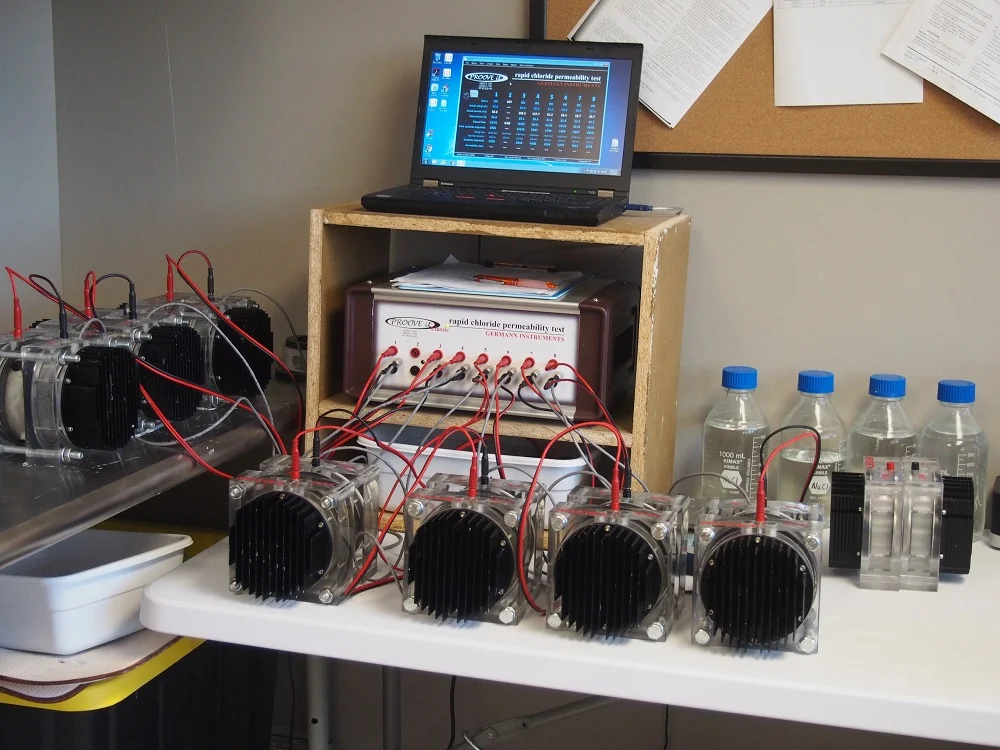
The test method, ASTM C1202 (and its highway-sector twin, AASHTO T277), applies 60 V DC across a 50 mm thick slice of a 100 mm diameter cylinder for six hours. One face sits in sodium chloride solution, the other in sodium hydroxide. Current is logged and integrated over the six hours to give a total charge passed, in coulombs.
What moves that current is every ion in the pore solution, not just chloride. As Doug Hooton put it in an ACI educational presentation on chloride ingress tests, it “is a Rapid Index test for conductivity (connectivity) of the pore system. It does not measure permeability or chloride ingress.”
Three consequences follow, and they explain most of the surprising results we see on batch reports:
- Pore solution chemistry moves the number, not just pore structure. The NRMCA notes that conductivity “is a function of the ionic concentration that is impacted by the use of pozzolanic materials and slag cement or certain admixtures, such as calcium nitrite,” and that silica fume in particular strongly influences it.
- A corrosion-inhibiting admixture can push the reading the wrong way. Calcium nitrite adds ions to the pore solution. The concrete may be more durable and the coulomb number higher. If you are specifying an inhibitor and an RCPT limit together, read our note on corrosion-inhibiting admixtures before you write both lines.
- Conductive materials in the mix skew it. Steel fibres are the obvious case, which is why Alberta’s bridge specification requires fibre-reinforced deck overlay concrete to be tested without the fibres present.
The classification table everyone quotes
This is the table that appears in nearly every submittal, originally from AASHTO T277:
| Charge passed (coulombs) | Chloride penetrability | Typical concrete |
|---|---|---|
| > 4,000 | High | High water-cement ratio, conventional (~0.6) |
| 2,000 – 4,000 | Moderate | Moderate water-cement ratio, conventional (0.4 to 0.5) |
| 1,000 – 2,000 | Low | Low water-cement ratio, conventional (< 0.4) |
| 100 – 1,000 | Very low | Latex-modified, internally sealed concrete |
| < 100 | Negligible | Polymer impregnated, polymer concrete |
Two independent technical sources reproduce it identically, so the numbers are not in dispute. What the number means is. The authors of the PCI Journal study that tested this test against 90-day chloride ponding recommended the table “be removed since it is inaccurate and can be misleading,” concluding that reliable correlations do not exist without mixture-specific calibration.
Use the table as shorthand for where a mix sits, not as evidence of service life. The specification limits below govern acceptance.
What CSA A23.1 requires
CSA A23.1 attaches chloride ion penetrability limits to the C exposure classes — the ones that cover concrete exposed to chlorides, with or without freezing and thawing. The two that matter most on Calgary work:
| Exposure class | Max w/cm | Min specified strength | Chloride ion penetrability |
|---|---|---|---|
| C-XL | 0.40 | 50 MPa within 56 days | < 1,000 coulombs within 91 days |
| C-1 | 0.40 | 35 MPa within 56 days | < 1,500 coulombs within 91 days |
The 1,500-coulomb figure for C-1 is confirmed independently in the ACI presentation cited above, which states that “in C-1 exposure (35 MPa, 0.40, Air-entrained), the Canadian CSA A23.1 Standard requires max. 1500 coulombs @ 91 days for concrete exposed to frost and chlorides.” A Concrete International review of performance-based chloride specifications gives the same pair of numbers: 1,500 coulombs by 91 days for reinforced concrete in chloride exposure, and 1,000 coulombs where a long service life is required.
Note the 91-day age on both rows. That is the standard acknowledging that mixes designed to hit these limits are SCM mixes, and SCM mixes have not finished developing their pore structure at 28 days. If you are unsure which class your job falls into, we walked through all of them in our guide to the CSA A23.1 exposure classes.
The standard also gives you a way to use more than one cylinder. The same ACI material describes the average of the three most recent tests being used for prequalification, and for acceptance testing, the running average staying below 1,500 with every individual result below 1,750 coulombs. That is the right shape for a test with this much scatter, and it is worth writing into a project spec that only says “1500 coulombs max.”
Where Alberta departs: the 28-day requirement
Alberta Transportation’s Specifications for Bridge Construction, Section 4, takes a different approach for high performance concrete. Under clause 4.4.2(i):
- Test method: ASTM C1202
- Test age: 28 days
- Acceptance: the average of all tests shall not exceed 1,000 coulombs, with no single test greater than 1,250 coulombs
- Specimens: duplicate laboratory moist-cured samples; for HPC with steel fibres, tested without the fibres
It applies to Class HPC and Class HPC with Steel Fibres — deck concrete, deck overlays with internal reinforcement, curbs, barriers, medians, roof slabs, approach slabs and MSE wall coping. No chloride ion penetration requirement is specified for Class B, C, D, S or pile concrete.
Put the two side by side and the trap is obvious:
| CSA A23.1 (C-XL) | Alberta Transportation (Class HPC) | |
|---|---|---|
| Limit | < 1,000 coulombs | Average ≤ 1,000, single ≤ 1,250 coulombs |
| Age | 91 days | 28 days |
| Curing before test | Per standard | Duplicate lab moist-cured samples |
Same number. Sixty-three days of hydration between them. A ternary mix with slag and fly ash that reads 1,800 coulombs at 28 days can be comfortably under 700 by 91 days, because slag and fly ash keep refining the pore structure long after the cement has done its work. That is the single most common reason an Alberta mix “fails chloride” — not the mix, the calendar.
Why SCM mixes read high early
The mechanism is straightforward. Portland cement hydrates fast and mostly finishes early. Slag cement and fly ash react with the calcium hydroxide that cement hydration produces, so they cannot start in earnest until there is something to react with, and they carry on for months. The pore network keeps getting less connected the whole time, and conductivity keeps dropping.
Hooton’s presentation says it directly: “it is not helpful to use 28-day limits for assessment of concretes containing SCMs that develop their durability performance at later ages.”
The NRMCA review adds the workaround specifications adopt where a 28-day answer is genuinely needed: extend curing, or use accelerated curing — a common protocol being 7 days moist cure followed by 21 days in a heated bath — “so that the contribution of the supplementary cementitious materials (SCMs) to the beneficial performance of concrete can be realized.”
If your mix will be judged at 28 days, that conditioning clause has to be in the spec. Without it, the only way to hit a 28-day coulomb limit is to change the mix in ways that usually make the concrete worse. Our comparison of fly ash and slag cement covers how the two behave differently on this curve.
How much one number is worth
Not as much as most submittals assume. The ACI material reports an average coefficient of variation of about 18% between laboratories. On a 1,500-coulomb limit, that is a band of a few hundred coulombs before you have said anything about the concrete at all.
Three habits keep that from becoming an argument:
- Never accept or reject on a single cylinder. Use the running-average structure CSA supports: average of recent tests against the limit, with a higher ceiling on any individual result.
- Fix the conditioning. Curing history, specimen age, and how the slice was cut and vacuum-saturated all move the answer.
- Prequalify the mix, then verify. Run the test on trial batches during design, where there is time to react, and treat field results as confirmation.
Surface resistivity: faster, same physics, same caveats
AASHTO T358 measures surface resistivity on a standard cylinder in seconds rather than running a six-hour migration cell, and it is non-destructive, so the same cylinder can be read repeatedly as it matures and then broken for strength. That makes it useful for tracking a mix through its 28-to-91-day window instead of guessing.
It is not a different test in principle. The FHWA notes that resistivity methods offer “the advantage of speed” but are “still based on electrical measurements and as such the inclusion of conductive materials will remain a problem just as for the electrical migration cells and the RCPT.” Everything above about pore solution chemistry, inhibitors and fibres applies unchanged.
The practical use on an Alberta job: resistivity for trend, C1202 for the contract line.
Writing a chloride spec that means something
Five lines:
- Name the exposure class first. C-XL and C-1 carry their own w/cm, strength and air requirements, and the coulomb limit only makes sense attached to them.
- State the test age explicitly and make it 91 days unless a structural reason forces 28.
- If 28 days is unavoidable, specify the conditioning — the curing regime, accelerated or otherwise, that the specimens will receive.
- State the acceptance structure, not just a number: running average plus an individual-result ceiling.
- Require prequalification data from trial batches before the first load.
Get those five right and the test does the job it is good at: sorting a well-proportioned, well-cured, low-connectivity mix from a wet one.
FAQ
What is a good coulomb value for concrete? For chloride exposure in Canada, under 1,500 coulombs at 91 days meets CSA A23.1’s C-1 requirement and under 1,000 coulombs at 91 days meets C-XL. On the general AASHTO scale, 1,000 to 2,000 coulombs is “low” penetrability and 100 to 1,000 is “very low.”
Does the rapid chloride permeability test measure permeability? No. It measures total charge passed in six hours, which is an index of how connected and how conductive the pore system is. Chloride never has time to travel through the specimen during the test.
Why did my slag mix fail at 28 days? Because slag and fly ash keep reducing pore connectivity for months. A mix that reads high at 28 days routinely meets the same limit comfortably at 91. If the spec demands 28 days, it also has to specify the curing regime.
Can an admixture make the result worse without making the concrete worse? Yes. Calcium nitrite and other ionic admixtures raise pore solution conductivity, which raises the coulomb number even where corrosion resistance improves.
Is surface resistivity an acceptable substitute? It is widely used for tracking because it is fast and non-destructive. It relies on the same electrical principle and carries the same sensitivities, so treat it as a companion to the specified test rather than a replacement for a contract requirement.
Which Alberta work actually requires this test? Under Alberta Transportation’s bridge specification it applies to Class HPC and Class HPC with steel fibres — decks, overlays, curbs, barriers, medians, approach slabs and similar. Building work picks it up through the CSA A23.1 exposure class named in the structural drawings.
Getting the mix right before the test date
If your drawings call for C-XL or C-1, the chloride number is decided at mix design, not at the lab. Cementing materials, replacement level, water-cementing materials ratio and the curing the concrete receives on site are the four variables that move it, and the first three are ours to get right.
Send us the exposure class, the test age in the spec and the pour date, and we will put a mix in front of you with trial data behind it. For chloride-heavy work like curb and gutter concrete in Calgary, that conversation is worth having early. For large-volume pours where consistency over a long placement matters, see how our on-site production works.
Sources
- Alberta Transportation, Specifications for Bridge Construction, Section 4 — Cast-in-Place Concrete — https://www.transportation.alberta.ca/content/doctype246/production/10bcs04.pdf
- American Concrete Institute, educational presentation on chloride ingress tests (R.D. Hooton) — https://www.concrete.org/portals/0/files/pdf/webinars/ws_F20_DougHooton.pdf
- Concrete International / NRMCA, performance-based specifications for chloride resistance (2018) — https://www.nrmca.org/wp-content/uploads/2020/06/2018CICHLORIDES.pdf
- PCI Journal, The Rapid Chloride Permeability Test and Its Correlation to the 90-Day Chloride Ponding Test — https://www.pci.org/PCI_Docs/Publications/PCI%20Journal/1994/Jan-Feb/The%20Rapid%20Chloride%20Permeability%20Test%20and%20Its%20Correlation%20to%20the%2090-Day%20Chloride%20Ponding%20Test.pdf