
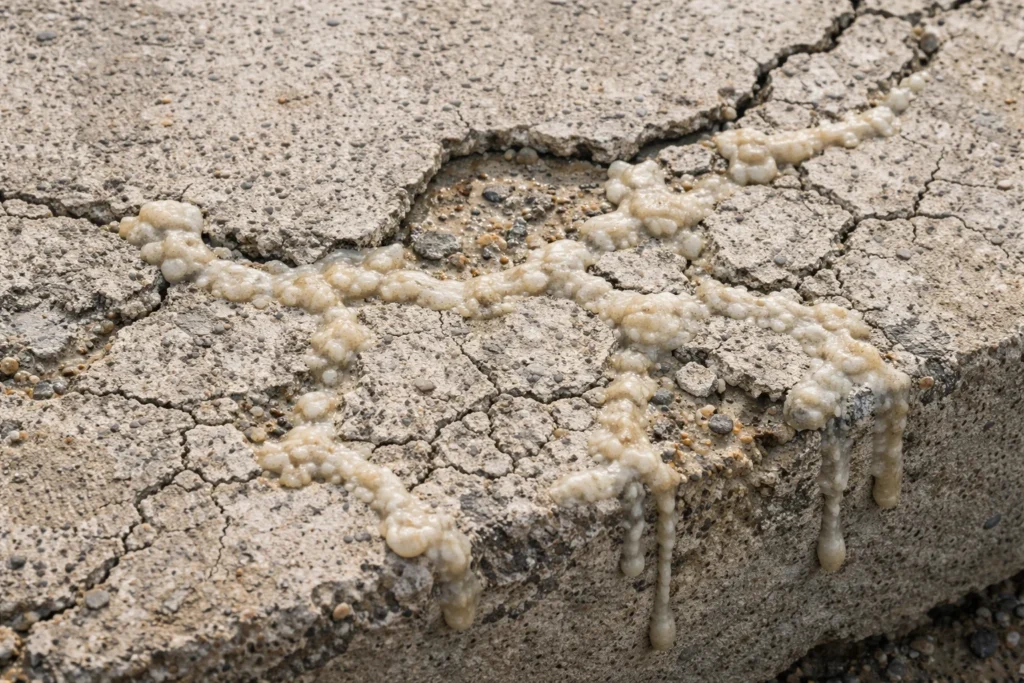
Alkali-aggregate reaction is a slow chemical reaction between reactive silica in the aggregate and the alkali hydroxides in the cement paste pore solution. It produces a gel that swells when it takes up water, and the swelling cracks the concrete from the inside out. It does not show up on a cylinder break, it does not show up on a slump test, and by the time it shows up on the structure it is ten to twenty years too late to fix cheaply. The control happens before the first truck loads: the aggregate is tested, classified, and the mix is designed to a matching level of prevention.
This article covers how that classification works under CSA, the two test methods and their expansion limits, what Alberta Transportation requires in its own concrete supply specification, and what the preventive measures actually are.
The reaction needs three things at once
The mechanism is well documented, and ACI Committee 201’s chapter on alkali-aggregate reactivity states the requirement plainly: damage needs reactive silica, alkalis, and water present together. Available calcium oxide from the cement paste is a fourth contributor to the damaging form of the gel.
- Reactive silica comes from the aggregate. Certain cherts, greywackes, argillites, volcanic glasses and strained quartz are the usual culprits. Whether a given pit is reactive is a question of geology, not of supplier diligence.
- Alkalis come mainly from the portland cement, expressed as sodium oxide equivalent. They can also arrive from admixtures, some aggregates, and from external sources such as de-icing salts.
- Water is needed both to move the ions and to swell the gel. Concrete that stays genuinely dry in service does not develop the damage, which is why exterior flatwork, parkade decks, retaining walls and buried elements are the exposed cases in Alberta while conditioned interior slabs generally are not.
Remove any one leg and the reaction stops. In practice you cannot change the water — this is Alberta, and the freeze-thaw cycle keeps exterior concrete wet for months. So the control levers are the aggregate and the alkalis.
How CSA classifies an aggregate: two tests, two timescales
There are two standard ways to find out whether an aggregate is reactive, and they trade speed against reliability.
The accelerated mortar bar test — 14 days
CSA A23.2-25A (the Canadian counterpart of ASTM C1260) casts mortar bars with the aggregate in question and stores them in hot sodium hydroxide solution. Expansion is read at 14 days.
It is fast and cheap, which is why it is used for screening. It is also aggressive enough to condemn aggregates that perform acceptably in service, so a failing result is a reason to run the longer test rather than a reason to reject the pit outright.
The concrete prism test — one year
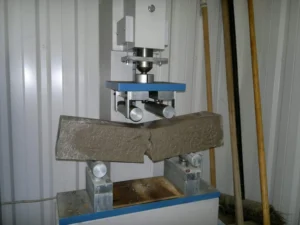
CSA A23.2-14A casts actual concrete prisms — 75 by 75 by 275 to 405 mm — and stores them at 38 °C above 95% relative humidity, with expansion read out to 52 weeks and sometimes to 104. This is the reference method. It uses real concrete, real aggregate proportions and a realistic alkali loading, and its results correlate far better with field performance than the mortar bar test does.
The cost is time. A pit that needs the prism test needs a year of it, which is why aggregate reactivity is established on a standing programme rather than project by project.
The expansion limits
The classification bands published by FHWA in HIF-13-002, which use the same test methods and the same numbers the Canadian practice works from, are these:
| Classification | Accelerated mortar bar, 14 days | Concrete prism, 1 year |
|---|---|---|
| R0 — non-reactive | ≤ 0.10% | ≤ 0.04% |
| R1 — moderately reactive | > 0.10% to 0.30% | > 0.04% to 0.12% |
| R2 — highly reactive | > 0.30% to 0.45% | > 0.12% to 0.24% |
| R3 — very highly reactive | > 0.45% | > 0.24% |
FHWA’s own note on the prism limit is worth repeating: “an expansion value of 0.04% at one year was selected to separate non-reactive from reactive aggregates.” That is the number everything else hangs off. Four hundredths of one percent, over twelve months, in a lab.
What Alberta actually requires
Alberta Transportation’s Supplemental Specification 5.5, Supply of Portland Cement Concrete, names three CSA documents for this: A23.2-27A, the standard practice to identify the degree of alkali reactivity of aggregates and to identify measures to avoid deleterious expansion; and A23.2-14A and A23.2-25A, the two test methods above.
A23.2-27A is the one that matters to a specifier, because it is not a test — it is the decision framework. You bring it three inputs: the aggregate’s reactivity classification, the structure’s required service life, and the consequence of failure. It returns a level of prevention, and the level of prevention dictates what the mix has to carry. The specification works from a 50-year service life unless the project states otherwise.
Alberta’s own supply specification then adds a hard constraint: where the aggregate is assessed as potentially alkali-silica reactive, fly ash may be used, to a maximum of 30% by mass of total cementing materials. Type HS or HSb cement, or Type GU with supplementary cementing materials demonstrating compliance with CSA A3001, are the named routes.
If you want the parallel framework for the other Alberta durability problem — sulphate attack from our soils — that is a different standard and a different spec line; our walk-through of CSA A23.1 exposure classes covers how those get called out.
The preventive measures, and the number that catches people
Supplementary cementing materials prevent alkali-silica reaction by binding alkalis — ACI 201 describes the mechanism as “alkali-binding which reduces the availability of alkalis in the pore solution for reaction with aggregate.” The pore solution simply has less hydroxide in it to attack the silica.
The replacement levels ACI 201 gives as typically sufficient to control expansion:
| Supplementary cementing material | Typical replacement to control ASR |
|---|---|
| Silica fume | 10 to 15% |
| Metakaolin | 15 to 20% |
| Low-CaO fly ash | 20 to 30% |
| Slag | 35 to 50% |
| High-CaO fly ash | 40% or more |
Read that table against Alberta’s 30% fly ash cap and the practical consequence is obvious. A low-calcium fly ash fits inside the cap with room to spare. A high-calcium fly ash — the kind that comes off a lot of western Canadian coal — needs 40% or more to do the job, which the 30% cap will not allow on that specification. On a reactive aggregate, the answer is then slag, a blended cement, a ternary mix, or a different fly ash source. It is not “run fly ash at 30% and hope.”
This is also why the SCM conversation on a reactive-aggregate job is not the same conversation as the one about carbon or cost. Those are covered in our piece on eco-friendly concrete options in Calgary; here the replacement level is a durability requirement with a number attached, and it is not negotiable downward for finishing convenience.
The other levers, used alone or in combination, are limiting the total alkali content of the concrete in kilograms of sodium oxide equivalent per cubic metre, using a low-alkali cement, and lithium-based admixtures for severe cases.
What this means when you order concrete in Calgary
Four practical points for anyone specifying or placing.
- Reactivity is a property of the pit, not of the truck. Ask your supplier what the source aggregate’s classification is and which test produced it. A 14-day mortar bar result and a one-year prism result are not interchangeable evidence.
- The level of prevention belongs in the spec, not in a phone call. If the drawings say only “32 MPa, C-2”, nothing in that line addresses alkali reactivity. A23.2-27A output — reactivity class, service life, prevention level — needs to be written down.
- Do not substitute cementitious materials on site. Swapping one fly ash for another because a load is late can quietly take a compliant mix out of compliance. The replacement percentage was chosen against a specific material.
- Strength does not protect you. A 35 MPa mix on a reactive aggregate with inadequate prevention will crack the same way a 25 MPa one does. If anything, higher cement contents raise total alkali loading. Our guide to concrete strength covers what strength numbers do and do not buy.
Because we batch on site from our own volumetric equipment, the cementing-materials proportions on a job are set at the truck and can be documented for that pour rather than inferred from a plant ticket. On a mix carrying a level of prevention, that documentation is the deliverable.
FAQ
How long before alkali-aggregate reaction shows up? Typically a decade or more. It is a slow expansive process, which is why prevention is designed in and cannot be retrofitted economically.
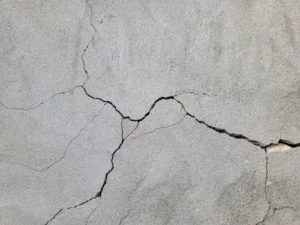
What does it look like in the field? Map cracking on exposed surfaces, gel or damp staining at cracks, and in restrained elements, cracking that runs parallel to the direction of restraint rather than randomly.
Is the 14-day mortar bar test enough on its own? For screening, yes. For condemning or clearing an aggregate that matters, the one-year concrete prism test to CSA A23.2-14A is the reference method, and a mortar bar failure is a trigger to run it.
Does air entrainment help? No. Entrained air controls freeze-thaw damage, a completely separate mechanism. A properly air-entrained mix on a reactive aggregate with no prevention measures will still expand.
What is the single number to remember? 0.04% expansion at one year in the concrete prism test. That is the line between non-reactive and reactive, and everything in the prevention framework follows from which side of it an aggregate lands on.
Get the classification before you get the price
If you are specifying concrete for exterior or buried work in the Calgary area and alkali reactivity has not been addressed in the documents, that is a gap worth closing before tender, not after. Talk to us about what the source aggregate classification is, what level of prevention the structure needs, and which cementing-materials combination meets it inside the specification you are building to. We will put the proportions in writing for the pour.
Sources
- Alberta Transportation, Supplemental Specification 5.5 — Supply of Portland Cement Concrete: https://www.transportation.alberta.ca/Content/docType29/Production/5_5%20Supply%20of%20PCC.pdf
- FHWA, Selecting Measures to Prevent Deleterious Alkali-Silica Reaction in Concrete (HIF-13-002): https://www.fhwa.dot.gov/pavement/concrete/asr/hif13002/hif13002.pdf
- ACI Committee 201, alkali-aggregate reactivity chapter (M.D.A. Thomas): https://www.concrete.org/portals/0/files/pdf/webinars/aciu_2018_ACI201AARChapter_Thomas.pdf
- Fournier et al., inter-laboratory study on the CSA A23.2-14A concrete prism test, 10th ICAAR: https://icaarconcrete.org/wp-content/uploads/2024/04/10ICAAR-FournierB-2.pdf