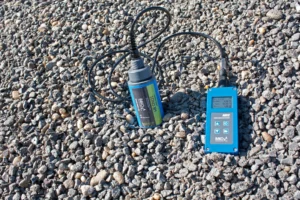

The maturity method estimates the in-place compressive strength of concrete from its own temperature history, using a strength-maturity relationship developed in the lab for that specific mix. In practice it answers one question earlier and more honestly than a field-cured cylinder can: how strong is the concrete in the element, right now, at 3 a.m., under the hoarding.
That matters here more than most places. An Alberta winter schedule is built around waiting — waiting on forms, waiting on backfill, waiting on the next trade. Maturity is a way of replacing a calendar assumption with a measurement. It is not a way of skipping curing, and it is not a substitute for acceptance testing. This is how it works, what setting it up actually costs in time, and where it fails.
What maturity measures
Maturity is the combined effect of time and temperature on cement hydration, expressed as a single index. NRMCA’s CIP 39 defines it as “the extent of the development of properties, such as strength, that depend on the chemical reactions occurring in a cementitious mixture,” and notes the principle holds as long as there is enough water present for hydration to continue.
The logic is simple. Cement hydration is a chemical reaction, and like most reactions it runs faster warm and slower cold. Two slabs of the same mix that reach the same maturity index have had, in effect, the same amount of hydration — regardless of whether one got there in 3 warm days and the other in 9 cold ones. So if you know how strength relates to maturity for that mix, and you know the element’s temperature history, you can estimate its strength.
The two inputs are therefore a calibration curve and a temperature record. Neither is optional, and the first is the one people skip.
The two maturity functions
ASTM C1074 allows the maturity index to be expressed either as a temperature-time factor or as an equivalent age at a specified temperature. They are different models of how temperature affects strength gain, and your meter is using one of them whether or not anyone on site knows which.
| Nurse-Saul (temperature-time factor) | Arrhenius (equivalent age) | |
|---|---|---|
| Assumption | Rate of strength gain after final set is a linear function of temperature | Rate of strength gain follows an exponential relationship with temperature |
| Index units | °C-hours or °C-days | Hours or days at a reference temperature |
| Key input | Datum temperature | Activation energy |
| Typical value for Type I portland cement | Datum temperature of 0 °C, for expected temperatures of 0 °C to 40 °C | Activation energy of 42 kJ/mol |
| Reference temperature | n/a | Typically 20 °C or 23 °C |
CIP 39 is candid about the trade-off: the Arrhenius function better represents the effect of temperature on strength development, while the Nurse-Saul function sees wider use among highway agencies because it is simpler to compute.
For an Alberta winter this distinction is not academic. Nurse-Saul’s linear assumption is least accurate at the temperature extremes, and a heated enclosure running at 20 °C over concrete placed at 12 °C is exactly the kind of history where the two functions diverge. If a spec allows maturity, it should say which function and which constants.
Calibration: the part that takes two weeks
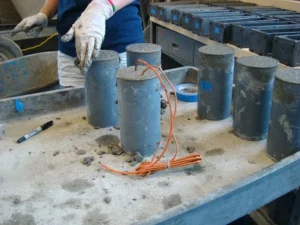
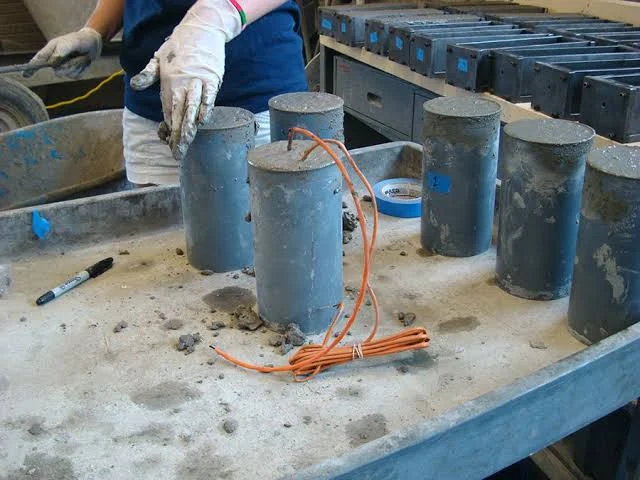
The strength-maturity relationship is developed in the laboratory, for one specific mixture, before anyone uses it in the field. CIP 39 describes the procedure: prepare the mixture using the job materials, cast test specimens with temperature probes embedded in two of the cylinders, and measure compressive strength at various ages. The temperature and strength data together define the curve.
Three consequences follow from that, and they are the ones that decide whether maturity is worth it on your job.
- The curve belongs to the mix, not to the project. Change the cement source, the supplementary cementing material content, the admixture package or the air content, and the relationship is no longer the one you calibrated. A job running a 30 MPa footing mix, a 32 MPa wall mix and a 35 MPa flatwork mix needs three curves.
- It has to exist before the pour. Testing to 28 days means the calibration starts weeks ahead. Maturity is a planning decision made at the spec stage, not a rescue thrown at a slab that is behind schedule.
- It has to be verified in production. NRMCA’s guidance on the steps involved is explicit that the relationship developed in the lab must be checked against field specimens from production concrete before it is relied on.
That is why maturity pays off on repetitive work — parkade decks, multi-unit foundation walls, tilt panels, a winter-long slab program — and rarely on a one-off pour.
If you are already reading batch tickets closely, this is a natural extension of the same discipline; we covered what the numbers on a concrete batch ticket mean separately, and mix consistency between loads is exactly what makes a calibrated curve trustworthy.
Why it matters more here
Alberta’s protection requirements are written in days and degrees, and maturity is the only common method that reads both at once. Concrete Alberta’s cold weather guidance sets out the CSA A23.1 placement temperature window by section size:
| Section thickness | Placement temperature range |
|---|---|
| Less than 0.3 m | 10 °C to 35 °C |
| 0.3 m to 1 m | 10 °C to 30 °C |
| 1 m to 2 m | 5 °C to 25 °C |
| Over 2 m | 5 °C to 20 °C |
The same guidance calls for a curing regime of 7 days at a minimum temperature of 10 °C for concrete that will be exposed to freeze-thaw cycling and de-icing salts — which in Calgary is most exterior concrete. If you want to understand which exposure class puts you there, our breakdown of the CSA A23.1 exposure classes walks through the C and F designations.
Here is the point. That 7-day, 10 °C regime is a minimum protection requirement, and it does not move because the concrete happens to be strong. But the separate question — has the element reached the strength needed to strip, backfill or load it? — is exactly what maturity answers, and it is the question that gets guessed at on a cold site. Concrete Alberta’s own position on stripping is that field-cured cylinders or nondestructive methods should be used to estimate in-place strength before stripping forms or applying loads, with forms typically staying put for 1 to 7 days depending on rate of strength gain, ambient conditions and anticipated loading.
“Depending on rate of strength gain” is doing a lot of work in that sentence. Maturity is how you measure it instead of assuming it. Our guide to cold weather pours in Calgary covers the protection side; this is the verification side.
The decision maturity is actually for
Most specifications state form removal as a choice between an elapsed time and a percentage of the specified 28-day strength. Manitoba Infrastructure’s cast-in-place concrete specification is a clear published example of the pattern:
| Operation | Time criterion | Strength criterion |
|---|---|---|
| Formwork removal, footings | 3 days | 30% of f’c |
| Formwork removal, deck slabs | 7 days | 50% of f’c |
| Placing vertical dead loads on deck slabs and pier soffits | 14 days | 85% of f’c |
That specification also ties the strength criterion to field-cured cylinders, and requires cold-weather concrete to be enclosed and held between 15 °C and 25 °C for 4 days, with subsequent cooling never exceeding 5 °C over an 8-hour period.
Read the table again and the value of maturity becomes obvious. The time criterion is a worst-case assumption. If the element is warm and the mix is gaining strength fast, it hits 50% of f’c well before day 7 — and with a calibrated curve and a logger in the pour, you can demonstrate that rather than argue it. If the element is cold and the assumption was optimistic, maturity tells you that too, which is the more valuable of the two outcomes.
Where it goes wrong
CIP 39 lists four limitations, and all four show up on real jobs:
- The structural concrete differs from the calibration mixture — different materials, admixtures or air content. The most common version of this is a mix change nobody told the QC tech about.
- Initial concrete temperature affects the rate of strength gain, which the index does not fully capture. CIP 39 calls this and the previous item inherent limitations of the method.
- Improper placement, consolidation or curing disrupts hydration. Maturity measures temperature and time. It cannot see a honeycombed pocket or a slab that lost its water to a chinook wind.
- Wrong constants — an incorrect datum temperature or activation energy quietly biases every reading.
Which is why ASTM C1074 recommends supplementary tests before safety-critical operations. CIP 39 names the options: in-place strength tests such as penetration resistance, pullout strength or cast-in-place cylinders; accelerated curing to ASTM C1768/C1768M; or field-molded cylinders instrumented alongside the structure.
Treat maturity as a high-resolution reading of the temperature history that you confirm at the decision points — not as a replacement for the cylinders that establish acceptance.
FAQ
What is the concrete maturity method? It is a procedure, standardized in ASTM C1074, for estimating the in-place compressive strength of concrete from its measured temperature history, using a strength-maturity relationship developed in the laboratory for that specific mixture.
Does maturity replace cylinder breaks? No. It estimates in-place strength for construction decisions such as stripping forms or applying load. Acceptance of the concrete against the specified strength still rests on standard-cured cylinders, and ASTM C1074 recommends supplementary in-place tests before safety-critical operations.
How long does it take to set up? Plan on several weeks. The strength-maturity relationship is built from laboratory specimens tested at a range of ages up to the specified age, and the relationship must then be verified against production concrete before it is used.
What is the datum temperature, and why does it matter? It is the temperature below which the Nurse-Saul function assumes no strength gain occurs. For Type I portland cement with expected concrete temperatures between 0 °C and 40 °C, CIP 39 gives a recommended datum temperature of 0 °C. Using the wrong value biases every maturity reading on the job.
Can maturity shorten the required cold weather protection period? No. Protection requirements — such as the 7 days at a minimum of 10 °C called for where concrete will face freeze-thaw cycling and de-icing salts — are durability requirements, not strength requirements. Maturity informs stripping and loading decisions, not how long you keep the heat on.
Do I need a new curve for every mix? Yes. The relationship is specific to the mixture. Changes to materials, admixtures or air content invalidate it, which is why maturity suits repetitive work with a stable mix design.
Talk to us before the calibration, not after the pour
If you are specifying a winter program and want maturity to be usable on it, the mix design has to be locked early enough to calibrate against — and it has to stay locked. That is a supply conversation as much as a testing one. Have a look at our custom mixed concrete in Calgary, or send us the spec and the pour schedule and we will tell you which mixes on the job are worth calibrating and which are not.
Sources
- NRMCA — CIP 39: Maturity Methods to Estimate Concrete Strength: https://www.nrmca.org/wp-content/uploads/2021/01/39pr.pdf
- Concrete Alberta — Concrete Tech Tip #26: Cold Weather Concreting: https://www.concretealberta.ca/public/download/files/221629
- Manitoba Infrastructure — Specification 1030: Reinforced Cast-in-Place Concrete: https://www.gov.mb.ca/mti/contracts/pdf/manual/1030.pdf