
Every mix design you have ever been handed assumes the aggregate is saturated surface dry. No stockpile in Alberta has ever been saturated surface dry. The gap between those two sentences is the single largest uncontrolled variable in ready mix production, and closing it is most of what a batch plant does between the ticket and the truck.
This is what the moisture correction is, why it is the number that moves your water-to-cementing-materials ratio, and what a one per cent error in the sand actually costs on a cubic metre.
The four moisture states
Aggregate holds water in two different places, and only one of them counts as mixing water.
| State | Internal pores | Surface | Effect on the mix |
|---|---|---|---|
| Oven-dry | Empty | Dry | Steals water from the paste |
| Air-dry | Partly filled | Dry | Steals water from the paste |
| Saturated surface dry (SSD) | Full | Dry | Neutral — the basis of every mix design |
| Wet | Full | Free water on the surface | Adds water to the paste |
The NRMCA’s technical guidance on aggregate moisture draws the line cleanly: absorbed water sits inside the pores, does not affect slump and is excluded from the water-cementing materials ratio. Free moisture — also called surface moisture — is the film on the outside of the particle. It becomes mixing water the moment the batch is combined, and it counts in full against your w/cm.
That is why mix proportions are always quoted at SSD. SSD is the zero point. Anything wetter adds water; anything drier takes it away.
Absorption and free moisture are different numbers, measured different ways
Absorption is a property of the rock. It does not change from load to load, and it comes from laboratory testing — ASTM C127 for coarse aggregate and ASTM C128 for fine aggregate give relative density and absorption.
Moisture is a property of today’s stockpile. It changes with rain, with snowmelt, with how long the pile has drained, and with how deep into the pile the loader bucket went. It is measured by:
- ASTM C566 — Standard Test Method for Total Evaporable Moisture Content of Aggregate by Drying. The common one: weigh wet, dry to constant mass, weigh again. NPCA’s guidance defines “dry enough” as the point where further heating would cause less than 0.1 per cent additional weight loss.
- ASTM C70 — Standard Test Method for Surface Moisture in Fine Aggregate, for sand specifically.
- AASHTO T255, for total and free moisture in coarse and fine aggregate.
Free moisture is the difference: total moisture minus absorption. Get that subtraction backwards and you correct in the wrong direction.
The magnitudes are not exotic. Trade reporting on free and surface moisture measurement puts sand’s internal (absorbed) moisture at an assumed one per cent as a working figure, with coarse aggregate absorbing “usually much less than one per cent when saturated.” A published field example from a coarse aggregate test — 1½ in. limestone with an absorption capacity of 0.71 per cent measuring 3.9 per cent total moisture — shows the shape of it: most of what comes in on a wet stockpile is free water, not absorbed water.
What one per cent of sand moisture is worth
Here is the arithmetic on a nominal cubic metre. Take a mix proportioned at 350 kg of cementing materials, 154 L of mixing water and 850 kg of sand at SSD. Design w/cm: 0.44.
Suppose the sand actually carries 4.0 per cent free moisture, and the plant batches on a reading of 3.0 per cent — a one point error, which is well inside the range a poorly placed probe or a stale morning sample will produce.
| Correct correction (4.0%) | Batched on 3.0% | |
|---|---|---|
| Wet sand batched | 884.0 kg | 875.5 kg |
| Water withheld for sand moisture | 34.0 L | 25.5 L |
| Water added at the plant | 120.0 L | 128.5 L |
| Free water carried in on the sand | 34.0 L | 33.7 L |
| Total mixing water | 154.0 L | 162.2 L |
| SSD sand actually delivered | 850.0 kg | 841.8 kg |
| Resulting w/cm | 0.440 | 0.463 |
Two things happened at once, and both of them go the wrong way. The mix picked up 8.2 L of water it was not supposed to have, and it came up 8.2 kg short of sand. If the specification caps w/cm at 0.45 — a common cap in Alberta, where Alberta Transportation’s supply specification sets maximums by class across a 0.40 to 0.50 range — that load is out of spec before the truck leaves the yard, and nothing on the ticket will say so.
The rule of thumb worth carrying: one per cent of free moisture on 850 kg of sand is 8.5 L of water per cubic metre. On a 9 m³ load that is 76 L, about the volume of a laundry tub, arriving unannounced in the drum.
Why the first load of the day is the one to watch
Stockpiles are not uniform and Alberta weather does not help.
- Drainage gradient. Water runs down. The bottom third of a sand pile can be materially wetter than the working face two metres up, so where the loader digs changes the number.
- Rain and snowmelt. A pile that has taken 20 mm of rain overnight has not reached equilibrium by 6 a.m. Moisture keeps migrating downward through the shift, which means the correct correction at 7 a.m. is not the correct correction at noon.
- Freezing. Frozen aggregate does not release its free water into the mix at the same rate. It also refuses to read correctly on a probe, which is one of several reasons cold-weather production runs on more frequent hand sampling, not less.
- Chinooks. A warm wind across an exposed face dries the top of the pile quickly while the core stays wet — the two-number problem in one stockpile.
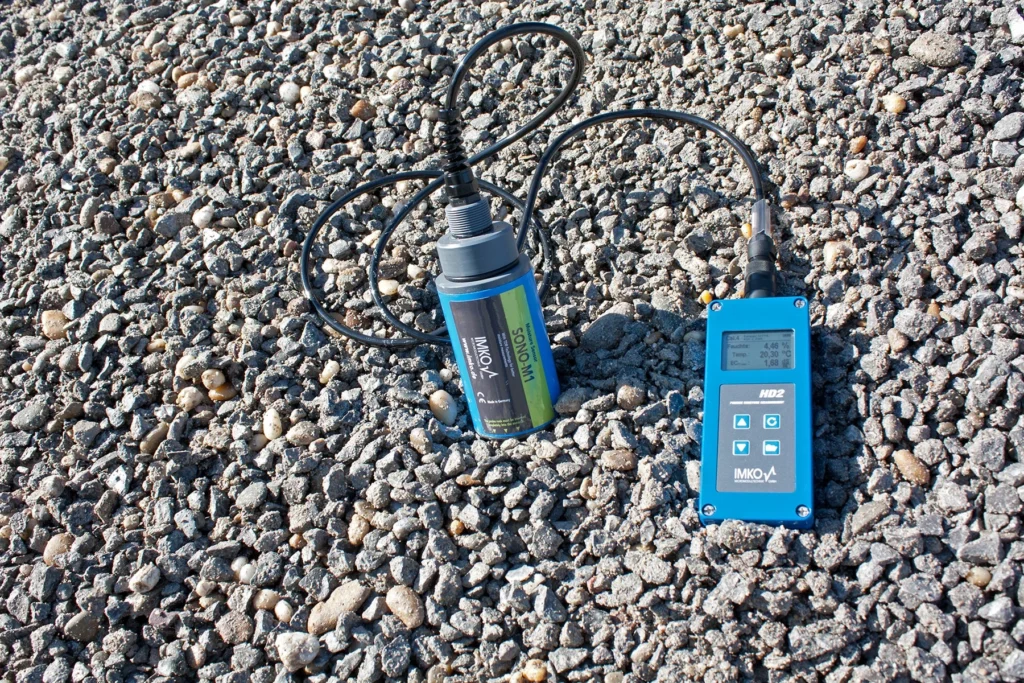
This is why sampling frequency matters more than sampling precision. NPCA’s quality control guidance calls for determining moisture content of each aggregate at least once daily, or at least once per week where automatic moisture probes are in continuous use. Probes are not a licence to stop checking: the same trade reporting notes that microwave sensors lose real accuracy above 3/8 in. aggregate, and that even ¼ in. material can produce errors up to 0.5 per cent.
The tolerances the plant is working inside
Batching tolerances are tight enough that the moisture correction has nowhere to hide. Manitoba Infrastructure’s concrete specification, representative of the Canadian practice CSA A23.1 governs, is explicit at Section 5.1.2: weighing devices must measure successive quantities “to within one percent of the desired amount,” the water measuring device must be “accurate to ± 0.5% of the design quantity,” scales must be calibrated within a year, and — the sentence that matters here — “the mixing water shall be measured by volume or by weight and adjusted for retained moisture in the sand.”
Alberta Transportation’s Supplemental Specification 5.5 adds the delivery-side limits our climate makes non-negotiable: discharge temperature between 10 °C and 25 °C unless otherwise specified, and no more than 60 minutes from batching where site water addition is permitted at all.
So: a plant may weigh cement to one per cent and meter water to half a per cent, and still deliver a 0.46 mix against a 0.44 design, purely because someone read the sand wrong. The instrument tolerance is not the accuracy of the concrete. The moisture correction is.
Volumetric batching changes where the error shows up
On a volumetric mixer the aggregate is metered by volume through a calibrated gate rather than weighed. Free moisture still has to be subtracted from the water, but it also changes the bulk density of what passes through the gate — wetter sand occupies more space per kilogram, so the same gate setting delivers a different mass of solids.
That is why ASTM C685/C685M, the specification covering concrete made by volumetric batching and continuous mixing, is built around metering accuracy, verification procedures and documented calibration rather than around a batch ticket. On our volumetric fleet the moisture reading is taken per stockpile and per shift, not per week, and the yield check is the proof that the gate and the correction agree. If you are weighing the two production methods against each other, we covered the trade-offs in volumetric mixing versus traditional ready mix.
What you can see from the site
You will not get a moisture reading on a delivery ticket, but the symptoms are visible on the slab.
- Slump higher than ordered on the first load, normal on the rest. Classic stale morning moisture reading.
- Slump that drifts down across a long pour. Often the stockpile drying out under sun or wind while the correction stays fixed.
- Colour variation between loads on the same pour. Water content, not cement content, most of the time.
- A finisher reporting that the mix “bleeds forever.” Extra free water has to go somewhere, and it goes up.
If you see any of these, ask for the moisture correction used on that load before you start adjusting anything at the truck — and take the slump test at the point of discharge, so the number you are arguing about is the number the standard recognizes. It is also worth confirming the exposure class you actually need, because the w/cm cap is what decides how much headroom the correction has: our walkthrough of CSA A23.1 exposure classes sets that out.
Getting the mix you specified
Moisture control is unglamorous and it decides more about in-place strength than most of the things that get argued about on site. Every mix we supply through custom mixed concrete is corrected to SSD from a same-shift stockpile reading, and we will put that correction in front of you if a load ever looks wrong. Call the plant before the pour with your exposure class, your w/cm cap and your placement method, and we will tell you what the sand is reading that morning.
FAQ
What is free moisture in aggregate? Free moisture, or surface moisture, is water on the outside of the aggregate particle, over and above what the pores have absorbed. It becomes mixing water and counts fully in the water-cementing materials ratio. Absorbed water inside the pores does not.
What does SSD mean in a concrete mix design? Saturated surface dry: the pores are full, the surface is dry. It is the neutral reference state that mix proportions are quoted at, so that aggregate neither adds water to nor takes water from the paste.
How is aggregate moisture content measured? Usually by drying: ASTM C566 for total evaporable moisture, ASTM C70 for surface moisture in fine aggregate, or AASHTO T255. Absorption comes separately from ASTM C127 and C128. Plants also run inline probes, but probes lose accuracy on larger aggregate and are verified against oven testing.
How often should a plant check aggregate moisture? Industry quality control guidance sets a floor of once daily per aggregate, or once weekly where automatic probes run continuously. In wet or freezing conditions, per-shift checking is the practical standard.
How much does aggregate moisture affect the water-cement ratio? On a typical cubic metre with 850 kg of sand, each one per cent of free moisture is about 8.5 L of water. On a 350 kg cementing materials mix, an 8.2 L error moves w/cm from 0.44 to 0.46 — enough to break a 0.45 cap.
Can the driver just add water to fix a low-slump load? Not freely. Site water addition is bounded by specification and by time — Alberta Transportation’s supply specification permits it only within 60 minutes of batching, and increases past the design w/cm are not permitted under typical Canadian specifications. Fixing a moisture error with a hose converts a batching problem into a strength problem.
Sources
- NRMCA, Tip 6 — Aggregate Moisture and Making Adjustments — https://www.nrmca.org/wp-content/uploads/2020/04/Tip6w.pdf
- National Precast Concrete Association, Aggregate Moisture Content Testing — https://precast.org/blog/aggregate-moisture-content-testing/
- Concrete Products, “How to measure free or surface aggregate moisture” — https://concreteproducts.com/index.php/2019/08/07/how-to-measure-free-or-surface-aggregate-moisture/
- Alberta Transportation, Supplemental Specification 5.5 — Supply of Portland Cement Concrete — https://www.transportation.alberta.ca/Content/docType29/Production/5_5%20Supply%20of%20PCC.pdf
- Manitoba Infrastructure, Specification 1030 — Concrete — https://www.gov.mb.ca/mti/contracts/pdf/manual/1030.pdf
- ASTM C685/C685M, Standard Specification for Concrete Made by Volumetric Batching and Continuous Mixing — https://store.astm.org/c0685_c0685m-25.html