
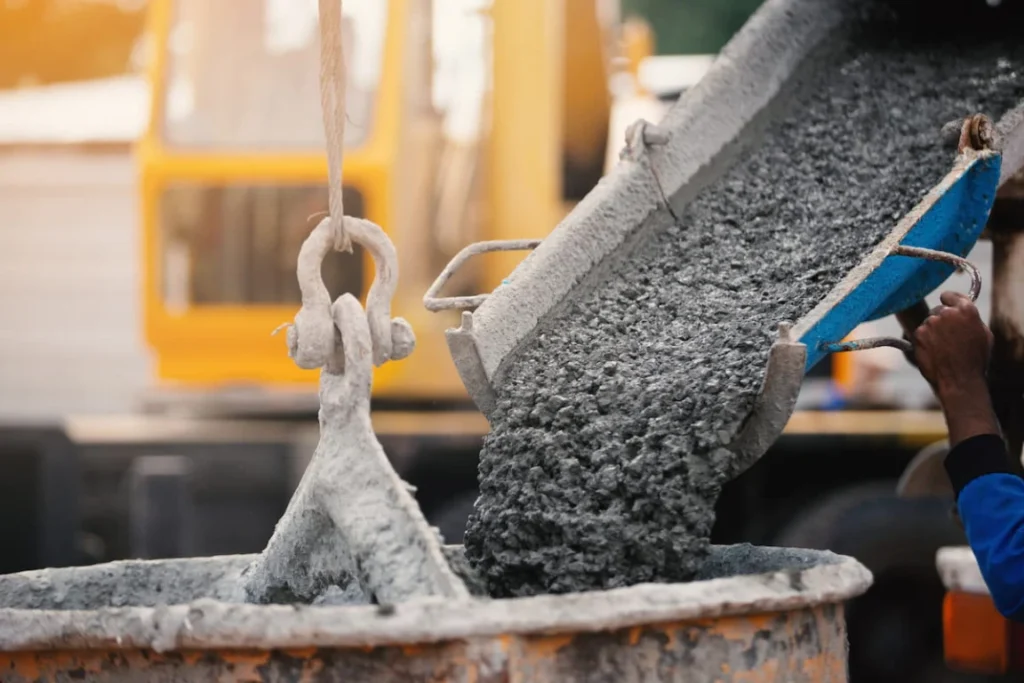
Pumping does not change what a mix is specified to do. It changes what arrives. A 32 MPa air-entrained mix that leaves the chute at 6.5% air can reach the deck at 5% — or, on a boom with a long vertical drop, at less than half what went into the hopper. Everything below is about closing that gap before it costs somebody a rejected load.
Two questions decide a pumped placement: can the mix travel the line without plugging, and does the concrete that lands in the forms still meet the spec it was ordered against. They have different answers, and both belong in the pre-pour conversation rather than in an argument beside the truck.
What actually makes a mix pumpable
A pump moves concrete as a plug of material riding on a thin lubricating layer of paste and mortar against the pipe wall. Pumpability is that lubricating layer surviving the trip. Three variables control it: aggregate size and shape, the sand grading, and the volume of paste available to coat everything.
| Parameter | Working target | Why it matters in the line |
|---|---|---|
| Maximum coarse aggregate | Not more than one-third of the smallest inside diameter of the pump or line | Oversize particles bridge across a reducer or bend and start a plug |
| Sand fineness modulus | ASTM C33 allows 2.3 to 3.1; roughly 2.5 is the practical target for pump mixes | Coarse sand starves the lubricating layer; very fine sand raises water demand |
| Cementitious content | Around 320 kg/m³ (540 lb/yd³) as a floor for a 20 mm mix | Paste volume is what carries the aggregate, not water |
| Slump | Ordered slump held within CSA tolerance: ±20 mm below 80 mm, ±30 mm from 80–180 mm, ±40 mm above 180 mm | A mix at the low end of tolerance pumps at much higher pressure |
| Free fall at discharge | Keep the drop at the hose end to about 1 m (3 ft) | Long free fall segregates the mix and knocks out air |
Note what is not on that list: adding water at the pump. Water thins the paste, raises bleed, and a bleeding mix is the classic setup for a plug — the water separates in the line, the aggregate packs, and everything stops. A high-range water reducer buys the same flow without the water, which is why most pumped structural mixes in Calgary run one.
Gradation is the quiet variable. A gap-graded pile of aggregate that trucks and places fine on a slab can be miserable to pump, because there is nothing sized between the coarse fraction and the sand to keep the mortar continuous. If the pour is pumped, that gets decided at the batch plant, not at the boom.
The air problem: what the pump takes out
Air entrainment is not optional in Calgary. Under CSA A23.1, air content Category 1 — the freezing-and-thawing category that covers exterior flatwork, foundations and anything exposed — calls for 6–9% air with 10 mm aggregate, 5–8% with 14–20 mm aggregate, and 4–7% with 28–40 mm. Category 2, for concrete not exposed to freezing and thawing, drops each band by roughly one point.
Pumping works against that air, and the amount it removes depends almost entirely on boom geometry.
- Typical loss through a pump is 0.5 to 1.0 percentage points of air, per NRMCA’s technical guidance.
- With a long boom section oriented vertically downward, air content at the point of placement can be less than half of the air going into the hopper.
- Loss up to about 3 percentage points still generally leaves adequate freeze-thaw resistance; beyond that the mix is no longer the mix that was specified.
The mechanism is simple: concrete free-falling down a vertical pipe pulls a partial vacuum, the air bubbles expand, and they collapse when the material hits an elbow or the placement surface. High-cement, flowable mixes are the most vulnerable, and the effect shows up in mixes with cementitious contents as ordinary as 300 kg/m³. Upward and horizontal boom configurations, and the flexible end hose, cause no meaningful loss.
The practical fix is not more air in the truck as a reflex. It is boom configuration first — avoid the long vertical downward run where possible, and put the flexible hose at the end so the concrete does not free-fall out of a rigid pipe — and only then a batch adjustment, agreed in advance, with the supplier told what the boom will look like.
Where the acceptance sample gets taken
This is the argument that shows up on site, and it is worth settling before the truck arrives, because two credible sources point in different directions.
Sample after the pump. NRMCA’s guidance on air loss recommends sampling from concrete placed in the structure rather than from the end of the pump line, on the reasoning that what matters is the air in the concrete that hardens in the element. Ontario’s OPSS.MUNI 1350 takes the same practical line for acceptance: total air content is measured with an air meter immediately prior to placing, against CSA A23.1.
Sample before the pump. Research published through the American Concrete Pumping Association found roughly 20% of the air disappearing from the plastic measurement after one circulation through a pump — but also that the dissolved air largely reforms before the concrete sets, redistributing at a spacing similar to what went in. On that evidence, the pre-pump sample is the better predictor of the hardened air-void system, which is what actually resists freeze-thaw damage.
Both can be right, because they measure different things: the plastic air test measures what is in the concrete at that moment, and durability depends on the air-void system in the hardened concrete. What matters commercially is that everybody agrees on the sampling point before the pour, writes it into the pre-pour meeting notes, and applies it consistently to every load that day. The Canadian Farm Builders Association’s concrete guidelines put the warning plainly: air contents measured after pumping may be significantly lower than those measured at the end of the chute. A load rejected on a post-pump air test that was specified against a chute number is an argument nobody wins.
Our own practice is to ask two questions when a pump is on the ticket: what is the boom configuration, and where is the air test being taken. Both change what we batch.
What this means on an Alberta pour
Calgary’s exposure classes drive the air requirement, and the air requirement is what pumping threatens. A C-2 exterior slab or an F-1 element is ordered air-entrained for a reason — the mix has to survive more than a hundred freeze-thaw cycles a year with de-icing salt on it. If the pump quietly removes two points of air on the way to the deck, the slab that gets placed is not the slab that was specified, and nobody finds out for five winters.
Three habits keep that from happening:
- Tell the supplier the placement method when ordering, not on the morning of the pour. Pumped, chuted, buggied and conveyed placements are not the same order.
- Match aggregate size to line size, not to habit. A 20 mm mix through a 75 mm line is asking for a plug at the first reducer.
- Prime properly and keep the line moving. A grout or slurry prime, then continuous pumping — every stop lets the mix stiffen and raises the pressure needed to restart.
Cold-weather pumping adds its own list. Lines and hoppers sitting in a −20°C morning pull heat straight out of the first metres of concrete, so priming matters more, not less. Where a winter placement needs heat in the material itself, hot mix concrete — batched with heated water and warmed aggregate — arrives at a higher plastic temperature, which also means faster slump loss in the line. That trade is worth planning for: order the hot mix concrete for the placing temperature you need, and keep the pump moving so the extra heat does not become extra stiffening in the pipe.
Why lines plug, in order of frequency
Plugs are rarely mysterious. In order of what we see:
- Slump loss during a stop — the pour waits for rebar, the mix stiffens, and the restart pressure exceeds what the pump can deliver.
- Bleeding or over-wet mixes — water separates, aggregate packs against a bend.
- Gradation gaps or oversize aggregate — a bridge forms at a reducer or elbow.
- A dry or badly primed line — the lubricating layer never establishes.
- Worn line and reducer wear — thin spots and steps in the bore catch material.
Only one of those is a pump problem. The other four are ordering and coordination problems, which is the same reason we would rather have the conversation the day before.
FAQ
Does pumping reduce concrete strength? Not by itself. Pumping a properly designed mix does not reduce strength — but adding water at the pump to make a stiff mix travel does, and losing entrained air reduces freeze-thaw durability even when the cylinder breaks fine.
How much extra air should be batched for a pump? There is no fixed number, because loss depends on boom geometry. Typical loss is 0.5–1.0 percentage points; a long vertical drop can take far more. Agree the target and the sampling point with the supplier and the testing agency before the pour rather than adjusting mid-pour.
What is the largest aggregate that can be pumped? The working limit is one-third of the smallest inside diameter in the system — including reducers and the end hose, not just the boom pipe. In practice most Calgary pumped mixes run 20 mm or smaller.
Can air-entrained concrete be pumped at all? Yes, and most Alberta exterior concrete is. The point is not to avoid pumping; it is to plan for what the pump does to the air and to test where everyone agreed to test.
What slump should be ordered for a pumped pour? Order the slump the placement needs and let the admixture, not water, deliver it. Under CSA A23.1 the allowable variation is ±20 mm below 80 mm slump, ±30 mm between 80 and 180 mm, and ±40 mm above 180 mm, so an order at the low end of a range can arrive stiffer than the pump wants.
Planning a pumped pour in Calgary
If the pour is going through a line, tell us the line size, the boom configuration and the exposure class, and we will batch for the placement rather than for the chute. Our concrete line pump service in Calgary runs off the volumetric trucks, so slump and mix can be adjusted mid-pour rather than sent back.
Before you order, it is worth confirming two things: the exposure class the element actually falls under, and whether the standard 32 MPa Calgary mix is the right starting point for what you are placing. Once it is in the forms, the CSA A23.1 curing requirements decide whether the air you protected does its job.