
For most residential and light commercial concrete in the Calgary area, the standard mix is 32 MPa, Type 50 (sulphate-resistant, the same thing the current CSA code calls Type HS), with 5 to 8 percent entrained air. Two local conditions drive that spec: Alberta’s sulphate-heavy soils chemically attack ordinary cement, and the freeze-thaw cycle cracks concrete that has no air voids to relieve the pressure. Ask your supplier to confirm your mix meets it.
Concrete looks like one grey material. It is not. The mix that goes into your footings is a recipe that changes with the ground it sits in and the weather it faces. Here is how the standard mix is built, where it belongs, and when you step up from it.
1. What the numbers on your mix ticket actually mean
Three specs do most of the work on a residential or light commercial pour.
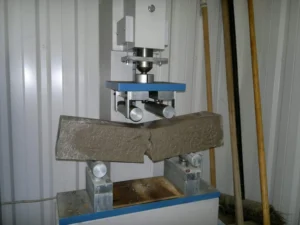
“32 MPa” is compressive strength at 28 days: how much load the cured concrete can carry. “Type 50” is the cement type, chosen for chemical resistance rather than raw speed. “5 to 8 percent air” is the volume of tiny air bubbles deliberately entrained in the mix. None of these is a marketing number. Each one answers a specific threat to concrete poured into Calgary ground, and the rest of this article walks through them one at a time.
When the truck arrives, ask one thing: can you confirm this load is 32 MPa, Type 50, with 5 to 8 percent air? A supplier who batches its own concrete can answer without hesitating.
2. Why Type 50: Alberta’s sulphate soils attack ordinary cement
Much of the soil around Calgary and the surrounding foothills carries sulphates. When sulphate-laden groundwater reaches concrete made with ordinary cement, it reacts with the cured paste and expands. Over years, that expansion pushes the concrete apart from the inside. Footings spall, foundation walls crack, and flatwork that touches grade starts to break down.
Type 50 cement is formulated to resist that reaction. It is the sulphate-resistant cement, and in the current CSA naming it is labelled Type HS (high sulphate resistance). Same material, updated label. For anything sitting in or against Calgary-area soil, footings, foundation walls, grade beams, structural flatwork, Type 50 is the honest default, not an upgrade you should have to fight for.
If a quote is silent on cement type, that is worth a question. In this region, sulphate resistance is the baseline, not the extra.
3. Why 5 to 8 percent air: freeze-thaw does the cracking
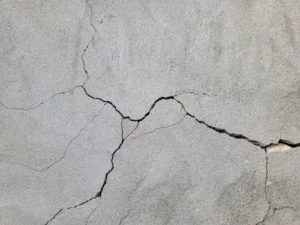
Calgary swings across the freezing point again and again through the season. Water gets into the surface pores of concrete, freezes, expands, and thaws again, sometimes many times in a single week. Concrete with no room to absorb that expansion cracks and flakes from the surface down. That is scaling.
Entrained air fixes it. Air-entraining admixture creates millions of microscopic bubbles distributed through the paste. When pore water freezes, it has somewhere to push. Get 5 to 8 percent air in the mix and the concrete rides out the freeze-thaw cycle that would destroy a mix with none. This is why air content is not optional on exterior work in this climate. It is the difference between a driveway that lasts and one that pits within a few winters.
4. Where 32 MPa is the right call, and where it is not enough
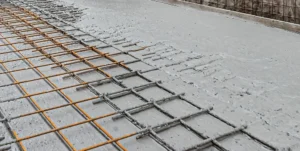
32 MPa is the workhorse because it carries the loads on most residential and light commercial jobs with margin to spare: footings, foundation and basement walls, garage slabs, structural flatwork. In a recent stretch of work our footings ran from 14 to 90 cubic metres and our walls from 40 to 60 cubic metres, and 32 MPa Type 50 covered the bulk of it.
You step up when the loading or the code calls for it. For higher-demand municipal and utility work, thrust blocks that restrain pressurized pipe, for example, the spec moves to 35 MPa Type 50. The cement type stays the same because the sulphate exposure has not changed; the strength goes up because the structural demand has. The lesson is that strength and cement type are two separate decisions. Do not let a higher strength number reassure you that sulphate resistance was handled. Confirm both.
5. Salted flatwork: the C-2 exposure question most people never ask
Your driveway, sidewalks, and steps get de-icing salt every winter. Salt makes freeze-thaw worse and adds chloride attack on top of it. The CSA standard has a specific exposure class for exactly this situation: C-2, for exterior flatwork exposed to chlorides and freeze-thaw but not continuous heavy traffic.
Meeting C-2 means the mix has to satisfy three things together: 32 MPa at 28 days, 5 to 8 percent air, and a water-to-cementing ratio of 0.45 or lower. That last number matters as much as the other two. A wetter mix is easier to place, but a higher water-to-cement ratio means a more porous surface that lets chlorides in. C-2 caps it. This is the standard your salted flatwork should meet. Ask us to confirm your driveway mix is batched to C-2, and if another supplier will not put that in writing, that tells you something.
6. Specialty mixes exist, but they are the exception
The standard mix covers most jobs. Some do not fit it, and that is where a supplier that batches its own concrete earns its place. Tight commercial pours sometimes call for a 10 mm aggregate, no-fibre mix. Voids, trenches, and abandoned utilities get filled with flowable fill, a low-strength 5 MPa self-levelling backfill that can be dug out later. Decorative work can carry an integral colour such as a “smoke” grey. The point is that the right mix is a decision made per pour, not a single product sold to everyone.
Choosing the right concrete mix is only half of the planning process. You also need to know how much concrete can realistically be delivered in one trip, how large pours are coordinated, and when multiple trucks are required. Before scheduling your project, read our guide on How Much Concrete Can You Get Delivered in Calgary? From a 1 m³ Trench to a 90 m³ Pour to understand delivery capacity, truck scheduling, and what to expect on pour day.
Proof from a recent ten-day stretch
Specs only matter if a supplier can batch them consistently and deliver on schedule. In a recent ten-day stretch, our own plant and crews batched, delivered, and placed more than 1,100 cubic metres of concrete across roughly 80 separate pours, including Saturday work. Single pours ran up to 90 cubic metres, including a footing for a major Calgary developer. We placed flowable fill up to 70 cubic metres on commercial sites and around 25 cubic metres for builder void-fill. Days ran from 5:00 am starts to evening pours around 5 pm, including a roughly 1,500 square foot garage slab on a Saturday.
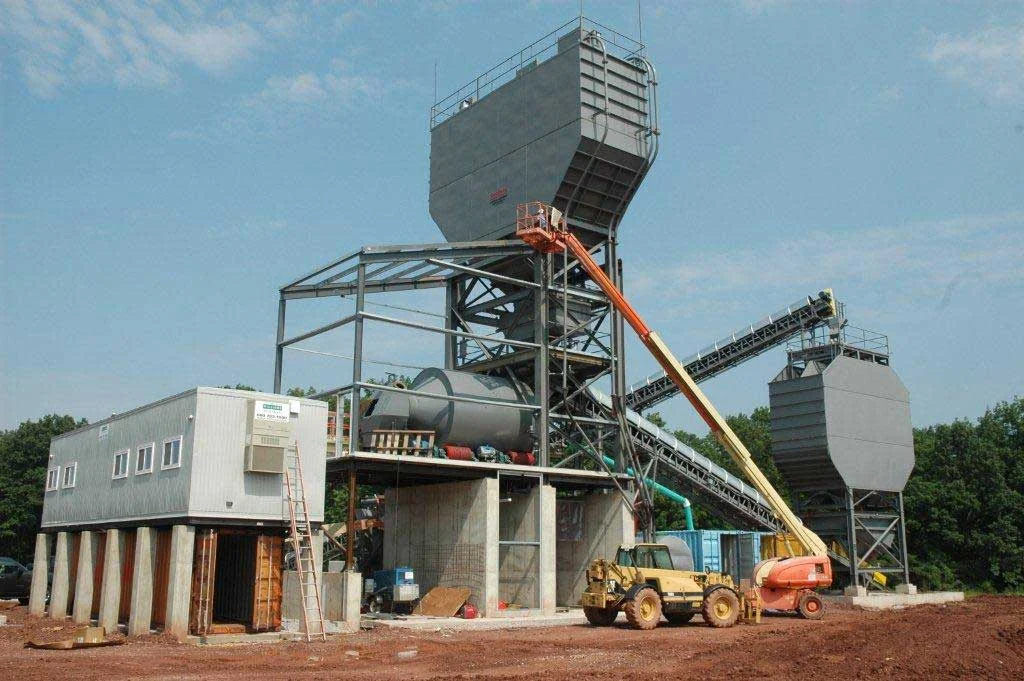
That volume came off a five-truck ready-mix fleet feeding from our own batch plant with two cement silos and near-daily bulk cement deliveries: our own fleet and our own cement supply, real batching capacity, not a broker. The work spanned residential, commercial, municipal, institutional, and industrial pours in the same week, and builders’ concrete testers were accommodated on site whenever they came to sample a load.
If you’d like to understand the standards behind these specifications, the CSA Group publishes CSA A23.1, Canada’s governing standard for concrete materials and construction, while the Cement Association of Canada provides practical technical resources on sulphate-resistant cement, freeze-thaw durability, exposure classes, and concrete best practices. Together, these references explain why cement type, air entrainment, and water-to-cement ratio are specified together rather than as separate requirements.
FAQ
What is the standard concrete mix for Calgary? For most residential and light commercial work in the Calgary area, the standard mix is 32 MPa strength, Type 50 sulphate-resistant cement (called Type HS in current CSA naming), with 5 to 8 percent entrained air. That combination handles Alberta’s sulphate soils and the local freeze-thaw cycle.
Why does Calgary concrete need Type 50 cement? Soils around Calgary carry sulphates that chemically attack ordinary cement, causing it to expand and break apart over time. Type 50 cement is formulated to resist that reaction, which is why it is the regional default for anything in contact with the ground.
What does 5 to 8 percent air do in concrete? Entrained air creates microscopic bubbles that give freezing pore water somewhere to expand, preventing the surface cracking and flaking (scaling) that freeze-thaw would otherwise cause. It is essential for exterior concrete in Calgary’s climate.
When do I need 35 MPa instead of 32 MPa? You step up to 35 MPa for higher structural demand, such as thrust blocks on municipal and utility projects. The Type 50 cement stays the same because the sulphate exposure has not changed; only the strength requirement increases.
What mix should my driveway be? A salted driveway, sidewalk, or step should meet CSA exposure class C-2: 32 MPa at 28 days, 5 to 8 percent air, and a water-to-cementing ratio of 0.45 or lower. The low water ratio keeps the surface dense enough to resist de-icing chlorides.
How do I know I am getting the right mix? Ask your supplier to confirm the strength, cement type, air content, and, for salted flatwork, the C-2 exposure class before the pour. A supplier that batches its own concrete can confirm those numbers directly rather than passing your question up a chain.
Get a quote / next step
Tell us what you are pouring, footings, walls, a garage slab, a driveway, or a commercial placement, and we will confirm the right mix for your ground and get you on the schedule. We batch from our own plant and run our own fleet, so scheduling is often next-day or same-week rather than weeks out.
Need the Right Mix for Your Calgary Project?
Whether you’re pouring footings, foundation walls, garage slabs, driveways, sidewalks, commercial flatwork, or municipal infrastructure, we’ll recommend the mix that’s appropriate for your site conditions—not just the strongest concrete available.
Omega Ready Mix batches CSA-compliant concrete from our own Calgary plant, including:
- 32 MPa and 35 MPa structural concrete
- Type 50 (Type HS) sulphate-resistant cement mixes
- 5–8% air-entrained concrete for Calgary freeze-thaw conditions
- C-2 exposure-class concrete for salted exterior flatwork
- Flowable fill and specialty commercial mixes
- Quality-controlled batching with consistent mix designs
- Fast scheduling throughout Calgary and surrounding communities
Before your pour, we’ll confirm the required strength, cement type, air content, aggregate size, and exposure class so your concrete matches both your engineer’s specifications and Calgary’s soil and climate conditions.
Contact Omega Ready Mix today to discuss your project, verify the correct concrete mix, and schedule delivery from our own plant and fleet.