
CSA A23.1 does not set one curing period. It sets three, and the one that applies to your slab is determined by the exposure class in the spec — not by the weather, not by the schedule, and not by when the finisher wants to go home. Basic curing is 3 days at 10 °C or until the concrete reaches 40% of specified strength. Additional curing is 7 days at 10 °C and until 70% of specified strength. Extended curing is a wet-curing period of 7 days. Everything else in this article is detail hanging off those three lines.
Curing is the cheapest durability you will ever buy and the first thing cut when a crew is behind. That trade is worse than it looks: concrete that is not cured can lose up to 40% of its strength, and the losses land in the cover layer — exactly the few millimetres that stand between de-icing salt and your reinforcement.
The three regimes, and how to tell which one you are on
| Regime | Requirement | Typical trigger |
|---|---|---|
| Basic curing | 3 d at 10 °C, or for the time necessary to attain 40% of the specified strength | Ordinary interior and low-exposure work |
| Additional curing | 7 d at 10 °C and until 70% of the specified strength | Severe exposures — the freeze-thaw and chloride classes that cover most Calgary exterior flatwork |
| Extended curing | A wet-curing period of 7 days — ponding, continuous sprinkling, or wet fabric kept continuously wet | Extended-service-life work, where the spec is buying decades, not years |
Read the conjunctions carefully, because they carry the whole obligation.
Basic curing uses “or.” Three days at 10 °C satisfies it, and so does reaching 40% of specified strength, whichever you can demonstrate. Either one closes it out.
Additional curing uses “and.” Seven days at 10 °C is not enough on its own. The concrete must also have reached 70% of specified strength. On a mix with supplementary cementing materials placed in a cold October week, those two conditions do not land on the same day, and the later one governs. If your crew has been treating “additional curing” as “a week,” they have been meeting half the clause.
Extended curing is a method requirement, not just a duration. It calls for wet curing — ponding, continuous sprinkling, or wet fabric — for seven days. A membrane compound is not the same thing and does not substitute for it.
Which regime applies comes from the exposure class, which comes from the spec. If you are unsure which class your project sits in, work through the eleven CSA A23.1:24 exposure classes and what each one actually asks for before you plan the cure. On most Calgary exterior flatwork — driveways, walks, aprons, anything that will meet a snow plough and a bag of ice melt — you are in a freeze-thaw or chloride class, and additional curing is the floor.
What “at 10 °C” actually obligates you to do
The 10 °C in each regime is a minimum temperature threshold that the concrete has to be held at through the curing period, not an ambient reading you hope for. Cold-weather practice puts the same number in the same place: maintain the concrete at a minimum of 10 °C for the duration of the curing period, and continue protection for as long as it takes to develop the required properties.
In Calgary, that threshold is the whole reason curing plans go sideways. The heat that keeps a slab above 10 °C for seven straight days does not come from October afternoons. It comes from the mix and the protection:
- Placement temperature. Hot mix concrete gives you a head start on the clock — you are banking degrees before the first hoarding tarp goes up. Our field rules for that are in the cold-weather concrete rules every Calgary crew should cite before October 1.
- Insulated blankets and hoarding. These hold hydration heat rather than adding it. On a thin exterior slab with a high surface-to-volume ratio, they run out of heat faster than crews expect.
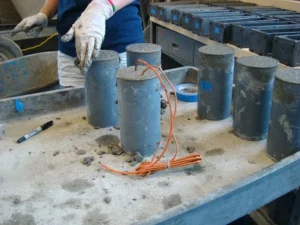
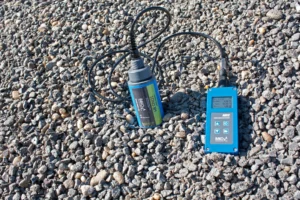
- Maturity or field cylinders to prove the strength gate. Under additional curing you owe 70% of specified strength, and “it’s been a week” is not evidence. Field-cured cylinders or an accepted maturity method is what closes the clause.
A Chinook makes this harder, not easier. A slab that sat under blankets at 4 °C for five days and then hits +12 °C and wind has not been cured for five days — it was protected badly for five days, and the wind now pulls moisture out of a surface that never developed a skin.
Curing compounds: what the standards actually require
Membrane-forming compounds are the default on flatwork because ponding a driveway for a week is not realistic. They are legitimate, and they are also where most of the field non-compliance lives.
ASTM C309 governs liquid membrane-forming curing compounds. The performance requirement is a moisture-retention limit: a maximum moisture loss of 0.55 kg/m² of water in 72 hours, measured by ASTM C156. Compounds are sorted into three types — Type 1 (clear or translucent), Type 1-D (clear or translucent with a fugitive dye) and Type 2 (white pigmented) — and two classes, Class A and Class B, where Class B restricts the vehicle solids to resin.
Public-works specifications commonly narrow that to a single product description. Nova Scotia’s cast-in-place concrete specification, for example, calls for a white-pigmented Type 2, Class B compound meeting ASTM C309, applied immediately after texturing, and backs it with acceptance testing for non-volatile content (ASTM D1644, within ±2.5% of specification), relative density (ASTM D244, within ±0.01) and settlement rate (ASTM D1309). If your project spec is that specific, the drum on the pallet has to match it — a Type 1 clear compound is a different product, not a substitution.
Application rate is a compliance item, not a preference. A typical published rate is 200 ft²/gallon, roughly 4.9 m²/L. Stretching a drum across more area than that is the single most common way a compliant compound produces a non-compliant cure. The moisture-loss limit was measured at the specified rate; thin the film and the number no longer applies.
CSA A23.1:24 added a second acceptance path. Clause 7.8.2.2 now recognizes ASTM C1315 for liquid membrane-forming compounds having special properties for curing and sealing. That matters if your architect wants a cure-and-seal on an exposed slab: it is now a named standard rather than a product claim, and you can specify it directly.
The 2024 edition also introduced CSA A23.2-27C, a fluid penetration resistance test method offered as an alternative to rapid chloride permeability testing for evaluating performance-based curing alternatives. That is the standard opening a door it had previously kept shut — if you want to propose a curing method that is not on the prescriptive list, there is now a test that can support it.
Where curing failures show up in Calgary
Curing defects rarely announce themselves at stripping. They show up in the first or second winter, and by then they look like somebody else’s problem.
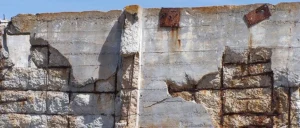
Year-one spalling. A surface that lost its moisture in the first 72 hours has a weak, porous skin. Salt-laden meltwater gets into it by absorption in hours, not by diffusion over years. That is the mechanism behind a new Calgary driveway that spalls in year one, and no sealer applied in year two reaches back to fix it.
Crazing and dusting. Fine map cracking and a surface that chalks under a broom are classic under-curing signatures — plastic and drying shrinkage at the surface with nothing holding it.
Curling at joints and edges. Differential drying between top and bottom of a slab lifts the edges. That interacts directly with joint layout, which is why curing and jointing have to be planned together rather than sequentially — see the control-joint mistakes that crack Calgary driveways in year one.
A durable mix that never got to be durable. Specifying a low water-cementing-materials ratio and the right exposure class buys a concrete that can last decades. The value of that mixture is wasted if curing is inadequate, because the property you paid for develops in the cover layer — and the cover layer dries first.
A curing plan that survives a real schedule
- Pull the exposure class off the drawings and write down which regime it triggers. Do this at pre-pour, not on pour day.
- Decide how you will prove the strength gate if you are on additional curing. Field cylinders or maturity — pick one and set it up before placement.
- Match the compound to the spec, including type and class, and confirm the coverage rate on the label against the area you intend to cover. Order for the rate, not for the budget.
- Apply immediately after finishing or texturing. The window is minutes on a windy Calgary afternoon, not hours.
- Plan the 10 °C hold as a heat budget: placement temperature, blanket R-value, hoarding, and how many days of overnight lows the slab has to get through.
- Do not stop at day seven by default under additional curing. Stop when both conditions are satisfied.
- Record it. Dates, temperatures, product and lot, coverage rate, cylinder breaks. If a surface is questioned in year three, the curing record is the only document that answers.
FAQ
How long does CSA A23.1 require concrete to be cured? It depends on the regime. Basic curing is 3 days at 10 °C or until 40% of specified strength. Additional curing is 7 days at 10 °C and until 70% of specified strength. Extended curing is a 7-day wet-curing period.
What is the difference between basic and additional curing? Duration and logic. Basic curing is satisfied by either 3 days at 10 °C or 40% of specified strength. Additional curing requires both 7 days at 10 °C and 70% of specified strength — meeting one is not enough.
Does a curing compound satisfy extended curing? No. Extended curing specifies wet curing for 7 days — ponding, continuous sprinkling, or wet fabric kept continuously wet. A membrane compound is a different method and does not meet that requirement.
What does ASTM C309 actually test? Moisture retention. A compliant compound must limit moisture loss to a maximum of 0.55 kg/m² of water over 72 hours when tested to ASTM C156, at the manufacturer’s specified application rate.
Is a cure-and-seal product allowed under CSA A23.1? Yes, and as of the 2024 edition it has a named standard. Clause 7.8.2.2 recognizes ASTM C1315 for liquid membrane-forming compounds with special properties for curing and sealing.
How much strength do you lose if concrete is not cured? Published guidance puts the loss at up to 40%, along with surface cracking, curling, crazing and dusting. The durability loss in the cover layer is the more expensive half of that.
Plan the cure when you order the mix
The curing regime is set by the exposure class, and the exposure class is set when the mix is specified. That makes curing a supply-side conversation, not a finishing-day one — the placement temperature you order, the mix you order, and the schedule you commit to all determine whether a 10 °C hold for seven days is realistic on your site.
If you have flatwork coming up and want the exposure class, the mix and the curing plan settled in one call, talk to us about your flatwork supply. Bring the exposure class from the drawings, the placement date, and the surface area. Those three inputs size the cure as reliably as they size the load.
Sources
- American Concrete Institute — Doug Hooton, “Bridging the Gap” (CSA A23.1 curing regimes)
- ASTM International — ASTM C309, Standard Specification for Liquid Membrane-Forming Compounds for Curing Concrete
- CSA Group — CSA A23.1:24 / CSA A23.2:24, Concrete materials and methods of concrete construction