A practical comparison for homeowners choosing concrete reinforcement in Calgary.
For most residential slabs in Calgary, fiber reinforcement is the best all-around choice — it distributes evenly through the mix, eliminates positioning problems, and provides excellent crack control for driveways, patios, and garage pads at 4 to 5 inches thick. Rebar is the right call for thicker slabs, heavy loads, or structural applications. Wire mesh works in theory but has well-documented installation problems that undermine its effectiveness.
Why Does Concrete Need Reinforcement in the First Place?
Concrete is incredibly strong in compression — it can handle enormous weight pressing down on it. But it is weak in tension, meaning it cracks easily when forces try to pull it apart or bend it. Reinforcement adds tensile strength to hold the slab together when cracks inevitably form.
In Calgary, reinforcement is even more critical than in milder climates. Our freeze-thaw cycles subject slabs to enormous stress. Ground freezing can heave soil by 2 to 4 inches, creating bending forces that unreinforced slabs simply cannot handle. A reinforced slab may still crack, but the reinforcement holds the pieces together so the crack stays tight rather than widening into a structural failure.
The general rule of thumb from concrete professionals: slabs under 4 inches typically do not need steel reinforcement. Slabs 4 to 5 inches thick benefit from wire mesh or fiber. Slabs over 5 inches thick, or any slab carrying heavy loads, should use rebar.
Reinforcement standards for structural concrete in Canada are defined by the CSA Group, particularly CSA A23.1 and A23.3, which outline material performance and reinforcement requirements for durability in freeze-thaw climates like Calgary.
What Are the Three Main Reinforcement Options?
Rebar (Reinforcing Bar)
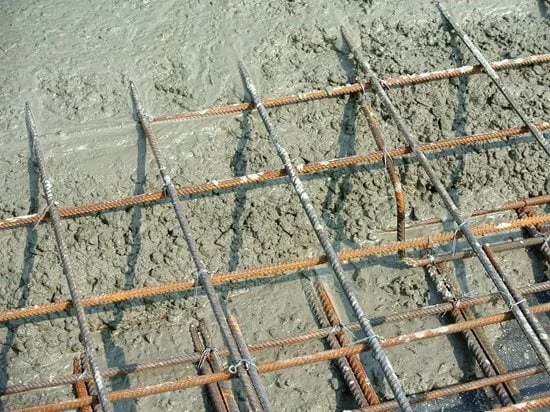
Rebar is steel bar, typically 10M or 15M diameter for residential work, laid in a grid pattern inside the slab. It provides the highest tensile strength and is the standard for structural concrete applications.
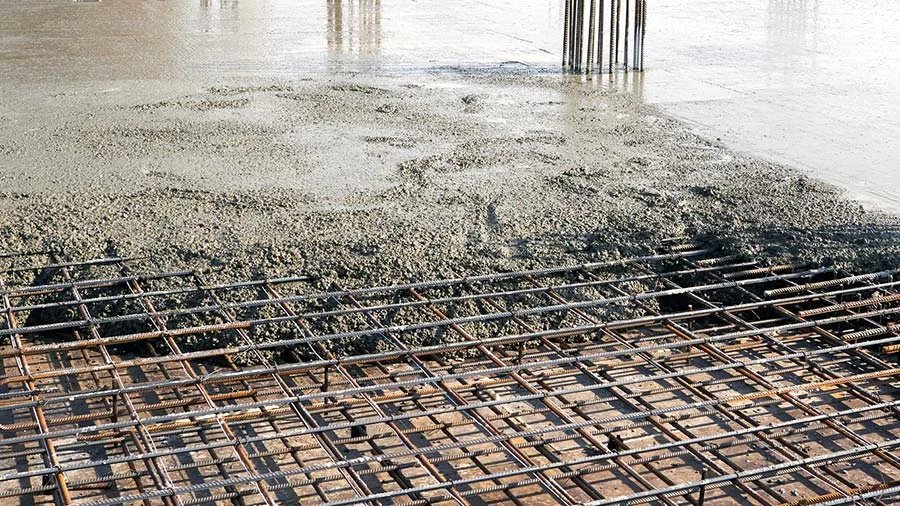
How it works: Rebar is tied into a grid (usually 12 to 18 inch spacing) and supported on chairs or dobies to position it in the lower third of the slab. When properly placed, it creates a steel skeleton inside the concrete that holds everything together under stress.
Cost: $0.75 to $1.50 per square foot for material and installation in Calgary.
Best for: Driveways with heavy vehicle traffic, garage pads, slabs over 5 inches thick, any load-bearing application, and areas with known soil movement.
Wire Mesh (Welded Wire Fabric)
Wire mesh is a pre-made grid of thinner steel wire, typically 6×6 W1.4/W1.4 (6-inch grid, 10-gauge wire) for residential slabs. It comes in flat sheets or rolls and is placed inside the slab to control cracking.
How it works: Mesh is laid over the gravel base on supports and should sit in the lower to middle third of the slab. As concrete is poured and finished around it, the mesh theoretically holds cracks tight.
Cost: $0.25 to $0.60 per square foot for material and installation in Calgary.
The controversy: Wire mesh is one of the most debated topics in concrete forums. The core issue is positioning. As one veteran concrete finisher put it: “90 percent of wire mesh ends up lying on the ground because workers walk on it during the pour.” When mesh sinks to the bottom of the slab, it provides almost no structural benefit — it is just expensive scrap metal embedded in your concrete.
Best for: Interior slabs on stable ground where positioning can be carefully maintained, budget-conscious projects where rebar is overkill.
Fiber Reinforcement
Fiber reinforcement consists of synthetic (polypropylene) or steel fibers mixed directly into the concrete. The fibers distribute throughout the entire slab, providing three-dimensional crack resistance.
How it works: Fibers are added to the concrete mix before or during pouring. Millions of tiny fibers spread throughout the slab, bridging micro-cracks as they form and preventing them from growing into larger structural cracks.
Cost: $0.15 to $0.40 per square foot (added to the concrete mix price) in Calgary.
Best for: Driveways, patios, sidewalks, garage pads — most standard residential flatwork at 4 to 5 inches thick.
How Do the Three Options Compare?
| Factor | Rebar | Wire Mesh | Fiber |
|---|---|---|---|
| Tensile strength | Highest | Moderate | Good for crack control |
| Cost per sq ft | $0.75 – $1.50 | $0.25 – $0.60 | $0.15 – $0.40 |
| Installation difficulty | High (tie, support, inspect) | Medium (position and support) | None (mixed into concrete) |
| Positioning issues | Moderate (needs chairs) | Severe (sinks during pour) | None (distributed throughout) |
| Crack control | Excellent at crack location | Good if properly positioned | Excellent throughout slab |
| Corrosion risk | Yes (if exposed to moisture) | Yes (if exposed to moisture) | No (synthetic fiber) |
| Best application | Structural, heavy loads | Interior, stable ground | General residential flatwork |
| Calgary frost heave protection | Excellent | Fair (positioning dependent) | Good |
On a typical 400 sq ft Calgary driveway, the cost difference is meaningful:
- Rebar: $300 to $600 added cost
- Wire mesh: $100 to $240 added cost
- Fiber: $60 to $160 added cost
Why Is the Concrete Industry Moving Toward Fiber?
The trend across North American residential concrete is clearly shifting toward fiber reinforcement, and the reasons are practical:
No positioning problems. This is the single biggest advantage. Fiber cannot sink to the bottom of the slab because it is part of the mix itself. Every cubic inch of concrete contains reinforcement. This eliminates the most common failure mode of wire mesh entirely.
Faster installation. There is no mesh to lay, no chairs to set, no rebar to tie. The concrete crew pours and finishes without working around steel. On a typical Calgary residential pour, fiber reinforcement saves 30 to 60 minutes of labor compared to mesh, and 1 to 2 hours compared to rebar.
Three-dimensional protection. Rebar and mesh only resist cracking in two dimensions — along the plane of the grid. Fiber resists cracking in all directions, including surface crazing and edge cracking that steel reinforcement does nothing to prevent.
No corrosion. Synthetic fibers cannot rust. In Calgary, where road salt and de-icers are a fact of life, this matters. Corroding steel inside a slab creates expansion pressure that can cause spalling — the very damage the reinforcement was supposed to prevent.
Reinforcement choice directly affects your total price — here’s a breakdown of concrete cost per square foot in Calgary and how fiber, rebar, and mesh impact your final quote.
Why Does Calgary’s Climate Make Reinforcement Choice Matter More?
Calgary experiences some of the most aggressive freeze-thaw cycling in Canada. In a typical winter, concrete slabs endure 30 to 50 freeze-thaw cycles. Each cycle pushes moisture into micro-cracks, freezes it (expanding by 9 percent), and then thaws it — widening the crack slightly each time.
On top of that, Calgary’s clay-heavy soils are prone to frost heave. When the ground freezes to depths of 4 to 6 feet, it can lift and shift the soil beneath your slab unevenly. This creates bending stress that demands proper reinforcement.
For exterior slabs in Calgary, reinforcement is not optional — it is essential. The combination of freeze-thaw cycling and frost heave means unreinforced slabs have a significantly shorter lifespan, often showing serious cracking within 3 to 5 years.
Air entrainment (tiny bubbles mixed into the concrete) works alongside reinforcement to combat freeze-thaw damage. A properly reinforced slab with 5 to 7 percent air entrainment is the Calgary standard for exterior concrete that lasts.
Can I Combine Reinforcement Methods?
Yes, and many Calgary contractors do. Common combinations include:
- Rebar plus fiber: Used for driveways or garage pads that will support heavy loads. Rebar handles the major structural forces while fiber controls surface cracking.
- Wire mesh plus fiber: A budget compromise that compensates for mesh positioning problems with distributed fiber reinforcement.
For most homeowners, fiber alone is sufficient for standard 4 to 5 inch residential slabs. Adding rebar makes sense for slabs over 5 inches or areas with known soil instability.
How Does Volumetric Delivery Help With Reinforcement?
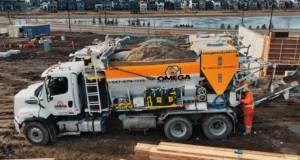
When you order concrete from Omega Ready Mix, fiber reinforcement can be added directly to the volumetric mix on-site. This means:
- The fiber dosage is precisely controlled and verified at your pour site
- No separate installation step is needed — fibers are already in the concrete when it comes out of the truck
- The mix can be adjusted on-site if conditions change (for example, adding more fiber for a thicker section)
- You are not paying a separate crew to lay and position mesh or rebar for standard flatwork
For projects that require rebar (structural slabs, footings, or heavy-load areas), your contractor installs the rebar in advance and Omega delivers the fiber-reinforced concrete to pour around it — giving you both structural steel and distributed crack control.
Frequently Asked Questions
Do I need rebar for a residential driveway in Calgary?
For a standard 4 to 5 inch driveway, fiber reinforcement provides excellent crack control and is the most reliable option. Rebar is recommended if your driveway exceeds 5 inches thick, supports heavy vehicles (RVs, trailers), or sits on known problem soil.
Is wire mesh a waste of money?
Not if it is properly installed — but that is the problem. Keeping mesh at the correct height during a pour requires skill and attention. Many experienced concrete professionals have moved away from mesh because the installation failure rate is too high. Fiber achieves similar crack control without the positioning risk.
How much fiber goes into a cubic yard of concrete?
Typical dosage for residential slabs is 1.0 to 1.5 pounds of synthetic fiber per cubic yard for crack control. Higher dosages (3 to 7.5 pounds per cubic yard) or steel fiber are used for structural applications. Your concrete supplier adjusts the dosage based on the project requirements.
Will I see fibers sticking out of my finished concrete?
With standard polypropylene fiber at normal dosage rates, any surface fibers are tiny (about 0.75 inches long) and barely visible. Proper finishing pushes them below the surface. After a few weeks of weathering, they are essentially invisible.
Does reinforcement prevent all cracking?
No. Concrete will crack — that is a physical certainty. Reinforcement controls where cracks occur (through control joints) and keeps cracks tight so they do not become structural problems. A hairline crack in a reinforced slab is normal. A wide, shifting crack in an unreinforced slab is a failure.
What reinforcement does the City of Calgary require?
The Alberta Building Code does not mandate specific reinforcement for most residential flatwork (driveways, patios, sidewalks). However, structural elements like foundation walls, footings, and suspended slabs have specific rebar requirements. Your contractor should follow CSA A23.3 standards for any structural concrete work.
Is fiber reinforcement approved by Alberta building codes?
Yes. Fiber reinforcement is recognized in CSA A23.1, the Canadian standard for concrete materials and methods. It is widely accepted for non-structural flatwork across Alberta. For structural applications, engineered fiber designs must meet specific performance criteria.
How does frost heave affect reinforcement choice?
Frost heave creates bending forces in your slab. Rebar is the best choice for resisting these forces in areas with severe heave. However, proper base preparation (6 to 8 inches of compacted gravel) is actually more important than reinforcement type for managing frost heave. The gravel base provides drainage that reduces heave, while reinforcement holds the slab together if heave occurs despite proper prep.
Get Expert Advice on Your Concrete Reinforcement
Not sure which reinforcement your project needs? Omega Ready Mix provides technical support on mix selection and reinforcement, so you get the right concrete for your specific application. Our volumetric trucks can add fiber reinforcement directly to your mix on-site — precisely dosed and evenly distributed.
Get a free quote from Omega Ready Mix — call (587) 579-1110 or email [email protected]
Omega Ready Mix | 5065 13 St SE 135, Calgary, AB T2G 5M8 | Available 24/7
Schema Markup Notes
Recommended schema types for this page:
- FAQPage schema for the FAQ section (8 question-answer pairs)
- Article schema with
datePublished: 2026-04-09anddateModified: 2026-04-09 - LocalBusiness schema for Omega Ready Mix (name, address, phone, email, areaServed: Calgary)
- Table structured data for the comparison table
- HowTo schema for reinforcement selection decision process
- Use
speakableproperty on the answer capsule paragraph for voice search optimization