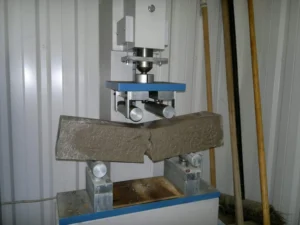

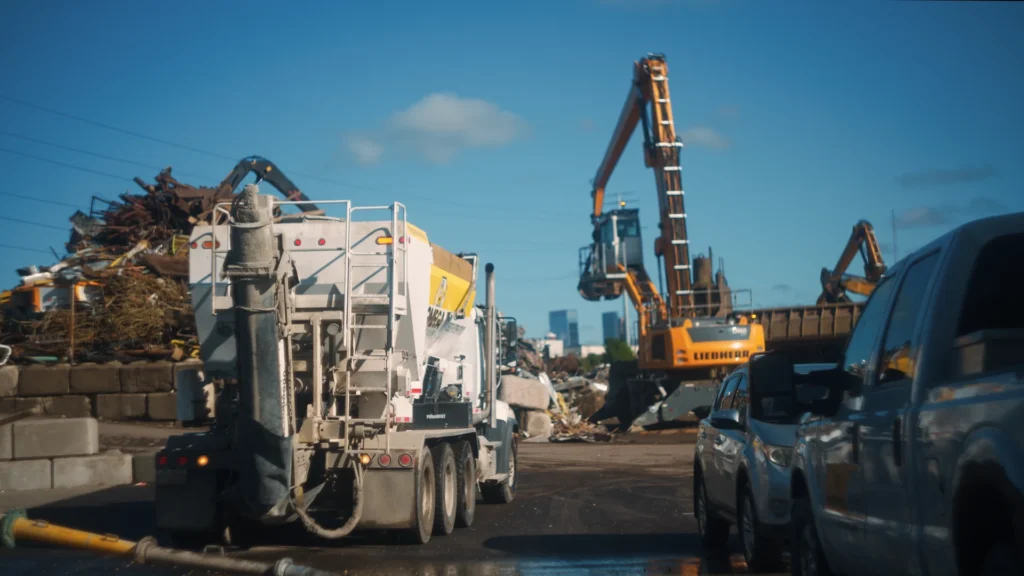
A junior structural engineer in downtown Calgary signs off on volumetric for a 380-cubic-yard parking-structure repair in March 2026. The supplier emails a calibration certificate dated 2025 — current, real, VMMB-stamped. But it’s for a different truck in the fleet. The pour proceeds. 28-day cylinders test 4 MPa low. Remediation: $186,000.
Across the Calgary commercial market, volumetric mixers are landing on spec writers’ desks more often than at any time since the equipment category was introduced. The default reaction — silently strike “ready-mix” from the spec and substitute “or volumetric” — is the most dangerous thing a spec writer can do in 2026. Volumetric concrete, when batched on a VMMB-rated truck under a current per-truck calibration certificate and discharged within the CSA A23.1:24 2-hour clock, meets the same ASTM C685/C685M-25a and CSA A23.1 performance standards as plant ready-mix on every measurable parameter. But the documentation pillars are different, the calibration discipline is different, the operator-certification chain is different, and the spec-language defaults assume drum-mix delivery.
What follows is the 9-verification pre-approval checklist a Calgary spec writer should perform before adding “volumetric acceptable” to any project spec — with the standard citation for each.

1. The calibration cert that doesn’t transfer between trucks
The fleet has six VMMB-rated trucks. The spec said “VMMB-certified supplier” — not “per-truck calibration cert dated within 12 months.” The supplier emails the newest cert in the fleet. The pour goes ahead. Three weeks later the 28-day cylinders are 4 MPa under-spec and a forensic concrete engineer is pulling the records.
ACI 304.6R-09 (Reapproved 2019), Section 4.2, is explicit on this point: calibration data obtained for one volumetric mixer cannot be transferred to another mixer in the same fleet. Each truck requires its own calibration certificate, current within a defined interval. The Volumetric Mixer Manufacturers Bureau (VMMB) standards reinforce the same rule on the unit-certification side — annual recalibration per truck, because mixer wear, drum geometry, and metering linearity drift differently across trucks in the same fleet.
The structural reasoning is straightforward. Volumetric mixers meter cement, aggregate, water, and admixtures through individual metering devices on each truck. Those devices wear at different rates depending on the loads each truck has carried, the abrasion of the local aggregate, and the duty cycle of the metering hardware. A calibration record from a truck with 200 hours of recent service tells you almost nothing about a truck with 2,000 hours of recent service. The standards bodies have known this since the 1980s; the current edition of ACI 304.6R-09(R2019) simply restates a long-established engineering rule.
A spec writer who accepts a fleet-level certification creates the loophole that lets a non-current truck show up to the pour. Remediation on a structural pour averages six to twelve times the original mix cost when 28-day cylinders fall short. The engineering professional’s E&O insurance covers some of the technical exposure; the owner covers the rest. The fix is one specification sentence: “Supplier shall provide a current VMMB calibration certificate for each volumetric truck assigned to the project, dated within 12 months of the first pour.”
The calibration certificate is only the first of three documentation pillars. The next item is the operator certification that has to back it up.
2. The operator card the City inspector will ask to see
A City of Calgary building inspector arrives on a Bridgeland infill pour at 7:15 a.m. on a Tuesday in May. The truck is set up. The operator is mid-discharge. The inspector asks for the operator’s current Volumetric Mixer Operator Certification (VMOC) card. The operator can’t produce it. The inspector orders the pour halted. The pump truck idles at $300/hour while the supplier dispatches a certified operator from across the city. Roughly two hours of delay get billed back somewhere.
VMMB’s Volumetric Mixer Operator Certification is the operator credential that pairs with the unit certification. ASTM C685/C685M-25a Section 5 references qualified operator personnel, and ACI 304.6R-09(R2019) §3.1 reinforces the requirement on the placement-guide side. The operator card is not optional under either standard — and Calgary’s Type-A inspectors are increasingly asking to see it on site.
The certification covers the daily duties that determine whether the truck on the project is operating as a plant or as a hose with sand in it: calibration verification at start of shift, mix-design entry, slump correction, air-content monitoring, and discharge documentation. An operator without that training set can produce concrete that passes a visual check at discharge and fails an air-content test by the time it reaches the slab — or vice versa.
A spec writer who specifies “VMMB-rated mixer” without also specifying “VMOC-certified operator on site for the duration of every pour” leaves the operator-qualification chain to chance. The most expensive volumetric pours in Calgary in 2025–2026 were stopped not because the truck was wrong but because the operator on it was uncertified or the certification had lapsed. The corrective spec sentence: “Volumetric pours shall be discharged only by an operator holding a current VMOC certificate, with the card produced on request for the inspector or engineer of record.”
Calibration certificate plus operator card — that’s documentation pillars one and two. Pillar three is the document that links both to the standard.
3. The standard the spec must cite by edition, not by number
A spec writer in a Bow Trail office is finalizing a tilt-up specification in February 2026. Their template still reads “ASTM C685-17.” It hasn’t been updated. The bid set goes out. Three suppliers quote against C685-17. One quotes against ASTM C685/C685M-25a — the current edition — and lands the bid because the submittal language matches what the structural review board actually accepts on a 2026 project.
ASTM C685/C685M-25a is the current edition of the volumetric mixed concrete standard. It supersedes the -17 edition and the intermediate revisions. The current edition specifies metering tolerances, mixing proportion verification, and discharge documentation requirements at a level of granularity that older editions left more open. ACI 304.6R-09 (Reapproved 2019) is the companion installation guide. Together they form the two-citation default every Canadian volumetric spec should carry: “Volumetric concrete shall be batched in accordance with ASTM C685/C685M-25a and placed in accordance with ACI 304.6R-09 (Reapproved 2019).”
A spec frozen at “ASTM C685-17” or — worse — “ASTM C685” with no edition gives the supplier room to argue any post-2017 interpretation. The current edition closed several drum-vs-volumetric equivalency loopholes that older editions left ambiguous. The structural engineer of record may sign off on the older standard during design review and discover at substantial completion that the current code-cycle reference materially differs from what the supplier delivered.
The discipline is small. Every standard citation in the spec carries the year. ASTM C685/C685M-25a. ACI 304.6R-09 (Reapproved 2019). CSA A23.1:24 (the 14th edition). Once the year is on every line, supplier interpretation has nowhere to run.
The standard citation locks the supplier into measurable performance. The next item is the time clock that locks them into measurable freshness.
4. The 2-hour clock that’s not 90 minutes
A site superintendent on a Tuscany custom-home foundation pour in April 2026 has been operating off a printed copy of an old US specification that reads “concrete shall be discharged within 90 minutes of batching.” Volumetric meters batch on the truck — so the clock starts at discharge, not at the plant. The superintendent applies the 90-minute rule anyway. The supplier’s quality manager pulls the spec book and walks the super through the actual Alberta-applicable rule.
CSA A23.1:24 specifies a 2-hour (120-minute) discharge clock from the time of batching, with allowances for temperature and additional adjustments documented in the standard. The 90-minute figure that circulates in older US specifications is the pre-2021 ASTM C94/C94M legacy default for drum-mix delivery and is no longer the current default reference for Alberta projects. The spec writer’s job is to make sure the project doesn’t import that legacy figure into 2026 documentation.
Volumetric batching has a different physical relationship to the discharge clock than drum-mix delivery. With drum-mix, the mix is batched at the plant and rides in the rotating drum to the site; the clock starts at the plant. With volumetric, the materials ride dry on the truck and meet water only at the auger; the clock starts at discharge. The CSA A23.1:24 2-hour clock applies in both cases, but the supplier’s documentation should explicitly cite the standard so there’s no field dispute about which clock governs.
Spec writers carrying US-template language into Alberta projects routinely import the 90-minute clock without realizing it doesn’t apply. The downstream result is two-sided: legitimate, in-spec deliveries get rejected at the truck for “exceeding the 90-minute window” that doesn’t govern, and out-of-spec deliveries get accepted because the 90-minute frame distracted everyone from the actual CSA-applicable parameters. The corrective spec language: “Discharge time shall conform to CSA A23.1:24, with batch ticket documenting time of batching and time of completion of discharge.”
Time discipline is one quality lever. Air content is another — and air is the one that destroys driveways and parking structures faster than any other parameter.
If your project extends into Calgary’s fall construction season, documentation is only part of compliance. Cold-weather placement introduces additional CSA requirements for concrete temperature, curing, hoarding and early-strength protection. Read our guide on weather concrete rules every Calgary pour crew should cite before finalizing your specification.
5. The air-entrainment verification the spec must require on the ticket
A Cranston tilt-up commercial pour in late September 2026. F-1 exposure class specified. The spec called for 5–8% entrained air at discharge. The supplier’s ticket shows 4.2% — under-spec. The spec writer’s submittal language said “report air content on the batch ticket” but didn’t say “reject pour below 5% measured at discharge.” The crew places the concrete. First Calgary chinook freeze-thaw cycle in November cracks the slab edges.
CSA A23.1:24 specifies entrained-air ranges by exposure class. For F-1 exposure (freeze-thaw without de-icing chemicals), the specification calls for 5–8% air content at the typical aggregate size — and 32 MPa at 28 days with a maximum water/cementitious materials ratio of 0.55. The air-content percentage must be verifiable at the point of discharge, not just on a mix-design submittal sheet filed weeks earlier. Discharge measurement is the only number the standard actually cares about; everything upstream is intent.
Adding water at the site destroys entrained air rapidly. Even small tempering-water additions can drop measured air by one to two percentage points within minutes. Volumetric mixers can adjust the mix on the truck — that’s a structural advantage of the equipment — but the spec writer must specify a measured-at-discharge air range, not just a target on the mix-design sheet. The corrective language: “Air content shall be measured at the point of discharge for each truck and recorded on the batch ticket. Pours measuring below the F-1 (or F-2, as applicable) range shall be rejected at the truck unless on-site adjustment brings the mix back into range.”
Calgary’s freeze-thaw load is among the most aggressive in North America. The City of Calgary 30-year freeze-thaw cycle data shows over 100 documented zero-crossings per year on common methodologies. Air content under the F-1 or F-2 spec is the single most consequential parameter the spec writer can lock in.
Air discipline assumes the mix design is right to start. The next item is what the spec writer must require to verify the mix design itself.
6. The mix-design submittal the supplier should already have ready
A structural engineer in a Beltline office reviews a submittal package for a 24-unit infill project in Marda Loop in August 2026. The supplier (volumetric) submits a 2-page summary. The engineer asks for the cementitious-content breakdown, the supplementary cementitious materials (SCM) replacement percentage, the aggregate gradation analysis, the chemical admixture data sheets, and the trial-batch test report. A serious supplier produces all five within 24 hours; a less prepared one produces none of them.
CSA A23.1:24 §4.4 (and the related annex provisions) governs mix-design submittal requirements. For volumetric specifically, ACI 304.6R-09 (Reapproved 2019) §4 requires that the metered proportions match the approved design within the standard’s metering tolerances. The supplier must demonstrate by trial batch (or by production history of equivalent mixes) that the mix meets the specified performance.
A serious volumetric supplier already maintains a library of Calgary-region-appropriate mix designs by exposure class: C-2 (chloride exposure), F-1 and F-2 (freeze-thaw without and with de-icing chemicals), S-2 and S-3 (sulphate exposure — 32 MPa at 56 days with Type HS or HSb at w/cm ≤ 0.45 for S-2, 35 MPa at 56 days with Type HSb only at w/cm ≤ 0.40 for S-3), N-CF (no exposure, structural), and the residential mix family. The submittal should arrive within 48 hours of request because the documents already exist.
A volumetric supplier who cannot produce a full mix-design package within 48 hours is operating off a single boilerplate mix and adjusting in the field. That’s the operating mode the spec writer must screen for during pre-qualification — because it’s the operating mode that misses on exposure-class-specific durability and produces the kind of cylinder failure that ends up in arbitration two years later.
Documentation establishes capability. The next item is what the spec writer must require to verify capability is actually being executed in the field.
7. The cylinder-testing protocol the spec must specify by frequency, not just “as required”
A Type-A inspector for a Calgary commercial parking-structure repair in October 2026 reviews the testing log at substantial completion. The spec said “concrete cylinders as required by CSA A23.2.” The supplier interpreted that as one set per 100 yd³. The City interpretation (and the engineer’s expectation) was one set per truck for the first three trucks plus one set per 100 yd³ thereafter. The first three trucks were never tested. The structural review board issues a deficiency notice. Remediation runs into the high five figures before lawyers get involved.
CSA A23.2-3C (cylinder casting) and CSA A23.2-9C (compressive strength testing) specify the cylinder protocols. CSA A23.1:24 §7.2 governs acceptance criteria. The spec writer must state explicit cylinder frequency, the strength acceptance criteria (typically the average of three consecutive tests meeting the specified compressive strength f’c with no individual test under f’c − 3.5 MPa), and the testing-lab qualifications.
Volumetric pours benefit from per-truck cylinder testing because the metered mix can be adjusted between trucks. Per-truck testing creates a tighter feedback loop than the “one set per 100 yd³” default that gets carried over from plant ready-mix conventions. A reasonable middle ground for a structural pour: cylinders cast from each of the first three trucks (to verify the calibration is hitting the mix design across the start of the shift), plus one set per 50 yd³ for structural placements thereafter, plus a cylinder set from any truck where the meter shows an adjustment of more than a defined threshold.
“As required by CSA” is not a specification — it’s a punt. The spec writer must specify the testing schedule explicitly to lock the supplier into the cylinder-frequency expectation that the engineer of record assumed during review. The corrective language reads as a numbered protocol: cylinders per truck for the first N trucks; cylinders per X cubic yards thereafter; testing lab to be CSA A283-qualified or equivalent; copies of all break results to engineer of record within 48 hours of the 28-day test.
Testing closes the loop on quality. The next item is what the spec writer must require to keep the supplier honest on quantity.
8. The yard-metered billing the spec must allow the owner to audit
A multi-family general contractor in Mahogany is closing out a 60-unit project in late 2026. The cumulative volumetric concrete bill is $312,000 across eight months. The GC’s project accountant pulls the daily batch reports to verify against the contract unit price. The reports are PDF print-outs with no machine-readable metering data. The accountant cannot independently verify the cubic yards delivered against the unit price billed. The dispute goes to a third-party concrete consultant at $4,200 of additional cost.
ACI 304.6R-09 (Reapproved 2019) §3.2 and §4 specify that volumetric mixers must produce a record of the volume discharged. The VMMB calibration system underwrites the metering accuracy that makes the volume record audit-defensible in the first place. The spec writer can — and on any project of meaningful size, should — require the supplier to provide a machine-readable (CSV or equivalent) batch report for every pour, not just a printed dispatch ticket.
Yard-metered billing — billing based on actual metered cubic yards rather than estimated dispatch quantity — is the structural economic advantage of volumetric versus drum-mix delivery for short-load, variable-quantity, and multi-mix pours. The spec writer who locks in the metering audit right captures that advantage for the owner. The spec writer who doesn’t, defaults the relationship back to drum-mix billing conventions — truck-load minimums with short-load fees on top — even when the actual delivery method makes those conventions inappropriate.
Volumetric’s economic case rests on the meter being trustworthy. The corrective specification language: “Supplier shall provide an electronic batch report for every pour, including time of batching, time of discharge, metered volume by material, total cubic yards discharged, and operator identification. Reports shall be made available to the owner within 24 hours of pour completion.”
Billing discipline closes the commercial loop. The final item closes the loop on the entire spec — by naming what the spec writer must NOT allow to slip into the document.
Batch tickets, metered volume reports and delivery charges create confusion well beyond commercial projects. If you’re comparing residential concrete quotes, our guide to concrete quote line items Calgary homeowners misread explains exactly what each line means—and which charges are legitimate.
9. The 5 forbidden phrases that void every other spec-writer protection
A Calgary spec writer in Inglewood receives a redlined version of a tilt-up specification back from a supplier in September 2026. The supplier has added five phrases the spec writer didn’t catch on first read: “or equivalent,” “subject to availability,” “fleet-level certification acceptable,” “discharge time per industry standard,” and “air content per supplier QC plan.” Each phrase, individually, looks innocuous. Together, they reverse every protection the original spec carried.
Specification language that delegates parameters to supplier interpretation surrenders the spec writer’s authority. The standards bodies recognize this implicitly — ACI 304.6R-09 (Reapproved 2019) §1.2 (scope), §3 (certification), §4 (calibration), and §6 (specifications), and CSA A23.1:24 §4 (specification authority) all assume the spec writer makes the specification, not the supplier. Each of the five phrases above maps to a specific protection the spec writer just bargained away if the phrase survives into the executed document.
“Or equivalent” — appended to a standard citation — deletes the standard. The supplier can argue any document of similar topic is “equivalent.” “Subject to availability” deletes the supplier-qualification requirement, because non-qualified suppliers can be substituted on availability grounds. “Fleet-level certification acceptable” deletes the per-truck calibration rule from Item 1. “Discharge time per industry standard” deletes the CSA A23.1:24 2-hour clock from Item 4 and lets the supplier reach for the legacy US 90-minute figure. “Air content per supplier QC plan” deletes the measured-at-discharge air verification from Item 5 and substitutes the supplier’s own internal target. A spec that has accepted all five reads strict on first pass and is wide open on second pass.
A spec writer who allows these phrases into the final spec has built a fortress and unlocked every door. The most expensive volumetric failures in Calgary in 2025–2026 cluster around late-cycle redlines that introduced one or more of these phrases after the substantive technical review was complete. The defense is editorial discipline rather than a citation: a final-pass read whose only job is to scan for delegation language and remove it.
This item lives in spec-writer training, not in the standards. Worth printing and posting next to the spec-template library.
FAQ
Q1: Is volumetric concrete weaker than plant-batched ready-mix?
No. Volumetric concrete, batched on a VMMB-rated mixer by a VMOC-certified operator under a current per-truck calibration certificate, meets the same ASTM C685/C685M-25a and CSA A23.1:24 performance standards as plant ready-mix. The comparative durability and strength data show equivalent performance when both are properly specified and verified. The difference is operational and documentary, not metallurgical.
Q2: What ASTM edition should the spec cite?
ASTM C685/C685M-25a — the current edition as of 2026. Spec language frozen at C685-17 (or C685 without an edition) gives the supplier room to argue against current-edition interpretations. Pair the citation with ACI 304.6R-09 (Reapproved 2019) for placement guidance and CSA A23.1:24 (14th edition) for the Canadian project-level overlay.
Q3: Does CSA A23.1:24 explicitly allow volumetric?
Yes. CSA A23.1:24 §4 and the supplier-qualification provisions accommodate both plant-batched and on-site-batched ready-mixed concrete, provided both meet the same performance and documentation requirements. Volumetric is not a separate category under CSA; it’s a delivery method that must satisfy the same overarching CSA performance and documentation rules as drum-mix delivery.
Q4: What’s the difference between VMMB, NRMCA, and VMOC?
VMMB (Volumetric Mixer Manufacturers Bureau) certifies the truck and underwrites the per-truck calibration system. NRMCA (National Ready Mixed Concrete Association) is the longstanding plant-ready-mix certification body. VMOC (Volumetric Mixer Operator Certification) certifies the operator running the truck. The three together form the documentation pillar set for an audit-defensible volumetric pour: the unit, the operator, and (via the calibration and batch records) the mix delivered.
Q5: Can a spec writer specify “volumetric only” instead of “drum-mix or volumetric”?
Yes, but the use case must justify it. Volumetric is strongest on variable-quantity, short-load, remote-site, multi-mix, and cold-weather pours where the on-truck batching and mix-flexibility advantages dominate. For high-volume continuous monolithic placements, drum-mix delivery may pace the work better because of cycle-time considerations. The spec writer should choose by use case, not by default — and a hybrid spec (“drum-mix or volumetric, both subject to the same documentation pillars”) is often the best answer.
Q6: Is there a Canadian volumetric authority equivalent to VMMB?
Not yet at the national level. Canadian volumetric operations currently reference VMMB (US) for unit certification, ASTM C685/C685M-25a (international) for batching, ACI 304.6R-09 (Reapproved 2019) for placement guidance, and CSA A23.1:24 (Canadian) for project-level performance and documentation requirements. A Canadian-specific volumetric authority has been discussed within the industry but has not been formalized as of 2026.
Sources
- ASTM C685/C685M-25a — Standard Specification for Concrete Made by Volumetric Batching and Continuous Mixing — https://www.astm.org
- ACI 304.6R-09 (Reapproved 2019) — Guide for the Use of Volumetric-Measuring and Continuous-Mixing Concrete Equipment — https://www.concrete.org
- CSA A23.1:24 — Concrete materials and methods of concrete construction (14th edition) — https://www.csagroup.org
- CSA A23.2:24 — Test methods and standard practices for concrete — https://www.csagroup.org
- CSA A23.3:24 — Design of concrete structures — https://www.csagroup.org
- Volumetric Mixer Manufacturers Bureau (VMMB) — Plant Certification & Calibration Standards — https://www.vmmb.org
- VMMB Operator Certification Program (VMOC) — https://www.vmmb.org/operator-certification
- NRMCA Quality Plant Certification — https://www.nrmca.org
- City of Calgary — Standard Construction Specifications — https://www.calgary.ca/development/standards
- Concrete Alberta — Cold Weather Best Practices — https://www.concretealberta.ca
About Omega Ready Mix
Omega Ready Mix (est. 2023) is Calgary’s volumetric ready-mix supplier serving commercial, multi-family, and residential projects across the Calgary region. The brand operates VMMB-rated trucks under VMOC-certified operators and maintains a documentation library aligned to ASTM C685/C685M-25a, ACI 304.6R-09 (Reapproved 2019), and CSA A23.1:24.