
Precast concrete steps isn’t poured at your house — it’s cast as one solid piece in a plant, cured under controlled conditions, then delivered and set at your Calgary entry in a single morning. That’s why it arrives crack-free, joint-free, and ready to use the same day. Here’s how it’s built, and why it lasts.
If you’ve ever watched a site-poured stoop go in, you know the routine: forms built on the spot, concrete poured into them, then days of waiting, weather-watching, and hoping the surface cures clean before the first frost. A precast step skips almost all of that.
The unit that shows up at your door has already done its hardest growing-up — the pour, the cure, the strength gain — inside a plant, where none of it was left to chance. What follows is the actual sequence: how the step is formed, what goes inside it, why plant-curing matters so much here, and how a roughly two-ton unit gets set at your entry by a single operator in one morning.
1. How a precast step is built: one solid piece, cast top-down in a reusable steel form
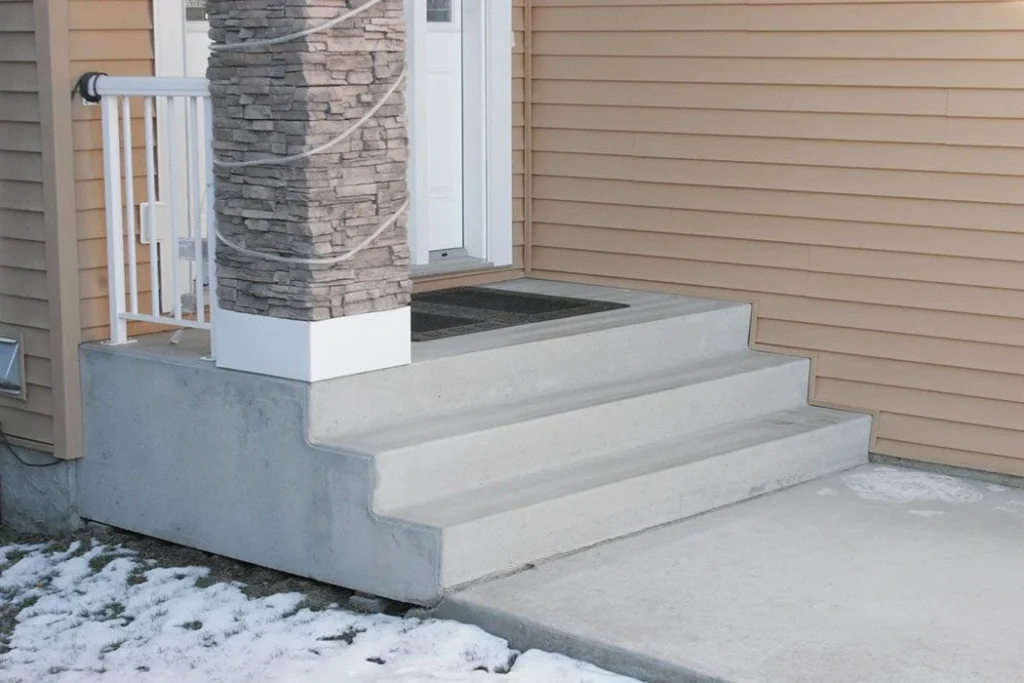
The first thing to understand about a precast step is that it is one piece. The treads (the parts you step on), the risers (the vertical faces), and the landing at the top are not separate components mortared together later — they are all cast at the same moment, in the same form, as a single monolithic unit. When the finished step lands at your house, there are no seams holding it together, because it was never in pieces.
That single piece is formed in a reusable steel mould rather than wood knocked together on a job site. Steel forms hold a precise, repeatable shape pour after pour, and they give the finished concrete a clean, dense surface — the crisp tread nosings and square edges you can see and feel on a quality precast unit. Because the form is engineered and reused, every step that comes out of it matches the spec, instead of depending on how carefully someone built a one-time wooden box in your driveway.
The pour itself runs top-down. The form is set so that what will become the top landing of your finished step sits at the bottom of the mould, and the unit is cast upside-down. There’s a practical reason for this: the most visible, most walked-on, most weather-exposed surfaces end up cast against the smooth steel of the form, which produces a tighter, denser finish exactly where you want it.
Inside, the step is hollow — a solid concrete shell rather than a fully solid block — which keeps the unit strong while holding its weight to something a single machine can lift and place.
And because the form is configurable, the same plant process produces a wide range of step geometries: different widths, different numbers of risers, different landing depths to suit your entry. The method is consistent; the dimensions flex to the door.
2. Reinforced and vibrated: why the inside matters more than the surface
A precast step earns its lifespan on the inside, where you can’t see it. Two things happen during the pour that decide how the unit will hold up for decades: reinforcing steel goes in, and the concrete gets vibrated.
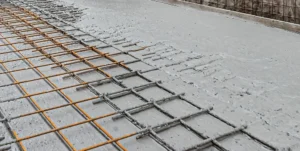
The reinforcing — re-rod, in the trade — is placed mid-pour, not laid in at the start and not dropped in at the end. The form is partly filled, the steel is positioned, and the pour continues over and around it, so the reinforcement ends up embedded in the body of the concrete rather than sitting at the bottom or floating near a face.
Encasing the steel this way gives the step its tensile backbone: concrete is tremendously strong in compression but weak in tension, and the embedded re-rod is what holds the unit together against the bending and prying forces a set of steps actually sees — the load of people, the lever of a heavy landing, the stress of being lifted and placed.
The second move is vibration. Freshly placed concrete is full of trapped air and tends to bridge over corners and around the reinforcing steel, leaving voids — pockets of empty space inside the unit. Voids are where a step gets weak and where water later finds a home. So the filled form is vibrated, which fluidizes the mix just enough to let it flow into every corner of the mould, fully surround the re-rod, and drive the trapped air out.
The result is dense, consolidated concrete with no hidden hollows — the kind of sound, void-free body that CSA A23.1:24 is built around when it sets out how concrete materials and placing should deliver durable, properly consolidated concrete.
This is the part of the process a homeowner never witnesses and a brochure rarely shows, but it is the part that matters most. A step can look flawless on the surface and still be compromised by voids and poorly-placed steel underneath. Plant precasting, done to standard, is precisely about controlling what happens inside the unit — not just dressing up the outside.
3. Cured in a plant, not in your driveway: the Calgary freeze-thaw advantage
Here’s where precast pulls decisively ahead in our climate. Concrete doesn’t reach its strength the instant it’s poured — it cures, gaining strength over time, and that curing is wildly sensitive to temperature and moisture. Concrete poured and left to cure outdoors in Calgary is at the mercy of whatever the sky does next: a cold snap, a dry chinook wind, an overnight dip below freezing. Cure concrete badly and you get a weaker, more porous, less durable surface — exactly the surface that scales and spalls a few winters later.
A precast step doesn’t cure in your driveway. It cures overnight inside the plant, under controlled conditions, protected from the swings that wreck a site-poured cure. By the time the unit is stripped from its form and loaded for delivery, it has gained its early strength in a stable environment — not while fighting an Alberta night. That control is the single biggest reason a precast step arrives sound and stays sound.
Why does this matter so much here specifically? Because Calgary’s signature climate challenge is freeze-thaw cycling. Water gets into concrete, freezes, expands, and pushes it apart from the inside; then it thaws and the cycle repeats — and our chinooks mean we can run that loop many times in a single winter, far more than a steadier cold climate.
Concrete Alberta’s cold-climate guidance is built around this reality: durable concrete here depends on a dense, well-consolidated, properly-cured, air-entrained mix that resists water intrusion in the first place. A step vibrated void-free and cured under control in a plant is engineered to keep that freeze-thaw water out — which is the whole game in a Calgary winter.
Precast plant production also follows CSA A23.4-16 (R2021), the Canadian standard for precast concrete materials and construction, which governs how precast units are made and what they have to deliver. The point of all of it — the steel forms, the embedded re-rod, the vibration, the controlled cure — converges on one outcome: a step built to survive the exact weather your front entry faces.
4. One piece, no mortar joints: where water gets into brick and block steps
Now compare that one-piece unit to the alternatives. Brick steps, block steps, and stacked-paver steps are assemblies — many small pieces held together with mortar joints. Those joints are the weak link, because every one of them is a seam, and every seam is a path for water.
In a Calgary winter, that path matters enormously. Water works into the mortar joints of a brick or block step, freezes, and expands — and because the joint is the softest part of the assembly, that’s where the freeze-thaw damage concentrates. Joints crack, mortar crumbles, individual pieces loosen and shift, and the step slowly comes apart from the seams outward. You’ve seen it on older entries all over the city: the staircase that’s gone wavy, the bricks that have popped loose at the nose of a tread, the mortar lines that have washed and crumbled away. The masonry didn’t fail randomly — the joints let water in, and Calgary’s freeze-thaw did the rest.
A one-piece precast step has no mortar joints to fail. There are no seams between treads and risers, no grout lines for water to exploit, no individual pieces to work loose. Water hits a continuous, dense concrete surface with nowhere to seep in. The single most common failure mode of a brick or block entry — joint-driven freeze-thaw breakdown — simply isn’t present, because the feature that causes it doesn’t exist on a monolithic unit.
The same one-piece logic helps with settling. A single precast unit sits and moves as one rigid body on its prepared base, so it resists the differential settling — one corner sinking while another holds — that opens cracks in jointed and site-cast steps. It’s not that precast defies the ground; it’s that one solid piece has no internal seams to tear apart when the ground does shift.
5. Delivered and set in a morning: the two-ton lift, one operator
The install is the part that surprises people most. A finished precast step is heavy — a typical unit runs around two tons — and yet it’s set at your entry by a single operator, often in well under an hour on site, with the whole visit wrapped up in a morning.
That’s possible because the unit arrives complete. There’s no form-building, no pour, no finishing crew, no curing time spent at your house — all of that already happened at the plant. The truck arrives with the step ready to go. The operator preps the base the step will sit on, then uses a boom (a hydraulic arm, frequently run by remote control) to lift the two-ton unit off the truck, swing it into position, and set it precisely against your entry. One person, one machine, one lift, dialed into place.
Contrast that with the timeline of a site-poured stoop: forms framed, concrete poured, days of curing before anyone can lean weight on it, and a job site tied up the whole time. A precast step is delivered and usable the same day. You can walk up your new steps the morning they’re installed, because the concrete finished curing days earlier, in the plant.
For a Calgary homeowner replacing a crumbling old entry — or an acreage owner dealing with steps that have settled or worn out — that speed is more than a convenience. It means a single short visit instead of a multi-day disruption, no stretch of days where your front or side door is unusable, and no gamble on the weather cooperating with an outdoor cure. The hard, slow, weather-sensitive work was done in a controlled plant; what’s left at your house is a clean, fast set.
6. Sizes and configurations: matching the step to your entry
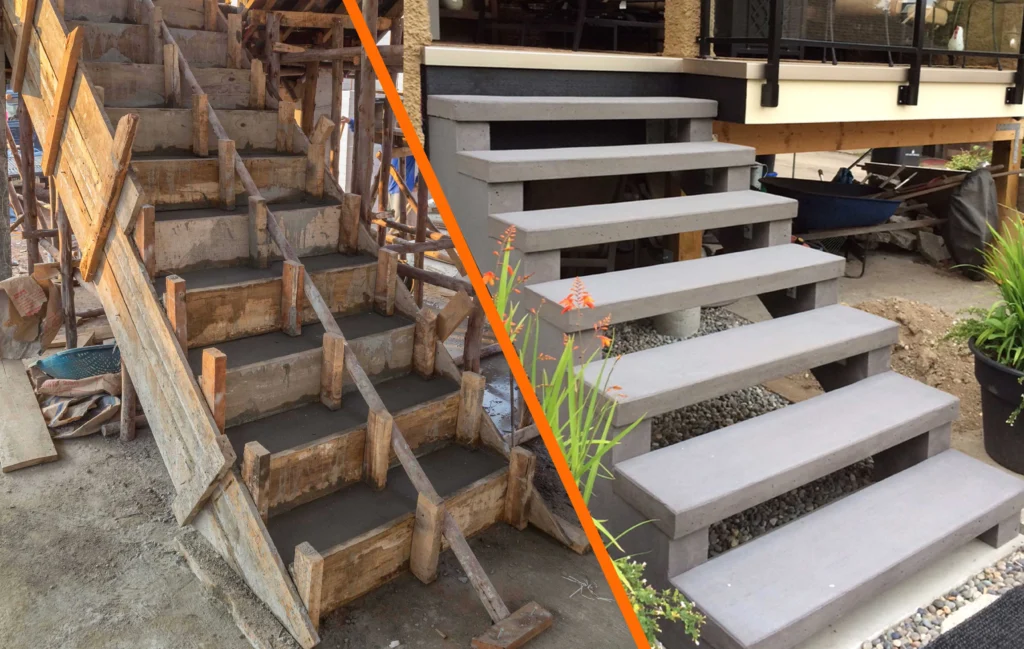
Because the steel forms are configurable, precast steps come in a broad range of sizes and layouts rather than a single off-the-shelf shape. The variables that get matched to your entry are straightforward: the width (how wide the step is, set by your door and landing), the number of risers (how many steps up, set by the height from grade to your threshold), the landing depth (how much flat platform you have at the top, in front of the door), and whether the unit needs to wrap, turn, or sit against a sidewall to suit the approach.
The single most important measurement is the rise — the total vertical distance from the finished ground to your door’s threshold. That height determines how many risers your step needs and how deep the unit has to be. A low entry a step or two above grade is a very different unit from a tall entry climbing five or six risers up from a sloped acreage yard, and both are produced from the same configurable plant process. Getting the rise right is what makes the finished step land flush and comfortable at your door, which is why a proper measure of your entry comes first, before anything is cast.
This is also where the residential focus of precast steps shows: these are front-entry, side-entry, and back-entry steps for houses and acreage homes — the everyday entries people use. Matching one to your door is a matter of measuring the opening, the rise, and the approach, then selecting the configuration that fits. The plant process is the constant; the dimensions are what get tailored to your home.
When you’re weighing a precast entry step, the questions worth asking are the ones this article has answered: Is it cast as one solid piece, or assembled from parts? Is it reinforced and vibrated, or just poured? Was it cured under control, or left to the weather? And will the size and rise be measured to fit your specific entry? Those four answers are what separate a step that lasts a Calgary lifetime from one that starts coming apart at the seams.
FAQ
Q1: How are precast concrete steps made? A precast concrete step is cast as one solid piece in a plant, not poured at your house. The treads, risers, and landing are all formed together in a reusable steel mould, poured top-down so the visible surfaces cure against smooth steel. Reinforcing re-rod is placed mid-pour and the concrete is vibrated to drive out air and fill every void, then the unit cures overnight under controlled conditions before it’s stripped from the form and delivered.
Q2: Are precast concrete steps better than poured concrete or brick? Precast steps have two structural advantages over the alternatives. Unlike a site-poured stoop, a precast unit cures under controlled plant conditions rather than fighting Calgary’s weather during its cure, which is what makes it arrive sound. Unlike brick or block steps, a precast unit is one solid piece with no mortar joints — and mortar joints are exactly where water gets in and freeze-thaw damage concentrates on a masonry step. We won’t tell you it’s the right choice for every entry, but for a durable, low-maintenance step in our climate, the one-piece, plant-cured approach is built to outlast jointed masonry.
Q3: How long do precast concrete steps take to install? Set at your entry in a single morning, often in well under an hour of actual install time on site. Because the step arrives fully cast and already cured, there’s no form-building, no pour, and no curing time spent at your house. A single operator preps the base and uses a boom — frequently remote-controlled — to lift the roughly two-ton unit off the truck and set it precisely in place. The step is usable the same day it’s installed.
Q4: Do precast concrete steps crack or settle in Calgary winters? They’re specifically built to resist it. A precast step is vibrated void-free and cured under control, producing dense concrete that keeps freeze-thaw water out — the durability outcome Concrete Alberta’s cold-climate guidance and CSA A23.1:24 are built around. Because it’s one solid reinforced piece with no mortar joints, it has no seams for water to exploit and no separate parts to work loose, and it sits and moves as a single rigid body, which resists the differential settling that cracks jointed and site-poured steps. No step is immune to a badly prepared base, which is why the base prep matters as much as the unit.
Q5: What sizes do precast concrete steps come in? A wide range, because the steel forms are configurable. The variables matched to your entry are the width, the number of risers, the landing depth, and whether the unit needs to wrap or sit against a sidewall. The key measurement is the rise — the total height from the finished ground to your door’s threshold — which sets how many risers you need. A low two-riser entry and a tall five- or six-riser acreage entry both come out of the same configurable plant process; the dimensions are tailored to your door.
Q6: Why are precast steps cast as one hollow piece instead of solid? Casting the step as a single hollow shell keeps it strong while holding its weight to something a single machine can lift and set. A fully solid block of that size would be far heavier without adding meaningful strength, since the reinforcing steel and the dense, vibrated outer shell are what carry the load. The hollow, one-piece design is what lets a roughly two-ton unit be delivered and placed by one operator with a boom — while still arriving as a seamless, joint-free step with no internal seams to fail.
Sources
- NPCA (National Precast Concrete Association) — precast manufacturing practice — https://precast.org
- CSA A23.1:24 — Concrete materials and methods of concrete construction (materials, consolidation, and durability) — https://www.csagroup.org
- CSA A23.4-16 (R2021) — Precast concrete — Materials and construction — https://www.csagroup.org
- Concrete Alberta — cold-climate and freeze-thaw concrete guidance — https://concretealberta.ca
About Omega Precast
Omega Precast launched in late 2025 as the precast arm of the Omega Group, supplying residential precast steps, window wells, and septic tanks to Calgary and Alberta acreage homes. It carries forward the Omega family’s Calgary concrete craftsmanship — a lineage that runs back to sister company Omega 2000 Cribbing, building foundations since 1988.