
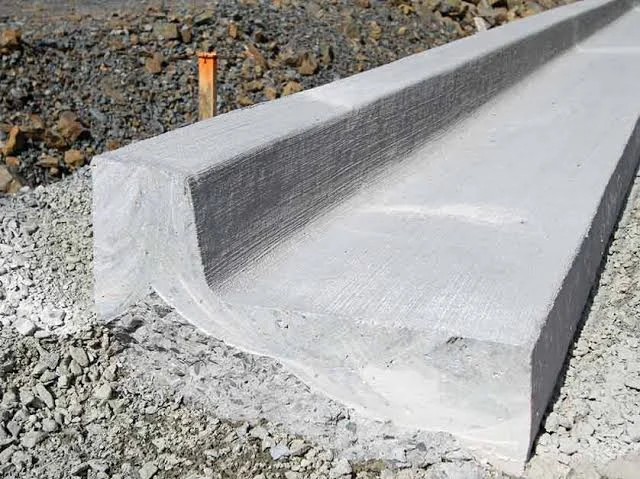
Curb and gutter looks like the simplest concrete on a site. It is also, load for load, one of the most frequently rejected.
The reason is that curb concrete has to do three things at once that pull against each other: hold its shape coming out of a slipform or a hand form, survive fifteen Alberta winters of salt and plow blade, and go down fast enough that the crew keeps moving. Get the mix wrong on any of the three and the load goes back.
This is what actually matters when you order.
The exposure class is the whole conversation
Curb and gutter sits in the harshest exposure condition on a residential street. It is saturated, it freezes and thaws, and it is salted directly every winter.
Under CSA A23.1, that puts it firmly in the C-class exposure family — concrete subject to chlorides with freezing and thawing. That classification drives minimum strength, maximum water-to-cementing-materials ratio, and required air content. It is not a suggestion; on municipal work it is the specification.
If you are unclear on which class applies to which element, our breakdown of the CSA A23.1:24 exposure classes walks through all eleven and where each one shows up on a Calgary site.
The practical consequence: you cannot substitute a general-use slab mix into curb work and expect it to last. It will place fine. It will scale in year three.
Air entrainment is not optional here
Of everything on the ticket, air content is the number that decides whether the curb is still intact in a decade.
Entrained air gives freezing water somewhere to expand. Without it, the salt-saturated surface paste blows off in sheets — the scaling you see on every failed curb face in the city. With it, the same mix survives.
Two things go wrong in practice:
Air gets lost between the plant and the placement. Pumping, over-vibration and extended haul time all drop air content. The number that matters is the one measured at the point of placement, not at the plant.
Air gets over-corrected. Too much air costs strength. There is a window, and the field test is what confirms you are in it.
Our post on the eight concrete specs a Calgary inspector checks covers where and when these tests get taken.
Slump: the tension nobody warns you about
Here is the conflict at the heart of curb work.
A slipform curb machine needs a low, consistent slump. Too wet and the extruded shape slumps, the face bellies, and the top edge rolls. Too dry and the machine tears the surface and the crew fights it all day.
A hand-formed curb, by contrast, tolerates — and often wants — a wetter mix, particularly on tight radii and around catch basins.
So the correct slump depends entirely on the placement method, and the two are not interchangeable. Tell your supplier which method you are using before the truck is batched. A slipform crew that receives a hand-form slump loses the morning.
Consistency between loads matters as much as the target. A curb line poured from three trucks at three different slumps will show it in the finished face.
How much concrete a curb run actually takes
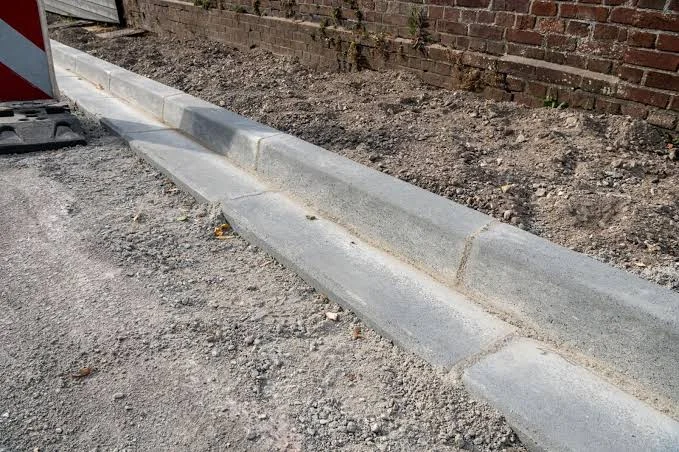
The most common ordering mistake on curb work is under-ordering, because the cross-section is small and people estimate it in their head.
The arithmetic is straightforward: work out the cross-sectional area of the curb-and-gutter profile in square metres, multiply by the run length in metres, and you have cubic metres.
Two adjustments that catch people:
- Add for the sub-base tolerance. A trimmed base that is 20 mm low across a long run adds real volume.
- Add for transitions. Wheelchair ramps, driveway crossings, catch basin transitions and radii all thicken the section.
A five to ten percent allowance over the calculated figure is normal on curb work. Running short mid-run is worse than a small return — a cold joint in the middle of a curb face is permanent and visible.
Our concrete calculator handles the base arithmetic if you would rather not do it by hand, and to estimating concrete without running short covers the allowances in more detail.
Why curb loads get rejected
In our experience, rejected curb loads come down to four things:
- Slump outside the window for the placement method — usually because nobody told the plant it was slipform.
- Air content out of spec at placement — often after a long haul or aggressive pumping.
- Temperature — hot chinook days accelerate before the crew can finish the face; cold mornings do the opposite.
- Wait time — a truck that sits while the crew fixes the base is a different mix by the time it discharges.
Three of those four are scheduling problems, not concrete problems. Curb work is unusually sensitive to a crew that is not ready when the truck arrives.
Ordering checklist
Send these with the order and you will not have a conversation on the shoulder of the road:
- Placement method — slipform or hand form
- Total linear metres and the curb profile
- Exposure class required by the specification
- Required strength and age
- Site access and truck turnaround
- Placement start time and expected rate per hour
- Whether the pour is municipal-spec or private
FAQ
What concrete mix is used for curb and gutter in Calgary? Curb and gutter is exposed to chlorides and freeze–thaw, which places it in the C-class exposure family under CSA A23.1. That drives minimum strength, maximum water-to-cement ratio and required air entrainment. On City work, the Roads Construction Standard Specifications govern — confirm the current edition applies to your project.
How do I calculate concrete for curb and gutter? Multiply the cross-sectional area of the curb-and-gutter profile by the length of the run to get cubic metres, then add five to ten percent for base tolerance, transitions and radii.
What slump should curb concrete be? It depends on the placement method. Slipform requires a low, tightly controlled slump so the extruded shape holds. Hand-formed work generally takes a wetter mix. Tell the supplier which method you are using before batching.
Why does curb concrete scale and flake? Almost always inadequate air entrainment combined with de-icing salt, sometimes made worse by a mix with too high a water-to-cement ratio or by finishing water worked into the surface. Air content measured at placement is the control.
Can you pour curb and gutter in cold weather in Calgary? Yes, with cold-weather measures — mix temperature control, protection and cure management. The constraint is usually the finishing window and the sub-base condition rather than the concrete itself.
Do you supply concrete for curb and gutter across Calgary? Yes. Omega Ready Mix supplies curb and gutter concrete throughout Calgary and the surrounding region, including volumetric on-site mixing for runs where a fixed truck load does not fit the schedule.
Pouring curb this season? Omega Ready Mix batches curb and gutter concrete to City spec and can mix on site so you are not paying for what you do not place. Curb and gutter concrete is unforgiving. The wrong slump, air content, temperature or delivery timing can turn a straightforward pour into a rejected load, a slow crew or a costly return.
Omega Ready Mix supplies concrete for curb and gutter projects across Calgary and the surrounding region, with mix options suited to your placement method and project requirements.
Tell us your placement method, curb profile, linear metres, required specification and pour schedule. We’ll help you determine what you need before the first truck arrives.
Request a curb and gutter concrete quote from Omega Ready Mix today.