
A volumetric mixer batches concrete on-site continuously under ASTM C685/C685M-25a — the same CSA A23.1:24 exposure-class specs and air-entrainment requirements apply as with plant-batched ready-mix. But calibration, cylinder-testing protocols, and submittal language differ in 9 specific ways every spec writer, inspector, and RFI issuer should know before the truck arrives.
Volumetric mixers have moved well beyond remote pours and small accessory pads. They are appearing on multi-family foundations, utility infrastructure, and municipal flatwork across Alberta — and the questions landing in RFI logs reflect genuine spec ambiguity. This guide addresses the nine points that most commonly generate those RFIs, grounded in the current standard editions.
1. The Governing Standard: What ASTM C685/C685M-25a Actually Requires for Volumetric Batching
The foundational document is ASTM C685/C685M-25a, Standard Specification for Concrete Made by Volumetric Batching and Continuous Mixing. The 25a edition is the current edition; do not accept submittals referencing the -17 or any earlier designation. When a volumetric supplier appears on your project, this is the first string to pull: confirm the submittal package cites ASTM C685/C685M-25a explicitly.
The standard covers the equipment, the proportioning accuracy requirements, the water addition system, and the sampling and testing procedures that are specific to continuous-mix production. It does not waive CSA A23.1:24. All exposure-class performance requirements — compressive strength, w/cm limits, air content, supplementary cementing material minimums — remain fully in force. ASTM C685/C685M-25a governs how the concrete is made; CSA A23.1:24 governs what the concrete must achieve once made.
Companion guidance comes from ACI 304.6R, Guide for Volumetric-Measuring and Continuous-Mixing Concrete Equipment, published by the American Concrete Institute. ACI 304.6R is not a code but a detailed technical guide that addresses equipment design, calibration intervals, operator qualification, and field sampling. Specifiers who want to write defensible volumetric acceptance language should read both documents in parallel: ASTM C685/C685M-25a for the specification requirements, ACI 304.6R for the procedural framework behind them.
One important framing point for your submittal review: volumetric-batched concrete that meets ASTM C685/C685M-25a and CSA A23.1:24 meets the same standards as plant-batched ready-mix. The delivery method is different; the performance standard is not.
2. Item 1 — Calibration and Certification: VMMB and NRMCA Requirements for Volumetric Mixers
The Volumetric Mixer Manufacturers Bureau (VMMB) is the primary industry body for volumetric mixer certification in North America. A VMMB-certified mixer has been built and tested to a published performance standard covering bin segregation, aggregate-gate accuracy, water-metering precision, and discharge consistency. The NRMCA (National Ready Mixed Concrete Association) operates complementary plant-certification programs, and many volumetric suppliers seek NRMCA quality certification as a parallel credential.
As a spec writer or inspector, there are three specific calibration items to require at submittal stage:
Current calibration certificate. The mixer’s calibration should be current — ACI 304.6R recommends intervals tied to equipment condition and project volume, but at minimum a certificate dated within the past 12 months from a qualified calibration body (VMMB-affiliated or equivalent) is a reasonable submittal requirement.
Water-metering verification. Water is added at the point of discharge in a volumetric system, and the accuracy of the water meter directly determines w/cm. Require documentation of the flow-meter calibration and verification that the meter has been checked on-site prior to the pour. ASTM C685/C685M-25a Section 7 addresses water-measuring equipment tolerances; your inspector should verify the meter is within tolerance before the first batch is accepted.
Aggregate-gate and bin calibration. VMMB standards set tolerances for aggregate proportioning by volume. Your submittal package should include the manufacturer’s calibration data for the specific bins loaded for the project mix. This is distinct from a generic certificate — it should reflect the actual aggregates, their moisture correction, and the mix design being produced.
Requiring both VMMB certification and current calibration documentation in Division 03 of the project spec eliminates the most common RFI ambiguity before the truck leaves the yard.
3. Item 2 — Batching Tolerances: How Volumetric Compares to ASTM C94 Plant Tolerances
Architects and structural engineers who work primarily with plant-batched ready-mix are familiar with the batching tolerances in ASTM C94/C94M. Volumetric mixers operate under ASTM C685/C685M-25a tolerances, which differ in one important structural way: plant-batched concrete is measured by weight, while volumetric concrete is measured by volume, with moisture-corrected aggregate density as the conversion bridge.
ASTM C685/C685M-25a Section 7 establishes permissible variations for cementitious materials, aggregates, and water. The tolerance framework is comparable in stringency to ASTM C94 when the volumetric system is properly calibrated and operated — but the tolerance mechanism is different, and inspectors trained exclusively on drum-mix plant acceptance may not recognise an out-of-tolerance condition when it appears in a volumetric context.
The practical implication for spec writers is this: do not write a spec that simply cross-references ASTM C94 tolerances for a project that may use volumetric supply. Either write parallel acceptance criteria under ASTM C685/C685M-25a or require that all tolerance documentation submitted by the volumetric supplier explicitly map its calibration data to the ASTM C685/C685M-25a Section 7 framework. ACI 304.6R Table 3.1 provides a useful side-by-side summary of the proportioning accuracy requirements that can inform your acceptance criteria language.
One batching distinction that frequently generates RFIs: aggregate moisture correction. Plant batches correct for aggregate moisture at the plant scale before the truck leaves. A volumetric mixer corrects for aggregate moisture in the field, based on periodic moisture testing of the aggregate bins. Your spec should require documentation of the moisture-correction method and frequency — particularly on hot, dry Alberta days when surface moisture in aggregate bins can change materially between morning and afternoon batches.
4. Item 3 — Submittal Language: How to Specify Volumetric Acceptance with ACI 304.6R Sample Language
The most common point of confusion in volumetric acceptance is submittal language that was written for plant-batched supply and was never updated. Submittals referencing “batch plant certification” or “plant QC records” are structurally inapplicable to a volumetric system, and the resulting RFI chain wastes time on both sides.
ACI 304.6R Section 7 provides normative guidance on what a volumetric concrete submittal should contain. Drawing from that framework, consider requiring the following in Division 03 or your project-specific concrete specification:
- Mix design documentation certifying the target w/cm, cementitious content (including SCM percentages and sources), aggregate gradations, and air-entraining admixture dosage rate.
- Equipment certification: VMMB certification certificate for the specific mixer unit, current calibration certificate (within 12 months), and water-meter calibration records.
- Operator qualification documentation, as referenced in ACI 304.6R Section 4.
- Pre-pour calibration check protocol — a written procedure the supplier commits to performing on-site before the first batch is released.
- A testing and sampling plan specifying cylinder frequency, who takes the samples, at what point in the discharge stream, and the testing laboratory’s accreditation.
When amending a standard Division 03 section originally written for drum-mix supply, the clearest approach is to add a subsection titled “Volumetric Batching Acceptance” that explicitly invokes ASTM C685/C685M-25a as the governing standard and lists the above submittal items. This removes interpretive ambiguity without requiring a full rewrite of the section.
5. Item 4 — Cylinder Testing at Discharge: What ASTM C685-25a Allows and Requires
Cylinder sampling for volumetric concrete follows ASTM C685/C685M-25a Section 10, which has specific provisions that differ from ASTM C94 plant-batched acceptance. The key distinction is where in the discharge stream samples are taken.
ASTM C685/C685M-25a requires that test samples be taken from the concrete after it has passed through the complete mixing and discharge system — not from the aggregate or paste streams individually. This is analogous to taking samples at the chute for drum-mix, but the inspector needs to understand that the volumetric discharge stream is a continuous flow, not a discrete batch. ASTM C685/C685M-25a Section 10.2 addresses composite sample collection from a moving discharge stream.
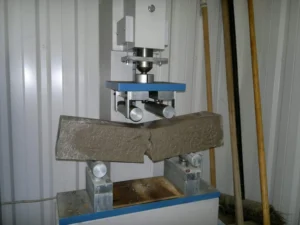
Cylinder frequency for volumetric supply should be established in your spec. A common starting point is one set (typically four cylinders — two tested at 28 days, two held as contingency) per 50 m³ or per day of pour, whichever produces more frequent sampling. Your structural engineer of record may specify a tighter frequency for critical structural elements. The key is that the frequency is written in the spec before the pour, not negotiated on-site when the inspector arrives.
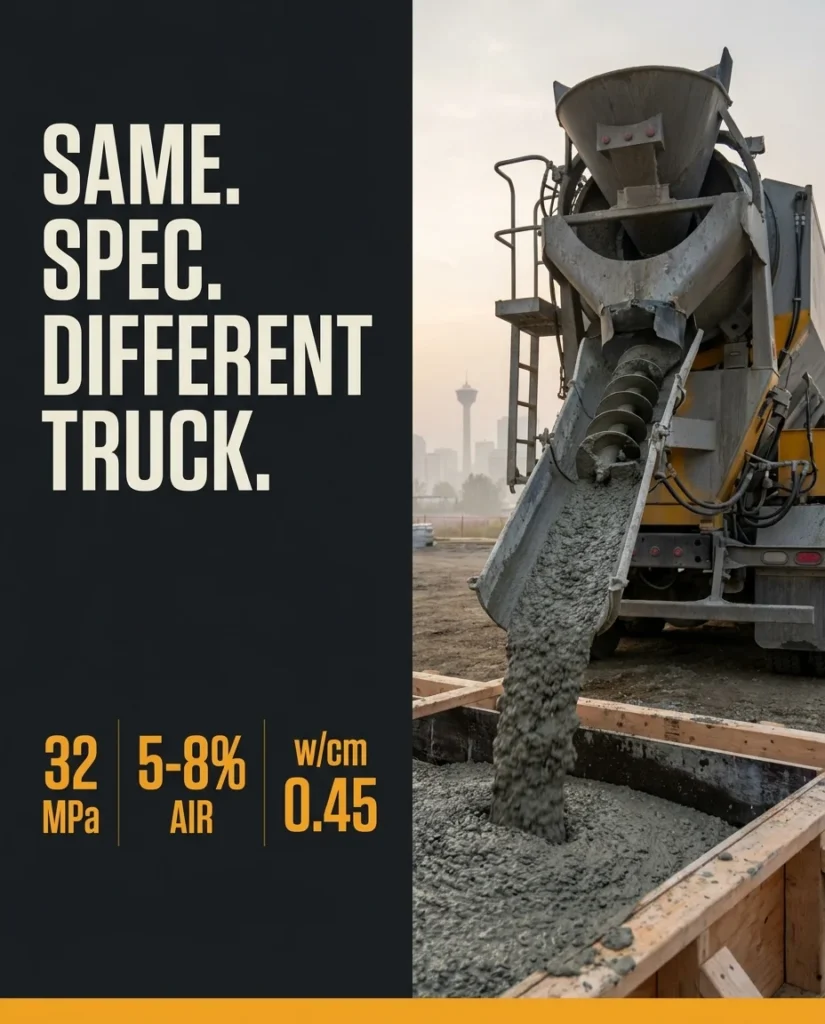
Acceptance criteria remain tied to CSA A23.1:24 exposure-class minimums. For C-2 (F-2 freeze-thaw with de-icing chemicals, which covers most Calgary exterior flatwork): 32 MPa at 28 days, 5–8% air, w/cm ≤ 0.45. For C-XL (severe sulphate, S-3): 35 MPa at 56 days, Type HSb cement only, w/cm ≤ 0.40. These cylinder acceptance thresholds are the same regardless of whether the concrete arrived by drum-mix truck or volumetric mixer.
Early frost resistance is assessed at 7 MPa — not 8 MPa. If your specification references a threshold for cold-weather protection of fresh concrete, confirm it uses 7 MPa as the criterion.
6. Item 5 — Air Entrainment Verification On-Site: CSA A23.1:24 C-2 Exposure 5–8% Requirement
Air entrainment in volumetric concrete deserves specific attention because the air-entraining admixture (AEA) is introduced at the point of discharge — typically injected into the water stream — rather than pre-batched at a plant. This means the AEA dosage is adjusted in real time, and it means that air content can vary more with changes in discharge rate, temperature, and aggregate gradation than it would in a controlled plant environment.
For C-2 exposure (freeze-thaw plus de-icing chemicals) under CSA A23.1:24, the required air content is 5–8% measured at point of delivery. Your inspector needs to verify air content at the point of placement, not at a remote test location, because air loss between discharge and placement can be meaningful — particularly with pump delivery or extended haul time.
Require air-content tests at a frequency that matches cylinder sampling. ASTM C231 (pressure method) or ASTM C173 (volumetric method, required for lightweight aggregate mixes) should be specified. Note that ASTM C672, historically cited for scaling resistance testing of air-entrained concrete, was withdrawn by ASTM in 2021 and has not been replaced by an active standard. If your spec references C672, replace that citation with a note that the standard is withdrawn and that WK76964 is the pending ASTM reinstatement work item. Do not cite C672 as an active testing requirement.
For C-1 exposure (freeze-thaw, no de-icing chemicals, F-1): the CSA A23.1:24 requirement is 32 MPa at 28 days, 5–8% air, w/cm ≤ 0.55. The air range is the same; the w/cm limit is more relaxed. Many spec writers inadvertently apply C-2 (F-2) restrictions to interior or sheltered concrete that only warrants C-1 (F-1) classification. Confirm exposure class assignment before writing air and w/cm requirements into the spec.
7. Item 6 — The Discharge-Clock Difference: Volumetric vs Drum-Mix Under CSA A23.1:24
Drum-mix ready-mix is governed by a discharge clock: CSA A23.1:24 requires all concrete to be discharged within 2 hours of water introduction at the plant (not 90 minutes, not 1.5 hours — the CSA standard is a 2-hour limit). This clock starts the moment water first contacts cementitious materials.
Volumetric mixers do not operate under the same discharge-clock framework because water is introduced at the point of discharge, not at a central plant. There is no pre-loaded drum sitting in traffic losing workability. Concrete is batched continuously and discharged fresh — the mixed product exists for seconds to minutes between the mixing chamber and the pour. This is one of the operational advantages of volumetric delivery for remote sites, phased pours, or projects where truck cycle time would push drum-mix into the 2-hour window.
What this means for spec writers: do not apply drum-mix discharge-clock language to a volumetric spec. If your Division 03 section contains a clause referencing the 2-hour discharge limit, add a carve-out that this provision applies to drum-mix supply only and that volumetric supply is governed by ASTM C685/C685M-25a Section 10 and CSA A23.1:24 Clause 7.2 (or the applicable clause in the current edition).
However, volumetric delivery is not workability-unlimited. Concrete placed too slowly — particularly in cold weather — can begin to stiffen in the form before consolidation is complete. Your spec should still include a placement-time requirement (time from discharge to consolidation), which applies to all concrete regardless of delivery method. Consult CSA A23.1:24 Table 7 for cold-weather concrete placement-time guidance.
8. Items 7–9 — Alberta Acceptance: APEGA Submittal, Calgary Building Services, and Owner-Directed Testing
Item 7: APEGA Submittal and Engineer-of-Record Sign-Off. In Alberta, structural concrete mix designs must be reviewed and accepted by a Professional Engineer registered with APEGA. For volumetric supply, this means the mix design package — which must include all ASTM C685/C685M-25a calibration documentation and ACI 304.6R submittal items — needs to be reviewed and formally accepted by the engineer of record prior to placement. This is not unique to volumetric concrete, but it is a step that field-focused contractors sometimes attempt to skip by treating volumetric as a “standard product” that needs no engineering review. It does. The engineer of record is responsible for confirming the proposed mix meets the project spec, the applicable CSA A23.1:24 exposure-class requirements, and any project-specific durability or structural requirements. That acceptance must be documented before first pour.
Item 8: Calgary Building Services and Permit Inspection. Under the NBC(AE) 2023 (Alberta edition, in force since May 1, 2024), concrete used in permitted construction in Calgary is subject to inspection at the field level and documentation review by Calgary Building Services. Volumetric concrete is not categorically excluded from building-permit inspection requirements. If the project involves permitted work — footings, foundation walls, slabs on grade for residential or commercial occupancies — the volumetric supplier’s documentation package (calibration, mix design, cylinder logs) must be available for inspector review in the same way plant-batched tickets would be. Confirm with Calgary Building Services at pre-construction whether they have a preferred submittal format for volumetric supply; if they do not have a standing procedure, a memo from the engineer of record accepting the mix design and confirming ASTM C685/C685M-25a compliance is a reasonable bridging document.
Item 9: Owner-Directed Testing and Third-Party Inspection. On projects where the owner’s quality plan includes third-party concrete inspection (testing agencies operating under CCIL or equivalent accreditation), confirm that the inspection agency has technicians qualified to sample volumetric-discharged concrete under ASTM C685/C685M-25a. Sampling technique from a continuous discharge stream differs from sampling a drum-mix truck chute. ACI 304.6R Section 7.4 describes the composite-sample method from a volumetric discharge stream. If the agency does not have documented experience with volumetric sampling, consider requiring the volumetric supplier to provide a pre-pour sampling demonstration and sign-off from the inspection agency before first structural placement. This protects all parties: the owner has documented that the inspection protocol was confirmed before the pour, the contractor has confirmed the inspector accepts the method, and the supplier has confirmed its system is operating within ASTM C685/C685M-25a tolerances at the start of work.
FAQ
Q1: Does volumetric concrete have to meet the same CSA A23.1:24 exposure-class requirements as drum-mix ready-mix? Yes. ASTM C685/C685M-25a governs the batching and mixing process, but it does not modify or waive CSA A23.1:24 exposure-class performance requirements. Compressive strength minimums, w/cm limits, air-entrainment requirements, and cement type restrictions all apply to volumetric concrete exactly as they do to plant-batched ready-mix. The delivery method changes; the performance specification does not.
Q2: What certification should I require from a volumetric supplier at submittal stage? At minimum, require a current VMMB (Volumetric Mixer Manufacturers Bureau) certification for the specific mixer unit and a calibration certificate dated within the past 12 months. NRMCA quality certification, where held, is a complementary credential. Also require water-meter calibration records, aggregate-gate calibration data for the specific mix design, and documentation of the operator qualification as referenced in ACI 304.6R. These items should be specified in Division 03 before the truck is engaged.
Q3: How does the CSA A23.1:24 2-hour discharge rule apply to volumetric mixers? It does not apply in the same way. The 2-hour CSA A23.1:24 discharge clock governs drum-mix supply because water contacts cementitious materials at the plant and the clock starts there. Volumetric mixers introduce water at the point of discharge, so there is no equivalent pre-loaded-drum clock. Your spec should include a carve-out distinguishing the two delivery methods and should instead specify a placement-time (discharge to consolidation) requirement applicable to all concrete, consistent with CSA A23.1:24 cold-weather provisions where relevant.
Q4: What air-entrainment percentage does CSA A23.1:24 require for Calgary exterior flatwork subject to de-icing chemicals? Calgary exterior flatwork subject to de-icing chemicals typically falls under C-2 exposure (F-2 freeze-thaw classification), which requires 5–8% air content at point of delivery, 32 MPa at 28 days, and w/cm ≤ 0.45. For flatwork sheltered from de-icing chemicals (C-1 / F-1), the air range remains 5–8% but the w/cm limit is 0.55. Confirm the correct exposure class with your structural engineer before writing these requirements into the spec.
Q5: Can I cite ASTM C672 as a scaling-resistance test in my spec? No. ASTM C672 was withdrawn by ASTM International in 2021 and is no longer an active standard. ASTM work item WK76964 is the pending reinstatement effort. If your current spec section still references C672, remove it or note it as withdrawn and flag the pending work item. Do not accept concrete testing reports citing C672 compliance as active code satisfaction.
Q6: Does a volumetric mix design in Alberta still require APEGA engineer-of-record review and acceptance? Yes. In Alberta, structural concrete mix designs must be reviewed by a Professional Engineer registered with APEGA regardless of the delivery method. Volumetric supply is not a pre-approved or “catalogue” product that bypasses engineering review. The APEGA-registered engineer of record must review and formally accept the volumetric mix design — including calibration documentation and ASTM C685/C685M-25a compliance — before any placement on a permitted structural element.
Sources
- ASTM C685/C685M-25a — Standard Specification for Concrete Made by Volumetric Batching and Continuous Mixing — https://www.astm.org/c0685_c0685m-25a.html
- ACI 304.6R — Guide for Volumetric-Measuring and Continuous-Mixing Concrete Equipment — https://www.concrete.org
- VMMB — Volumetric Mixer Manufacturers Bureau — https://vmmb.org
- NRMCA — National Ready Mixed Concrete Association — https://www.nrmca.org
- CSA A23.1:24 — Concrete materials and methods of concrete construction (14th edition) — https://www.csagroup.org/store/product/2701210/
- APEGA — Association of Professional Engineers and Geoscientists of Alberta — https://www.apega.ca
- NBC(AE) 2023 — National Building Code of Canada (Alberta Edition), in force May 1, 2024
About Omega Ready Mix
Omega Ready Mix (est. 2023) is a Calgary-based volumetric concrete supplier serving residential, commercial, and infrastructure projects across the Calgary region, delivering CSA A23.1:24-compliant mixes batched to ASTM C685/C685M-25a.
Need Volumetric Concrete That Meets ASTM C685 and CSA A23.1 Requirements?
Before your next foundation, slab, utility, or infrastructure pour, make sure your supplier can provide more than concrete.
Ask for:
- Current calibration certificates
- VMMB documentation
- Water-meter verification records
- ASTM C685-compliant sampling procedures
- Air-content testing support
- Engineer-ready mix-design submittals
Omega Ready Mix supplies volumetric concrete across Calgary and Southern Alberta with project-specific mix designs, on-site batching flexibility, and documentation packages designed to support engineers, inspectors, and contractors.
Request a quote today and verify your project requirements before the truck arrives.