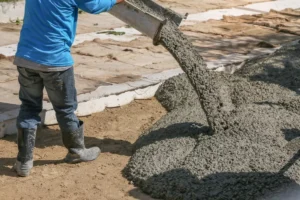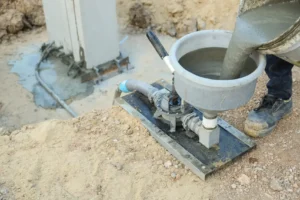

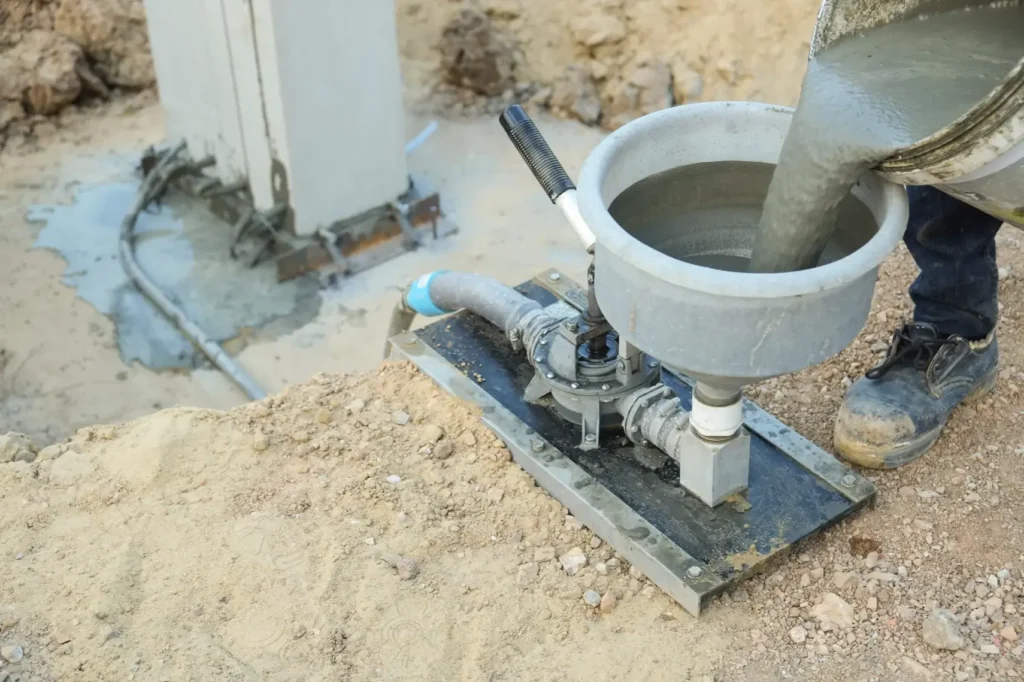
A concrete cylinder is a fair sample of the concrete that was placed. A grout cylinder is not. Grout is the one cementitious product on a site that is ordered deliberately wet, placed into a material designed to take its water away, and then tested in a mould that cannot take any water at all. Every surprising number in a masonry grout submittal comes from that single fact, including the one that makes a specifier reject a batch that would have performed.
Here is what CSA A179 and CSA A371 require for block fill, and where a specification writer can spend money without buying anything.
What CSA A179 lets you specify: proportion or property
There are two compliance routes, and the standard expects you to name one.
A proportion specification requires grout mixed to the volume proportions in Table 5 of CSA A179-14. Compliance is demonstrated by the proportions themselves. No minimum compressive strength is required under this route, and grout mixed this way typically tests in the range of 10 to 12 MPa at 28 days.
A property specification requires a product that has passed the standard’s testing requirements. Under this route the minimum 28-day compressive strength is 10 MPa for fine grout and 12.5 MPa for coarse grout.
The practical instruction from the Canada Masonry Design Centre is to specify compliance with one of those two routes rather than writing a minimum strength of your own. That is not simplification. It is the difference between a submittal that can be accepted and one whose acceptance criterion came from a different standard than the mix did.
Why the slump is 200 mm and up, and why that is not a quality problem
Grout slump is specified high on purpose. Published figures differ slightly at the top of the band: the Masonry Institute of British Columbia gives 200 to 250 mm for coarse grout, and notes that fine grout may need more than 250 mm for some conditions, while the Canada Masonry Design Centre gives a required range of 200 to 275 mm and recommends working toward about 275 mm. Both agree on the floor of 200 mm and on why it is there.
The reason is flowability into small cores around congested reinforcement. Grout at a concrete slump will not reach the bottom of a 200 mm cell with two bars and a lap in it. The high water content does not stay in the wall: the units absorb the free water, which lowers the effective water to cementing materials ratio in place and also builds the bond between grout and unit.
One method note that costs real money when it is ignored. Reach the required flow through water content rather than through jobsite plasticizers, because plasticized grout tends to stick to mortar fins and unit webs on the way down. Grout runs the opposite way to structural concrete here, where the problem is usually the one in our note on slump control and concrete quality.
Where the test specimen stops representing the wall
The test method referenced by CSA S304 uses 28-day cylinders cast in non-absorbent moulds. The wall does not have non-absorbent sides. So the specimen keeps water the wall would have lost, cures at a higher water to cementing materials ratio than the grout in the cells, and reports a lower strength than the material it came from.
The gap is not marginal. The Masonry Institute of British Columbia cites a comparison in which the same mix reported 12.5 MPa by cylinder and 18 to 25 MPa by a specimen moulded against masonry, and states that in-wall strength is typically above 20 MPa. So a cylinder result near the bottom of the published minimum is usually not a failure. It is a known artefact of the mould, and one of the few places in concrete work where the standard itself tells you to correct for the test rather than argue about it.
What the design standard does with your cylinder result
CSA S304, clause 12.4.1.2, takes the in-situ grout strength used in design, f’gr, as 1.5 times the 28-day cylinder strength. For proportion-specified grout a typical assumed value is 20 MPa.
Run the arithmetic on the minimum and the mechanism becomes obvious. A coarse grout meeting the 12.5 MPa property minimum carries a design in-situ strength of about 18.75 MPa, which sits inside the 18 to 25 MPa range measured independently against masonry moulds. The two sources are describing the same wall from two directions.
| Figure | Value | Where it comes from |
|---|---|---|
| Minimum 28-day strength, fine grout, property route | 10 MPa | CSA A179-14 |
| Minimum 28-day strength, coarse grout, property route | 12.5 MPa | CSA A179-14 |
| Typical result, proportion route | 10 to 12 MPa at 28 days | Industry guidance |
| Design in-situ strength | 1.5 times the 28-day cylinder strength | CSA S304, cl. 12.4.1.2 |
| Typical assumed in-situ strength, proportion route | 20 MPa | Industry guidance |
| Measured strength against masonry moulds, same mix | 18 to 25 MPa versus 12.5 MPa by cylinder | Industry test comparison |
Why specifying 25 MPa grout usually buys nothing
This is the part worth taking to a specification review.
A grout specified at 25 MPa by cylinder may reach roughly 40 MPa in the wall once absorption has done its work. That cement was bought and then wasted twice over, because assemblage strength rises only slightly when grout strength rises substantially. The governing capacity of a reinforced masonry wall is not sitting in the grout. In-situ strengths above 20 MPa are also compatible with the design strengths in CSA S304.1 across the full range of block strengths, so the upgrade does not unlock anything on the design side either.
There is a related trap in the other direction. Where project notes do not acknowledge the 12.5 MPa minimum and instead carry a borrowed 20 or 25 MPa cylinder requirement, a compliant mix can be rejected on paper. Fixing that is an edit to the specification, not a change to the mix.
What the clear space decides for you
Fine or coarse is not a preference. It is read off the geometry of the cell.
CSA A371-14, clause 8.2.5.7.1, sets the minimum clear distance between reinforcing bars and unit surfaces at 6 mm for fine grout and 13 mm for coarse grout. Coarse grout carries aggregate up to 12 mm and uses less cement per unit volume, which makes it the cheaper and more common choice. Fine grout is the one required in heavily reinforced or congested masonry, and in small-core units.
Congestion is usually a bar-count question, and the counts are modest.
| Unit width | Vertical bars per core | Horizontal bars per course |
|---|---|---|
| 125 mm | 1 | 1 |
| 150 mm | 1 | 1 |
| 200 mm | 1 | 2 |
| 250 mm | 2 | 2 |
| 300 mm | 2 | 2 |
The number that catches people is the splice. At a lap the bar count per core doubles, so a wall designed with one vertical bar per core has two wherever bars are spliced. That is where coarse grout stops clearing 13 mm and the order changes, and it is a drawing question rather than a site question. Gradation requirements for both grouts are in Table 1 of CSA A179-14, and masonry sand rather than concrete aggregate is what normally goes into the mix.
What pour height and lift height do to the order
Two terms get used interchangeably on site and mean different things in the standard. A pour is the total height of grout placed in one operation. A lift is one pass of the filling process within that pour.
A typical pour is 2.4 m, bond beam to bond beam. CSA A371-14 sets a maximum pour height of 4.5 m, which in practice is only workable with H-block or 250 and 300 mm units. Any pour of 3 m or more has to be placed in lifts of 2 m or less.
For a supplier that is a delivery-rate question before it is a technical one. A 4.5 m pour broken into three lifts is three sequenced placements against one wall, with waiting time set by consolidation and by the wall’s tolerance for pressure rather than by the truck. Planning that sequence against the delivery schedule is the same exercise as planning a continuous vertical placement, which is the subject of our note on preventing cold joints in ICF foundation walls.
One vocabulary note, since the words overlap: block fill grout is not flowable fill or CLSM, which is a low-strength self-levelling material for void filling and abandonment.
Where cleanouts fit, and when the designer can waive them
Cores that will be grouted have to be free of excessive mortar protrusions and base droppings. Cleanout or inspection holes at the base of reinforced cores do two jobs: they let droppings be removed before grouting, and they confirm afterwards that grout reached the bottom.
CSA A371-14, clause 8.2.3.2.2, allows the designer to waive cleanouts once the contractor has demonstrated acceptable performance, or where the walls are not structurally critical. The sensible pattern is to require them on the first walls and waive them once the crew has shown the cores are filling.
Two admixture restrictions belong on the submittal rather than in assumptions: antifreeze compounds are prohibited, and chloride-containing admixtures are excluded because they corrode reinforcement and promote efflorescence. Accelerators have to be chloride-free, and using one does not remove cold-weather protection obligations. Where water is added to ready-mixed grout at the site, remix for at least one minute before discharge.
What to settle before you order block fill
- Whether the specification calls up the proportion route or the property route, in writing.
- Whether a minimum strength has been written in, and whether it is the standard’s figure or a borrowed one.
- Fine or coarse, resolved from the clear distance at splices rather than at typical sections.
- The pour height and the lift sequence, element by element.
- Whether cleanouts are required throughout or for the first walls only.
- Who authorises water addition at the site, and the remix requirement that comes with it.
- The acceptance basis for cylinder results, including the 1.5 factor the design standard applies.
FAQ
What strength does grout for a block wall need to be? Under the property route of CSA A179-14 the minimum 28-day compressive strength is 10 MPa for fine grout and 12.5 MPa for coarse grout. Under the proportion route no minimum strength is required, and grout mixed to the Table 5 proportions typically tests at 10 to 12 MPa.
Why is grout slump so much higher than concrete slump? Because it has to flow into small cores around reinforcement. Published requirements run from 200 mm up, with 250 mm and 275 mm given as upper figures by different industry sources. The masonry absorbs the free water, so the finished wall ends up at a normal water content.
Why did my grout cylinder test lower than expected? Cylinders are cast in non-absorbent moulds, so the specimen retains water the wall would have lost and reports a lower strength. The same mix has been measured at 18 to 25 MPa against masonry moulds while reporting 12.5 MPa by cylinder.
What is f’gr? It is the in-situ grout strength used in design. CSA S304, clause 12.4.1.2, takes it as 1.5 times the 28-day cylinder strength, and 20 MPa is a typical assumed value for proportion-specified grout.
How high can a grout pour be? CSA A371-14 sets a maximum pour height of 4.5 m, practical mainly with H-block or 250 and 300 mm units. A typical pour is 2.4 m, and any pour of 3 m or more must be placed in lifts of 2 m or less.
Send the details, get the mix and the slot
Grout is easy to order badly: a borrowed strength number, the wrong grade for the clear space at splices, and a lift sequence nobody checked against the delivery schedule. Send us your project details – pour date, mix type, PSI, volume – and our team will get back to you within 1 business hour with a quote and delivery slot. Tell us the unit size, the bar count at splices and the pour heights in the same message, because those three decide what block fill concrete in Calgary has to be on the day.
Sources
- Canada Masonry Design Centre, Masonry Grout
- Masonry Institute of British Columbia, Section 2.3.2, Grout and Reinforcing
- Concrete Masonry and Hardscapes Association, TEK 09-04A, Grout for Concrete Masonry