A strength spec is a number you can hold a cylinder against. A water spec is not. Ask what the limit is for mixing water and the standards hand you back a procedure instead of a threshold, which is why the question stalls on rural and on-site pours more often than any other material question we field.
The distinction matters commercially. Cement, aggregate, and admixture all arrive from a plant with documentation attached. On a volumetric pour at an acreage, or a remote site where a water truck is filling from whatever source is closest, the water is the one ingredient that frequently originates with the job rather than with the supplier. Someone has to prove it is acceptable, and the standards are explicit that proof is comparative, not absolute.
What counts as mixing water is broader than the batch water
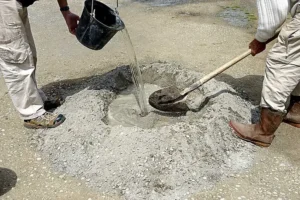
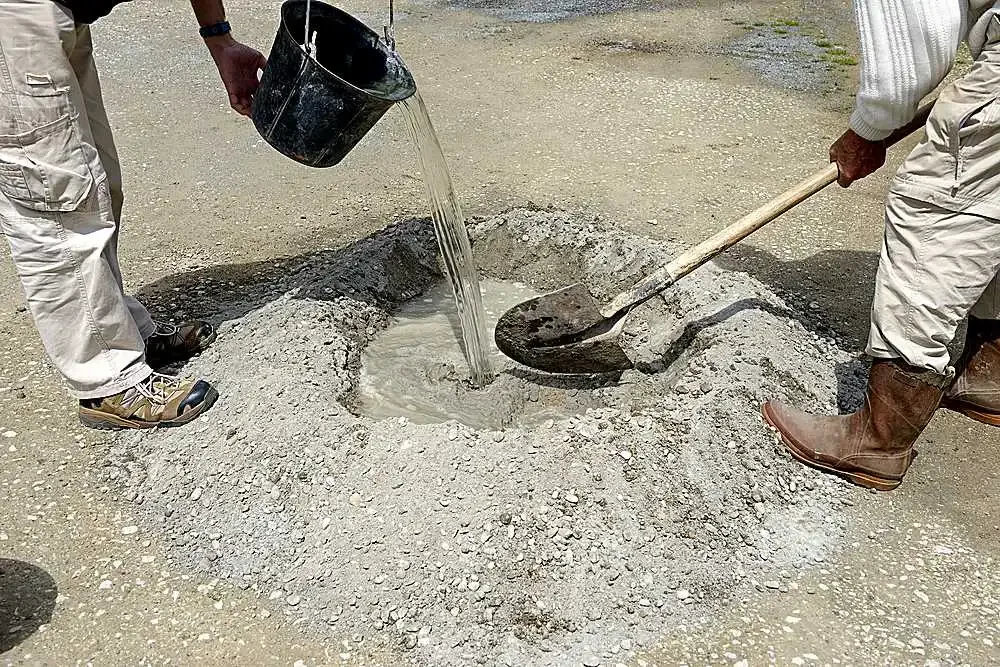
Mixing water is not just what goes in through the water meter. It includes batch water, ice, free moisture carried on the aggregates, any significant water contributed by chemical admixtures, and water added during delivery or at the jobsite. Water absorbed into the aggregate particles is excluded.
That definition does real work. A crew that adds twenty litres at the chute has changed the mixing water, and a stockpile sitting in a March thaw is contributing water nobody measured. Both are inside the specification’s scope even though neither passes through a batch plant control system. Water quality affects setting time, workability, strength, and durability, so the composition of every one of those streams is in play.
Municipal potable water is the only source that needs no proof
Potable municipal water can be used without qualification testing. That is the whole of the rule, and it is the reason the question almost never arises on a Calgary city lot.
Everything else inverts the burden. In the Ontario provincial standard, which spells the mechanics out more fully than most, municipal potable water requires no testing at all, while non-municipal potable water must meet drinking water regulation plus separate limits for chloride, sulphate, sodium, alkalinity, and total dissolved solids. Non-potable water is permitted only if it meets a defined qualification procedure. Recycled water is prohibited outright in that jurisdiction, which is a useful reminder that a source acceptable under one specification can be banned under the next.
Alberta’s own road specification takes the shorter route and points at the national standard: water shall conform to the requirements of the latest version of CSA Standard A23.1, and shall be free from harmful amounts of alkali, organic materials, or deleterious substances. It then adds a sentence that decides who carries the risk. Water used in portland cement concrete construction shall be subject to the prior approval of the Consultant.
How a non-potable source is actually qualified
Here is the answer to the question everyone starts with. A non-potable source is not approved by hitting a chemistry number. It is approved by batching with it and comparing the result against a control batch made with known-good water, using the same materials, proportions, and admixture dosages.
Two performance criteria carry the decision:
| Criterion | Requirement | Test basis |
|---|---|---|
| 7-day compressive strength | Not less than 90% of the control batch strength | CSA A23.2 in the Canadian route; mortar cubes in the ASTM C1602 route |
| Time of set | Within a defined window of the control | ASTM C403 in both routes |
| Test mix strength floor | Mixes must reach 25 MPa or greater (Ontario standard) | CSA A23.2 |
The chemical limits still exist, but they sit a layer down. Where a Canadian specification needs numbers for a non-potable source, it sends you to Table 9 of CSA A23.1 rather than reproducing the values. Under the ASTM framework, the chemical limits are optional provisions covering alkalis expressed as sodium oxide equivalent, chlorides, sulfates, and total solids, which a purchaser may invoke individually when the structure makes one of them important. A chemical lab tests a sample against whichever of those the purchaser has called up.
The practical reading for a specifier: if your structure is sensitive to chlorides, you have to say so in the specification. The default qualification path is a strength and set comparison, and it will not catch a chloride problem that your reinforcement cares about.
Where the two frameworks disagree, and why you should name one
The set-time window is not the same number in both systems, and this is the detail that produces arguments on mixed-standard projects.
| Framework | Time of set tolerance against control |
|---|---|
| Ontario provincial standard, referencing CSA | No more than 60 minutes different from the control concrete |
| ASTM C1602 route | Not accelerated by more than 1 hour, and not retarded by more than 1.5 hours |
A water source that retards initial set by 80 minutes passes one and fails the other. Neither is wrong. They are different acceptance criteria, and a specification that says only “water shall be suitable for concrete” has not chosen between them. Name the standard and the edition in the contract documents, the same way you would for an exposure class, and the dispute disappears before it starts.
The sources Alberta rules out by name
Most of what a specification does about water is exclusion rather than permission. The Alberta road specification bars three categories explicitly: the contractor shall not use slurry water, treated wash water, or water from shallow, stagnant, or marshy sources.
Read that list with a rural site in mind. A dugout that has drawn down through a dry August is shallow and stagnant by the time you get to it. Plant wash water and reclaimer slurry from returned concrete are exactly the streams a producer is tempted to reuse, and they are the first two named. The sources that a non-potable programme typically draws on, as the industry literature lists them, are wells, streams, and other water bodies for rural or portable plants, plant wash water, collected storm water, and reclaimer slurry. Three of those five run straight into the Alberta exclusion.
That is why the practical answer on an acreage pour is usually a well, not surface water, and why the well needs a sample taken before anyone schedules concrete.
Water added at the jobsite is still mixing water, and it has hard limits
The one place the standards do give you numbers is the chute. On-site water addition is allowed only with the Consultant’s permission, and then within three constraints at once:
- The specified water to cementing materials ratio is not exceeded.
- No more than 60 minutes have passed since batching.
- The amount added does not exceed the lesser of 16 litres per cubic metre or 10% of the mixing water.
The lesser-of structure is the part crews miss. On a lean mix with low water content, 10% of the mixing water is the binding limit well before 16 litres per cubic metre is. Exceed it and the Consultant may reject the batch, including requiring removal of concrete already placed from that batch.
Documentation closes the loop. Every water source added to a batch is to be identified and recorded, water may be added at the jobsite only where the slump is below target and the mix design water content is not exceeded, and the added water is noted and signed off on the delivery ticket. That signature is the record that decides a later strength argument, which is why the water line belongs on your list of numbers to read on the batch ticket before the truck leaves.
What this means on a rural or on-site pour
On a city pour, the supplier’s plant water is municipal and the question never surfaces. On a rural or on-site pour it surfaces immediately, and the sequence that works is unglamorous.
Sample the intended water source before the mix design is finalized, not after. Submit test certificates from an independent laboratory, and give the submission the lead time the specification asks for. In the Ontario standard that is at least 7 days before concrete placement, which is a reasonable planning figure even where your specification is silent. Expect resampling obligations once you are in production: that standard requires samples at the start of placement in each calendar year, taken no more than 30 days before placement, again once more during the year, and whenever the source changes, with two samples of at least one litre each time.
The source-change trigger is the one that catches long jobs. Switching from the first well to a second one partway through a season is a new source and a new qualification, not a continuation of the old file.
On the production side, the comparison test is only as good as the samples behind it, so the field sampling procedure is part of the water file and not a separate exercise.
FAQ
Can you use well water to mix concrete in Alberta? Usually yes, but it is a non-potable or non-municipal source, so it has to be qualified rather than assumed. The Alberta road specification points water requirements at CSA A23.1 and makes the water subject to the prior approval of the Consultant.
What is the actual limit for chloride or sulphate in mixing water? Canadian specifications send you to Table 9 of CSA A23.1 for those values rather than printing them. Under the ASTM route the chloride, sulfate, alkali, and total solids limits are optional provisions that the purchaser invokes when the structure requires them.
How is non-potable water approved? By comparison. The 7-day compressive strength of the test mix must be at least 90% of a control mix made with known-good water, and the time of set must fall inside a defined window of the control, tested to ASTM C403.
Is slurry or wash water allowed? Not under the Alberta road specification, which states the contractor shall not use slurry water, treated wash water, or water from shallow, stagnant, or marshy sources.
How much water can the crew add at the site? Only with the Consultant’s permission, within 60 minutes of batching, without exceeding the specified water to cementing materials ratio, and no more than the lesser of 16 litres per cubic metre or 10% of the mixing water.
Does ice count? Yes. Mixing water includes batch water, ice, free moisture on the aggregates, significant water in admixtures, and water added during delivery or at the jobsite.
How far ahead do we need the water test? Plan on submitting independent laboratory certificates at least 7 days before placement, and re-sample whenever the source changes.
Get the water question settled before the pour date
If your project draws its water from anything other than a municipal main, the qualification is a scheduling item, not a formality. We supply on-site and rural pours across the region and we will tell you what the water source means for your mix and your submittal timeline before you commit to a date. Start with our rural project supply.
Send us your project details, pour date, mix type, PSI, volume, and our team will get back to you within 1 business hour with a quote and delivery slot.