
A mixer uniformity test answers one question: does concrete taken from the front of a load match concrete taken from the back of the same load. If it does, the drum is mixing. If it does not, every other test you run on that truck is measuring the sample, not the batch — and the cylinder set you break at twenty-eight days is a report on whichever part of the load the technician happened to reach.
This is the test nobody on site watches, because it is normally a one-time qualification done on a mixer design rather than a routine check on a given truck. That is also why it quietly stops being true. A drum that qualified when it was new is a different machine once the blades have worn.
The short answer
Uniformity is specified in two places that Alberta readers run into. CSA A23.1, Clause 5.2.3.5 is the Canadian uniformity provision, and it is the clause Alberta Transportation’s bridge specification points to when it wants mixing proved. ASTM C94/C94M, the US ready-mixed concrete specification, carries the equivalent requirement and the annex procedure behind it.
Neither of those is free to read, and that matters for how this page is written: below, every number is attributed to the document that states it, because the documents do not all say the same thing, and one of them deliberately says nothing.
What the test actually does
The procedure is comparative, not absolute. Two samples are taken from one load at defined points, and a list of properties is measured on both. What qualifies the mixer is not whether either sample passes the mix spec — it is whether the difference between the two samples stays inside permitted limits. The properties compared are the ones that separate when mixing is poor: consistency, air, density, the proportion of coarse aggregate, the mortar fraction, and strength.
That is the logic worth carrying away even if you never see the full tolerance table. Segregation and under-mixing do not show up as a bad number. They show up as two different numbers from one truck.
Where Alberta points, and what it leaves out
Alberta Transportation’s Specifications for Bridge Construction, Section 4 (Cast-in-Place Concrete) handles mixing equipment in Section 4.6. On uniformity, Section 4.6.1 says the Consultant may require that the uniformity of the mixed concrete be tested for conformance with CSA A23.1, Clause 5.2.3.5. That is the whole provision. The spec names the clause and hands the tolerance table to CSA.
On blades, the same section is deliberately qualitative. Blades must be renewed if they are bent or worn down so as to affect the mixing efficiency. There is no percentage, no dimension and no measuring point. Section 4.6.1 also requires the inner surfaces to be kept free of hardened concrete and mortar, caps batch size at the mixer’s rated capacity, requires an accurate and dependable means of measuring added water that is not affected by pressure variation, and removes defective mixers from service until they are repaired. Section 4.6 also rules out mobile continuous mixers on that work altogether.
So Alberta sets the duty and declines to set the threshold. If you are the one who has to decide whether a blade is “worn down so as to affect the mixing efficiency,” you need a number from somewhere else.
The number comes from the NRMCA inspection criteria
The NRMCA Quality Control Manual, Section 5 (Vehicle Inspection) is where the industry number lives. It defines excessive wear by measuring the blade’s radial height from the drum shell, at the point of maximum drum diameter nearest the drum head. A blade is considered excessively worn once that height has dropped by more than a tenth of its original radial dimension — the manual calls the original a specific dimension on a sketch for each blade type, and notes those originals are available from the mixer manufacturer on request.
Two things follow that are easy to miss:
- Wear is measured at one specific station on the drum, not wherever it looks worst. A blade that is badly scoured near the opening and sound near the head is a different finding than the reverse.
- You cannot assess it without the original dimension. “Looks worn” is not the criterion. The criterion is a comparison against a manufacturer figure, which means the fleet needs that figure on file before the inspection, not after.
The same NRMCA section covers the rest of the truck’s credentials. The drum rating must not exceed sixty-three per cent of gross mixer volume. The mixer must carry a plate showing the manufacturer’s recommended mixing speed, which must fall within a band of not less than four nor more than twenty-two revolutions per minute. Water measurement is spot-checked and expected accurate to within one gallon on a sight gauge, or two per cent of target water for a truck-mounted water meter. Interior surfaces are expected to show no appreciable accumulation of hardened concrete, with blades free of excessive wear.
Mixing revolutions are not the same question as the discharge clock
This is the distinction that causes the most confusion on a Calgary site, so it is worth separating cleanly.
Mixing revolutions are how many turns at mixing speed the batch needs before it is concrete at all. Alberta Transportation’s Section 4.6.2 requires a minimum of fifty revolutions at the manufacturer’s recommended mixing rate to thoroughly mix the concrete, and a minimum of twenty additional revolutions before discharge whenever a site adjustment — water, air-entraining agent or superplasticizer — has been authorized. Manitoba Infrastructure’s Specification 1030, Section 5.1.3.3, states the same two figures: fifty revolutions for initial mixing and twenty additional revolutions after a site admixture adjustment. Two provincial specifications, independently written, landing on the same numbers is about as close to settled as this gets.
Manitoba also brackets the speeds: initial mixing at four to six revolutions per minute, with a maximum of one hundred revolutions above six revolutions per minute.
The total revolution count a load is allowed before discharge is a separate limit with a separate purpose, and it belongs to the delivery window rather than to mixing performance. We have written about that side of it in eight critical numbers on your concrete batch ticket. Do not read a mixing minimum as permission against a total maximum, or the other way round.
The check you can actually run at the chute
You are not going to run a full uniformity evaluation on a Thursday morning pour. You can run the short version.
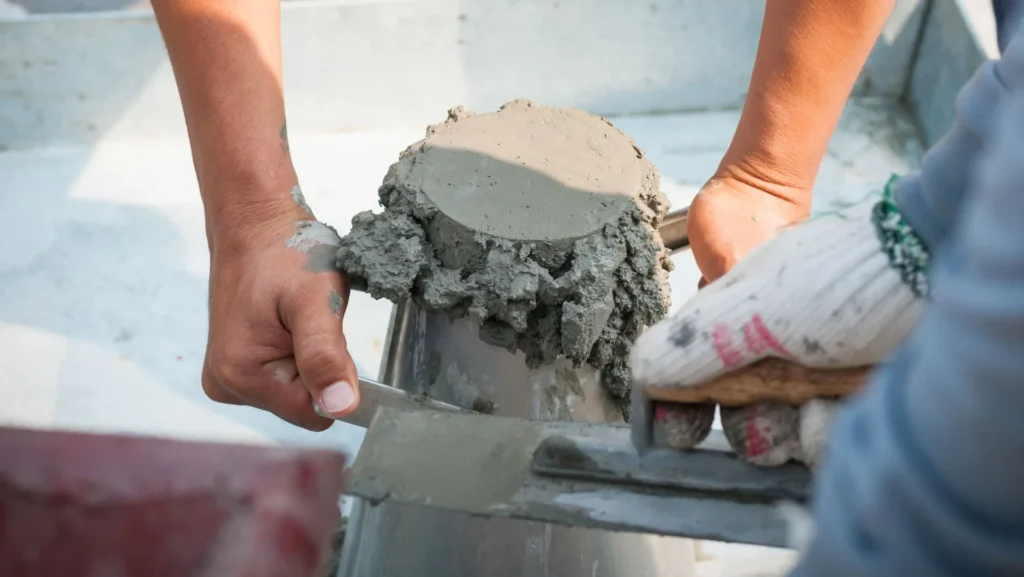
Manitoba’s Specification 1030, Section 5.1.3.2, gives the field form of the test: the Engineer may test individual batches at approximately the one-quarter and three-quarter points of the load, and if the results show a variation in slump exceeding fifty millimetres, the mixer or agitator is not to be used until the condition is corrected.
Two slump cones, taken a known distance apart in the discharge, and a threshold. That is a test a site super can ask for, and it is the single most useful thing on this page for anyone who suspects a truck is delivering two different concretes. It is also a cleaner diagnosis than arguing about one slump reading, which is the situation described in ten pour-day conditions worth rejecting a truck over.
What each document requires
| Requirement | Alberta Transportation BCS Section 4 | Manitoba Infrastructure 1030 | NRMCA QC Manual Section 5 |
|---|---|---|---|
| Uniformity tolerance table | Refers to CSA A23.1 Clause 5.2.3.5 | Slump variation limit of 50 mm between quarter points | One-time evaluation on one mixer size of a given design |
| Minimum mixing revolutions | 50 at manufacturer’s mixing rate | 50 at 4 to 6 rpm | Plate must show manufacturer’s mixing speed |
| After an authorized site adjustment | 20 additional revolutions | 20 additional revolutions | — |
| Blade wear criterion | Qualitative: renew if bent or worn so as to affect mixing efficiency | Not stated | Radial height loss of more than a tenth of the original dimension |
| Drum capacity | Batch not to exceed rated capacity stamped on the mixer | — | Rating not to exceed 63% of gross mixer volume |
| Water measurement | Accurate, dependable, unaffected by pressure variation | — | Within 1 gallon on sight gauge; 2% of target on meter |
Why this lands harder in Alberta
Two local conditions make mixing performance less forgiving here than the standards alone suggest.
The first is haul distance. Rural and acreage work around Calgary routinely puts long hauls between the plant and the forms, and a long haul means a high revolution count arriving before anyone has poured a cubic metre. The drum spends that time agitating, not mixing, and whatever non-uniformity the blades allowed at mixing does not fix itself on the highway.
The second is temperature. Winter work moves to hot mix concrete, which starts its reactions sooner, and that narrows the window in which a marginal mixing job can still be corrected by extra revolutions at the site. A worn drum is a slower problem in October than it is in January.
There is a structural answer to both, which is to stop hauling mixed concrete at all and batch at the forms. That is the premise of volumetric supply, and the comparison is laid out in volumetric mixer versus traditional ready-mix and in how our mixers work.
Where this page stops
This page is about whether a mixer mixes: uniformity, mixing revolutions, blade wear and the truck’s rating. It does not cover the total time or revolution limit on a load before discharge, which is a delivery-window question. It does not cover plant batching accuracy, scale calibration or how aggregate moisture is corrected into batch water — those are plant-side measurement questions with their own tolerances, and we have treated them separately. It does not set out slump, air or strength acceptance limits for a mix, and it does not address precast plant quality control, which runs under a different standard entirely.
Frequently asked questions
What is a concrete mixer uniformity test? A comparative test. Samples are taken from two defined points in one load and the same properties are measured on both. The mixer qualifies on the difference between the samples staying within permitted limits, not on either sample’s absolute value.
Which standard governs mixer uniformity in Alberta? CSA A23.1, Clause 5.2.3.5. Alberta Transportation’s Specifications for Bridge Construction, Section 4.6.1, is explicit that uniformity, where required, is tested for conformance with that clause. ASTM C94/C94M is the corresponding US specification.
How many revolutions does ready-mixed concrete need? Alberta Transportation requires a minimum of fifty revolutions at the manufacturer’s recommended mixing rate, plus a minimum of twenty additional revolutions before discharge if a site adjustment has been authorized. Manitoba Infrastructure’s Specification 1030 states the same two minimums and adds an initial mixing range of four to six revolutions per minute.
When is a truck mixer blade too worn? Alberta’s specification is qualitative — renew the blade if it is bent or worn so as to affect mixing efficiency. The NRMCA Quality Control Manual supplies the measurable version: measure radial height from the drum shell at the point of maximum drum diameter nearest the drum head, and treat the blade as excessively worn once more than a tenth of the original radial dimension is gone.
Can I check mixing uniformity on site without a lab? Partly. Manitoba’s Specification 1030 allows testing a batch at approximately the one-quarter and three-quarter points of the load and treats a slump variation over fifty millimetres as grounds to stop using that mixer until it is corrected. That is a two-cone check, not a full evaluation.
Does a worn drum affect my strength results? It can, indirectly and in a way that is hard to diagnose. If a load is not uniform, a cylinder set represents the portion sampled rather than the batch, so both a low break and a passing break become less informative. Proving uniformity is what makes the rest of the testing programme mean something.
Need concrete that is mixed where it is placed?
If your project involves long hauls, staged pours or rural access, batching at the site removes the drum-condition variable from the conversation entirely. See how our volumetric mixers work, or send us the mix spec and haul details and we will tell you what we would supply and why.
Sources
- Alberta Transportation, Specifications for Bridge Construction, Section 4 — Cast-in-Place Concrete — https://www.transportation.alberta.ca/content/doctype246/production/10bcs04.pdf
- NRMCA, Quality Control Manual, Section 5 — Vehicle Inspection — https://www.nrmca.org/wp-content/uploads/2020/01/Section5VehicleInspection.pdf
- Manitoba Infrastructure, Specification 1030 — Concrete — https://www.gov.mb.ca/mti/contracts/pdf/manual/1030.pdf
- Concrete Alberta, Codes and Standards — https://www.concretealberta.ca/resources/codes-standards