
A placement becomes mass concrete when the heat its own cement generates cannot escape fast enough to keep the interior and the surface within about 20°C of each other. The two numbers that govern it are a peak in-place temperature of 71°C and a core-to-surface differential of roughly 19 to 20°C. In Alberta, the second number is the one that gets blown — and it gets blown most often in January, not July, because the differential is driven by how cold the outside face is, not by how hot the day is.
That last point is worth sitting with, because almost every published guide on mass concrete is written for a hot climate and frames the problem as a summer problem. On a 1.5 m pile cap poured in Calgary in February, the core will climb past 60°C on its own hydration heat regardless of the weather. What changes in winter is the surface: it sits against forms exposed to minus twenty, it sheds heat fast, and the gradient across the outer 300 mm opens up far wider than it ever would in August.
This article covers what makes a placement mass concrete, which limits apply in Alberta, what the mix can and cannot do about them, and what belongs in a thermal control plan before the trucks are booked.
What makes a placement mass concrete
ACI defines mass concrete by behaviour rather than by size: any volume of structural concrete where the member dimensions, boundary conditions, mixture characteristics and ambient conditions can combine to produce undesirable thermal stresses, cracking, deleterious chemical reactions or a loss of long-term strength from hydration heat.
That definition is correct but hard to use on a Tuesday. The working rule the industry applies is dimensional. NRMCA states that a member with a minimum dimension of 4 ft (1.3 m) should be considered mass concrete; the commonly cited threshold elsewhere is 1.2 m (4 ft) least dimension. Either way, once the smallest dimension of the element passes roughly 1.2 m, assume you are in mass concrete territory until someone models it and proves otherwise.
Three qualifiers matter in practice:
- Least dimension, not volume. A 200 m³ slab at 200 mm thick is not mass concrete. A 12 m³ pile cap at 1.5 m thick is. Heat escapes through the nearest face, so thickness governs.
- Cementitious content moves the threshold down. A high-strength mix at 450 kg/m³ of cementing materials generates far more heat than a 300 kg/m³ footing mix, and can behave as mass concrete at dimensions below 1.2 m.
- Boundary conditions count. Concrete cast against soil loses heat slowly on that face; concrete cast against a steel form in wind loses it quickly. The same element can pass on one face and fail on another.
The two numbers a thermal control plan has to hold
| Limit | Value | Source | What it protects against |
|---|---|---|---|
| Maximum in-place temperature | 71°C (160°F) | ACI 301 | Delayed ettringite formation and long-term strength loss |
| Maximum core-to-surface differential | 19°C (35°F) | ACI 301 | Thermal cracking from restrained surface contraction |
| Maximum centre-to-surface differential | 20°C | Alberta Transportation BCS 4.4.2(l) and 4.20(5) | Same, as written into an Alberta specification |
| Common differential rule of thumb | 35°F (20°C) | NRMCA CIP 42 | Same |
The two limits do different jobs and are frequently confused.
The 71°C peak is a durability limit. Above roughly that temperature, the chemistry of the hardening paste changes in ways that can allow delayed ettringite formation later in the structure’s life, and the concrete that forms at high temperature is measurably weaker at 28 days and beyond than the same mix cured cooler. This limit is about what the concrete becomes.
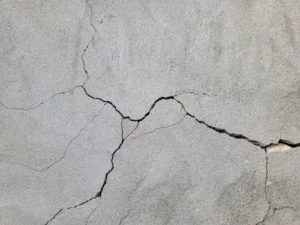
The 19 to 20°C differential is a cracking limit. The interior expands as it heats; the cooler surface does not. When the surface is restrained by the warmer mass behind it, tensile stress develops in the outer layer, and concrete has very little tensile strength — particularly at one or two days old, when the differential typically peaks. NRMCA gives the coefficient of thermal expansion for concrete as 5.5 to 14.5 millionths per °C, which is what turns a 25°C gradient into a real strain rather than an academic one. This limit is about whether the surface cracks.
Alberta’s own bridge specification lands on 20°C for the centre-to-surface differential, both in its cold weather clause and in its high-performance concrete curing clause. Notably, it does not define mass concrete by any dimension — it refers to mass pours without setting a size threshold. That gap is where most Alberta disputes start: the limit is written down, the trigger for applying it is not.
Why Alberta’s differential problem peaks in January
Heat of hydration does not care what month it is. A cubic metre of 35 MPa concrete at 400 kg/m³ of cementing materials releases the same energy in winter as in summer, and a thick element retains it either way. The core temperature curve is, to a first approximation, a property of the mix and the geometry.
The surface temperature is a property of the weather, and in Alberta it swings enormously. That gives three winter-specific problems:
- The gradient opens wider. A core at 60°C against a form face at 5°C is a 55°C differential — nearly three times the limit. The same core against a summer form face at 35°C is 25°C, still over but far more manageable.
- Form stripping becomes a thermal shock event. Pulling forms off a warm element into cold air is the single most common way a compliant placement turns into a cracked one. The surface drops tens of degrees in minutes while the core is still near peak. Alberta’s bridge specification requires cold weather enclosures maintaining above 15°C for seven days after placement, which exists precisely to prevent this.
- Heated concrete raises the starting point. Winter placement often means hot mix concrete delivered warm to protect against early freezing. That is correct practice for a thin element, and exactly wrong for a thick one: every degree of extra delivery temperature carries through to a higher peak core temperature, roughly degree for degree, and the 71°C ceiling arrives sooner.
Point three is the one that catches experienced crews, because the winter instinct that protects a 100 mm slab actively damages a 1.5 m pile cap.
What the supplier controls: the discharge temperature window
The most powerful and least expensive lever on peak core temperature is the temperature of the concrete when it leaves the chute — and that is a supplier-side number.
Alberta Transportation’s Specifications for Bridge Construction set the discharge temperature at between 10°C and 25°C for general classes of concrete, and between 10°C and 20°C for high-performance concrete and HPC with steel fibres. Those windows are narrow on purpose. The top of the range exists because placement temperature propagates directly into peak temperature; the bottom exists because concrete that is too cold gains strength too slowly and is vulnerable to early freezing.
For a mass placement, aim at the bottom of the permitted window rather than the middle. Practical means, in ascending order of cost:
- Aggregate temperature management. Aggregate is roughly 70 to 80% of the mix by mass and dominates its thermal mass. Shaded, unheated stockpiles in summer; minimum necessary heating in winter.
- Chilled batch water. Replacing ambient batch water with chilled water is the standard first step and is cheap.
- Ice substitution. Replacing part of the batch water with flake ice absorbs the latent heat of fusion as it melts, and is dramatically more effective per kilogram than chilled water. The practical ceiling is how much of the free water you can replace.
- Liquid nitrogen injection. Effective to a degree nothing else reaches, and priced accordingly. Reserved for placements where the model says nothing else will hold.
Whatever is used, the delivered temperature belongs on the batch ticket and should be verified at the chute, not assumed.
Mix design levers, and what each one actually does
| Lever | Effect on peak temperature | Effect on differential | Caution |
|---|---|---|---|
| Slag cement replacement | Large reduction; heat released more slowly | Reduces gradient meaningfully | Slower early strength; matters for form stripping |
| Fly ash replacement | Moderate to large reduction | Reduces gradient | Slower early strength; supply variability |
| Lower-heat portland cement | Moderate reduction | Modest | Availability, and cost |
| Reducing cementitious content | Direct reduction | Direct | Bounded by the specified strength and exposure class |
| Retarding admixture | Little to none | Little to none | Delays the peak, does not lower it — a common and expensive misunderstanding |
| Avoiding very low w/cm | Prevents unnecessary heat | Indirect | A w/cm lower than durability requires is wasted cement and wasted heat |
Supplementary cementing materials are the primary tool, and NRMCA names them first among mitigation measures for exactly this reason. Slag and fly ash both reduce the total heat released and slow the rate at which it comes out, which flattens the peak and gives the surrounding concrete time to conduct heat outward. The trade is early strength, which has to be reconciled with the form stripping schedule rather than discovered on site.
The retarder line in that table is worth emphasising. A retarding admixture moves the temperature peak later. It does not make it lower. Specifying one as a thermal control measure is a reasonably common error and produces a placement that is over the limit on day two instead of day one.
What belongs in a thermal control plan
ACI 207 allows a project to depart from the prescriptive 71°C and 19°C limits by demonstrating, through a thermal control plan, that the specific element will perform. A usable plan contains:
- The mix design, with cementitious content and SCM proportions stated
- Predicted temperature rise, from modelling or from prior data on the same mix and geometry
- The allowed concrete temperature at the point of placement
- Form insulation requirements and the R-value assumed
- The duration of the thermal control period and the criteria for ending it
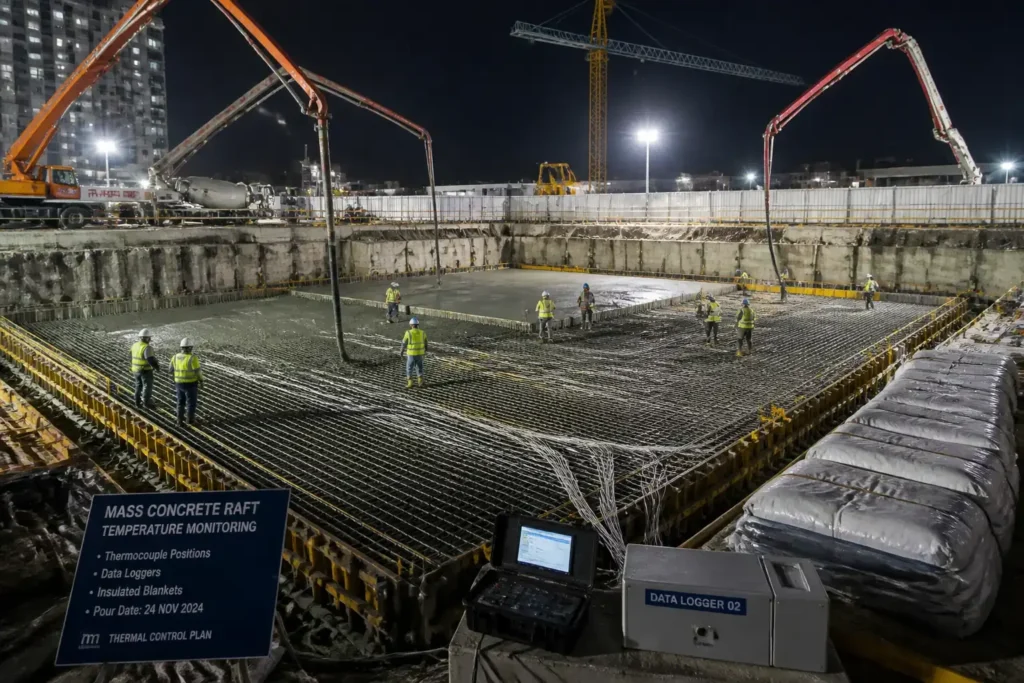
- The number and location of temperature sensors, including at least one at the geometric centre and one 50 mm inside the nearest surface
- The strip criteria, expressed in temperature differential rather than in days
- What happens if a limit is exceeded, and who decides
The sensor line matters most. A differential limit cannot be enforced without paired measurements, and a single sensor in the middle of an element tells you about the 71°C limit and nothing whatever about the 20°C one.
FAQ
Is a 1.2 m thick raft slab automatically mass concrete? Treat it as mass concrete unless modelling shows otherwise. The 1.2 m (4 ft) least dimension is a screening threshold, not a legal definition, and a high cementitious mix can behave as mass concrete somewhat below it.
Does CSA set a mass concrete temperature limit? The differential figure most Alberta projects work to comes from ACI 301 at 19°C, with Alberta Transportation’s bridge specification independently stating 20°C for centre-to-surface in its cold weather and HPC curing clauses. For any given job, the governing number is the one in the project specification — confirm it with the engineer of record before batching rather than assuming an industry default.
Can insulation alone solve a differential problem? Often yes, and it is usually the cheapest fix. Insulating blankets or insulated forms raise the surface temperature toward the core temperature, closing the gradient from the outside. The limitation is that insulation also traps heat, so on an element already near the 71°C ceiling it can trade a cracking problem for a durability one.
When is the differential at its worst? Typically between 24 and 72 hours after placement for most elements, with thicker sections peaking later. Monitoring that stops at 48 hours can easily miss the maximum on a 2 m section.
Does a volumetric mixer change any of this? The physics are identical, but on-site production gives direct control over batch water temperature and allows continuous placement without cold joints between lifts — both of which are useful on a large placement. The limits do not move.
Planning a thick placement in Alberta?
Peak temperature and differential are decided by the mix and the delivery temperature long before anybody hangs a sensor. If you have a pile cap, raft or transfer slab coming up, talk to us about the mix and the discharge window at design stage — on-site production gives the tightest control over batch water temperature and lets a large element go in continuously, and line pump placement keeps lift timing under control on constrained sites.
Related technical reading: fly ash versus slag cement covers the SCM choice in more depth, Calgary cold weather concrete rules covers winter placement generally, the numbers on a concrete batch ticket explains where to find your delivered temperature, and admixture types in Alberta sets out what retarders do and do not do.
Sources
- NRMCA, CIP 42 — Thermal Cracking of Concrete — https://www.nrmca.org/wp-content/uploads/2020/04/42p.pdf
- Alberta Transportation, Specifications for Bridge Construction, Section 4 — Cast-in-Place Concrete — https://www.transportation.alberta.ca/content/doctype246/production/10bcs04.pdf
- Construction Canada, Assessing mass concrete with thermal control plan — https://www.constructioncanada.net/assessing-mass-concrete-with-thermal-control-plan/