
A corrosion-inhibiting admixture does one thing: it delays the onset of chloride-induced corrosion in embedded reinforcing steel. It does not stop chloride from entering the concrete, it does not repair steel that has already started to rust, and it is not a substitute for a low water-cementing materials ratio or adequate cover. Specified in the right place it buys years. Specified as a shortcut it buys nothing.
That distinction matters more in Alberta than in most of the country. Calgary applies chlorides to roads through a long winter, chinooks drive repeated wet-dry and freeze-thaw cycling that pumps salt solution into concrete rather than leaving it to sit, and parkade decks collect all of it off vehicle tires. If you are placing structural concrete that will see de-icing salt — a parking structure, a loading apron, exterior stairs, a ramp — the corrosion question belongs in the mix design conversation, not in a repair conversation five years later.
Here is what the standards actually say, what the field evidence shows, and the order the protective measures should be pulled in.
What corrosion actually is, in one paragraph
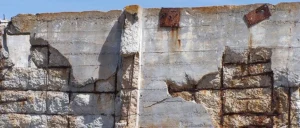
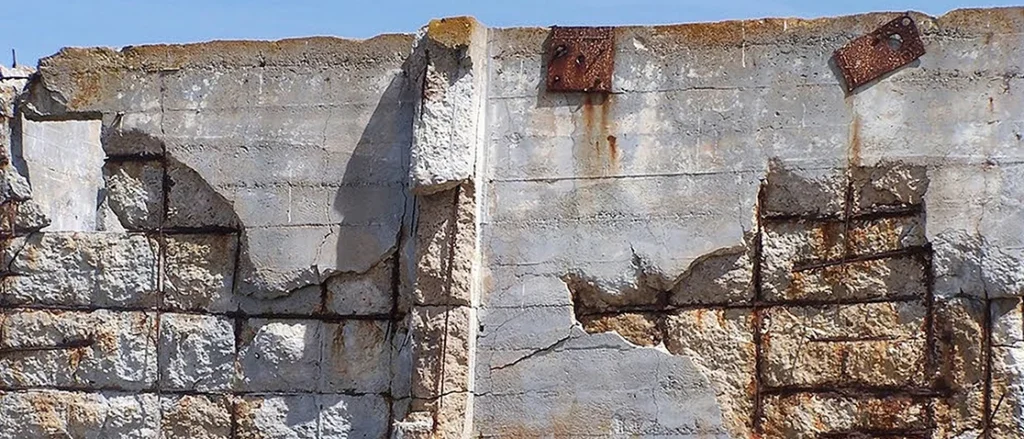
Steel in sound concrete does not corrode, and the reason is chemistry, not coverage. Fresh concrete has a pore solution with a pH above 13, and at that alkalinity a microscopically thin passive oxide film forms on the steel and holds. Corrosion begins when that film is disrupted. Two things disrupt it: carbonation, which lowers the pH at the steel — corrosion initiates once pH at the bar falls below 9 — and chloride ions, which break the passive film down directly even while the concrete around them is still highly alkaline.
Chloride is the mechanism that matters for Alberta exterior structural work. Carbonation is a slow, mostly interior-and-sheltered problem. Road salt is an annual event.
The chloride numbers that trigger it
Corrosion does not begin the moment the first chloride ion arrives. It begins when the concentration at the level of the steel crosses a threshold. Published threshold values vary with mix, moisture and temperature, but the working range is well established: roughly 0.05 to 0.1 percent chloride by weight of concrete — about 2 to 4 lb/yd³ — which works out to approximately 0.4 to 0.8 percent by weight of cement.
Separately from that ingress threshold, there are limits on how much chloride your concrete is allowed to contain on day one, from the mix constituents themselves. Under the ACI 318 exposure categories, the water-soluble chloride ion limits by mass of cement are:
| Category | Condition | Limit, % by mass of cement |
|---|---|---|
| C0 | Concrete dry or protected from moisture | 1.0 |
| C1 | Concrete exposed to moisture, no external chloride source | 0.3 |
| C2 | Concrete exposed to moisture and an external chloride source | 0.15 |
| — | Prestressed concrete, all categories | 0.06 |
Those limits are verified by testing to ASTM C1218 on samples at an age of 28 to 42 days.
A note on which system you are reading, because it trips people up on Canadian jobs: C0, C1 and C2 above are ACI 318 categories, not CSA classes. CSA A23.1:24 uses its own exposure class system — C-XL, C-1, C-2, C-3, C-4 — and a Canadian specification will name those. The chloride limits and the exposure classes answer two different questions, and the hyphen is the only thing visually separating them. If you are choosing the class for an Alberta pour, start with CSA A23.1 exposure classes explained; this article deals only with the admixture decision that sits on top of that choice.
What ASTM C1582 actually requires
This is the part most specifications get wrong. Corrosion-inhibiting admixtures are frequently called up under ASTM C494 as a Type S — “specific performance” — admixture. Type S is a catch-all category that certifies an admixture does not harm the concrete. It does not certify that the product inhibits corrosion, because C494 has no corrosion test in it.
The standard that does is ASTM C1582/C1582M, Standard Specification for Admixtures to Inhibit Chloride-Induced Corrosion of Reinforcing Steel in Concrete. It works by comparison: a control concrete without the admixture is tested against a test concrete containing it, and the product must demonstrate corrosion-inhibiting performance measured through macrocell current and corroded area, with chloride-ion content confirmed to have reached or exceeded critical thresholds by the end of the test. In other words, the standard verifies the admixture performed while chloride was genuinely present, not merely that chloride stayed out.
C1582 also runs the ordinary battery on fresh and hardened properties — slump, air content, setting time, compressive and flexural strength, freeze-thaw resistance and length change — so an admixture that protects the steel while wrecking the air-void system does not qualify.
Practical consequence: specify the admixture to ASTM C1582, not to ASTM C494 Type S. If a submittal comes back citing only C494, it has not been tested for the thing you are buying it for. Raise it at submittal review rather than after placement — and if you are building the admixture package for a job, that conversation belongs in custom mixed concrete before the mix is finalised.
What the long-term field evidence shows
Here is where honesty is worth more than a sales pitch. The Federal Highway Administration ran a long-term field study on corrosion inhibitors used in the repair of chloride-contaminated reinforced concrete, evaluating both calcium nitrite-based inorganic inhibitors and amine-based organic inhibitors at dosages from roughly 1.2 L/m³ up to 39.94 L/m³ depending on product and site.
The conclusion was blunt: neither inhibitor evaluated in that study, using the specified repairs and exposed to those environments, provided any corrosion-inhibiting benefit. Corrosion continued in treated areas, and in some spans corrosion rates in treated sections ran higher than in the control span.
Read that carefully, because it is easy to over-generalise. That study examined inhibitors introduced into patch repairs placed into structures that were already chloride-contaminated and already corroding. It is not a test of an inhibitor batched into new concrete before any chloride has arrived. But it does establish something useful: an inhibitor is a preventive measure with a window, and once corrosion is underway, adding one to a patch is not a fix. If the steel has already depassivated, you are in repair engineering, not mix design.
The order the levers should be pulled
Every protective measure below works by the same logic — keep chloride from reaching the steel in quantity, or keep the concrete around it dense and uncracked. The admixture is the last one on the list, not the first.
- Lower the water-cementing materials ratio. Permeability is the whole game. A w/cm in the 0.40 to 0.50 range produces low-permeability concrete, and 0.40 maximum is the benchmark where an external chloride source is present. Nothing else on this list compensates for a wet mix.
- Use supplementary cementing materials. They refine the pore structure and cut chloride diffusion substantially. Benchmark proportions: roughly 5 percent silica fume, 25 percent fly ash, or 50 percent slag cement as replacement levels.
- Increase cover over the steel. Cover is the distance chloride has to travel. Minimum cover requirements should be increased over the baseline where concrete is exposed to a corrosive environment.
- Control cracking. A crack is a shortcut through everything above it. Crack widths should be held to about 0.006 in. where corrosion is a concern — which is a reinforcement, jointing and curing question as much as a mix question. Our guide to fibre, rebar and wire mesh covers how the reinforcement choice changes crack behaviour, and fibre mesh in concrete covers where secondary reinforcement genuinely helps.
- Entrain air and cure properly. Air entrainment is non-negotiable for freeze-thaw exposure in Alberta. Curing should run at least 7 days, with concrete temperature maintained above 50 °F (10 °C). Concrete that dried out in its first week is permeable concrete no matter what the mix ticket said.
- Then consider the corrosion-inhibiting admixture, specified to ASTM C1582, as additional time on the clock — not as permission to relax any of the five above.
What this means on a Calgary job
Three Alberta-specific realities shape the decision.
Wet-dry cycling accelerates ingress. Chloride does not only diffuse; it is drawn in by absorption when a dry surface is wetted with salt solution. A chinook that thaws a salted deck and then lets it dry, repeatedly, moves chloride into concrete faster than steady cold would. Surfaces that cycle are the ones to protect.
Freeze-thaw and chloride are the same exposure. The air entrainment you specify for freeze-thaw and the low permeability you specify for chloride resistance are not competing requirements — they are the same durable mix. What they do compete with is finishing convenience, which is where added water on site quietly undoes both.
Strength class is not durability class. A higher strength number does not automatically mean a chloride-resistant mix, though the two usually move together because both follow w/cm. Specify the durability requirement explicitly rather than assuming it rides along with the MPa or PSI number.
How to specify it
- Name the exposure class from CSA A23.1:24, not just a strength.
- State the maximum w/cm and require it on the batch ticket.
- Specify the corrosion-inhibiting admixture to ASTM C1582, and state the dosage rate the supplier is to use, since dosage varies by product chemistry over roughly an order of magnitude.
- Require the admixture manufacturer’s compatibility confirmation with the air-entraining admixture and water reducer in the same mix.
- Specify chloride ion content testing to ASTM C1218 at 28 to 42 days where the specification imposes a limit.
- Specify the curing duration and minimum temperature, and enforce them.
FAQ
Does a corrosion-inhibiting admixture stop chloride from entering concrete? No. It raises the chloride concentration the steel can tolerate before the passive film breaks down, which delays the onset of corrosion. Keeping chloride out is the job of low permeability and adequate cover.
Which standard should a corrosion-inhibiting admixture be specified to? ASTM C1582/C1582M. ASTM C494 Type S certifies that an admixture does no harm; it contains no corrosion performance test.
At what chloride level does steel in concrete start to corrode? Threshold values typically run about 0.05 to 0.1 percent by weight of concrete — roughly 2 to 4 lb/yd³, or about 0.4 to 0.8 percent by weight of cement — measured at the level of the steel.
Will an inhibitor help a slab that is already spalling? Not on the evidence. FHWA’s long-term field study of inhibitors used in repairs to already-contaminated structures found no corrosion-inhibiting benefit. Once corrosion is active, the problem belongs to a repair engineer.
Does it affect setting time or air content? It can, which is exactly why ASTM C1582 tests slump, air content, setting time, strength, freeze-thaw resistance and length change alongside the corrosion performance. Confirm compatibility with the rest of the admixture package before the first load.
Is it worth it on a residential driveway? Usually not. The economics favour the basic levers — correct exposure class, a low w/cm, proper air, real curing. Inhibitors earn their cost on structures where the steel is critical and replacement is disruptive: parkades, ramps, decks and structural exterior elements.
Getting the mix right before the first truck
Corrosion protection is decided at mix design and confirmed on the batch ticket, not diagnosed later off a spalled deck. If you have an Alberta pour coming up with de-icing salt exposure and reinforcing steel you cannot afford to lose, our team can work through the exposure class, the w/cm, the SCM proportions and whether an ASTM C1582 admixture is justified for your structure — see custom mixed concrete in Calgary, and bring your specification with you.
Sources
- NRMCA CIP 25 — Corrosion of Steel in Concrete — National Ready Mixed Concrete Association: passivation and pH, chloride limits by ACI 318 exposure category, ASTM C1218, w/cm, SCM proportions, cover, crack width, curing
- ASTM C1582/C1582M-11(2017)e1, Standard Specification for Admixtures to Inhibit Chloride-Induced Corrosion of Reinforcing Steel in Concrete — scope and required performance testing
- FHWA-RD-01-097, Long-Term Performance of Corrosion Inhibitors Used in Repair of Reinforced Concrete — Federal Highway Administration field study, inhibitor types, dosages and findings