
Block fill grout is not concrete with extra water in it. It is a separate material with its own standard, its own slump range and its own strength criteria, and the number that gets it wrong most often on a Calgary site is slump.
Grout goes into a narrow, absorbent cavity full of reinforcing steel. Masonry units pull water out of it almost immediately, which is why grout is batched at a water content that would be rejected outright in a slab mix. Arrive at 100 mm slump because someone ordered “concrete for the block,” and it will bridge over a bar, leave a void behind the face shell, and the wall will not carry what the engineer designed it to carry.
This is what the Canadian standards actually require, and what changes between April and November in Alberta.
What CSA A179 requires
Grout for unit masonry is governed by CSA A179, and it can be specified two ways.
| Specification path | How it works | Strength requirement |
|---|---|---|
| Proportion specification | Mixed to prescribed proportions of cement, aggregate and water | No minimum compressive strength is required; grout mixed this way typically tests 10–12 MPa at 28 days |
| Property specification | The producer formulates the mix to meet a stated strength | 10 MPa minimum for fine grout, 12.5 MPa minimum for coarse grout, at 28 days |
Two things about those numbers surprise people the first time they see them.
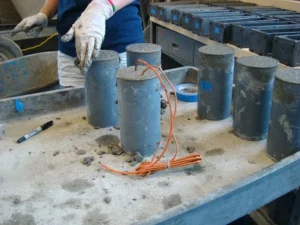
First, the strengths are low relative to structural concrete. A grout that tests 12.5 MPa in a cylinder is behaving very differently inside the wall, because the block absorbs mixing water and the grout densifies in place. In-situ grout strength is commonly estimated at about 1.5 times the cylinder strength — roughly 20 MPa for a proportion-specified grout. The cylinder is a quality-control check, not a picture of the material in the cell.
Second, a low cylinder break is therefore not automatically a failing wall. Confirm what was specified and how the sample was taken before anyone raises removal.
Coarse grout or fine grout
The choice is dictated by the space, not by preference.
- Fine grout uses sand as its aggregate. It is used in narrow cells and in cavities congested with steel.
- Coarse grout carries aggregate up to about 12 mm. It is the normal choice for standard block cores where the space allows it.
CSA A371 sets the clear distance between reinforcing steel and the masonry unit that decides which one you can use: 6 mm minimum for fine grout, 13 mm for coarse. Measure the actual cell after the bars are placed, laps included. A wall detailed with 20M bars lapped in a 200 mm block can lose coarse-grout clearance at exactly the spot where consolidation matters most.
Slump: the number to get right
Grout slump belongs in the 200–275 mm range. Coarse grout usually sits at 200–250 mm; fine grout is often specified above 250 mm.
That is deliberately fluid. Grout has to travel down a cell, flow around bars and fill under a bond beam without vibration doing all the work. The high water content is not a durability problem the way it would be in exterior flatwork, because the block draws that water out within minutes of placement.
Practical consequences on site:
- Order grout, not concrete. Tell the plant it is block fill and give the cell size and bar size. We batch it as grout to CSA A179 and hold the slump where the standard puts it.
- Do not add water at the wall to fix a stiff load. If a load arrives outside the range, correct it at the truck under the supplier’s control so the water addition is recorded, not guessed at with a hose.
- Consolidate anyway. High slump reduces the risk of voids; it does not eliminate them. Vibrate or puddle each lift, then reconsolidate after the initial water loss into the block.
Volumetric mixing helps here for a reason specific to grout: block fill quantities are awkward. A wall takes the volume its cells take — rarely a clean truckload — and the mix differs from everything else pouring that day. That is the same logic behind running footing, slab and step mixes off one truck.
Lift heights and pour heights
These two terms get used interchangeably on site and they are not the same thing.
- A pour is the full height of grout placed in one continuous operation, from the bottom of the grout space to the top.
- A lift is one increment within that pour, placed and consolidated before the next increment goes in.
CSA A371 caps the pour height at 4.5 m. Where a pour is 3 m or more, it must be placed in individual lifts of 2 m or less. In practice most Alberta block walls are grouted in roughly 2.4 m pours, bond beam to bond beam, which keeps everything comfortably inside those limits and gives the mason a natural stopping point.
North American practice splits grouting into two methods, and it is worth knowing which one your wall assumes:
| Low-lift grouting | High-lift grouting | |
|---|---|---|
| Wall built before grouting | Sections not exceeding about 1.63 m | Up to full storey height |
| Reinforcement | Spliced between sections | Continuous, fewer splices |
| Cleanouts | Not required | Required |
| Main advantage | Lower blow-out risk, bar placement visible | Mason builds continuously, better productivity |
Low-lift grouting suits small walls, retaining stems and anything where the crew is grouting as they go. High-lift grouting suits full-storey commercial walls, and it comes with a condition that gets skipped: the cleanouts.
Cleanouts, and why they exist
Cleanout openings at the base of grouted cells let the crew remove mortar droppings and check bar position before grout goes in. Mortar fins that squeeze into a cell during laying land at the bottom, and they are exactly where the grout has to be continuous for the wall to work.
CSA A371 addresses cleanouts in Clause 8.2.3.2.2, and the designer is permitted to waive the requirement under certain conditions. That waiver is a design decision, not a field decision. If cleanouts are shown, the sequence is: lay the wall, clean the cells, have the bars and cavities inspected, close the cleanouts, then grout. Closing them before the inspection turns a five-minute check into a coring exercise later.
Bar placement is the other half of that inspection. Grout only develops the wall’s designed capacity if the steel sits where the drawing puts it, which is the same principle that governs reinforcement selection in a slab — the material does its job only when it is in the right plane.
Grouting block in an Alberta winter
Cold-weather grouting is stricter than most crews expect, because a block wall is thin and exposed with no thermal mass to protect the grout.
CSA A371 requires grout to be delivered between 20 °C and 50 °C, and the masonry must be kept above 0 °C for 48 hours after placement — 24 hours where high-early-strength cement is used. The protection measures step up by air temperature:
| Air temperature | Required measures |
|---|---|
| 0 to 4 °C | Heat the sand or the mixing water to 20–70 °C; protect the masonry from rain and snow for 48 hours |
| −4 to 0 °C | Heat both sand and mixing water to 20–70 °C; cover the masonry completely for 48 hours |
| −7 to −4 °C | Heat both materials; apply heat to both faces during construction; windbreaks where wind exceeds 25 km/h; insulating blankets for 48 hours |
| Below −7 °C | Heat both materials; enclose the work and supply heat to hold the air above 0 °C; units at minimum 7 °C when laid; maintain above 0 °C for 48 hours |
Two Calgary-specific notes. First, that 20 °C minimum delivery temperature is why shoulder-season block fill is batched the same way we batch hot mix concrete — heated water and heated aggregate at the plant, timed so the material is still in range when it reaches the wall, not when it leaves the yard. Second, a chinook does not cancel the requirement. A wall grouted at +8 °C in the afternoon can be below freezing before the 48-hour protection period is half over, and warm wind moving across an unenclosed wall pulls heat out faster than still air at the same temperature. We have written about what that same wind does to a long haul on a hot chinook day; in winter the mechanism runs the other direction and it is the grout that pays.
What to give the plant when you order
A block fill order that goes smoothly contains six things:
- Grout, not concrete — state CSA A179 block fill grout explicitly.
- Coarse or fine, based on measured clear distance around the steel (6 mm fine, 13 mm coarse).
- Specified strength, if the project uses a property specification rather than proportions.
- Slump target within 200–275 mm.
- Volume by cell count, not by wall area — partially grouted walls are commonly overestimated.
- Placement window and temperature, so winter loads can be batched hot and timed to the wall.
If you are unsure how a spec reads, send it over before the day of the pour. Sorting out whether a wall wants coarse grout at 12.5 MPa or fine grout in a congested cell takes one phone call, and it is a far cheaper conversation than a core sample. For mix selection on the rest of the project, our note on why 32 MPa Type 50 is the workhorse mix for Calgary ground covers what usually goes in the footings under that wall.
Frequently asked questions
What slump should block fill grout be? Between 200 and 275 mm. Coarse grout is typically 200–250 mm and fine grout is often above 250 mm. Grout is intentionally fluid because the masonry units absorb mixing water immediately after placement.
Is block fill the same as concrete? No. Block fill grout is specified to CSA A179, uses smaller aggregate, and is placed at a much higher slump than structural concrete. Ordering standard concrete for block cells is the most common block fill mistake.
What is the maximum height a block wall can be grouted in one pour? CSA A371 limits a grout pour to 4.5 m. Pours of 3 m or more must be placed in lifts of 2 m or less. Most walls are grouted in roughly 2.4 m pours from bond beam to bond beam.
When are cleanouts required? Cleanouts are required for high-lift grouting so mortar droppings can be removed and bar placement verified before grout is placed. CSA A371 Clause 8.2.3.2.2 allows the designer to waive them under certain conditions — that decision belongs to the designer, not the crew.
How cold is too cold to grout a block wall? There is no single cut-off, but the protection requirements escalate below 4 °C, and below −7 °C the work must be enclosed and heated to hold the air above 0 °C. Grout must arrive between 20 °C and 50 °C and the masonry must stay above 0 °C for 48 hours.
Ordering Block Fill Grout in Calgary?
Don’t order standard concrete and try to make it work in the wall.
Give Omega Ready Mix the cell size, reinforcing bar size, specified strength, grout type and pour height before the truck is scheduled. We’ll help confirm whether the wall calls for fine or coarse grout, target the required slump and coordinate delivery conditions — including heated grout for Alberta cold-weather placement.
Whether you’re filling a small residential masonry wall or a multi-storey commercial project, getting the grout specification right before the pour is far cheaper than discovering a problem after the cells are filled.
Send us your masonry grout specification or project details and let’s get the right block fill mix scheduled.
Sources
- Canada Masonry Design Centre — Masonry Grout: https://www.canadamasonrydesigncentre.com/specifications/masonry-grout/
- Masonry BC — Grout and Reinforcing, Section 2.3.2: https://www.masonrybc.org/wp-content/uploads/2022/06/Section-2.3.2-R-Bill-June-2022.pdf
- Concrete Masonry and Hardscapes Association — High-Lift vs. Low-Lift Grouting: https://www.cmha.org/resource/cmu-faq-005/