
In one week, Omega Ready Mix ran more than 50 pours, over 400 cubic metres, across all four Calgary quadrants and out to Cochrane, Chestermere, Springbank, Carseland and the Bow Valley. The work ran from a 1 m³ patch to a 35 m³ pad, and from house slabs to thrust blocks, exposed aggregate, grout fill and shotcrete. That range is what you’re really buying.
When you’re choosing a concrete supplier, you’re not buying one pour. You’re buying whoever shows up the morning your forms are ready, with the right mix, the right placement method, and the discipline to be there before the crew is standing around waiting. So instead of telling you we can handle your job, here’s a real week, anonymized, but real, and what the spread of it actually means for you as a buyer.
1. The week in numbers: 50+ pours, 400+ m³, one fleet
Over roughly six working days this summer, Omega Ready Mix ran about 55 pours and recorded more than 400 cubic metres of concrete. We say “more than” on purpose, a few smaller jobs never got their volume logged, so the honest number is “several hundred metres and then some,” not a tidy round figure.
A typical day landed somewhere between 8 and 13 pours. The busiest single day was 13 pours and roughly 110 m³. The lightest was a pair of pours. That rhythm matters more than the totals: a supplier who only does big jobs treats your driveway as a nuisance, and a supplier who only does small jobs can’t carry a 35 m³ pad. A week that swings from 2 to 13 pours is a fleet built to do both without dropping either.
The equipment behind that week: five volumetric (mobile-mixer) trucks with their operators, one boom pump, one line pump, and several finishing and placing crews. A cement bulker, somewhere between 28 and 42 tonnes, backed up to the silo most mornings to keep the trucks fed. That’s the unglamorous part of reliability: if the silo runs dry at 9 a.m., the 11 a.m. pour doesn’t happen.
So when you ask “can you handle my job,” the more useful question is the one this week answers for you: does this supplier run enough capacity that my small pour won’t get bumped, and enough range that my big one won’t be a stretch?
2. The range of jobs one week covered (slabs to thrust blocks to shotcrete)
Here’s the menu one week actually touched, because the variety is the point:
- Slabs: house and floor slabs, garage pads, air-conditioner (AC) pads, mechanical-room slabs.
- Structure: foundation walls and footings.
- Flatwork: driveways, sidewalks (including stamped sidewalks), and a pin curb.
- Decorative: exposed aggregate, both small-rock and a black integral-colour finish.
- Utility / trade: thrust blocks for water and utility lines, poured at a higher-strength mix.
- Small pours: sonotubes and post holes for decks, fences and pile footings.
- Specialty: grout fill for masonry, and shotcrete placed by a dedicated crew.
- Big one: a parking pad with thickened slab edges.
If you’re a homeowner, you might only ever care about one of those rows. But the fact that all of them ran in a single week tells you something you can’t get from a single quote: this is a supplier that specifies and places each job type on purpose, not one that pours everything the same way and hopes. The grout-fill crew and the exposed-aggregate finisher are not the same skill set, and neither is the boom-pump operator on the parking pad.
For the trade and utility buyers reading this, note the thrust blocks specifically. They showed up several times across the week and they ran a different spec than the flatwork did, which is exactly the next section.
3. One default spec, and the times it changed (32, 35, and 25 MPa)
On nearly every exterior ticket this week, the default mix was the same: 32 MPa, Type 50 cement (sulphate-resistant, CSA’s Type HS), 5–8% air. In plain terms, that’s the CSA A23.1:24 C-2 exposure class, the class for exterior flatwork that gets hit with chlorides and de-icing salts and then freezes and thaws. Calgary driveways, sidewalks and steps live in that world every winter, so C-2 is the sensible Calgary default, not a luxury.
A few translations, since the alphabet soup is doing real work here:
- MPa is megapascals, the compressive strength the concrete is designed to reach.
- Type 50 / Type HS is sulphate-resistant cement, which matters because a lot of Alberta soil and groundwater carries sulphates that chew on ordinary concrete.
- 5–8% air means deliberately entrained microscopic air bubbles that give freezing water somewhere to expand, instead of cracking your slab apart.
Then it changed where it should. Thrust blocks ran at 35 MPa, the higher-strength utility mix, because they exist to brace a pressurized pipe against the thrust of moving water at a bend or a tee, and that’s not a job for everyday flatwork concrete. And once this week, a lighter-duty slab ran at 25 MPa, because over-speccing a slab that won’t see de-icing salt or freeze-thaw to 32 MPa just spends your money for no benefit.
That’s the tell of a supplier worth hiring: not one number on every ticket, but a default that fits Calgary and the judgment to step up or down when the job calls for it. If you only remember one question from this whole article, make it this one, ask one thing when the truck arrives: what’s the air content, measured at discharge? Air that’s been beaten out of the mix in transit is the single most common reason a salted Calgary slab scales and pops a few winters later.
4. Chute, line pump, or boom: getting concrete where it has to go
Mixing the right concrete is only half the job. The other half is getting it from the truck to your forms, and this week used all three common methods, matched to access:
- Chute. When the truck can back up close to the pour, concrete runs straight down the chute. It’s the simplest, fastest, cheapest option, and it’s the right call whenever access allows.
- Line pump. For tight backyards, side-yard gates and anywhere the truck can’t reach, a line pump pushes concrete through a hose. One setup this week ran roughly 200 feet of hose to reach a pour the truck couldn’t get near. If your forms are behind the house, this is usually how the concrete gets there.
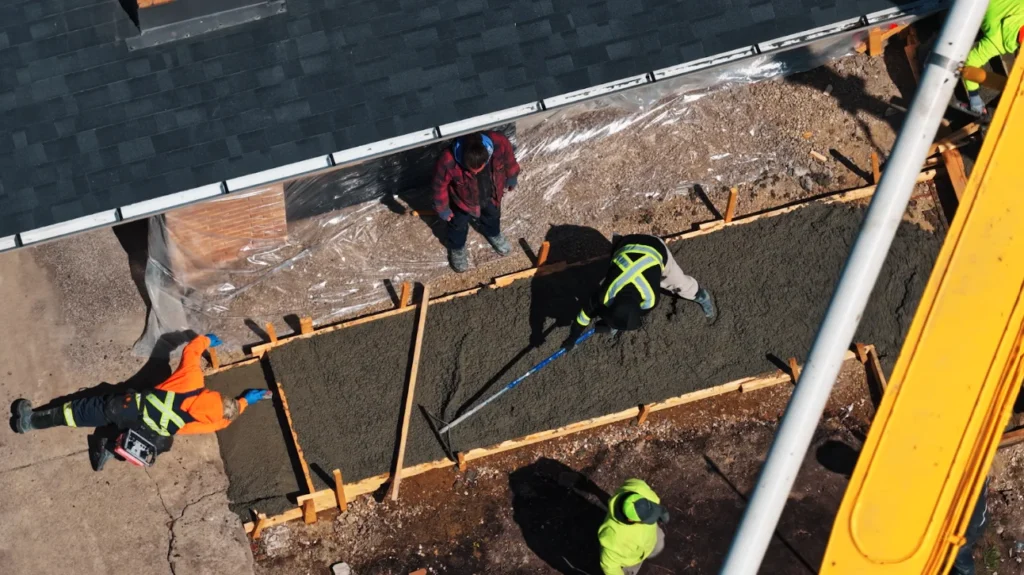
- Boom pump. For large, elevated, or over-an-obstacle pours, a boom pump reaches up and over on a hydraulic arm. It’s the heavy artillery for the parking pad or anything you can’t reach from the ground.
Shotcrete is a special case: it runs through the line pump and is sprayed into place by a dedicated placing crew (more on shotcrete in the FAQ). The reason placement is worth understanding before you book is that access drives both feasibility and cost. A backyard slab that needs 200 feet of hose is a different job than a driveway the truck pulls right up to, and a supplier who runs their own boom and line pumps can tell you which one you’ve got before pour day, not discover it that morning.
5. The region, not just the city: where the trucks actually went
“Calgary concrete” undersells where a week’s trucks really go. This one touched all four quadrants and a wide ring beyond them:
- Northwest: Bowness, Citadel, Nolan Hill, Rockland Park, Livingston and up through the Rocky Ridge area.
- Northeast: Taradale and the inner NE.
- Southwest: Shawnessy, Canyon Meadows and the inner SW.
- Southeast: Wolf Willow and the inner SE.
- The regional ring: Carseland, Chestermere, Cochrane, Springbank and Exshaw, plus Foothills and Rocky View rural sites out on the township roads.
That regional reach matters most if you’re outside the city limits, where “do you even deliver here?” is a real question. Acreage owners near Springbank, builders in Cochrane or Chestermere, and rural sites toward Carseland and the Bow Valley all got served in the same week as the inner-city flatwork. If you’re on a township road wondering whether a Calgary supplier will make the drive, the honest answer this week gives is: yes, that’s a normal Tuesday.
The volumetric (mobile-mixer) fleet is part of why the regional ring works. Because each truck batches concrete on site rather than carrying a pre-mixed drum, a longer drive doesn’t start the clock against you the moment the load is mixed, which is especially useful when the pour is an hour out of town.
6. The part you don’t see: preloads, bulkers, routing, and being on time
The pours you’d photograph are the easy part. The week’s real work happened before sunrise.
Truck starts ran from 5:00 to 6:30 a.m., with trucks preloaded the night before, all so the first pours could hit between 6:45 and 8:00 a.m. Early pours aren’t a flex, they’re how flatwork gets finished before the afternoon heat flash-sets the surface, and how a crew gets a full day instead of standing around waiting on concrete that shows up at 10.
Through the day, trucks were re-dispatched on return, whoever’s back first takes the next ticket, with leftover balances carried to the next job and the offload order planned in advance. And the cement bulker backing up to the silo most mornings is the quiet thing that keeps all of it possible.
The crews put it more bluntly than any brochure would: “on site means showing up five minutes before the concrete time.” That’s the reliability ethic this week was built on, and it’s the part you can’t see in a quote. When you’re choosing a supplier, the price is on the page; the question of whether they’ll actually be there when your forms are ready is the one this kind of week answers, and the one most worth asking their other customers about.
Not every concrete mix should be specified the same way. This week’s pours included 32 MPa C-2 exterior concrete, a higher-strength 35 MPa utility mix for thrust blocks, and even a lighter-duty 25 MPa slab because over-specifying wastes money.
If you’ve ever wondered what exposure classes like F-1, F-2, S-2, and S-3 actually mean—and when each applies in Calgary—our guide breaks down the CSA A23.1:24 requirements in plain English so you can understand why the right mix depends on soil, freeze-thaw exposure, sulphates, and de-icing salts rather than a single strength number.
7. What a full week tells you when you’re choosing a supplier
Step back and the week becomes a checklist you can use on any supplier, including this one.
A single quote tells you a price. A full week tells you four things a price can’t:
- Range. Can they pour 1 m³ and 35 m³, slabs and shotcrete, decorative and structural, or are you a poor fit for what they actually do all day?
- Spec judgment. Do they default to the right Calgary exposure class (C-2, 32 MPa) and then change it on purpose for a thrust block or a lighter-duty slab, or is it one number on every ticket?
- Placement. Do they run their own chute, line and boom options so access isn’t a pour-day surprise?
- Reliability. Do they have the capacity, the morning cement deliveries, and the routing discipline to actually show up on time, every time?
You don’t have to take any of that on faith. Ask the supplier the questions this article hands you, what’s the air content at discharge, what exposure class are you speccing and why, how will you place it given my access, and what time will the truck actually be on site. A supplier who can answer those plainly is showing you the same range a full week does. To be clear about our own work: Omega Ready Mix’s volumetric concrete meets the same ASTM C685/C685M-25a and CSA A23.1:24 standards as plant ready-mix, the value is in matching the mix, the method and the timing to your job, not a claim that any one truck pours something stronger.
That’s what a week of Calgary concrete is really for: not to impress you with totals, but to show you the spread, and to hand you the questions that turn a price quote into a real decision.
FAQ
Q1: What is a thrust block, and why is it poured at 35 MPa instead of 32? A thrust block is a mass of concrete poured behind a bend, tee or valve on a pressurized water or utility line. When pressurized water changes direction, it pushes hard against the fitting; the thrust block braces that force against the surrounding soil so the joint can’t blow apart. Because it’s structural utility infrastructure rather than everyday flatwork, it’s poured at a higher-strength mix, this week, 35 MPa, Type 50 cement, 5–8% air, rather than the 32 MPa default used for driveways and sidewalks.
Q2: What’s the smallest pour I can actually get delivered in Calgary? This week’s range started at a 1 m³ pour, small patches, repairs, sonotubes and post holes for decks and fences. Small pours are where volumetric (mobile-mixer) trucks have an edge, because they batch only the concrete you need on site instead of sending a barely-used full drum. If you’re booking a small job, ask the supplier directly what their minimum delivered volume is and whether a short-load charge applies, so there are no surprises.
Q3: What are grout fill and shotcrete, and when would I need them? Grout fill is a flowable concrete mix, often with small rock, pumped into masonry block cores to lock the wall together and add strength; it’s a specialty mix, not the same as the concrete in your driveway. Shotcrete is concrete sprayed into place through a line pump by a dedicated crew, used for retaining walls, pools and shoring where you’re building a surface against soil or onto a vertical face rather than pouring into forms. Both came up in this single week, which is why it helps to use a supplier who runs the specialty mixes and the placing crews, not just standard slabs.
Q4: Do you deliver concrete to the towns around Calgary, like Cochrane, Chestermere and Springbank? Yes. One week this summer reached Carseland, Chestermere, Cochrane, Springbank and Exshaw, plus Foothills and Rocky View rural sites on the township roads, alongside all four Calgary quadrants. The volumetric (mobile-mixer) fleet suits the regional ring well, because batching on site means a longer drive doesn’t start the discharge clock the moment the load is mixed. If you’re on an acreage or a rural road, it’s still worth confirming your specific site and access when you book.
Q5: What’s the standard concrete spec for a Calgary driveway or sidewalk? On nearly every exterior ticket this week, the spec was 32 MPa, Type 50 (sulphate-resistant) cement, 5–8% entrained air, which is the CSA A23.1:24 C-2 exposure class for exterior flatwork exposed to de-icing salts and freeze-thaw. That C-2 spec is the right Calgary default for driveways, sidewalks and steps because of our salted, freezing winters. The one question worth asking on pour day is the air content measured at discharge, since air lost in transit is a leading cause of surface scaling.
Q6: How do I choose a concrete supplier in Calgary? Look past the single quote and judge four things a week of work reveals: range (can they handle both your size of job and your job type?), spec judgment (do they default to the right exposure class and change it on purpose when needed?), placement (do they run chute, line-pump and boom options for your access?), and reliability (do they have the capacity and routing to show up on time?).
Then ask the supplier directly, what’s the air content at discharge, what exposure class are you speccing and why, how will you place it given my access, and what time will the truck be on site. Clear answers to those questions tell you more than the price does.
Sources
- ASTM C685/C685M-25a, Standard Specification for Concrete Made by Volumetric Batching and Continuous Mixing, https://www.astm.org/Standards/C685.htm
- CSA A23.1:24, Concrete materials and methods of concrete construction, https://www.csagroup.org/store/product/CSA%20A23.1%3A24/
- NRMCA, About Concrete (ready-mixed concrete), https://www.nrmca.org/about-nrmca/about-concrete/
About Omega Ready Mix
Omega Ready Mix (est. 2023) is a Calgary-based ready-mix concrete supplier serving all four city quadrants and the surrounding region, including Cochrane, Chestermere, Springbank, Carseland and the Bow Valley, with a volumetric (mobile-mixer) fleet, boom and line pumps, and finishing crews. Our volumetric concrete meets the same ASTM C685/C685M-25a and CSA A23.1:24 standards as plant ready-mix.
Planning a Concrete Pour?
Whether your project is a 1 m³ repair, a 35 m³ commercial slab, a decorative exposed aggregate driveway, or a specialty utility pour, Omega Ready Mix will recommend the correct mix design, placement method, and scheduling for your site—not simply sell you concrete.
Contact our team for a free quote and we’ll help you determine:
- The right concrete specification for your project
- Whether you need a chute, line pump, or boom pump
- Estimated concrete volume
- Delivery timing that matches your crew schedule
- Service availability across Calgary, Cochrane, Chestermere, Springbank, Carseland, the Bow Valley, and surrounding areas
Request your quote today and get concrete delivered when your forms, not your supplier – are ready.