
A structural engineer in a Beltline office reviews a 26-unit submittal in March 2026. The spec calls for S-3 (moderate sulphate). The geotech report buried in the appendix shows soluble sulphate at 0.31% — that’s S-2 (severe) territory. The submittal was written off a standard template. The engineer redlines it up to S-2: 32 MPa at 56 days, Type HS or HSb cement, w/cm ≤ 0.45.
That single redline is the whole point of this article. The exposure class on a Calgary concrete spec is not decoration — it sets the strength, the air content, the water-to-cementing-materials ratio, and even which cement type the plant is allowed to use. Get it wrong and you either overpay for concrete you don’t need or, far worse, pour a foundation that the ground underneath it will slowly chew through.
These four classes — F-1, F-2, S-2, and S-3 — govern most Calgary residential and small-multi-family concrete. They are not the whole list. CSA A23.1:24 (the 14th edition) defines eleven exposure classes in Table 2, including the C-classes for de-icing chemicals and the A-classes for agricultural and industrial exposure.
If you want the complete map, read our companion piece, 11 CSA A23.1:24 exposure classes: which one your Calgary project actually needs. This article is the focused decoder for the four you’ll see on the overwhelming majority of driveways, garage pads, footings, and foundation walls in this city.
One framing to carry through every section: the exposure class is a property of the site and the use, not the template. Before you accept the class printed on a quote, ask for the geotech soluble-sulphate value and confirm whether the surface will see road salt. Those two facts — not the template — set the class.
1. F-1 — freeze-thaw without de-icers: 32 MPa @ 28 days, 5–8% air, w/cm ≤ 0.55
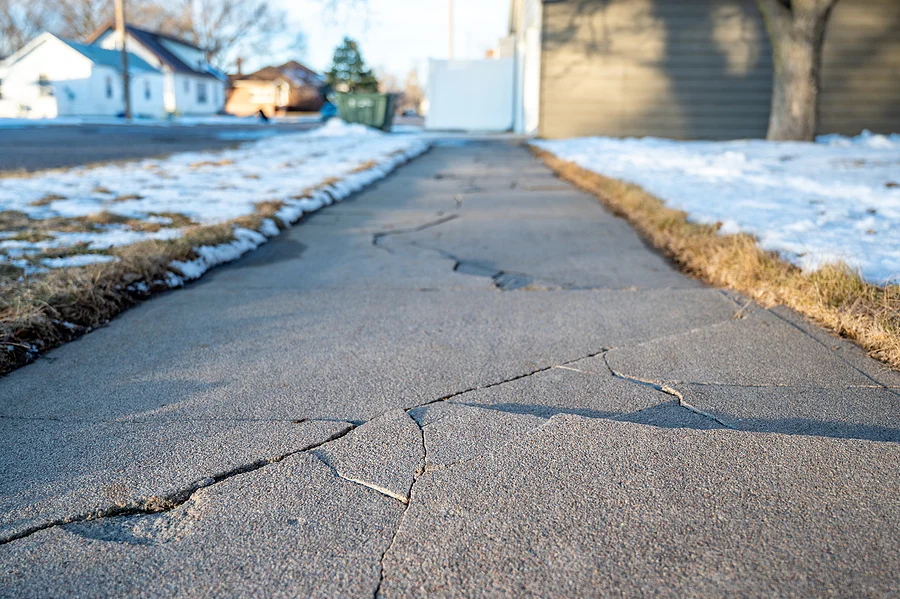
F-1 is the freeze-thaw class for concrete that gets saturated and then freezes, but never sees de-icing chemicals. In Calgary terms, that’s a huge share of exterior flatwork and structures: a backyard patio, a detached garage slab that’s never salted, a non-salted walkway, the exposed top of a foundation wall.
The CSA A23.1:24 requirement is precise. Minimum 32 MPa at 28 days. Air content of 5 to 8 percent (the air-void system is what actually survives the freeze-thaw cycle — the strength number alone doesn’t save you). And a water-to-cementing-materials ratio of 0.55 or lower. That w/cm cap is the durability lever; a lower ratio means a denser, less permeable paste that resists water ingress, and water ingress is the enemy in every freeze-thaw class.
Here’s the part contractors miss. Calgary’s Chinook climate is brutal on concrete precisely because it isn’t a steady deep freeze. A single Chinook week can drive the slab through several freeze-thaw cycles as the temperature swings above and below zero. That’s why the air-entrainment spec is non-negotiable for any exterior pour, even one that looks low-stakes. The 5–8% entrained air creates microscopic pressure-relief chambers; when the water in the paste freezes and expands, it has somewhere to go. Without it, the expansion cracks the concrete from the inside out.
A practical note on ordering: if your spec says F-1, the question to ask the supplier isn’t just “is it 32 MPa?” It’s “is the air content verified in the 5–8% band at the truck, and is the w/cm at or below 0.55?” A 32 MPa mix with no entrained air is not F-1 concrete — it’s a non-air mix that happens to hit a strength number, and it will scale and spall through its first hard Calgary winter.
2. F-2 — freeze-thaw without de-icers, more aggressive saturation: 32 MPa @ 28 days, 5–8% air, w/cm ≤ 0.45
F-2 sits one notch up from F-1. Same freeze-thaw mechanism, same no-de-icer condition, same 32 MPa at 28 days and same 5–8% air. The single difference that matters is the water-to-cementing-materials ratio: F-2 demands 0.45 or lower, tighter than F-1’s 0.55.
Why the tighter w/cm for the same strength? Because F-2 is for concrete that experiences more aggressive saturation — it stays wetter, longer, before it freezes. Think of a slab that sits in a low spot where meltwater pools, a structure with poor drainage, or any element where the concrete is essentially water-logged going into the freeze. The wetter the paste at the moment of freezing, the more internal pressure the freeze generates, and the more important it is that the paste be dense and low-permeability. Dropping the w/cm from 0.55 to 0.45 is how CSA tightens that paste.
This is the F-class pair that catches people: F-1 and F-2 look almost identical on a spec sheet — same MPa, same air — so it’s tempting to treat them as interchangeable. They are not. The w/cm difference is the whole distinction, and it changes the mix design and the cost. If a geotech or drainage condition pushes you to F-2, you can’t substitute an F-1 mix and call it close enough; the 0.45 cap is the requirement.
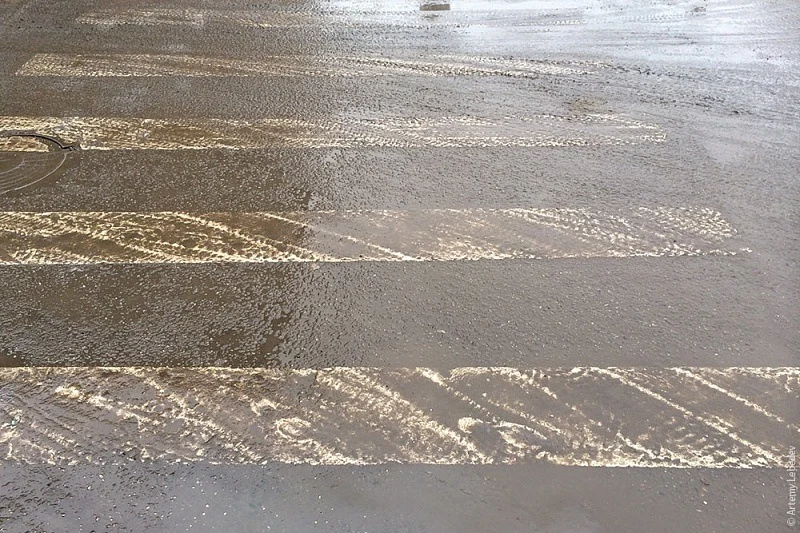
The critical clarification — F is not C. F-1 and F-2 are for freeze-thaw without de-icing chemicals. The moment road salt, ice-melt, or any de-icing chemical enters the picture — a driveway you’ll salt, a parking apron, a sidewalk against a salted road — you are no longer in the F-classes. You move to the C-classes (C-1, C-2, C-3, C-4), which add a de-icer-scaling requirement on top of freeze-thaw resistance.
This matters enormously for Calgary residential work, because a great many “driveway” specs are written as F-2 when the homeowner fully intends to salt the surface. If it gets salted, it’s a C-class job. (The de-icer-scaling test historically referenced for this, ASTM C672, was withdrawn in 2021; a reinstatement is pending under designation WK76964.
3. S-2 — severe sulphate exposure: 32 MPa @ 56 days, Type HS or HSb cement, w/cm ≤ 0.45
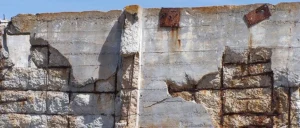
Now the sulphate classes — and this is where Calgary geology earns its own paragraph. Much of the Calgary region sits on glacial tills and bedrock with naturally elevated soluble sulphate in the soil and groundwater. Sulphate attacks ordinary concrete chemically: the sulphate ions react with the cement paste to form expansive compounds that crack and crumble the concrete from within. This is a below-grade, in-contact-with-soil problem — footings, foundation walls, grade beams, anything cast against Calgary dirt.
A quick orientation before the numbers, because CSA’s sulphate scale runs opposite to the U.S. system: a lower S-number means a more aggressive environment. The scale runs S-3 (moderate) → S-2 (severe) → S-1 (very severe), set by the soluble-sulphate concentration the geotech report measures. S-1, the very-severe class above S-2, covers soil sulphate over 2.0% and demands 35 MPa at 56 days with w/cm ≤ 0.40 — the worst-case end of the scale. Most Calgary foundation work lands in the S-2/S-3 band below it.
CSA A23.1:24 sets the S-2 (severe sulphate) requirement at 32 MPa at 56 days, Type HS or HSb cement, and a w/cm of 0.45 or lower. S-2 covers soil with water-soluble sulphate of 0.20–2.0% (or 1,500–10,000 ppm in groundwater). The cement type is the heart of it. Type HS (high sulphate-resistant) and Type HSb (a blended high-sulphate-resistant cement, defined in CSA A3000) are formulated to starve the sulphate reaction of the compounds it feeds on. A standard general-use cement in S-2 soil is a slow-motion failure.
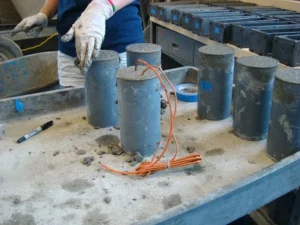
Why 56 days instead of 28? This is the single most common question on S-class concrete, and the answer is genuinely reassuring rather than alarming. Sulphate-resistant cements — and especially the blended HSb cements that incorporate supplementary cementing materials — gain strength more slowly than ordinary cement. They keep gaining well past the usual 28-day milestone. CSA recognizes this by specifying acceptance at 56 days for the sulphate classes. It’s not that the concrete is weaker; it’s that the standard gives the slower-reacting chemistry the time it actually needs to reach its design strength. A 56-day acceptance age is a feature of the durability chemistry, not a red flag. If you see “32 MPa @ 56 days” on a sulphate spec, that’s correct and intended — don’t let a 28-day expectation make you think the mix is underspecified.
For a contractor or owner reading the quote, the move is this: when the spec or geotech says “severe sulphate” or “S-2,” confirm two things on the order. First, that the cement is Type HS or HSb (either is permitted at S-2). Second, that the acceptance age on the documentation reads 56 days, not 28 — so nobody panics at a 28-day cylinder break that looks “low” but is exactly on track.
4. S-3 — moderate sulphate exposure: 30 MPa @ 56 days, Type MS or MSb cement, w/cm ≤ 0.50
S-3 is the moderate sulphate class — the mildest of the three, and the one a template will too often reach for when the ground actually calls for more. CSA A23.1:24 requires 30 MPa at 56 days, Type MS or MSb cement, and a w/cm of 0.50 or lower. S-3 covers soil with water-soluble sulphate of 0.10–0.20% (or 150–1,500 ppm in groundwater), and it’s also the class that captures seawater and seawater spray — the one place “moderate” includes a marine condition.
The cement here is the MS-family. Type MS (moderate sulphate-resistant) or Type MSb (a blended moderate-sulphate-resistant cement, defined in CSA A3000) is sufficient at S-3. You may use an HS-family cement instead — it over-delivers and is always accepted — but it is not required at S-3. The strength sits at 30 MPa (at the 56-day acceptance age, for the same slow-gain reason that runs through every sulphate class), and the w/cm cap is 0.50.
Step up to severe and the requirements tighten: S-2 demands 32 MPa, w/cm ≤ 0.45, and HS-family cement; S-1, very severe, demands 35 MPa, w/cm ≤ 0.40, and HS-family. Remember the direction of the scale — S-3 is the floor, not the ceiling.
Can you use S-2 concrete where S-3 is required? Yes — S-2 meets and exceeds every S-3 requirement (higher strength, lower w/cm, HS-family cement), so substituting up is technically fine on durability grounds. The honest catch is cost: S-2 is a richer, lower-w/cm, HS-family mix, so you’d be paying for severe-exposure concrete on a moderate-exposure site.
It’s not wrong; it’s just money you may not need to spend. The reverse — using S-3 (moderate) where the soil is actually S-2 (severe) — is the one that’s genuinely unsafe, and it’s exactly the error the Beltline engineer caught.
Which brings us back to the number that started this whole article. CSA classifies sulphate exposure by the soluble sulphate concentration in the soil and groundwater, measured in the geotechnical report. As a rough orientation, S-3 (moderate) corresponds to roughly 0.10–0.20% water-soluble sulphate in soil, S-2 (severe) to roughly 0.20–2.0%, and S-1 (very severe) to above 2.0% — these are the CSA classification ranges, and the site’s own geotech value is the basis, not a template guess.
The submittal in the opening was written off a standard template that assumed S-3. The geotech buried in the appendix read 0.31% — comfortably in S-2 (severe) territory. The template was wrong; the soil was the truth.
So here is the single most valuable thing to take from this piece, the number to demand before you accept any sulphate class on a Calgary spec: ask for the geotech soluble-sulphate value. That percentage, read against the CSA ranges, is what sets S-3 versus S-2 — not the line item someone copied from the last project.
FAQ
Q1: What’s the difference between F-1 and F-2 concrete? Both are freeze-thaw classes for concrete that gets saturated and frozen without exposure to de-icing chemicals, and both require 32 MPa at 28 days with 5–8% entrained air. The only difference is the water-to-cementing-materials ratio: F-1 allows up to 0.55, while F-2 tightens it to 0.45 for concrete that experiences more aggressive saturation (it stays wetter longer before freezing). The lower w/cm produces a denser, less permeable paste. They are not interchangeable — if a drainage or site condition calls for F-2, an F-1 mix does not meet the spec.
Q2: Why is S-class concrete accepted at 56 days instead of 28 days? Because sulphate-resistant cements, especially the blended Type HSb cements that incorporate supplementary cementing materials, gain strength more slowly than ordinary cement and keep gaining well past 28 days. CSA A23.1:24 specifies a 56-day acceptance age for the sulphate classes (S-2 and S-3) so the slower-reacting durability chemistry has the time it needs to reach design strength. A 56-day acceptance age is a deliberate feature of the chemistry, not a sign the mix is weak or underspecified.
Q3: Can I use S-2 concrete where S-3 is required? Yes. S-2 (severe) meets and exceeds every S-3 (moderate) requirement (higher strength, lower w/cm, HS-family cement), so substituting up is acceptable on durability grounds. The practical catch is cost — S-2 is a richer, lower-w/cm, HS-family mix, so you would be paying for severe-exposure concrete on a moderate-exposure site. The dangerous error is the reverse: using S-3 (moderate) where the geotech actually calls for S-2 (severe). Remember CSA’s scale runs opposite to the U.S. system — the lower S-number is the more severe class.
Q4: Does Calgary soil require S-2 or S-3 sulphate-resistant concrete? It depends on the soluble sulphate concentration at your specific site, which the geotechnical report measures — it is not a fixed value. Across the Calgary region, sulphate exposure ranges from S-3 (moderate) up to S-1 (very severe), with much of the area falling in the S-3/S-2 band. As a rough orientation, S-3 (moderate) corresponds to roughly 0.10–0.20% water-soluble sulphate in soil, S-2 (severe) to roughly 0.20–2.0%, and S-1 (very severe) to above 2.0% — but these are CSA classification ranges, and your site’s geotech value, not a template, is the basis. Because sulphate-bearing soils are widespread across the region, HS-type cement (Type HS, HSb, or an HS-equivalent blend) is the established, conservative default for Calgary foundations — one HS-type mix safely covers S-1, S-2, and S-3. Always confirm the number in your geotech report before accepting a class.
Q5: What CSA A23.1:24 exposure class does my Calgary driveway or foundation need? For a foundation in contact with Calgary soil, you’re almost always in a sulphate class (S-2 or S-3), set by the geotech soluble-sulphate value. For a driveway, it depends on salt: an unsalted exterior slab is an F-class (F-1 or F-2 depending on saturation), but a driveway you intend to salt moves into the C-classes, which add a de-icer-scaling requirement. Many residential driveways are mis-specified as F-class when they’ll actually be salted. Confirm both the geotech value and whether the surface will see de-icing chemicals.
Q6: Is a driveway that gets road salt an F-class or a C-class? A C-class. F-1 and F-2 are strictly for freeze-thaw without de-icing chemicals. The moment road salt or ice-melt enters the picture, you move to the C-classes (C-1 through C-4), which add a de-icer-scaling resistance requirement on top of freeze-thaw durability. The de-icer-scaling test historically cited, ASTM C672, was withdrawn in 2021 with a reinstatement pending under WK76964 — so older specs citing C672 as active are out of date. The full C-class breakdown is in our 11-class companion article.
Sources
- CSA A23.1:24 / A23.2:24 (Concrete materials and methods of concrete construction / Test methods, 14th edition) — Table 2 exposure classes; §4 mix design — https://www.csagroup.org
- CSA A3000 (Cementitious materials compendium — Type HS and HSb definitions) — https://www.csagroup.org
- CSA A23.3:24 (Design of concrete structures) — https://www.csagroup.org
- ASTM C672 (Standard Test Method for Scaling Resistance of Concrete Surfaces Exposed to De-Icing Chemicals — WITHDRAWN 2021; reinstatement pending under WK76964) — https://www.astm.org
- ACI 201.2R-16 (Guide to Durable Concrete) — https://www.concrete.org
- Alberta Geological Survey Bulletin 053 (Calgary-area regional geology) — https://ags.aer.ca
- Concrete Alberta (sulphate exposure and resistance guidance) — https://concretealberta.ca
- APEGA (professional practice on geotechnical reports) — https://www.apega.ca
About Omega Ready Mix
Omega Ready Mix (est. 2023) is a Calgary-area concrete supplier focused on making the spec readable — handing contractors and owners the exact numbers and questions to demand before they accept a mix design or a quote. For multi-decade Calgary foundation experience, our sister brand Omega 2000 Cribbing has been cribbing and forming foundations since 1988.
Know Your Exposure Class Before You Order Concrete
The exposure class on your quote determines far more than concrete strength—it controls air entrainment, water-cement ratio, cement type and long-term durability. If the class is wrong, the mix is wrong.
Whether you’re building a driveway, garage pad, foundation or multi-family project in Calgary, Omega Ready Mix can review your specification, explain the correct CSA A23.1:24 exposure class, and supply a mix designed for your site’s actual conditions—not a generic template.
Request a quote today or speak with our team before you place your concrete order.