
A fence crew setting 30 postholes typically needs roughly 1 to 2 cubic feet of concrete per hole, about 1 to 2 bags of 80-lb mix each, which across 30 holes lands around 30 to 70 bags, or roughly 1 to 1.5 cubic yards. That volume is the classic trap. It takes about 45 bags of 80-lb concrete to make one cubic yard, and each bag is roughly 5 to 6 minutes of mixing, so a yard is close to 4 hours of mixing by hand, yet it’s usually below a drum-truck’s minimum order.
A volumetric mixer solves both problems: it batches fresh on site, meters to the quarter-yard, and discharges a measured amount per hole, so the crew pours the exact total with no bag-mixing labour, no leftover, and no truck minimum.
If you’re coordinating a larger fencing project with multiple trades, timing still matters. Avoiding truck delays can save hundreds in waiting-time charges. Read our guide on 7 pour-day logistics mistakes that trigger waiting-time fees on Calgary concrete trucks before booking your delivery.
This article is the fence-crew workflow: many small footings, the labour math, and the metered per-hole pour. For the broader “can I even get a small load delivered” question, see the minimum-order article. For the discharge-clock physics behind on-site freshness, see the comparison article. Both are cross-linked below.
How much concrete does one fence post actually take?
Two named sources agree on the method, and the numbers are easy to work with.
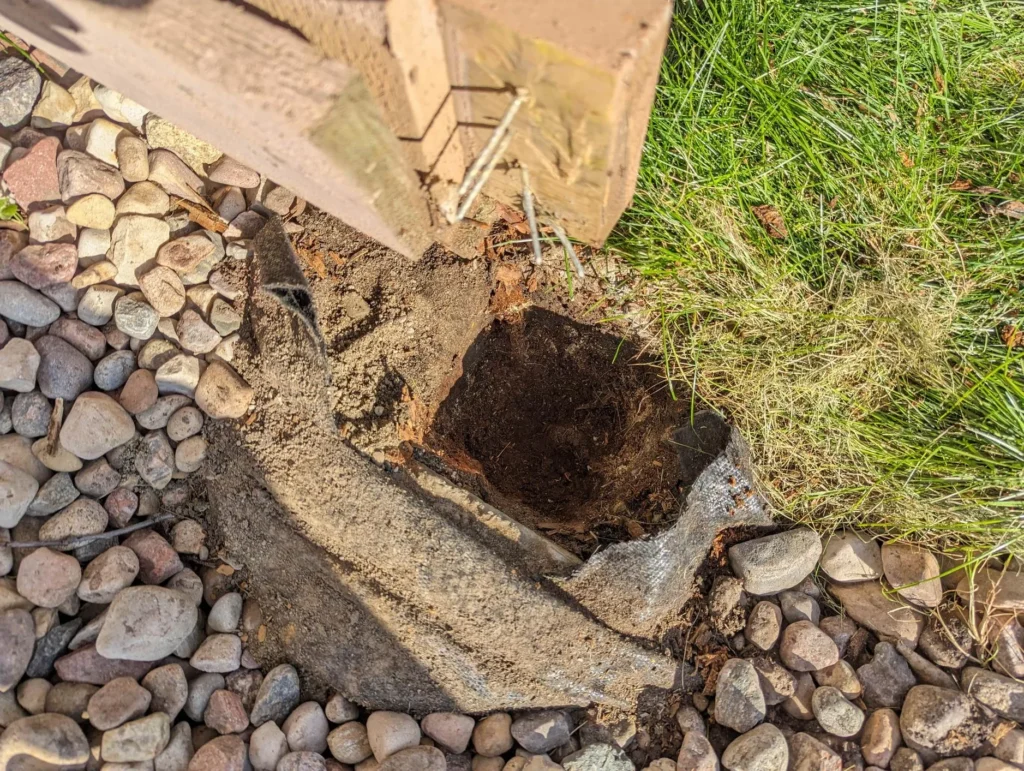
The standard sizing rule: the hole diameter is about 3 times the post width, and the depth is one-third to one-half the post height.
(Source: Bob Vila & Inch Calculator.)
Worked examples:
| Post and hole | Concrete per post | Source |
|---|---|---|
| 4″ round post, 2-ft-deep hole | 1.07 ft³ | Inch Calculator |
| 3.5″ square post set, 20 posts | 1.38 ft³ each | Inch Calculator |
| 8-ft post, 4″ wide, 4-ft-deep, 12″-dia hole | 2.79 ft³ (about eight 50-lb bags) | Bob Vila |
Two reference points to keep handy: 27 ft³ = 1 cubic yard, and an 80-lb bag yields about 0.60 ft³ (a 60-lb bag yields 0.45 ft³, a 50-lb bag 0.37 ft³, a 40-lb bag 0.30 ft³). (Sources: Inch Calculator, Bob Vila.)
Notice the jump in that last row. The shallow 2-ft US examples use about 1 ft³ a hole. The deeper 4-ft hole uses nearly 2.8 ft³. That depth difference matters a lot in Calgary, and we’ll come back to it.
How deep do fence posts go in Calgary?
Deep enough that your bag count climbs fast.
Alberta fence posts are commonly set around 4 ft (about 1.2 m) deep to clear the frost line and avoid frost heave, which lines up with the roughly 1.2 m design frost depth used for footings in southern Alberta. Deck footings and sonotubes need 10 to 14″ diameters below frost.
(Sources: Bob Vila on frost-line depth; Canadian frost-line guides primealux and barrierboss; Calgary design frost depth.)
You’ll see some web sources claim “Alberta frost depth 5 to 7 ft.” Treat that as overstated for fencing; the verified southern-Alberta design figure is about 1.2 m (4 ft), and a 4-ft hole is the practical Calgary depth. Always validate against City of Calgary requirements and local fencing practice.
The consequence for volume: deeper, wider Calgary holes use more concrete per post than the shallow-frost examples you’ll find on US calculators. At roughly 2.8 ft³ per deep hole, a 30-hole Calgary fence line can run 80+ ft³, around 3 cubic yards if you size to the deep end. That’s the difference between a long morning and a brutal full day with a wheelbarrow.
The bag math that decides everything
Here’s the spine of the whole question. Convert your hole count to bags, then bags to mixing time.
- An 80-lb bag yields about 0.60 ft³, so 45 bags = 1 cubic yard (27 ÷ 0.60). At 60-lb bags it’s about 60 a yard; at 50-lb, about 72; at 40-lb, about 90.
- Each 80-lb bag needs about 3 quarts of water and roughly 5 to 6 minutes of mixing. So 45 bags, one cubic yard, runs close to 4 hours of continuous mixing. For a crew mixing by hand, plan on longer.
Put it together for a 30-hole fence line:
| If your holes are… | Total concrete | 80-lb bags | Hand-mixing time (rule of thumb) |
|---|---|---|---|
| Shallow (~1 ft³ each) | ~50 bags | ~4+ hours | |
| Deep Calgary frost (~2.8 ft³ each) | ~140 bags | most of a working day |
That’s the labour drag a fence crew feels in its back by lunch. Fifty to a hundred-plus bags lifted, slit, dumped, watered, and stirred, one at a time, while the actual fence isn’t going up.
The metered per-hole pour: how it works
A volumetric mixer carries the ingredients separately (cement, sand, stone, plus water and admixtures in onboard tanks) and combines them with a metered auger only at the moment of discharge. Because nothing is pre-batched, the operator meters and bills in quarter-yard increments and makes fresh concrete on site, so a batch is never wasted.
For a fence line, the workflow is simple:
- Pull up and dial the mix. Set a posthole-appropriate slump so the concrete drops into the hole and consolidates around the post without slumping out.
- Discharge a measured amount per hole. Move down the line, filling each hole to the same level.
- Shut it off when the last hole is full. Because it’s metered, you pour the exact total and stop. No leftover to dump, no return-concrete charge.
The category is genuinely suited to this. Industry descriptions call out small precise jobs where waste is expensive: “fence posts, anchor bolts, small footings, and step pours where you need exactly what you need and no more,” and note that one truck can “pour a quarter yard for a fence post at one job, and then travel to another job to pour three yards for a sidewalk repair.” (Source: volumetric-mixer industry and service pages.)
There’s even a named Alberta product that proves the model is real, not theory: Mini Batch Concrete (Edmonton area) publishes a “20 MPa Fence Post” mix at sub-yard volumes, with “no charge for return of leftover concrete” and a minimum hour of driver wait-time included.
(Source: minibatchconcrete.com/price-list. Edmonton-area listing, not Omega’s price; validate Calgary quotes.)
When bags are still the right call (honest triage)
This matters, so here it is straight: for a handful of posts, fast-setting bagged concrete is genuinely fine and often faster than booking a delivery. Five posts for a gate and a corner? Grab bags. There’s no setup, no scheduling, no minimum to clear.
The metered-delivery case is the bigger job, not a knock on bags. The breakpoint is roughly a cubic yard of footings. Below that, bags usually win on simplicity. Above it (a long fence line, 30-plus deep Calgary holes, back-to-back contracts), the labour math tips hard toward one metered pour. The voice of the fence crew here is composite, drawn from contractor sentiment rather than a citable forum quote, but it’s consistent: the bag-mixing day is the part nobody enjoys.
If you’re managing commercial, municipal, or multi-family projects instead of residential fencing, the conversation shifts from labour efficiency to embodied carbon. Our guide explains 6 LEED v5 Embodied-Carbon Decisions That Quietly Shift Calgary Multi-Family Concrete Specs in 2026 and what they mean for upcoming specifications.
So the rule of thumb:
- A few posts: bagged mix. Simple and fast.
- A long fence line or many deep holes: metered on-site delivery. Fresh, per-hole, no bag-mixing, no leftover, no minimum.
Why this fits Calgary fence work specifically
- Deep frost holes multiply the pain. At about 2.8 ft³ per 4-ft hole, a Calgary fence line uses far more concrete than the shallow US examples, so the bag-mixing day is longer here than the calculators suggest.
- The summer peak is unforgiving. Fence and deck work clusters in the short Calgary building season. A crew running back-to-back contracts can’t surrender a half-day per job to a wheelbarrow.
- Acreage lines are far from any plant. Rural and acreage fence work sits well outside the city, where a volumetric truck batches on arrival and beats the discharge clock the same way it does on a shop slab. (For the clock mechanics, see the comparison article.)
FAQ
How much concrete do I need per fence post? About 1 to 2 ft³ for a typical 4×4 post, and closer to 2.8 ft³ for a deep Calgary frost-line hole. That’s roughly 1 to 2 bags of 80-lb mix per hole at the shallow end, and around eight 50-lb bags for a deep hole.
How many bags of concrete for 30 fence postholes? Roughly 30 to 70 bags of 80-lb mix for shallow holes (about 1 to 1.5 yd³), and up to around 140 bags if the holes are deep Calgary frost-depth holes. The conversion to remember: about 45 bags of 80-lb makes one cubic yard.
Is it worth mixing bags by hand for a whole fence line? At roughly 5 to 6 minutes a bag, one cubic yard is close to 4 hours of mixing, and a deep Calgary fence line can be most of a working day. Past about a cubic yard of footings, metered on-site delivery usually wins on labour.
Can a concrete truck pour a measured amount into each posthole? Yes. A volumetric mixer meters to the quarter-yard and discharges a measured amount per hole, so you pour the exact total down the line and shut off when the last hole is full. No leftover, no truck minimum.
How deep do fence posts go in Calgary? Commonly about 4 ft (1.2 m) to clear the frost line and avoid heave. That matches the southern-Alberta design frost depth. Deeper holes use more concrete per post, so budget more than US calculators suggest. Validate against City of Calgary requirements.
Bags vs truck vs on-site mixing for postholes: which is fastest for a crew? A few posts: bags, every time. A long fence line or many deep holes: metered on-site delivery, because it’s fresh, poured per hole, and skips the bag-mixing entirely. The breakpoint is around a cubic yard of footings.
Are the fence-post mix prices I see online Omega’s prices? No. The Mini Batch “Fence Post” mix is an Edmonton-area third-party listing, cited to show the metered model is a real product. It’s not Omega’s price. Validate against a current Calgary quote.