Planning a custom pool in the heart of Lake Bonavista or a retaining wall for your property in Signal Hill? Chances are you’ve heard the terms ‘shotcrete’ and ‘gunite’ from your contractor. Understanding which method is right for your project isn’t just about concrete—it’s about long-term durability against Calgary’s tough freeze-thaw cycles and finding a solution that fits your budget and timeline.
Both shotcrete and gunite are sprayed concrete applications used in construction, but they differ in the mixing process, application speed, and final quality, which makes each better suited for specific jobs. This guide cuts through the technical jargon to explain the key differences, applications, and pros and cons of shotcrete and gunite in plain language, so you can make an informed decision for your home or commercial project. As a local authority in Calgary, Omega Ready Mix provides the materials and insight needed for these specialized applications every day.
What Are Shotcrete and Gunite?
At first glance, shotcrete and gunite look identical: a high-pressure hose spraying concrete onto a surface. For a homeowner in Bridgeland or a developer in East Village, the end result can seem the same. The devil, as they say, is in the details—specifically, how the concrete is mixed before it ever reaches that hose.
These are not just fancy names for the same thing. The distinction lies in the state of the mix when it’s loaded into the delivery equipment and how water is added, which dramatically affects consistency, strength, and the skill required for a perfect application.
What Is Shotcrete?
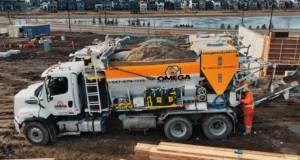
Shotcrete is a wet-mix process. This means the concrete—a blend of cement, aggregates, and water—is fully mixed in a transit mixer before it’s pumped through a hose. At the nozzle, compressed air propels the wet mixture onto the receiving surface at high velocity.
Think of it like a high-power paint sprayer for concrete. Because the mix is pre-blended, it has a consistent, slumpable quality. This method is widely used for larger commercial projects, tunnel linings, and swimming pools where high-volume placement and a smooth finish are priorities. The wet mix allows for faster application over big areas.
Bottom line: Shotcrete is pre-mixed, wet, and applied fast for large-scale projects.
What Is Gunite?
Gunite is a dry-mix process. Here, a pre-blended dry powder of cement and aggregate is loaded into the delivery equipment. Water is only introduced at the nozzle, where it’s mixed with the dry material just milliseconds before it’s sprayed onto the surface.
This gives the applicator incredible control over the mix’s consistency on the fly. They can adjust water content to suit the exact conditions of the site and the shape they’re spraying. Gunite is the traditional choice for intricate shapes, custom residential pools, and repair work where precision and immediate bonding are critical.
Bottom line: Gunite is mixed at the nozzle, offering superior control for detailed or complex shapes.
Key Differences Between Shotcrete and Gunite
Now that we know the basic definitions, let’s dive into the head-to-head differences. These aren’t minor technicalities; they directly impact your project’s cost, timeline, and final quality.
Choosing the wrong method for your application can lead to premature cracking, poor bonding, or a finish that doesn’t meet your expectations. Here’s what separates them in practice.
Application Method
Both methods use a high-pressure hose and nozzle system, but the equipment and setup differ. Shotcrete requires a pump to move the pre-mixed, heavy wet concrete through the hose. Gunite uses a pneumatic (air-powered) feeder to convey the dry mix, with water injected at the tip.
This means gunite equipment can be lighter and more mobile, which is a plus for tight residential lots in neighbourhoods like Mount Royal. Shotcrete setups are often bulkier but are designed for continuous, high-volume output.
Mixing Process (Wet-Mix vs Dry-Mix)
This is the core difference. Shotcrete’s wet-mix process ensures a homogenous blend before application, leading to very consistent quality from the first spray to the last. It’s less dependent on the nozzle operator’s instant judgement.
Gunite’s dry-mix process puts the final mixing responsibility squarely on the operator. The quality of the applied material depends on their skill in adding just the right amount of water for perfect cohesion as they work.
Water Addition and Consistency
Since shotcrete is mixed with water at the plant or in the truck, its consistency is fixed. It has what’s called ‘slump’—it’s more fluid. Gunite, with water added at the nozzle, has no slump; it’s a stiffer, drier mix that relies on the force of application to compact and bond.
That stiffer consistency is why gunite can be sprayed onto vertical or overhead surfaces without sagging or slumping, making it ideal for complex sculptural work or thin-shell structures.
Strength and Durability
Both methods, when applied correctly, produce strong, durable concrete. However, gunite often achieves higher density and compressive strength because the low-water mix is compacted with such high impact force. This creates a very tight, non-porous matrix.
For Calgary projects exposed to constant freezing and thawing, a less porous concrete is key. Reduced water absorption means less risk of internal ice damage and spalling over time, which is a common concern for foundations and retaining walls near Nose Hill.
Slump and Placement
Slump refers to how ‘wet’ or workable a concrete mix is. Shotcrete has slump, gunite does not. This affects how they’re placed. Shotcrete can fill forms and cover rebar quickly, but it requires forming or a surface to hold it in place initially.
Gunite’s no-slump property allows it to stick and build up on a surface immediately, layer upon layer, without support. This is why it’s the go-to for building free-form rock waterfalls or sculpted pool coves without extensive formwork.
Which factor matters most for your project: speed of placement or precision of application?
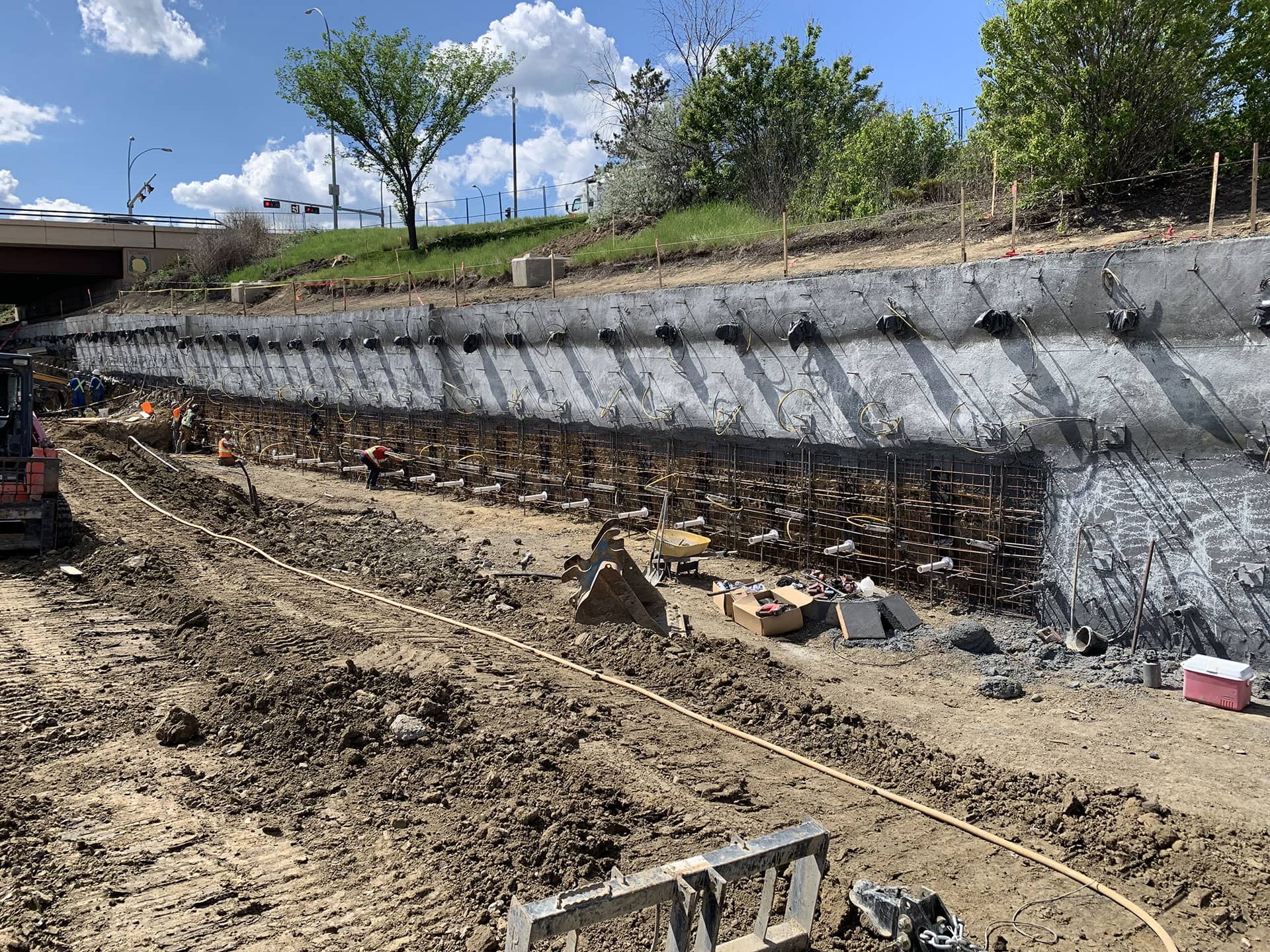
If you’re planning structural concrete work, explore our shotcrete for slope stabilization and retaining walls to ensure long-term ground support.
Pros and Cons of Shotcrete
Shotcrete is a powerhouse for efficiency. Let’s break down where it shines and where it might not be the perfect fit for your Calgary project.
Advantages of Shotcrete
- High Production Speed: The wet-mix is ready to go, allowing for rapid placement over large areas. This can shorten project timelines significantly, a major benefit for commercial developers on tight schedules.
- Consistent Mix Quality: Because it’s batched and mixed centrally, every load has a uniform composition. This reduces the risk of weak spots due to mixing errors on-site.
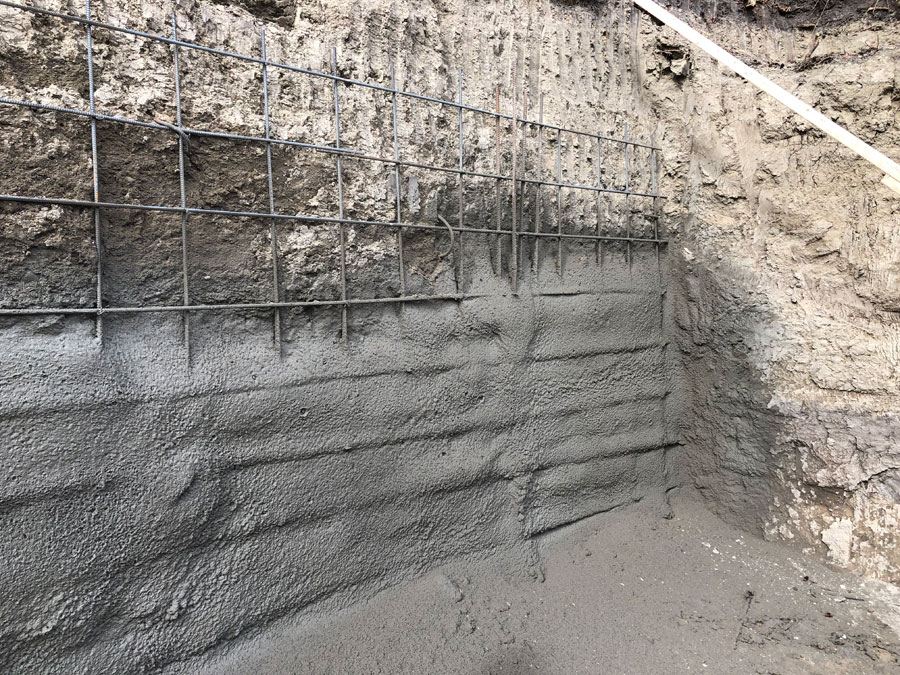
- Excellent for Large, Simple Shapes: It’s ideal for big vertical walls, tunnel linings, slope stabilization, and pool shells where the design is more geometric than artistic.
- Lower Skill Dependency: While still requiring trained operators, the process is somewhat less reliant on the nozzleman’s instantaneous judgement compared to gunite.
These advantages make shotcrete a cost-effective choice for volume work. The speed translates directly to labour savings on big pours.
However, that speed and consistency come with specific trade-offs you need to consider.
Disadvantages of Shotcrete
- Less Flexibility On-Site: Once the wet mix is loaded, its consistency is set. You can’t adjust the water content to adapt to changing site conditions or complex shapes.
- Potential for Rebound Waste: When sprayed, some of the aggregate can bounce off the surface (this is called ‘rebound’). This material is wasted and must be cleaned up, adding to site debris.
- Requires Formwork for Some Applications: For thicker sections or certain shapes, temporary forms may still be needed to contain the wetter mix initially, adding to material and labour costs.
- Equipment Size: The pumps and lines for wet shotcrete are larger, which can be a challenge in confined residential spaces with limited access.
Shotcrete is your best bet for large-scale, repetitive applications where speed and uniformity are the top priorities.
Pros and Cons of Gunite
Gunite is the artisan’s choice, prized for its adaptability and superior finish in the right hands. Here’s what it offers and where it might give you pause.

Advantages of Gunite
- Unmatched Control and Precision: The operator can fine-tune the mix at the nozzle, making it perfect for intricate detailing, thin applications, and complex free-form shapes like artificial rockwork.
- Higher Density and Strength: The low water-cement ratio and high-impact compaction typically result in a denser, stronger, and less permeable final product, enhancing durability.
- Minimal Rebound: The drier mix tends to stick where it’s sprayed, resulting in less material waste and a cleaner job site.
- No Formwork Needed: It can be applied directly to mesh or rebar and will build up on itself, eliminating the cost and time of building forms for many applications.
- Ideal for Repairs: Its excellent bonding characteristics and ability to be applied in thin layers make it the preferred method for repairing existing concrete structures.
This level of control is why luxury custom pool builders almost universally prefer gunite. It allows them to create the exact curves, benches, and features the homeowner desires.
Disadvantages of Gunite
- Highly Skill-Dependent: The quality is directly in the hands of the nozzle operator. Their experience in judging water addition and application technique is absolutely critical. A less skilled crew can produce poor results.
- Slower Application Rate: The process is more meticulous than shotcrete, so it takes longer to build up thickness. This can extend project timelines.
- Generally Higher Cost: The need for highly skilled labour and the slower pace often makes gunite more expensive on a per-project basis than shotcrete for comparable volumes.
- Material Sensitivity: The dry mix must be protected from moisture before use, and the equipment must be meticulously cleaned after each job to prevent clogging.
Gunite wins for projects where design complexity, maximum strength, and a perfect finish are non-negotiable.
Shotcrete vs Gunite for Swimming Pools
This is where the debate gets personal for many Calgary homeowners. Your backyard oasis in communities like Aspen Woods or McKenzie Lake is a major investment. The shell material choice is fundamental.
While both methods are used, the industry has strong preferences based on the type of pool you’re building. Let’s look at the key considerations.
Which Is Better for Custom Pools?
For true custom pools—think free-form shapes, integrated spas, grottoes, and detailed rock features—gunite is the undisputed champion. The on-the-fly control allows the crew to sculpt the concrete precisely to the design.
Every curve, bench, and step can be formed exactly as planned. The high-strength, low-porosity result also means a more stable shell that’s less susceptible to long-term movement or cracking in our expansive clay soils.
For standard geometric pools (simple rectangles or kidneys), shotcrete is often used successfully. It’s faster and can be more cost-effective. However, even for these shapes, many high-end builders still prefer gunite for the strength and finish advantages.
Installation Speed and Timeline
Shotcrete is faster. A pool shell can often be sprayed in a single day. Gunite takes longer, as layers are built up more slowly to achieve the desired thickness and shape.
If your primary goal is to get the pool in the ground as quickly as possible within a short Calgary construction season, a shotcrete shell might seem appealing. But remember, the spraying is just one part of the timeline. Plumbing, tile, and coping come after.
Sacrificing a day or two on the shell for a vastly superior end product is a trade-off most custom pool owners gladly make.
Quality Control and Skill Requirements
This is the most important factor. A gunite pool is only as good as the crew spraying it. You must choose a contractor with a proven track record of expert gunite application. Ask for local references and photos of completed projects.
A shotcrete application is less variable, but still requires skill to ensure even thickness and proper compaction. The risk with gunite is higher with a low-skilled crew, but the potential reward with a master crew is also higher.
For a custom pool that’s a centrepiece of your home, invest in an experienced gunite specialist. For a standard pool, discuss both options with your builder, prioritizing the crew’s expertise with their chosen method.
Applications and Best Uses
Beyond pools, both shotcrete and gunite have vital roles in construction. Knowing which to specify can save time, money, and future headaches.
Here’s a quick guide to matching the method to the job, from foundational work to decorative elements.
Residential vs Commercial Projects
In residential construction, gunite is often the star. Its uses include custom swimming pools, intricate retaining walls, landscaping features, fireplace surrounds, and concrete countertops. Its precision and strength are ideal for the detailed, durable features homeowners want.
Shotcrete dominates the commercial and civil sphere. You’ll find it in tunnel and mine shaft linings, large retaining walls for highway projects, seismic retrofitting of buildings, and constructing dome roofs. Its speed and volume capabilities are essential for these large-scale, engineering-driven projects.
For a massive soil retention project on a commercial site along Stoney Trail, shotcrete is likely the answer. For repairing and resurfacing the historic concrete on a character home in Hillhurst, gunite is the delicate touch required.
FAQ: Shotcrete and Gunite in Calgary
Let’s tackle some of the most common questions we hear from Calgary homeowners and contractors about these two methods.
Which is more expensive, shotcrete or gunite?
Generally, gunite is more expensive per cubic yard placed. The primary reason is labour. Gunite requires highly skilled, experienced nozzle operators who command higher wages, and the application process itself is slower.
However, for a full project quote, other factors matter more. The complexity of the design, site access, and total volume of material needed will have a bigger impact on your final price than the choice between the two methods alone. Always get detailed quotes based on your specific project plans.
Can you use shotcrete for pool repairs?
It’s possible, but gunite is almost always the better choice for repair work. Gunite bonds exceptionally well to existing concrete, and its dry-mix consistency allows for perfect application in thin layers to match the surrounding shell.
Shotcrete’s wetter mix is harder to control for patchwork and may not achieve the same seamless, strong bond. For fixing cracks or adding features to an existing pool in neighbourhoods like Douglasdale, a gunite specialist is the right call.
How does Calgary’s climate affect the choice?
Our freeze-thaw cycles demand concrete with low permeability. Both methods can produce suitable concrete, but gunite’s typically higher density gives it a slight edge in resistance to water intrusion and subsequent frost damage.
Proper curing and the use of air-entraining admixtures (which create tiny air bubbles to relieve freeze pressure) are critical with either method in our climate. A reputable contractor like Omega Ready Mix will ensure the mix design is tailored for Calgary durability.
Is one method stronger than the other?
When applied correctly by skilled crews, both produce strong concrete that exceeds standard code requirements. Gunite often achieves higher compressive strength due to its low water content and high compaction force.
For the vast majority of residential applications, the strength of either is more than sufficient. The choice should hinge more on the needed application speed, design complexity, and the specific skill set of your contractor.
Your project’s success depends less on an abstract “strongest” material and more on the right material applied correctly by experts.
Conclusion
Choosing between shotcrete and gunite ultimately comes down to your project’s specific needs. For large-scale, speed-focused commercial work or simple geometric pools, shotcrete offers efficiency and consistent quality. For intricate custom designs, artistic features, or repair work where precision and maximum durability are paramount, gunite is the superior choice.
The most critical factor in either case is the crew holding the nozzle. Their experience and skill will determine the quality of your finished project far more than the technical name of the process. Always vet your contractor’s past work, especially with the method they propose.
Ready to discuss which sprayed concrete application is right for your Calgary home or development? Omega Ready Mix has the local knowledge and material expertise to support your shotcrete or gunite project from the mix design to the final finish. Contact us for a consultation and let’s build something that lasts.