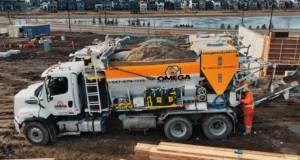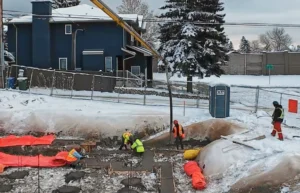
Planning a new driveway in Rocky Ridge, or estimating the foundation costs for a commercial development in East Village? Understanding your material options is the first step to a smart budget and a durable result. Choosing the right concrete mix is one of those foundational decisions that impacts everything from your upfront budget to the long-term value of your property. For a concrete decision in Calgary, comparing traditional mixes with recycled aggregate concrete can reveal surprising savings and sustainability benefits without sacrificing performance.
We’re going to break down the real numbers and practical details for Calgary homeowners, contractors, and developers. This comparison isn’t just about price tags; it’s about total project value, performance in our freeze-thaw climate, and making an informed choice for your specific build. Let’s start with the basics, so you know exactly what you’re comparing.
What is Recycled Concrete Aggregate (RCA)?
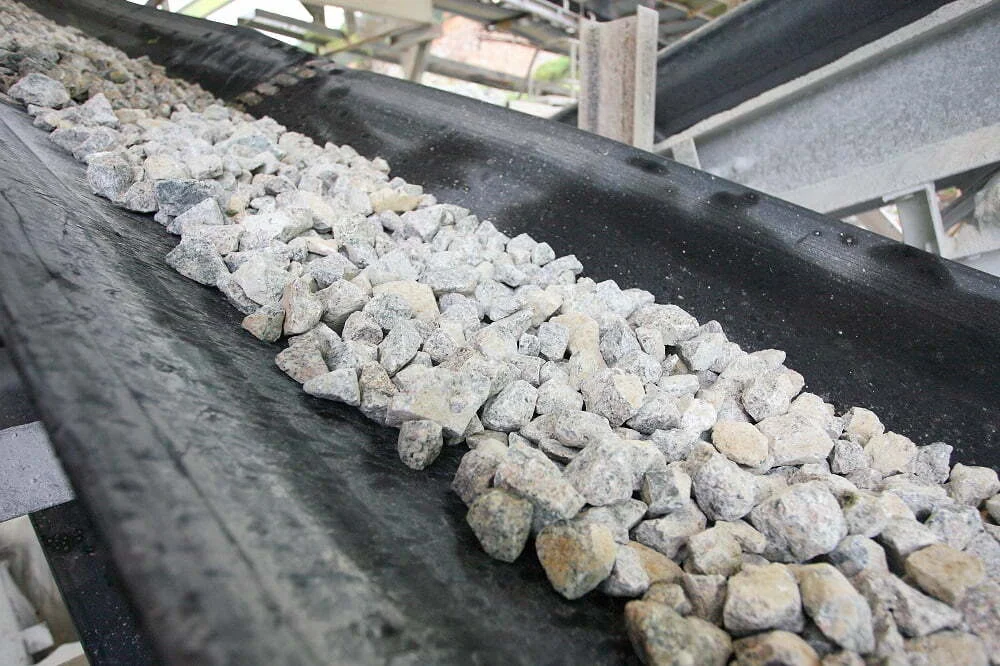
Recycled Concrete Aggregate (RCA) is simply concrete that’s been given a second life. Instead of mining new rock and gravel, RCA comes from demolished concrete structures—like old foundations, sidewalks, or commercial buildings—that are crushed and processed into a clean, usable aggregate. This isn’t random rubble; it’s a carefully produced material that meets specific size and quality standards for use in new concrete mixes.
In Calgary, with major redevelopment projects in areas like Inglewood or the Beltline, there’s a growing local supply of quality demolition concrete. This means RCA isn’t just an abstract “green” option; it’s a practical, locally-sourced material that can reduce hauling distances and project timelines.
Production Process of RCA
The journey from old slab to new mix involves several key steps. First, demolition concrete is collected and transported to a processing facility. There, it goes through primary crushing to break down large chunks, followed by screening to remove undesirable materials like wood, metal, or dirt.
The screened material is then often subjected to secondary crushing and additional washing to achieve the desired gradation—the mix of particle sizes that mimics traditional gravel. This processing ensures the final RCA product has consistent properties, making it a reliable ingredient for your new pour.
For more insights into concrete materials and sustainability in Canada, visit the Cement Association of Canada
RCA vs. Traditional Natural Aggregates
Traditional, or natural aggregate concrete (NAC), uses virgin materials mined from quarries. Think of the gravel sourced from places like the Big Hill Springs area. This aggregate is typically hard, dense rock like limestone or granite.
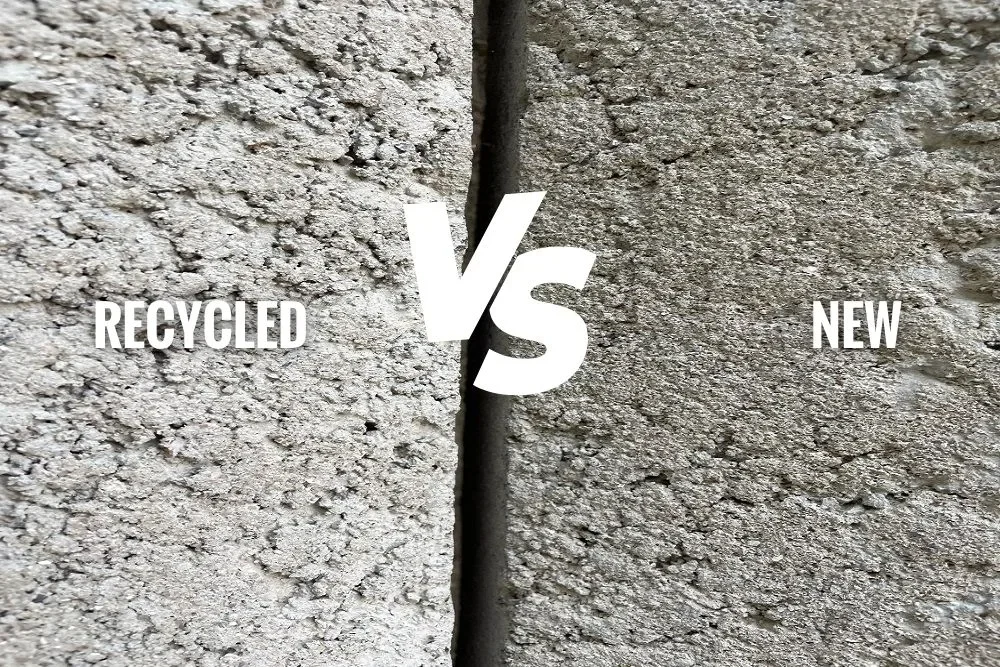
RCA, on the other hand, starts as hardened concrete. This means the aggregate particles themselves are a composite of the original cement paste and the natural aggregate it held. This difference in composition leads to subtle variations in weight, absorption, and bonding potential with new cement, which we’ll explore in the performance section.
The core difference: one is mined anew, the other is reclaimed and reprocessed.
Cost Analysis and Price Comparison
When you’re budgeting for a project along Deerfoot Trail or in a new Airdrie subdivision, the bottom line matters. The cost story for RCA is compelling, but it’s not just a single number. It’s a narrative of savings influenced by material, location, and project scale.
Average Costs of RCA per Ton or Cubic Meter
In the Calgary market, raw material costs are a major driver. Recycled concrete aggregate typically costs between $20 to $30 per tonne. Traditional natural aggregates, depending on type and hauling distance from the quarry, can range from $30 to $50 per tonne.
That’s a significant difference at the bulk material level. For a typical residential driveway requiring 15 tonnes of aggregate, the savings on just the raw rock could be several hundred dollars before we even factor in the concrete mix or labour.
Cost Savings with RCA (24.5% to 50% Less)
Studies and real-world project data consistently show that using Recycled Aggregate Concrete (RAC) can reduce overall concrete costs by 24.5% to 50% compared to Natural Aggregate Concrete (NAC). This range depends heavily on local factors.
In Calgary, where landfill fees for construction debris are a consideration and local processing facilities like those in Balzac create a supply, the savings often lean toward the higher end of that spectrum for larger commercial projects. The savings come not only from the cheaper aggregate but also from reduced waste disposal costs for the project itself.
Factors Affecting Costs (Location, Quality, Transportation)
Your specific savings will hinge on three main factors. First, location: if your project site is near a RCA supplier, like in northeast Calgary near major processing yards, transportation costs plummet. Hauling virgin aggregate from a distant quarry adds freight costs quickly.
Second, quality requirements: higher-grade concrete for structural elements might require higher-quality (and thus more expensive) RCA, or a blend with natural aggregate. Third, project scale: bulk orders for large developments maximize the per-unit savings, while smaller residential loads see less dramatic freight advantages.
Cost-Benefit Analysis of RAC vs. NAC
Looking beyond just the invoice price is key. The benefit of RAC isn’t purely financial; it includes environmental savings (lower carbon footprint from reduced mining and transport) and often supports local circular economies.
For many Calgary developers, especially those working on projects requiring sustainability certifications or aligning with municipal green goals, these non-financial benefits translate into real project value and community goodwill. The cost-benefit analysis, therefore, often shows RAC as the superior choice for projects where total value—not just lowest bid—is the goal.
For a true cost picture, weigh the invoice savings against any potential performance trade-offs for your specific application.
Production and Material Costs

The price advantage of RCA starts at its origin. The production cost curve for recycled material is fundamentally different from that of virgin aggregate.
Lower Production Costs of Recycled vs. Virgin Aggregates
Mining natural aggregate involves significant capital expenditure: land acquisition, permitting, heavy machinery for extraction (excavators, crushers), and ongoing operations. The process is energy-intensive and has substantial environmental management costs.
Producing RCA primarily involves processing: crushing, screening, and washing existing concrete. The “raw material” cost is often negative—it’s waste material that would otherwise incur a disposal fee. While processing plants require equipment and energy, the absence of mining overhead typically results in a lower cost per tonne of finished product.
Operating Capital and Additional Expenses
It’s important to note that RCA producers still face costs. Operating a crushing and screening facility requires capital for equipment maintenance, labour, and site management. Transportation from multiple demolition sites to the central plant adds logistical expense.
However, these costs are often offset by the revenue from selling the recycled product and, in many jurisdictions, by avoided landfill fees or even incentives for recycling. In Calgary’s market, this economic balance makes RCA a consistently available and competitively priced option.
The production economics favour RCA, making its lower market price a reflection of real cost advantages, not just a discount.
Performance and Strength Comparison
Savings are great, but can a driveway in Coventry Hills or a warehouse floor in the SE industrial area stand up to our climate with recycled content? The performance data is reassuring.
Strength of Recycled Concrete vs. Traditional Concrete
Concrete strength, primarily compressive strength, is the benchmark. Research shows that well-produced RAC can achieve compressive strengths very close to, and sometimes matching, NAC. For many non-structural applications like sidewalks, driveways, and slabs-on-grade, the strength difference is negligible.
The key is the quality of the source concrete and the processing. RCA from high-strength original concrete, cleaned and graded properly, performs excellently. For structural elements (columns, beams), engineers often specify a blend or limit the percentage of RCA to ensure design strength is met with confidence.
Properties of RCA Compared to Natural Coarse Aggregate (NCA)
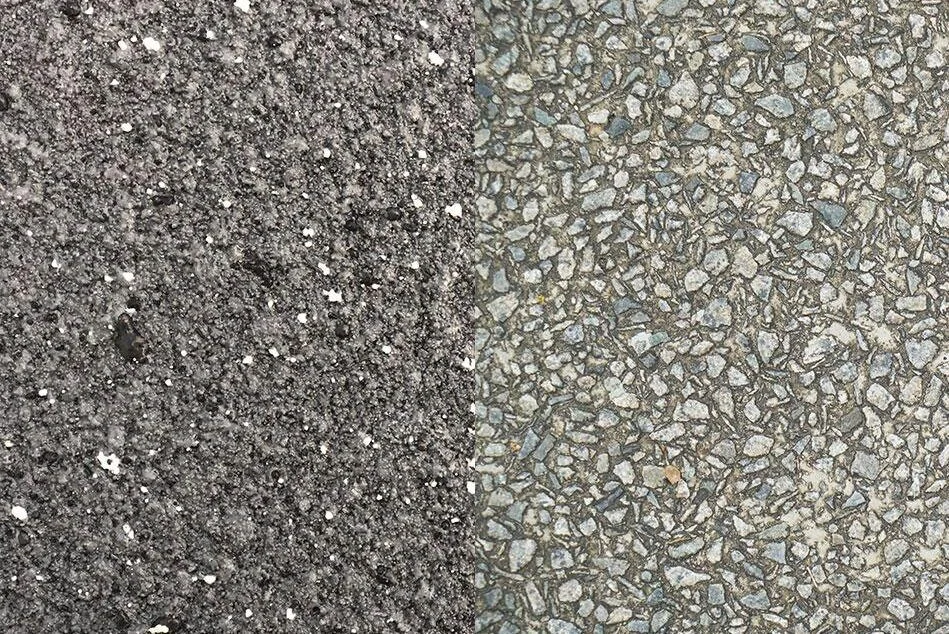
Beyond strength, other properties differ. RCA particles are generally less dense and more absorbent than natural aggregate. This can lead to a slightly higher water requirement in the mix design to achieve the same slump (workability).
This absorbency also means the bonding interface between the RCA particle and the new cement paste can be different. Modern mix designs from experienced providers like OmegaReadyMix account for this, adjusting admixtures and water-cement ratios to produce a final concrete that meets performance specs.
Enhancing RAC with Steel Fibers (0.25% Optimal)
For applications where tensile strength or crack resistance is paramount, RAC can be enhanced. Studies indicate adding a small volume (around 0.25%) of steel fibers to the RAC mix significantly improves its flexural strength, toughness, and durability.
This makes fiber-reinforced RAC an excellent choice for industrial floors, parking lots, or any application subject to heavy point loads or abrasion. It’s a way to boost performance while still capitalizing on the cost and sustainability benefits of the recycled base material.
With proper mix design, RAC can meet the performance demands of most Calgary projects.
Environmental and Sustainability Benefits
Choosing RCA isn’t just a financial decision; it’s a choice that impacts our local environment. From reducing quarry pits in our foothills to cutting down truck traffic on the Stoney Trail corridor, the benefits are tangible.
Resource Conservation and Waste Reduction
Every tonne of RCA used represents a tonne of virgin aggregate not mined. This conserves natural resources and preserves landscapes. Simultaneously, it represents a tonne of demolition concrete not sent to a landfill, reducing waste management burdens and extending the life of our landfill sites.
In a city like Calgary undergoing constant renewal, redirecting demolition waste back into new construction closes a valuable loop. It turns a disposal problem into a resource solution.
Contribution to Circular Economy
RCA is a cornerstone of the construction circular economy. Instead of a linear “take-make-dispose” model, it creates a “reclaim-reprocess-reuse” cycle. This reduces the overall environmental footprint of the construction sector, a major goal for forward-thinking developers and municipalities.
For projects aiming to meet green building standards or simply to minimize their environmental impact, using RCA is a clear, measurable step toward that goal. It’s a practical way to build sustainably without compromising on the material’s primary function.
Using RCA is a direct investment in reducing Calgary’s construction waste and preserving our natural surroundings.
Crushed Concrete vs. Gravel Cost Comparison
Sometimes the choice isn’t between concrete mixes, but between using crushed concrete (RCA) as a base material versus traditional gravel. For sub-base preparation under driveways or as a fill material, cost is a major factor.
Price Range ($10-20 per Ton for Crushed Concrete)
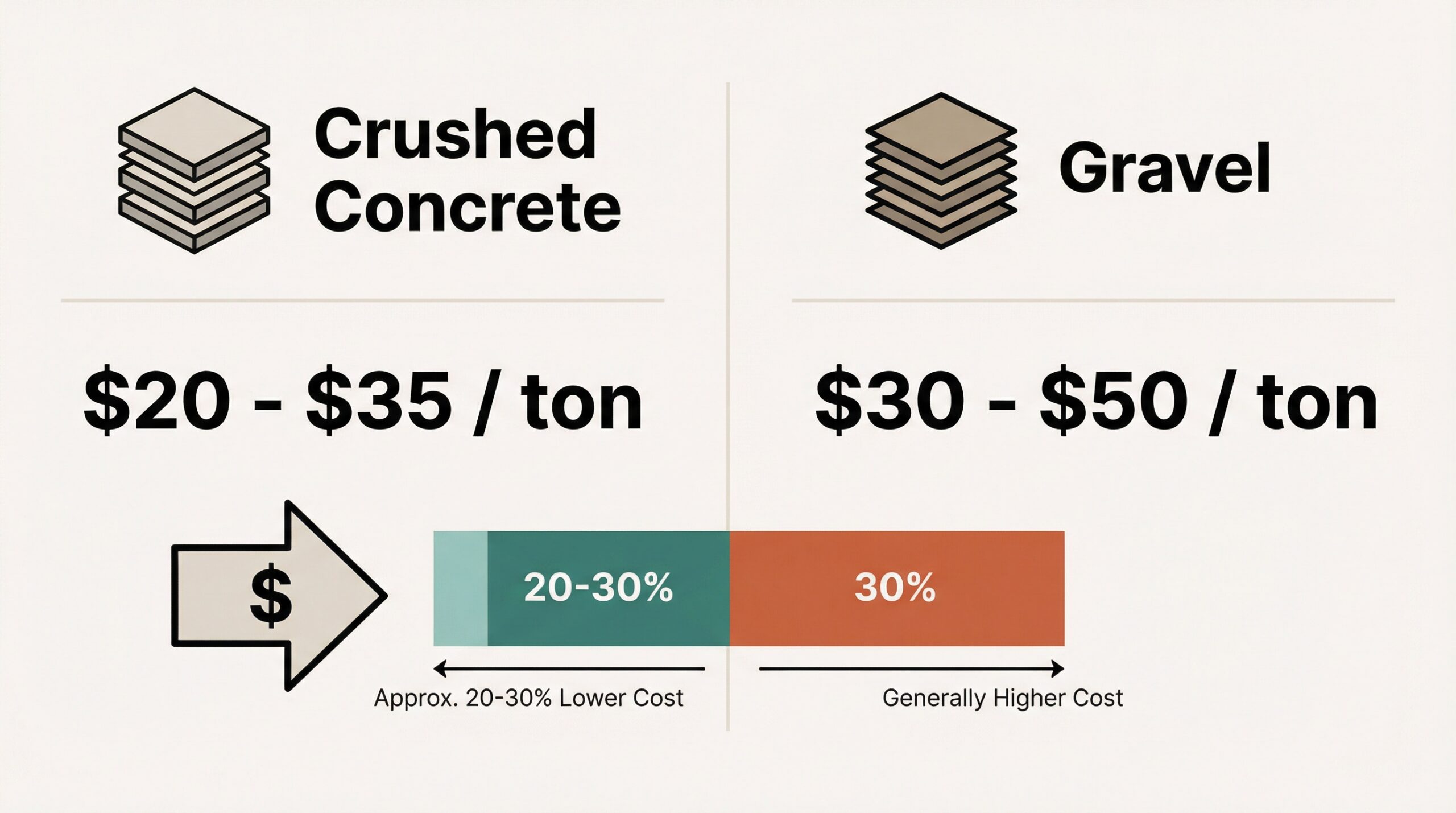
As a base or fill material, crushed concrete (often a less-processed form of RCA) is typically one of the most economical options. Prices generally range from $10 to $20 per tonne, depending on grading and cleanliness.
Comparable gravel can range from $15 to $30 per tonne. For a large site requiring hundreds of tonnes of fill, such as levelling a lot in Springbank, the savings can be substantial. Crushed concrete compacts well and provides a stable, permeable base, making it a cost-effective and functional choice for many earthworks applications.
Advantages and Cost-Effectiveness of RCA
Bringing the financial and practical points together, the case for RCA is strong for many projects. It combines direct savings with indirect benefits that add real value.
Financial Incentives for Recycled Materials
Beyond the basic material savings, there are sometimes additional financial incentives. Some municipalities offer reduced development fees or fast-track permitting for projects demonstrating sustainable practices, including using recycled materials.
For large commercial clients, using RCA can contribute to corporate sustainability reporting and help meet ESG (Environmental, Social, Governance) targets, which can have positive investor and public relations implications. The cost-effectiveness therefore extends beyond the simple line item on a material invoice.
Applications and Project Suitability
RAC is highly suitable for a wide range of applications. Non-structural elements like driveways, walkways, patios, and parking lots are prime candidates. For structural elements, it’s often used successfully in lower-strength requirements or when blended with natural aggregate.
Its cost-effectiveness shines in large-volume applications where the per-unit savings multiply: warehouse floors, mass pours for foundations, road base, and even certain pre-cast elements. Consulting with a knowledgeable supplier is key to matching the material to the project’s specific needs.
The advantages of RCA make it a go-to choice for cost-conscious and environmentally-minded projects across Calgary.
Considerations for Choosing RCA or Traditional Aggregates
Making the final choice for your project in McKenzie Towne or for a downtown core renovation requires weighing a few final, practical considerations.
Performance Needs and Project Requirements
The number one consideration is performance. What are the structural and durability requirements? For a high-strength structural column, a pure RAC mix might not be specified. For a driveway, it’s likely an excellent fit.
Second, consider supply and logistics. Is a reliable, high-quality RCA supplier accessible to your site? Third, think about the project’s overall goals: is minimizing upfront cost the top priority, or is achieving the highest possible strength with no variables more important?
For most Calgary projects, especially residential and many commercial applications, RAC offers a compelling blend of cost savings, reliable performance, and environmental benefit. It’s a modern choice that makes sense for our local market and climate.
FAQ
Here are the most common questions Calgary contractors and homeowners have about recycled aggregate concrete.
Is recycled concrete strong enough for a driveway in Calgary’s climate?
Yes, absolutely. When produced and mixed properly, Recycled Aggregate Concrete achieves compressive strengths suitable for driveway applications. Calgary’s freeze-thaw cycles demand durable concrete, and a well-designed RAC mix with appropriate air-entrainment will perform comparably to traditional concrete.
The key is working with a supplier like OmegaReadyMix who understands our climate and can tailor the mix design—adjusting cement content, admixtures, and the quality of the RCA—to ensure long-term durability against spalling and cracking.
How much can I actually save using RCA for a typical project?
Savings vary by project scale and location. For a standard residential driveway (about 500 sq. ft.), material savings on the concrete itself could range from $200 to $500 depending on current aggregate prices. For larger projects, like a commercial parking lot, savings can reach 24.5% to 50% of the total concrete cost.
The biggest savings often come on projects near an RCA source, where reduced transportation costs for both the aggregate and the eventual waste disposal add to the bottom-line advantage.
Does using recycled concrete affect the project timeline?
No, it typically does not. The pour and cure process for RAC is identical to that of traditional concrete. From mixing to placement to finishing, the workflow on site is the same.
In some cases, timeline might even be improved if local RCA supply avoids delays associated with sourcing and transporting virgin aggregate from farther quarries. Your contractor’s schedule should remain unchanged.
Are there any special permits required in Calgary for using RCA?
Generally, no special permits are required simply for using recycled aggregate in concrete. The City of Calgary encourages sustainable construction practices.
Your project will still need the standard building or development permits based on its scope. It’s always wise to ensure your concrete mix design, whether using RCA or traditional aggregate, meets the engineering specifications required for your permit application.
For most local projects, RCA is a permitted and even encouraged material choice.
Conclusion
The choice between traditional and recycled aggregate concrete isn’t about picking the “better” material universally; it’s about selecting the right material for your specific project, budget, and values. For many applications in and around Calgary—from a new patio in Britannia to a warehouse extension—RCA offers a proven, cost-effective, and sustainable solution.
The data shows significant cost savings without a sacrifice in performance for non-structural uses. Combined with its environmental benefits and support for a local circular economy, it’s a smart choice for modern construction.
Ready to see if recycled aggregate concrete is the right fit for your next pour? The team at OmegaReadyMix can provide a detailed cost comparison and mix recommendation tailored to your Calgary project’s exact requirements. Get a quote based on real local supply and expertise, and build with confidence.