A 30×40 shop slab needs about 14.8 cubic yards (11.3 m³) at 4 inches thick, or 22.2 cubic yards (17.0 m³) at 6 inches. A 40×60 shop slab needs about 29.6 cubic yards (22.6 m³) at 4 inches, or 44.4 cubic yards (34.0 m³) at 6 inches. Most Calgary-area shop and garage slabs are poured at 5–6 inches to carry vehicle and equipment loads. Add about 5–10% for sub-grade variation when you order. In Calgary, the concrete also needs Type HS sulphate-resistant cement and 5–7% entrained air.
The yardage table (4″, 5″, and 6″)
Here’s the full table for the two most-asked shop-slab sizes, plus a 24×24 garage pad and a 40×80 for reference. Volumes are rounded; the formula and a how-to are below.
| Slab size | Area | 4″ thick | 5″ thick | 6″ thick |
|---|---|---|---|---|
| 24×24 (garage pad) | 576 sq ft | 7.1 yd³ · 5.4 m³ | 8.9 yd³ · 6.8 m³ | 10.7 yd³ · 8.2 m³ |
| 30×40 (shop) | 1,200 sq ft | 14.8 yd³ · 11.3 m³ | 18.5 yd³ · 14.2 m³ | 22.2 yd³ · 17.0 m³ |
| 40×60 (shop) | 2,400 sq ft | 29.6 yd³ · 22.6 m³ | 37.0 yd³ · 28.3 m³ | 44.4 yd³ · 34.0 m³ |
| 40×80 (large shop) | 3,200 sq ft | 39.5 yd³ · 30.2 m³ | 49.4 yd³ · 37.8 m³ | 59.3 yd³ · 45.3 m³ |
These are the flat slab volumes. A thickened edge, a turned-down footing around the perimeter, or interior grade beams add concrete on top of these numbers — your engineer or builder will spec those, and they’re exactly the kind of “extra” the order should account for.
How to calculate it yourself
The formula every concrete calculator uses:
( Width × Length ) × ( thickness in inches ÷ 12 ) ÷ 27 = cubic yards
Worked example for a 40×60 slab at 6 inches:
- Area: 40 × 60 = 2,400 sq ft
- Convert thickness to feet: 6 ÷ 12 = 0.5 ft
- Volume in cubic feet: 2,400 × 0.5 = 1,200 cu ft
- Convert to cubic yards: 1,200 ÷ 27 = 44.4 cu yd (≈ 34.0 m³)
A quicker mental check uses coverage per yard: one cubic yard covers 81 sq ft at 4 inches or 54 sq ft at 6 inches. So a 2,400 sq ft slab at 6″ is 2,400 ÷ 54 ≈ 44 yd³. (Sources: Inch Calculator, Concrete Network.)
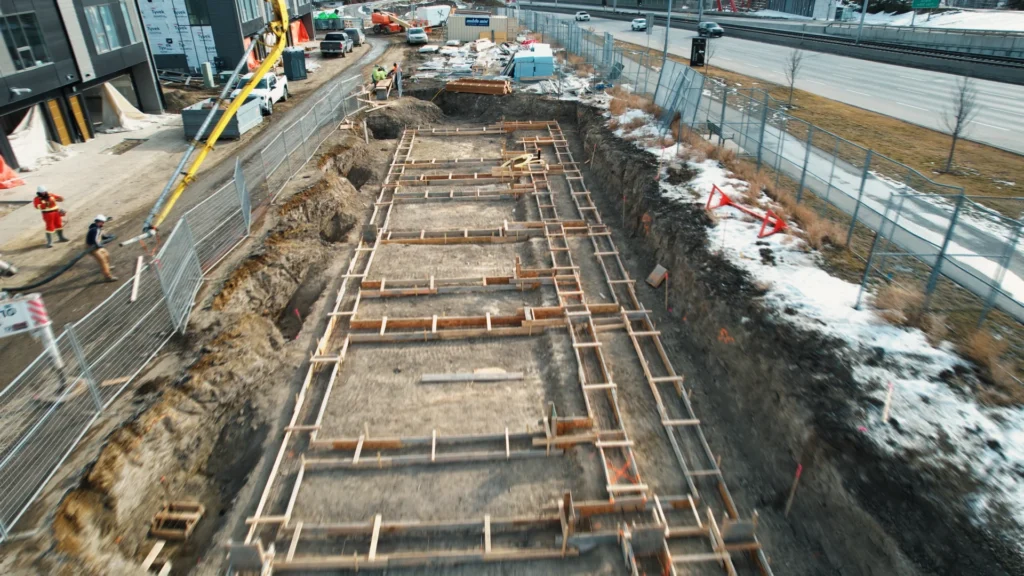
How thick should a Calgary shop slab be — 4, 5, or 6 inches?
Thickness drives both the yardage and whether the slab survives. As a working rule for the Calgary area:
- 4 inches — light-duty: garden workshops, storage sheds, foot traffic and light vehicles. The minimum for most slabs-on-grade.
- 5 inches — a common middle ground for a garage or shop that sees regular vehicle parking.
- 6 inches — the default for a working shop that holds trucks, trailers, a hoist, or heavy equipment. If you’ll ever park a loaded one-ton or run a lift, pour 6.
The jump from 4″ to 6″ adds 50% more concrete (a 40×60 goes from ~29.6 to ~44.4 yd³), but it’s the cheapest insurance you’ll buy on a slab that has to last decades under load. Reinforcement (rebar grid or mesh), control joints, and a properly compacted gravel base matter as much as the thickness — skipping the base is the most common cause of slab failure in our expansive clay soils.
Why you don’t pour a shop slab with bags
People ask “how many bags would that be?” mostly to confirm it’s a bad idea. One 80-lb bag yields about 0.6 cubic feet, so it takes roughly 45 bags per cubic yard (about 50 with a 10% waste allowance). (Source: Sakrete.)
That means:
- A 30×40 at 4″ = ~14.8 yd³ = about 667 × 80-lb bags.
- A 40×60 at 6″ = ~44.4 yd³ = roughly 2,000 bags.
Beyond the cost and the back-breaking labour, bag-mixing a slab this size guarantees cold joints — fresh concrete placed against concrete that has already started to set, because you can’t mix 600+ bags fast enough to keep one continuous pour. Past about a cubic yard, bagged concrete stops making sense. A shop slab needs continuous delivery, full stop.
What spec does an acreage shop slab need in Calgary?
A yardage number alone won’t keep your slab from cracking. The Calgary-area overlay matters as much as the volume:
- Type HS (or HSb) sulphate-resistant cement. Most lots here sit on S-2 sulphate soils (0.20%+ water-soluble sulphate). CSA A3001 Type HS is the default; ordinary cement degrades in sulphate ground.
- Minimum 32 MPa at 56 days for S-2 exposure under CSA A23.1:24 Table 2 (many shop slabs are poured at 35 MPa as a market premium).
- 5–7% entrained air to survive roughly 128 freeze-thaw cycles a year.
- 1.2 m frost depth for any thickened edge, footing, or grade beam tied to the slab.
- A Chinook-aware finish — sudden wind and warmth raise plastic-shrinkage risk; the crew adjusts curing accordingly.
This is where a generic out-of-province calculator leaves you exposed: it gives you the cubic yards but none of the Calgary spec that makes the slab last. For the full standards picture, see Is volumetric concrete as strong as plant concrete? (ASTM C685).
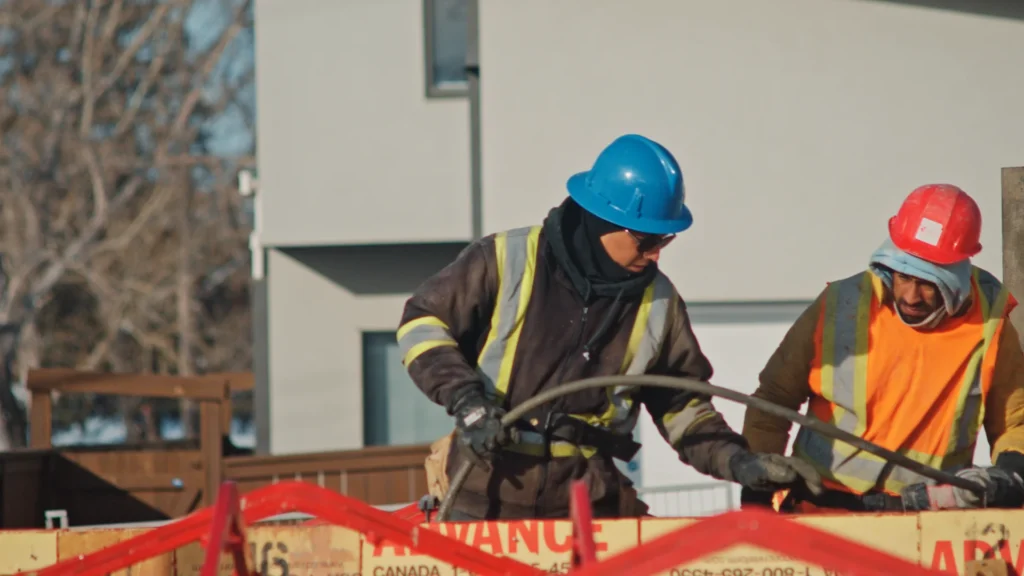
Getting it poured an hour from town: the drive-time problem
If your shop is on an acreage — Bearspaw, Springbank, Priddis, De Winton, Bragg Creek, Foothills MD, Rocky View County — you’ve got a second problem beyond yardage: most of these sites sit 30–90 minutes from any Calgary concrete plant.
That distance collides with the 2-hour (120-minute) CSA A23.1 discharge limit on drum-mix concrete — the clock starts when water meets cement at the plant. A drum truck driving 60 minutes to Bragg Creek has already burned more than half its window before it arrives, and hot summer days tighten it further. On a 30–44 yd³ shop slab, that’s several truckloads each racing the same clock.
Volumetric (mix-on-site) concrete removes the constraint. The truck carries the materials dry and mixes on arrival, so a 60-minute drive delivers concrete exactly as fresh as a 5-minute one — there’s no time-from-batching clock to race. For an acreage shop slab, that’s the structural reason volumetric usually wins. (More on the corridor in Acreage concrete delivery: Bearspaw, Springbank, Priddis, Bragg Creek.)
You can’t run short — and you don’t over-pay
A shop slab is a one-shot pour: you want it placed continuously, with no cold joint where one delivery ran out and the next hadn’t arrived. Two ways that goes wrong with fixed loads — you under-order and have to scramble for a top-up (cold-joint risk), or you over-order and pay for concrete that gets dumped.
On-site volumetric mixing solves both. Because the truck keeps batching continuously until the form is full, you can order an estimate and pour to the actual form without running short. And because it’s metered to the quarter-yard, you pay for what you pour — not for promised yards. On a 30–44 yd³ slab, a 5–10% over-order “just in case” is real money; volumetric lets you skip it. (Multi-truck and on-site reload handle the largest slabs without breaking the pour.) The full mechanism is in How much concrete do I need — and why you can’t run short.
What does a shop slab cost in Calgary?
Cost depends on thickness, reinforcement, finish, and site access, so treat these as directional public ranges, not quotes:
- Calgary/Alberta delivered concrete, material only: roughly $180–$280 / m³ (Alberta aggregation ~$180–$215/m³; Calgary delivered ~$200–$280/m³). Independent Calgary contractor pricing for finished work runs higher — around $300–$400 / m³. (Source: tnaconcrete.ca, 2024.)
Run the math on the material alone for a 40×60 at 6″ (≈34 m³) and you can see why precise ordering matters at this scale. Our published 2026 Calgary concrete price guide breaks the cost components down further.
FAQ
How many yards of concrete for a 30×40 slab? About 14.8 cubic yards (11.3 m³) at 4 inches, or 22.2 cubic yards (17.0 m³) at 6 inches. Add roughly 5–10% for sub-grade variation when ordering.
How many yards of concrete for a 40×60 shop slab? About 29.6 cubic yards (22.6 m³) at 4 inches, or 44.4 cubic yards (34.0 m³) at 6 inches. Most working shop slabs are poured at 5–6 inches.
How many bags of concrete would a 30×40 slab take? Roughly 667 × 80-lb bags at 4 inches — which is exactly why you don’t bag a slab this size. At ~45 bags per cubic yard, the labour and the cold-joint risk make continuous delivery the only sensible option past about one cubic yard.
How thick should a shop or garage slab be in Calgary? 4 inches for light duty, 5 inches for regular vehicle use, and 6 inches for a working shop carrying trucks, trailers, a hoist, or heavy equipment. Pair the thickness with rebar/mesh, control joints, and a compacted gravel base.
What concrete spec does an acreage shop slab need in Calgary? Type HS (or HSb) sulphate-resistant cement for S-2 soils, a minimum 32 MPa at 56 days (35 MPa is common), 5–7% entrained air for freeze-thaw, and footings below the 1.2 m frost depth.
How much does a 40×60 concrete slab cost in Calgary? Material-only concrete runs roughly $180–$280/m³ in the Calgary/Alberta market; finished contractor pricing runs higher (~$300–$400/m³). A 40×60 at 6″ is about 34 m³ of concrete before reinforcement, base, and labour. Get a job-specific quote.
Can a concrete truck reach my acreage, and will the mix still be good? Yes. Volumetric (mix-on-site) trucks carry the materials dry and batch on arrival, so a long drive doesn’t affect the concrete — there’s no 2-hour discharge clock to race the way there is with drum-mix delivered from a plant.
What happens if I order too little concrete for my slab? With fixed truckloads you risk a cold joint while you wait for more. With on-site volumetric mixing the truck keeps batching until the form is full, so you can’t run short — and because it’s metered, you don’t pay for concrete you don’t pour.