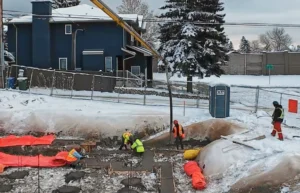
Everything you need to know before your first concrete pour in Calgary.
To survive concrete delivery day, you need three things done before the truck arrives: all formwork and grading completed, a clear access path for a 30 to 40 foot truck weighing up to 80,000 pounds, and enough helpers on-site to place and finish the concrete before it sets (typically 60 to 90 minutes in Calgary summer conditions). The number one mistake first-timers make is underestimating how fast everything moves once concrete starts flowing. Prepare the day before, not the morning of.
Why Is Delivery Day So Stressful for First-Timers?
Forums and homeowner groups are filled with delivery day anxiety stories, and for good reason. Unlike most home improvement projects, concrete is unforgiving:
- You cannot pause and come back tomorrow
- The material starts setting the moment it is mixed
- A traditional drum-mixer truck charges $2 to $4 per minute if you exceed 90 minutes on-site
- Mistakes are permanent — there is no undo button
The stress is real, but it is entirely manageable with preparation. Most delivery day disasters come from things that should have been handled the day before, not problems that arise during the pour itself.
Best practices for safe concrete handling and placement are outlined by the American Concrete Institute, including guidelines on timing, finishing, and site preparation.
What Should You Do the Week Before Delivery?
Book and Confirm
- Book your delivery 3 to 4 days in advance. During Calgary’s peak concrete season (May through August), a week or more is safer.
- Confirm 1 to 2 days before delivery. Call your supplier to verify the date, time window, mix design, and quantity. Confirm the delivery address and any special access instructions.
- Check the weather obsessively. Do not pour in rain or if temperatures will drop below 5 degrees Celsius within 24 hours. Have a backup date in mind.
Know Your Truck
Understanding what is coming to your property prevents surprises:
| Specification | Traditional Drum Mixer | Volumetric (Omega) |
|---|---|---|
| Length | 30 – 40 feet | 25 – 32 feet |
| Height | 11.5 – 13.5 feet | 10 – 12 feet |
| Loaded weight | 60,000 – 80,000 lbs | 40,000 – 55,000 lbs |
| Width | 8 – 8.5 feet | 8 – 8.5 feet |
| Chute reach | 10 – 12 feet | 10 – 14 feet |
| On-site time limit | 90 minutes (then overtime charges) | No time limit |
That loaded weight is not a typo. A full concrete truck weighs as much as a loaded semi-trailer. It can crack driveways, sink into soft ground, break underground utilities, and leave ruts in your lawn that take years to recover.
Volumetric trucks from Omega Ready Mix are significantly smaller and lighter — roughly 30 percent lighter than traditional drum mixers. They fit into tighter residential spaces and do less damage to your property.
If this process feels overwhelming, here is how to choose a concrete contractor in Calgary and avoid costly mistakes.
What Is the Site Prep Checklist?
Complete all of these items the day before delivery, not the morning of.
Access and Path
- Measure the access route: minimum 10 feet wide, 12 feet overhead clearance
- Check for low-hanging tree branches — trim anything below 14 feet along the path
- Identify overhead power lines — maintain minimum 3 metre (10 foot) clearance
- Ensure the ground along the access route is firm enough to support the truck weight
- Protect your lawn: lay double-thickness plywood sheets along any path the truck will drive over
- Check with your municipality about any right-of-way restrictions
Formwork and Prep
- All excavation completed and subbase compacted
- Forms installed, level-checked, and staked securely
- Reinforcement (rebar, mesh, or fiber specified with supplier) in place and positioned correctly
- Grading checked — proper slope for drainage (minimum 2 percent away from structures)
- Remove any standing water from inside the forms
- Vapor barrier installed if required (typically for interior slabs)
Site Organization
- Designate a concrete washout area away from storm drains, gardens, and waterways
- Stage all tools within arm’s reach of the pour area
- Set up a water source (garden hose) for finishing and cleanup
- Clear the area of anything you do not want splattered with concrete (vehicles, patio furniture, kids’ toys)
- Post “No Parking” in front of your property if the truck needs street access
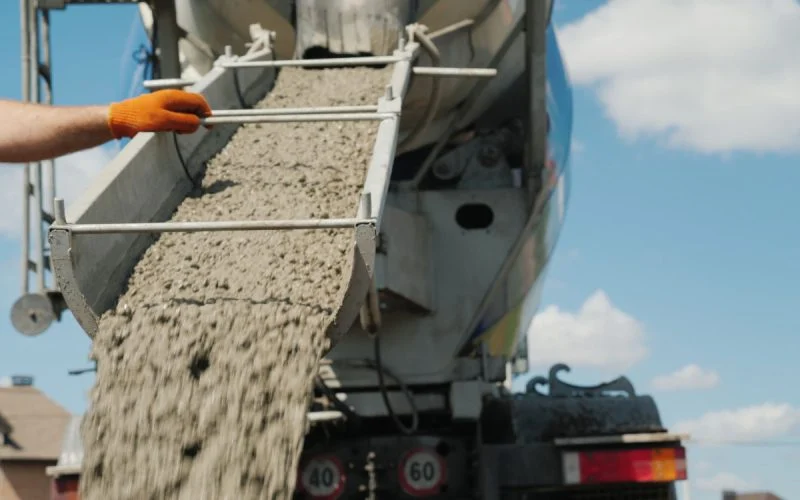
What Happens on Delivery Day? Hour-by-Hour Timeline
Here is what a typical Calgary residential concrete delivery looks like:
| Time | What Happens | Your Job |
|---|---|---|
| T minus 2 hours | Final check of weather, forms, tools, and helpers | Walk the site one last time, remove standing water |
| T minus 1 hour | Supplier calls to confirm they are on the way | Have all helpers on-site, review the plan |
| Truck arrives | Driver inspects access, positions truck | Guide the driver, point out obstacles and power lines |
| First 10 minutes | Driver sets up chute, confirms mix and quantity | Verify the mix design on the delivery ticket matches your order |
| Pour begins | Concrete flows down the chute into forms | Direct the chute, start screeding immediately behind the flow |
| 30 – 60 minutes | Bulk of concrete placed and screeded | Screed, bull float, check for low spots |
| 60 – 90 minutes | Pour complete, truck washes out and leaves | Begin waiting for bleed water to evaporate |
| 90 min – 3 hours | Bleed water evaporates, surface firms up | Monitor the surface — do not start finishing too early |
| 3 – 5 hours | Final finishing (steel trowel, broom, edging) | Apply chosen finish, cut control joints |
| 5 – 8 hours | Concrete firm enough to apply curing compound | Apply curing compound or cover with plastic |
| Day 2 – Day 7 | Curing period | Keep the concrete moist (water 2-3 times daily or keep covered) |
| Day 7+ | Remove forms | Carefully strip forms without chipping edges |
| Day 28 | Full cure reached | Apply sealer for exterior slabs |
Note: This timeline assumes a warm Calgary summer day (20 to 28 degrees Celsius). Cooler temperatures slow everything down. Hotter temperatures or high winds speed everything up — sometimes dangerously.
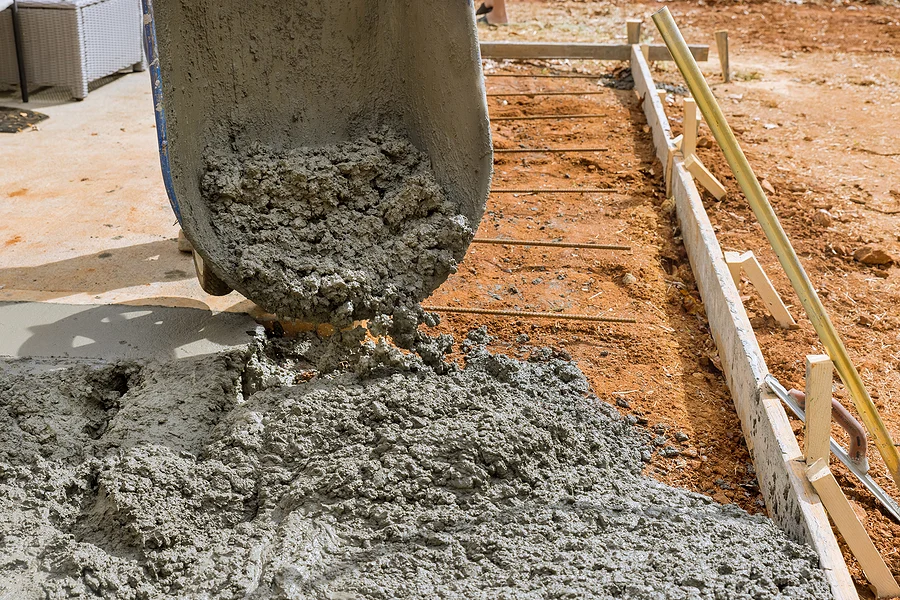
How Many Helpers Do You Need?
This is where most first-timers underestimate. You need:
| Project Size | Minimum Crew | Ideal Crew |
|---|---|---|
| Under 2 cubic yards | 2 people | 3 people |
| 2 – 5 cubic yards | 3 people | 4 – 5 people |
| 5 – 8 cubic yards | 4 people | 5 – 6 people |
| Over 8 cubic yards | 5+ people | Hire a professional crew |
Every person should have a defined role before the truck arrives: who is directing the chute, who is screeding, who is bull floating, who is handling edges and detail work. Concrete does not wait while you figure out who does what.
What Placement Method Will You Use?
The concrete has to get from the truck into your forms. There are three ways:
Direct chute: The truck backs up to your forms and concrete slides down a chute directly into place. Chute reach is only about 10 to 12 feet from the truck. This is the simplest and cheapest method, but your forms must be accessible to the truck.
Wheelbarrow: For areas the chute cannot reach, concrete is poured into wheelbarrows and wheeled to the forms. This is labor-intensive — a loaded wheelbarrow weighs about 300 to 400 pounds. Plan for fatigue and have multiple wheelbarrows ready.
Pump truck: A concrete pump extends a hose 50 to 200 feet or more, reaching backyards, elevated areas, or any location the truck cannot access. Pump truck rental runs $600 to $900 in Calgary. Book it separately and coordinate timing with your concrete delivery.
What Safety Gear Do You Need?
Wet concrete is a chemical hazard. It contains calcium hydroxide, which is highly alkaline (pH 12 to 13) and causes chemical burns on prolonged skin contact. This is not theoretical — concrete burns are a real and common injury.
Required safety gear for everyone on-site:
- Long pants (not shorts — concrete splashes)
- Long-sleeved shirt
- Waterproof gloves (rubber, not cloth)
- Rubber boots (tall enough that concrete cannot splash over the top)
- Eye protection (safety glasses or goggles)
If wet concrete gets on your skin, wash it off immediately with clean water. Do not wait until the pour is finished. Concrete burns develop slowly and can cause second-degree injuries that take weeks to heal.
What Do You Do If Something Goes Wrong?
The concrete is setting too fast
Stay calm. Focus on getting it screeded and bull floated. Skip the fancy finish — a rough surface that is structurally sound is infinitely better than a slab you ran out of time on. In extreme cases, mist the surface with water to slow setting slightly (but do not over-water).
You are running out of concrete
With a traditional delivery, you face the expensive decision of ordering a second truck ($250 to $330 minimum). With Omega Ready Mix’s volumetric delivery, the truck simply mixes more on-site — no second delivery, no cold joint, no short-load fee.
It starts raining
If it is a light mist and you are nearly finished, cover the fresh concrete with plastic sheeting immediately. If it is a real rainfall and you have just started, you may need to scrape out the fresh concrete before it sets with rain damage baked in. This is why checking the forecast is so critical.
The chute cannot reach the forms
You need wheelbarrows, and you need them now. This should have been identified before delivery. If you are caught off guard, the truck driver may be able to reposition, but every minute counts.
The concrete looks wrong
Check the delivery ticket against your order. If the mix design is wrong (different PSI, no air entrainment, wrong slump), address it before pouring. With volumetric delivery, the mix can be adjusted on the spot. With a traditional drum mixer, what is in the truck is what you get.
Why Is Volumetric Delivery Easier for First-Timers?
Traditional drum-mixer trucks create pressure that makes delivery day harder than it needs to be:
- The 90-minute clock starts the moment the truck arrives. Every minute you spend solving problems costs money.
- The minimum order means you are paying for 5+ yards whether you need it or not.
- The fixed mix cannot be changed once it leaves the plant. If the slump is wrong, your only option is a garden hose (which ruins the concrete).
Omega Ready Mix’s volumetric trucks eliminate all three of these pressure points:
- No time limit. The truck mixes fresh concrete as you need it. Pause to fix a form, take a break, adjust your approach — the concrete does not start setting until you are ready.
- No minimum order. Pay for exactly what you pour. Need 3.7 yards? That is what you pay for. No short-load fees, no waste.
- Adjustable mix. Slump too stiff? The driver adjusts it at the truck. Need a bit more air entrainment? Done on-site. The mix is dialed in for your specific conditions, not a guess made at the plant hours earlier.
For a first-time homeowner managing their own pour, these advantages reduce stress dramatically. You work at your pace, not the truck’s.
Frequently Asked Questions
How far in advance should I book concrete delivery in Calgary?
During peak season (May through August), book at least 1 week in advance. During shoulder season (April, September, October), 3 to 4 days is usually sufficient. Confirm your delivery 1 to 2 days before the scheduled date.
Will the concrete truck damage my driveway?
Possibly. A loaded drum-mixer truck weighs 60,000 to 80,000 pounds — well above what most residential driveways are designed to handle. Older or thinner driveways can crack under the weight. Discuss access with your supplier and consider alternative positioning. Omega’s volumetric trucks are significantly lighter at 40,000 to 55,000 pounds, reducing the risk.
Can the truck pour into my backyard?
Only if there is adequate access. Measure the path: minimum 10 feet wide, 12 feet overhead clearance, and firm ground. If direct access is not possible, you will need a pump truck ($600 to $900) or wheelbarrows. Some homeowners temporarily remove fence sections to create truck access.
What happens if the truck arrives and my site is not ready?
The driver will wait, but the clock is ticking. With a traditional drum mixer, you are paying overtime charges after 90 minutes. With volumetric delivery, there is no time pressure, but you are still paying for the driver’s time. Have everything ready before the truck arrives.
Do I need to be home for concrete delivery?
Yes, absolutely. Someone who understands the project and can make decisions must be on-site for the entire delivery. The driver needs direction on where to position the truck, and your crew needs to be ready to place concrete the moment it starts flowing.
What if I need to cancel my delivery?
Most suppliers require 24-hour notice for cancellation without charges. Same-day cancellations typically incur a fee of $100 to $200. Check your supplier’s cancellation policy when booking. Weather cancellations are usually handled without penalty.
How long after delivery can I walk on the concrete?
Light foot traffic is generally safe after 24 to 48 hours. Do not drive on new concrete for at least 7 days. Heavy vehicles (trucks, RVs) should wait 14 to 28 days. These timelines assume normal Calgary summer temperatures — cold weather extends curing time significantly.
Can I pour concrete on a weekend in Calgary?
Yes, though Saturday deliveries may carry a surcharge of $100 to $200 with some suppliers. Omega Ready Mix offers 24/7 delivery, including weekends, making scheduling flexible for homeowners who work during the week.
Make Your First Delivery Day Stress-Free
Omega Ready Mix takes the pressure out of concrete delivery for Calgary homeowners. Our smaller volumetric trucks fit residential sites better, mix your concrete fresh on-site so there is no ticking clock, and deliver exactly the amount you need with no short-load fees or waste charges. First time ordering concrete? We walk you through everything — from mix selection to site prep advice.
Get a free quote from Omega Ready Mix — call (587) 579-1110 or email [email protected]
Omega Ready Mix | 5065 13 St SE 135, Calgary, AB T2G 5M8 | Available 24/7
Schema Markup Notes
Recommended schema types for this page:
- FAQPage schema for the FAQ section (8 question-answer pairs)
- Article schema with
datePublished: 2026-04-09anddateModified: 2026-04-09 - LocalBusiness schema for Omega Ready Mix (name, address, phone, email, areaServed: Calgary)
- HowTo schema for the site prep checklist and delivery day timeline
- Table structured data for the truck specifications, timeline, and crew size tables
- ItemList schema for the safety gear list
- Use
speakableproperty on the answer capsule paragraph for voice search optimization