
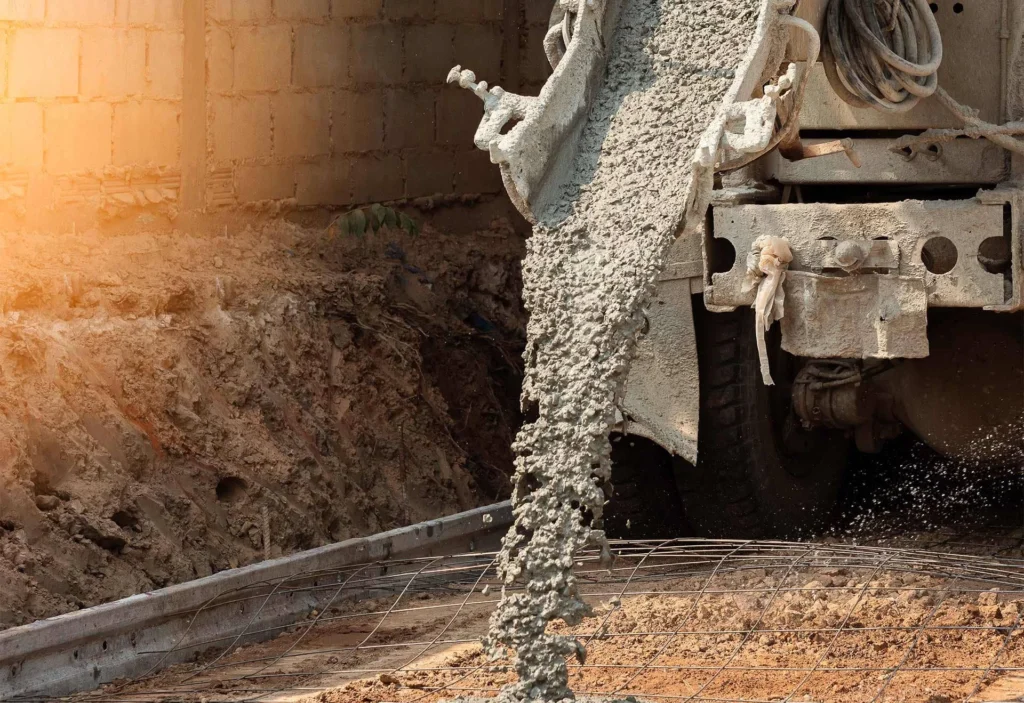
On a remote oilfield lease pad, well site, or industrial location with no batch plant nearby, a volumetric (mobile-mixer) truck carries cement, sand, stone, and water in separate compartments and batches fresh concrete on site to whatever mix design the job needs, an equipment base, a tank pad, a thrust block, or flowable fill.
Because the concrete is mixed on arrival, the CSA A23.1 two-hour discharge clock starts when the pour starts, not at a distant plant, so distance doesn’t degrade the load and there’s no “lost load” from a long haul. There’s no separate oilfield concrete standard: a remote Alberta pad is still governed by CSA A23.1 (and, for sulphate-bearing ground, a Type HS or HSb sulphate-resistant mix), which a volumetric truck batches to spec on the spot. The same metered truck can switch mix designs between elements on one mobilization.
This article is the industrial and energy-sector version of remote pouring: lease pads, well sites, tank pads, and the spec varying job to job.
The lease-pad problem
You’re pouring an equipment base on a lease pad an hour past the edge of any plant’s economical reach. You phone around. The plants that will even quote the distance add the same quiet caveat the acreage builders hear: “as long as the truck makes it in time.”
Out here that caveat is the whole job. A drum-mix truck batches the concrete at the plant, then drives. By the time it reaches a remote pad, a big share of its usable window is gone, and on a hot, windy day it’s worse. The load can arrive stiff, get water added on site (which weakens it), or get rejected at the chute, leaving a crew idle on a site that was expensive to reach in the first place. (This scene is a composite of common voice-of-customer experience on remote energy-sector work, illustrative rather than a single cited account.)
How a volumetric truck takes distance off the table
A volumetric truck is built to put the plant on the pad. Instead of a rotating drum holding pre-mixed concrete, it carries the raw ingredients separately and batches them continuously at the chute as you pour.
The manufacturer ProAll, the Alberta-rooted Reimer brand, builds and markets units specifically for this. Its oil-and-gas page names the problem directly: “Remote locations, limited resources, long wait times and idle equipment cost the industry substantial time and money.” The volumetric answer it describes: “On-site concrete production to eliminate transport concerns” and “a dedicated, uninterrupted supply of fresh concrete,” with “No lost loads due to time constraints” and “No return loads or piles at the jobsite.” A dedicated mixer can “sit onsite until the job is ready and produce fresh concrete on demand.”
(Source: ProAll, Oil & Gas applications.)
That’s the manufacturer’s framing of the use case, cited here for the mechanism, fresh on demand, no lost loads, not as a strength claim. The mechanism is what matters: the concrete doesn’t exist until it’s already at your pad, so the drive can’t degrade it.
CTS Cement senior research engineer John Kim makes the same point from the materials side: volumetric “eliminates the need to factor in unexpected haul times.”
(Source: Equipment World.)
Any mix design, any site
The other half of remote industrial work is that the spec changes job to job, and often element to element on the same pad. A volumetric truck handles that because the mix is programmed, not pre-loaded.
ProAll describes the capability as being able to “easily change the mix design on site, to ensure the quality of concrete is always fresh, never compromised,” produced “on a continuous or intermittent basis, fresh on-site, where the concrete is to be placed,” using “the automated controls to easily adjust the PSI mix on site.”
(Source: ProAll.)
Cemen Tech extends the same idea to the broader industrial and utility pour list: “Above or below ground, our mixers allow you to produce the exact design mix and quantity required. From sewer intake bases to thrust blocks and flowable fill, you’ll have the concrete you need, when you need it, without waste or extra costs,” filling open utility boxes or trenches “in one go.”
(Source: Cemen Tech applications.)
So the lease-pad job menu, an equipment base in one mix, flowable backfill in another, a thrust block in a third, can come off one truck on one mobilization. Getting any truck to a remote pad is the expensive part; making that single trip do several mixes is where the remote economics improve.
| Remote / industrial pour | What volumetric brings |
|---|---|
| Equipment and pump-jack bases | Spec mix batched fresh on site, no haul degradation |
| Tank pads | Continuous feed, exact volume, no return load |
| Thrust blocks | Switch mix design on the same mobilization |
| Flowable fill / trenches | Fill “in one go,” metered to what’s needed |
| Footings on remote structures | Sulphate-resistant Calgary/Alberta spec on the pad |
(Pour list per ProAll oil-and-gas and Cemen Tech utilities applications, attributed above.)
If your project is spread across multiple mobilizations instead of one continuous pour, our guide on phased concrete pours with one supplier explains how to maintain the exact same mix design and specification from footing to wall to slab without consistency issues.
“Remote” doesn’t lower the standard
A fair question on a gravel pad an hour from anywhere: are you still getting code-compliant concrete? Yes, and this is the credibility point most generic oilfield content misses.
There’s no oilfield-specific concrete standard. A remote Alberta pad or footing is governed by the same CSA A23.1 and the National Building Code (Alberta Edition) as any other pour. Sulphate-bearing ground still calls for a sulphate-resistant mix; freeze-thaw-exposed pads still need air-entrained concrete.
(Framing per Alberta building-code and CSA practice; see, for example, the Regional Municipality of Wood Buffalo Standard Construction Specifications, 2025 and Concrete Alberta placement guidance.)
Because the mix design is programmed into the truck, the operator batches that correct spec on the pad. Sulphate-bearing Alberta ground, common across the energy corridor, still gets a Type HS or HSb sulphate-resistant mix to CSA A23.1:24. Remote location, correct spec. For the standards-and-strength proof that on-site batching meets the same bar as plant concrete, on-site batching isn’t stronger, it meets the same ASTM C685 / CSA A23.1 standards.
The Alberta-corridor specifics
- The energy corridor and the rural counties put lease pads and industrial sites well past any plant’s economical haul, the structural reason volumetric lives out here.
- S-2 sulphate ground is common on Alberta sites, so the remote pad still needs Type HS/HSb to CSA A23.1:24, batched on site. (Source: Calgary Concrete Master Knowledge Base, S-2 section.)
- Hot or cold weather compounds the haul. A long drive on a hot Chinook day, or in Calgary’s cold regime, degrades a drum load further; volumetric sidesteps it because there’s no drive-time clock to burn.
See the hot Chinook fix and cold-weather discharge temperature; we keep that light here. - One mobilization, multiple mixes is the remote-economics win, the equipment base and the flowable fill off the same truck.
When a plant truck is still the right call
Honest triage, because volumetric isn’t the answer to every industrial pour:
- A big single-spec pour near a plant. If the site is within a short, reliable haul of a plant and you need one large pour of one mix, a drum truck (or several) is usually the faster, cleaner fit.
- Very high volume on a tight schedule, plant in range. For dozens of cubic metres where a plant genuinely services the distance with retarder dosed and a realistic arrival, a string of drum trucks can out-pace a single mobile mixer.
- The plant will commit to the site and stand behind the spec on arrival. If a supplier truly services your distance and warrants the concrete at the chute, a drum delivery can work.
Volumetric is strongest exactly where those break down: the pad with no plant in range, the haul that eats the clock, the job whose spec changes element to element. That’s the lease-pad reality.
FAQ
Can you pour concrete on a remote oilfield lease pad with no batch plant nearby? Yes. A volumetric (mobile-mixer) truck carries the dry materials and water separately and batches fresh on the pad, so distance from any plant doesn’t degrade the load. The CSA two-hour discharge clock starts when you start pouring on site, not at a faraway plant.
Can a volumetric truck mix any spec on a remote site? Yes. It meters to the required mix design on site, and it can switch mix designs between elements on a single mobilization, an equipment base in one mix, flowable fill in another, a thrust block in a third, off the same truck.
Is there a special concrete standard for oilfield or lease-pad pours? No. There’s no oilfield-specific concrete standard. The same CSA A23.1 and National Building Code (Alberta Edition) apply as on any pour, and sulphate-bearing ground still calls for a Type HS or HSb sulphate-resistant mix, which a volumetric truck batches on the pad.
Why does a long haul ruin plant-mixed concrete on a remote site? Drum-mix concrete starts hydrating the moment it’s batched at the plant. A long industrial haul can spend most or all of the CSA two-hour discharge window before the chute opens, so the load can arrive too stiff to place to spec, get water added on site (which lowers strength), or be rejected as a “lost load.”
What remote and industrial pours suit volumetric? Equipment and tank pads, thrust blocks, flowable fill, and footings, produced fresh on site, continuous or intermittent, to the required spec. Cemen Tech notes volumetric fills open utility boxes or trenches “in one go,” and ProAll markets it for dedicated, on-demand supply on remote energy-sector sites.
How is this different from a remote acreage shop-slab pour? The on-site-batching advantage is the same. This page is the industrial and energy-sector version, lease pads and well sites with changing specs. For a residential or acreage pour, a rural shop slab or home foundation, see the no-batch-plant article.
Build Remote Projects Without Concrete Delivery Risk
When your project is hours from the nearest batch plant, every delivery delay can threaten your schedule and concrete quality. Omega Ready Mix’s volumetric fleet produces fresh CSA-compliant concrete directly on your lease pad, well site, or industrial location—eliminating haul-time concerns, reducing waste, and allowing multiple mix designs from a single mobilization.
Whether you’re pouring equipment foundations, tank pads, thrust blocks, flowable fill, or remote industrial footings, we’ll batch the exact mix your project requires, exactly where you need it.
Contact Omega Ready Mix today to discuss your remote concrete requirements and receive a customized quote for your next Alberta oilfield or industrial project.