
In Calgary, a deck footing (pile) must be at least 10 inches in diameter and at least 4 feet deep, which is about 1.2 metres, so it bears below the city’s design frost line. The top of the pile must sit at least 6 inches above grade, per the City of Calgary’s residential-deck guidance, and screw piles need an engineer’s stamp plus a CCMC listing number. A building permit is required once any part of the deck surface is more than 0.6 metres (about 2 feet) above grade.
The total concrete for a typical deck is small and odd, often well under a cubic yard across a handful of piles, which is too little for a drum (plant) truck’s minimum order but exactly what a metered volumetric mixer is built for. It batches fresh on site, meters to the quarter-yard, fills each pile to the required depth, and bills only for what you pour, with no truck minimum and no short-load fee.
This article covers the Calgary deck-footing code and how to supply the small volume. For whether you can get a small load at all, see the smallest-amount article. For the strength and standards behind a buried pile, see the strength article. We cross-link both below.
How deep and how wide does a Calgary deck footing have to be?
The numbers come straight from the City of Calgary’s own structural cross-section for residential decks. Its labelled minimums are:
- Pile diameter: 10 inches minimum
- Pile depth: 4 feet minimum (below the frost line)
- Pile height above grade: 6 inches minimum
- Cantilever length: 2 feet maximum
- Deck guardrail height: 36 inches minimum, rising to 42 inches for decks over 6 feet above grade, with rail openings no wider than 4 inches
- Stairs: rise 5 inches min to 7⅞ inches max; tread 9¼ inches min to 14 inches max
- And, in the City’s words, “ENGINEERING IS REQUIRED IF SCREW PILES ARE BEING USED (INDICATE CCMC LISTING NUMBER)”
(Source: City of Calgary “Residential Decks” brochure, structural cross-section, brochure 2014-04.)
One honest caveat. That brochure carries its own disclaimer that it has “no legal status” and “cannot be used as an official interpretation.” Treat the 10-inch, 4-foot, 6-inch figures as the City’s published guidance and confirm current requirements with the Planning Services Centre or the Alberta Building Code when you pull your permit.
The 4-foot depth isn’t arbitrary. Calgary’s design frost depth is about 1.2 metres, and a footing that doesn’t reach below the frost line will heave as the ground freezes and thaws through the city’s chinook winters. National Building Code (Alberta Edition) Part 9 puts footings at least 1.2 metres below finish grade for the same reason. (Anchored to the 1.2 m southern-Alberta design frost depth; some web sources overstate Alberta frost at 5 to 7 feet, so anchor to the City’s “4 feet minimum” instead.)
Do I need a permit to build a deck in Calgary?
Often, yes, and the trigger is a specific height.
The City requires a building permit when “your deck will be higher than 0.6m (approximately two feet) above grade at any point,” or for any covered deck such as one with a pergola or roof. A development permit is also required in a developed area (zoning like R-C1(s), R-C2, RC1N, R-C1L(s), or R-CG) when the deck “will exceed 1.5m in height above grade,” or if it’s in or within 6 metres of the floodway. The City notes that “most Building Permit applications for decks can be issued the same day.” Point-in-time fees on the page were $205.92 for the building permit and $550.00 for the development permit.
(Source: City of Calgary Decks page; fees point-in-time, confirm current amounts.)
So a low, ground-hugging deck may need no building permit at all, while most raised decks do. The 0.6-metre line is the one to remember.
How much concrete does a deck actually need?
Less than you’d think, and that’s the whole supply problem.
A 10-inch-diameter pile poured 4 feet deep holds about 2.2 cubic feet of concrete. A 12-inch pile at the same depth holds about 3.1 cubic feet. Run that across a typical deck:
| Deck | Piles | Concrete per pile | Total volume |
|---|---|---|---|
| Small deck | 4 piles (10″) | ~2.2 ft³ | |
| Typical deck | 6 piles (10″) | ~2.2 ft³ | |
| Larger deck | 6 piles (12″) | ~3.1 ft³ |
(Pile volumes from cylinder geometry, corroborated by the Inch Calculator post-hole tool.)
A whole deck’s footings often add up to half a yard, sometimes less. That’s the trap: too much to mix comfortably from bags without a long day, and too little to fill a drum truck’s minimum order without a short-load fee.
Many homeowners assume bagged concrete is the cheapest option for small footing projects, but that’s only true up to a certain volume. Our guide, Select Bags vs Delivery for Fence Footings: The Exact Yard Where Bagging Stops Paying, calculates the point where buying bags becomes more expensive—in both cost and labour—than ordering delivered concrete. If you’re pouring several deck piles, fence posts, or small foundations, it will help you determine exactly when volumetric concrete delivery becomes the more economical and practical choice.
For context on how footing diameter scales with load, the 2018 IRC footing table sizes footings by tributary area, soil bearing, and load, so a heavily loaded post needs a wider footing. Decks.com and Fine Homebuilding own those US tables. (Sources: Decks.com footing size chart; Fine Homebuilding IRC footing table.) In Calgary, though, the governing minimums are the City’s 10-inch diameter and 4-foot depth. Treat the US tables as the sizing method, not the local rule.
How do you pour a few deck piles without a truck minimum?
This is where metered volumetric supply fits the job. A volumetric mixer carries cement, sand, stone, and water separately and meters them at discharge, so there’s no pre-batched truckload to fill and no truck minimum. You fill each pile to its 4-foot depth, shut off at the last one, and pay only for the yards that went down.
The Alberta small-load market shows the floor is real. Mini Batch near Edmonton lists a smallest order of 0.2 m³, and Astro Mini Mix in Calgary markets “load sizes starting at 1/4 yard and up.”
(Sources: Mini Batch price list, Edmonton-area; Astro Mini Mix, Calgary. Neither is Omega’s price; cited to show the sub-truck market exists.)
That’s the resolution to a half-yard deck job. A plant truck would either decline it or add a fee. A metered pour treats it as a normal small job.
What mix do Calgary deck piles need?
A buried deck pile sits below grade in sulphate-bearing soil and through repeated freeze-thaw, so it’s an F-1 and S-2 exposure. That calls for a sulphate-resistant cement (Type HS or HSb) at the S-2 spec, batched to CSA A23.1. A volumetric truck batches that correct Calgary-spec mix on site.
Volumetric concrete meets the same ASTM C685 and CSA A23.1 standards as plant concrete. For the full strength answer, see the linked strength article rather than re-reading it here. The takeaway for deck piles: a remote or rural site never means a wrong mix, because the mixer batches the spec on arrival.
How the pile and post go together
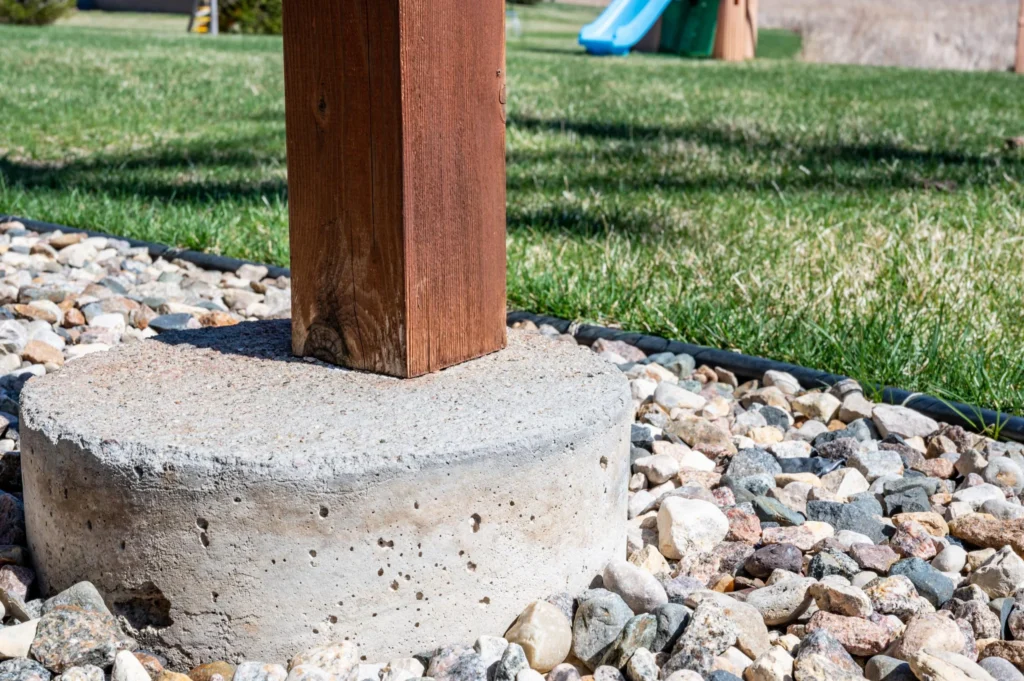
A quick assembly note, because a code list alone isn’t useful. The City’s cross-section requires the post to be “AT LEAST AS WIDE AS BEAM,” the connections to both the residence and the pile to be indicated, and the pile to stand 6 inches above grade so the post sits on the concrete rather than in the soil. (Source: City of Calgary brochure, p.2.) A saddle bracket cast into or fastened to the pile top keeps the post dry and off the ground, which is the point of the 6-inch standoff.
On an acreage deck far from any plant, the piles are a tiny total volume an hour’s drive from the nearest batch plant. A volumetric truck batches on arrival, so distance doesn’t degrade the mix. For the drive-time detail, see the remote-pour article linked below.
FAQ
How deep do deck footings have to be in Calgary? At least 4 feet, which is about 1.2 metres, so the pile bears below the frost line, and at least 10 inches in diameter, per the City of Calgary’s published deck guidance.
Do I need a permit to build a deck in Calgary? Yes if any part of the deck surface is more than 0.6 metres (about 2 feet) above grade, or if it’s covered. A development permit may also apply in developed areas when the deck exceeds 1.5 metres in height.
How big a footing does a deck post need? Calgary’s minimum is a 10-inch diameter. Beyond that, footing size scales with the load the post carries, which US tables size by tributary area and soil bearing.
How much concrete do deck footings need? A typical 6-pile deck is often only about 0.5 cubic yard total, which is below most drum-truck minimums. That’s why metered supply suits the job.
Can I get concrete delivered for just a few deck footings? Yes. Metered volumetric mixing has no truck minimum. It fills each pile to depth and bills only for what you pour, so a half-yard footing job is normal.
Do screw piles need an engineer in Calgary? Yes. The City requires screw piles to carry an engineer’s stamp and a CCMC listing number.
What concrete mix do Calgary deck piles need? A buried pile is an S-2 and F-1 exposure, so it wants a sulphate-resistant Type HS or HSb mix, air-entrained, batched on site to CSA A23.1. See the strength article for the standards detail.
Get the Right Amount of Concrete—Without Paying for More Than You Need
Whether you’re pouring four deck piles, replacing an old deck, or building a new backyard structure, ordering the correct amount of concrete can save both time and money. Omega Ready Mix supplies fresh volumetric concrete across Calgary, batching on-site so you receive exactly the quantity your project requires—without short-load fees or wasted material.
Our team can help estimate your footing volume, recommend the appropriate CSA-compliant mix, and schedule delivery when you’re ready to pour.
Contact Omega Ready Mix today for a free concrete estimate and get exactly the amount your deck project needs.