
For fence footings, bagged concrete stops paying once your footings add up to roughly three-quarters to one cubic yard. The reason is the bag count. A standard 80-pound bag yields about 0.60 cubic feet, so it takes about 45 bags to make one cubic yard (27 ÷ 0.60). The 30-kilogram bags most Calgary stores stock yield about 0.52 cubic feet each, so roughly 52 of them make a yard.
At a rough Canadian retail figure of $6 to $9 a bag, that’s about $270 to $470 in bags per cubic yard before you count the hours of hand mixing. Ready-mix delivery costs less per yard, but a drum (plant) truck carries a minimum order, commonly 1 to 3 cubic metres, plus a short-load fee below it, which is why bags seem to win on tiny jobs.
Metered volumetric mixing has no truck minimum. It batches on site and meters to the quarter-yard, so the honest break-even is simple: a handful of posts, grab bags; once your footings total about a yard (around 45 to 52 bags, or roughly half a day of mixing), metered delivery usually wins on labour and you pay only for what you pour.
This article is the bag-vs-delivery math specifically. For whether you can even get a tiny load delivered at all, see the smallest-amount article. For what the penalty costs when you order below a plant minimum, see the short-load-fee article. We cross-link both below.
How many bags of concrete make a cubic yard?
Start with the number everything else hangs on, and take it from the manufacturer’s own data sheet rather than a calculator that guessed.
QUIKRETE’s Concrete Mix data sheet lists the yield of each bag size. An 80-pound bag yields about 0.60 cubic feet. A 60-pound bag yields 0.45. A 50-pound bag yields 0.375, and a 40-pound bag yields 0.30.
(Source: QUIKRETE Concrete Mix No. 1101 data sheet, revised Oct 2022.)
A cubic yard is 27 cubic feet, so the math is just division:
| Bag size | Yield per bag | Bags per cubic yard |
|---|---|---|
| 40 lb | 0.30 ft³ | ~90 bags |
| 60 lb | 0.45 ft³ | ~60 bags |
| 80 lb | 0.60 ft³ | ~45 bags |
Here’s the Calgary wrinkle most US pages miss. The 80-pound bag is an American size. Walk into a Home Depot or RONA here and the concrete on the pallet is usually a 30-kilogram (66-pound) bag, which yields about 0.52 cubic feet. That works out to roughly 52 bags per cubic yard, or about 68 bags per cubic metre.
So when you price a job, count in the bag size that’s actually on the shelf. For most Calgary buyers that’s the 30 kg bag and the 52-per-yard figure.
For contractors setting multiple posts in a day, the biggest savings usually come from eliminating bag mixing altogether. See 5 reasons a volumetric truck beats bagged concrete for a 1-yard pour for how metered delivery changes production rates on fencing projects.
What does bagging actually cost, in dollars and in hours?
Two costs hide inside a pallet of bags: the money, and the day you’ll spend.
The money. Two independent US sources land on nearly the same figure. MyConcreteCalc puts bags at roughly $6 per 80-pound bag, about $270 per cubic yard, against roughly $150 per cubic yard for ready-mix. Rocket Concrete’s February 2026 worked example uses “approximately 45 bags to equal one cubic yard” at $5.98 a bag for $269.10 per cubic yard.
(Sources: MyConcreteCalc bags-to-yards; Rocket Concrete.)
A blunt caveat: both figures are in US dollars. The Canadian retail pages were not reachable when this was researched, so we can’t quote a live Calgary bag price. Use “about $6 to $9 a bag, $270 to $470 a yard” as a planning range and validate it against current Calgary Home Depot or RONA prices before you buy.
The hours. This is the cost people forget. Each bag has to be cut, dumped, mixed with water, and placed. At a realistic five to six minutes a bag, a single cubic yard of footings is roughly four hours of mixing, and that’s before the footings themselves.
Hansen Pole Buildings spells out the scale on a real job. A 20-post building at about 700 pounds of concrete per post is “7 TONS of concrete (3-1/2 yards),” and the company asks readers point-blank how “mixing over 200, 60 lb. bags of Sackrete by hand” sounds, then advises having the local ready-mix company “deliver concrete for holes (even if a ‘short load’ fee is charged).”
(Source: Hansen Pole Buildings, “Concrete: Why Not Bag It?”.) That’s an industry voice, not an Omega claim, but the labour reality it describes is exactly right.
How many fence postholes does it take to cross the line?
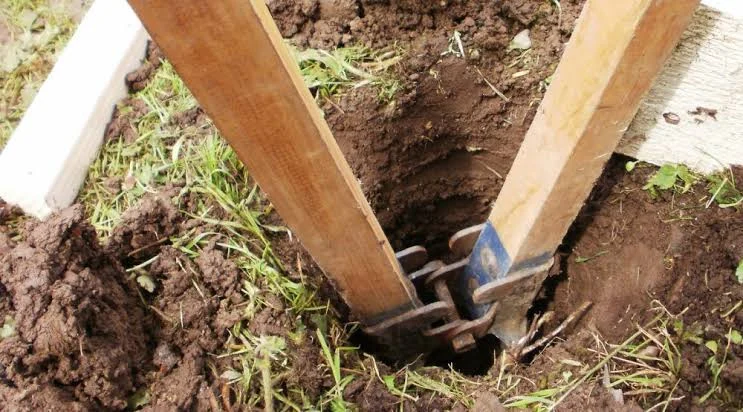
The break-even is a volume, so the real question is how fast your postholes get you there. In Calgary, they get you there quickly, because the holes are deep.
A shallow posthole might use 1 to 2 cubic feet around a 4×4. A deep Calgary frost-line hole uses much more. Bob Vila’s worked example of an 8-foot post in a 4-foot-deep, 12-inch-diameter hole comes out to about 2.8 cubic feet of concrete.
(Sources: Bob Vila; Inch Calculator post-hole.)
QUIKRETE’s own posthole method sets the hole at three times the post diameter and one-third the post height, with 6 inches of dry mix in the bottom.
(Source: QUIKRETE data sheet.)
Run that forward:
| Fence line | Concrete per hole | Total volume | Verdict |
|---|---|---|---|
| 5 deep posts | ~2.8 ft³ | Bag it | |
| 10 deep posts | ~2.8 ft³ | At the break-even | |
| 20 deep posts | ~2.8 ft³ | Deliver it | |
| 30 deep posts | ~2.8 ft³ | Deliver it |
Because Calgary’s roughly 1.2-metre frost depth forces deep holes, a fence line crosses the one-yard break-even with fewer posts than it would in a mild-frost region. A composite of contractor sentiment puts the rule of thumb at “more than about 20 holes, get it delivered or rent a mixer.” That tracks with the math here, since 20 deep holes is already about two yards.
Why do people think bags are the only small-pour option?
Because the usual comparison is rigged. Most pages frame the choice as “bags versus a big truck,” and a big truck comes with a minimum order, commonly 1 to 3 cubic metres, plus a short-load fee for going under it. MyConcreteCalc notes ready-mix trucks “typically have minimum order requirements of 1 to 3 yards, and many charge short-load fees of $30 to $50 per yard below the minimum.” Faced with a one-yard footing job, the buyer sees a minimum they can’t fill and a fee, so bags win by default.
Metered volumetric removes that floor. The truck batches cement, sand, stone, and water on site and meters the discharge, so there’s no pre-mixed load to fill and no truck minimum. The Alberta small-load market proves the floor is real: Mini Batch near Edmonton publishes a named “20 MPa Fence Post” mix from $334 per cubic metre at 1.0 m³ down to $223 at 0.2 m³, a smallest order of 0.2 m³, and “NO CHARGE FOR RETURN OF LEFTOVER CONCRETE.”
(Source: Mini Batch price list; Edmonton-area, not Omega’s price.)
That changes the whole comparison. The real choice for a one-yard footing job isn’t bags versus a 3 m³ minimum. It’s bags versus metered delivery, and metered delivery wins on labour at about a yard instead of making you wait until you’ve got three.
When is bagging still the right call?
Honesty first, because bags genuinely win some jobs.
- Five posts, or a single repair. Grab bags. There’s no setup, no scheduling, no minimum, and you’ll be done before a truck could arrive. Nobody should book a delivery for a couple of postholes.
- A scattered handful of holes over several weekends. If you’re setting two posts now and three next month, bags match the pace better than a single delivery.
- Anything that totals well under half a yard. The mixing is manageable and the cost is low.
The point isn’t that delivery always wins. It’s that there’s a named middle option for the jobs that are too big to bag comfortably and too small for a plant truck, and most buyers don’t know to ask for it.
A note on the mix, even for footings
A buried Calgary fence footing sits in sulphate-bearing soil, which is why a proper footing mix is sulphate-resistant (Type HS or HSb cement) and air-entrained for freeze-thaw, batched to CSA A23.1. Volumetric concrete meets the same ASTM C685 and CSA A23.1 standards as plant concrete. For the strength question in full, see the linked strength article rather than re-reading it here. Bagged hardware-store mix is a different product class with its own data sheet; if you bag a footing, follow the bag’s instructions and its 48-hour freeze protection.
FAQ
At what point does buying bagged concrete stop being worth it? Roughly three-quarters to one cubic yard of total volume, and the practical line comes earlier once you count hand mixing. Below that, bags are simplest. Above it, metered delivery usually wins on labour, and you pay only for what you pour.
How many bags of concrete make a cubic yard? About 45 of the 80-pound bags (27 cubic feet ÷ 0.60 per bag), or about 52 of the 30-kilogram bags Calgary stores usually stock. A cubic metre is roughly 68 of the 30 kg bags.
Is it cheaper to mix bags or get concrete delivered for fence footings? For a few posts, bags. Once the footings total about a yard, metered delivery usually wins once you count the four-plus hours of mixing per yard, and there’s no leftover to pay for.
Why do people think they have to buy bags for a small pour? Because a drum truck carries a 1-to-3-cubic-metre minimum and a short-load fee, so small jobs look uneconomical. Metered volumetric has no truck minimum, which changes the comparison.
How many 30-kg bags would I need for 20 deep Calgary fence postholes? About 2.8 cubic feet per deep hole times 20 is roughly 56 cubic feet, or about 2 cubic yards, which is over 100 of the 30 kg bags. That’s well past the break-even.
What does a yard of concrete cost in bags versus delivery? Bags run roughly US$270 a yard at about $6 per 80-pound bag. Ready-mix is lower per yard but carries a minimum. The dollar figures here are US and point-in-time, so validate against current Calgary quotes.
Can I get just one yard of concrete delivered in Calgary? Yes, through metered volumetric mixing, which has no truck minimum. A one-yard footing job is a normal metered pour, billed for the yards you actually discharge.