
ASTM C403 defines setting time with two penetration-resistance thresholds and nothing else: initial set is the moment sieved mortar from the mixture resists a needle at 3.5 MPa (500 psi), and final set is the moment it resists at 27.6 MPa (4000 psi). Both are arbitrary in the honest sense — they are agreed reference points, not physical events you could watch happen. That is exactly why the number gets misused on site.
Setting time is not curing, and it is not strength. A mixture at final set has a penetration resistance of 27.6 MPa in a laboratory mortar sample; it does not have 27.6 MPa of compressive strength, and it is nowhere near its specified 28-day value. Confusing those three ideas is behind a good share of the flatwork problems we get called about in Calgary.
This article covers what the test actually measures, what shifts the result, and the two separate field decisions the setting window governs — which are not the same decision and do not happen at the same time.
What ASTM C403 measures
The test does not push a needle into concrete. It pushes a needle into mortar sieved out of the concrete, because coarse aggregate would make the reading meaningless.
The procedure, in outline: a sample of the mixture is wet-sieved through a 4.75 mm sieve, the mortar is placed in a container, and at intervals a technician presses a needle of known bearing area into the surface to a depth of 25 mm and records the force required. Needle areas step down as the mortar stiffens, so the same instrument can cover the whole range. Plotting resistance against elapsed time from initial contact of cement and water gives a curve, and the two thresholds are read off that curve.
The National Ready Mixed Concrete Association describes the definition directly: “The elapsed time after initial contact of cement and water required for the mortar to reach a penetration resistance of 500 psi is defined as initial setting time and the elapsed time to reach a penetration resistance of 4000 psi is defined as final setting time.”
Two practical consequences follow.
The clock starts at the batch plant, not at the chute. Elapsed time runs from cement-water contact. A 40-minute haul and a 25-minute wait on site have already consumed an hour of the window before anyone touches the concrete.
The result is a property of that mixture at that temperature. It is not a property of the product line. Change the ambient temperature, the admixture dose or the cement source and the curve moves.
What “reasonable” looks like, and why your slab will not match the lab
NRMCA offers a benchmark worth knowing: “An ASTM C403 initial time or setting of 3 to 5 hours for a concrete mixture in the laboratory is considered reasonable.”
Note the qualifier. A laboratory result is produced at controlled temperature on a sample that is not losing water to a dry wind or gaining heat from a slab mass. On an actual Alberta pour, the departure from that figure is the story, not the figure itself.
The single largest mover is temperature. NRMCA’s guidance on managing concrete temperature is blunt about both directions: “A high initial concrete temperature coupled with a high ambient temperature will lead to increased slump loss, reduced set times, higher early-age strength, and lower later-age strength,” while “A low initial concrete temperature can result in unacceptable setting time in cool weather.” The same document notes that temperature variations beyond a narrow band cause fluctuations in setting time and rate of strength development, and that those variations “will impact the ability of the contractor to properly finish concrete and perform scheduled construction activities.”
That last sentence is the whole problem in one line. Setting time is a scheduling variable disguised as a material property.
The Alberta shoulder-season trap
Calgary’s spring and fall create a condition that rarely appears in the literature: a single slab poured across a morning that starts at 4°C and an afternoon that reaches 22°C, sometimes with a chinook doing the lifting.
The first loads go into cool ground under cool air and set slowly. The last loads go into a warming slab under a warming sun and set faster. The crew is then managing two different setting curves on one pour — the far end still bleeding while the near end is already past the window for floating. Crews who plan finishing manpower by cubic metres rather than by setting behaviour get caught here every April and every September.
The reverse also bites. Hot mix concrete arriving on a 30°C July afternoon can reach initial set well inside the lab’s three-hour floor, and the finishing crew that was adequate in May is suddenly two people short.
What moves the number, in order of leverage
| Factor | Direction | Practical note |
|---|---|---|
| Concrete temperature | Higher temperature shortens set | The dominant variable on most Alberta pours |
| Water-cement ratio | More water lengthens set | Also costs strength and durability |
| Retarding admixture (ASTM C494 Type B or D) | Lengthens set | Dose-dependent and temperature-dependent |
| Accelerating admixture (Type C or E) | Shortens set | Common on cool-weather placements |
| Supplementary cementing materials | Fly ash and slag generally lengthen set | Effect grows as replacement level rises |
| Cement source or type | Varies | NRMCA notes that even different shipments of the same materials influence set |
| Added water on site | Lengthens set, reduces strength | See the limits in our piece below |
Two entries on that table deserve a caution.
Retarders are not a fixed number of hours. A dose that buys three hours at 10°C may buy far less at 28°C. If a retarder is being used to hold a large placement open, the dose belongs in a conversation with the supplier for that day’s forecast, not copied from the last job. Our guide to what ASTM C494 admixture types actually guarantee sets out what each classification does and does not promise.
Water added at the truck is not a neutral adjustment. It lengthens set and reduces strength at the same time, which is why CSA A23.1 constrains it. We covered the allowable limits and the cost in adding water to concrete on site.
Field decision one: the cold-joint window
A cold joint forms when a new load is placed against concrete that has already passed the point where vibration can knit the two together. Practically, that point sits near initial set.
Before initial set, the older concrete is still responsive — a vibrator inserted through the new lift into the top of the old one re-liquefies the interface and the two become monolithic. After initial set, vibration no longer moves the older material; it just makes a seam that looks like a joint and behaves like one, with reduced shear capacity and a path for water.
The implication for scheduling is direct. On a wall or a deep placement, the maximum safe gap between loads is set by the setting curve, not by a convenient round number. On a cool morning that gap may be generously long. On a hot afternoon with an accelerated mix it can be shorter than the cycle time of your pump and your truck rotation, and no amount of good intention at the hose fixes it.
If delivery timing is the constraint, the mix should be built around the delivery interval rather than the other way around — a retarder specified deliberately is cheaper than a cold joint discovered at stripping.
Field decision two: the finishing window
This is the decision crews get wrong most often, and it is governed by a different signal than the cold-joint call.
Finishing timing is keyed to bleeding, not to the clock and not directly to initial set. The rule is unambiguous in the flatwork guidance: “All other finishing operations must wait until the concrete has stopped bleeding and the water sheen has left the surface.” Violating it has predictable consequences — “Any finishing operations done while the concrete is still bleeding WILL RESULT in later problems such as dusting, scaling, crazing and blisters.”
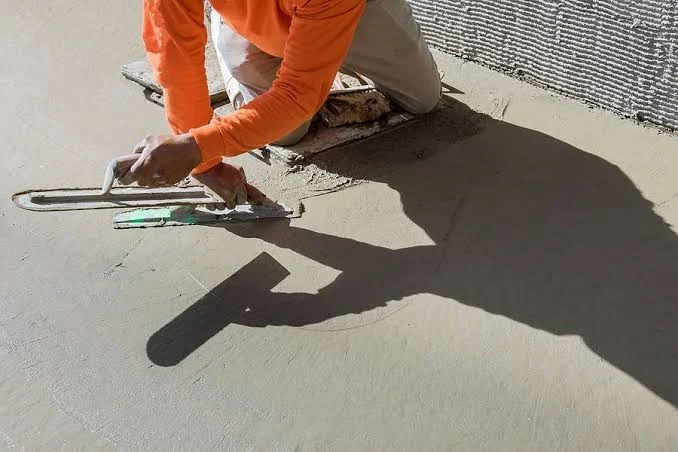
The correct sequence is: strike off and screed, bull float immediately, then wait, then edge, joint, float and trowel. The waiting period, as the same guidance notes, “depends on the amount of water, cement and chemical admixtures in the concrete; and the weather.”
Where setting time comes back in is at the other end of the window. Bleeding tells you when you may start. Approaching final set tells you when you must be finished. A mixture with a long retarded set and a fast-drying wind can present the worst of both: a surface that looks ready because the sheen evaporated, over concrete that is still bleeding underneath. Sealing that surface with a trowel traps the bleed water and produces exactly the blistering described above.
Two habits protect against it. Judge readiness by whether a bootprint leaves roughly 5 mm of indentation rather than by the look of the sheen, and treat any windy, low-humidity day as a reason to shade or fog the surface instead of finishing early. Air-entrained exterior flatwork is especially unforgiving — over-troweling it closes the surface and defeats the air system you paid for, which is why the air content verified at the truck has to survive the finishing crew as well as the pump.
What setting time is not
- It is not curing. Curing is the maintenance of moisture and temperature after placement so hydration continues. A slab at final set has barely started curing. The requirements are set out in CSA A23.1’s basic, additional and extended curing regimes.
- It is not a strength result. The 27.6 MPa at final set is penetration resistance of mortar, not compressive strength of concrete. The two numbers share a unit and nothing else.
- It is not “safe to walk on.” Foot traffic timing is a judgement about surface durability, not a threshold in this test.
- It is not a slump substitute. Slump measures consistency at delivery; setting time measures stiffening over hours. Both move with water content, which is why they are often confused. Our slump test guide covers the delivery-side measurement.
Frequently asked questions
How long does concrete take to set? Under ASTM C403, an initial setting time of 3 to 5 hours in the laboratory is considered reasonable. On site the figure moves substantially with temperature, admixture dose and cementing materials, so a specific pour should be planned around the mixture and the day’s forecast rather than a general figure.
Is initial set when I can start finishing? No. Finishing is keyed to bleeding stopping and the water sheen leaving the surface, which is a separate signal. Initial set is more useful as the boundary for placing fresh concrete against concrete already down.
Does ASTM C403 apply to the concrete in my slab, or to a sample? To a sample. The test runs on mortar wet-sieved from the mixture, in a container, at the sample’s own temperature. It represents the slab only to the extent the sample conditions match the slab conditions.
Do fly ash and slag really delay set? Generally yes, with the effect increasing at higher replacement levels and lower temperatures. That is a reason to review the mixture before a late-season placement, not a reason to avoid supplementary cementing materials.
Can I just add an accelerator to get the crew home earlier? An accelerator shortens the window on both ends. It moves initial set closer, which shortens the safe gap between loads, and it compresses the finishing window. On a large placement it can create the cold joint it was meant to prevent.
Who should be specifying setting time? If a placement depends on it — a tall wall, a long haul, a shoulder-season slab with a small finishing crew — it belongs in the conversation with the supplier before the order is placed, alongside slump, air and strength.
Planning a pour around the setting curve
Most setting-time problems are order-desk problems that surfaced at the hose. If we know the placement geometry, the delivery interval, the finishing manpower and the forecast, the mixture can be built so that the cold-joint window is comfortably longer than the truck cycle and the finishing window is wide enough for the crew on hand.
For Calgary flatwork where that window is the whole job, start with our flatwork concrete service and tell us the finishing crew size along with the cubic metres. It changes the mixture more often than people expect.
Sources
- NRMCA Concrete Technology Tip 14 — What is the Time of Setting of Concrete Mixtures?: https://www.nrmca.org/wp-content/uploads/2020/04/Tip14w.pdf
- NRMCA Concrete Technology Tip 18 — Managing Concrete Temperature for Specified Performance: https://www.nrmca.org/wp-content/uploads/2020/04/TIP18w.pdf
- Applied Testing Systems — ASTM C403 Time of Setting of Concrete Mixtures by Penetration Resistance: https://www.appliedtesting.com/standards/astm-c403-time-of-setting-of-concrete-mixtures-by-penetration-resistance
- Concrete Atlantic Tech Tip 16 — Finishing Concrete Flatwork: https://www.atlanticconcrete.ca/images/Tech_Tip_16_Finishing_Concrete_Flatwork.pdf