
The air content test measures the volume of air, expressed as a percentage, held in freshly mixed concrete — and on exterior Alberta flatwork it is the single most consequential field test run all day. Strength failures announce themselves in 28 days. An air failure announces itself in five winters, when the surface starts coming off in sheets.
Two numbers decide whether a load passes: the range the specification calls for, and where the technician stood when they filled the bowl. Get the second one wrong and a good load gets rejected, or a marginal one gets accepted. Both happen on Calgary sites, and both are avoidable.
What follows is what the air is doing, what CSA A23.1 categories require, the tolerance that applies, where the sample legitimately comes from, and what a pump boom does to the reading.
What entrained air is actually for
Entrained air is a deliberately created system of microscopic, stable bubbles distributed through the cement paste. It is not the same thing as entrapped air — the larger, irregular voids left by incomplete consolidation, which do nothing useful and cost you strength.
The mechanism is straightforward. When water in the paste freezes, it expands. If it has nowhere to go, it generates internal pressure that cracks the paste from the inside. Entrained bubbles give that water somewhere to go: a pressure-relief system spaced closely enough that no point in the paste is far from an escape route.
That spacing is the real durability criterion. NRMCA’s research on freeze-thaw resistant mixtures identifies an adequate air-void system as one with a spacing factor of 0.2 mm or less and a specific surface greater than 24 mm²/mm³. Total air content is the field proxy for that system, because you cannot run a hardened air-void analysis on a truck that is waiting to discharge.
This matters for Calgary specifically. Our freeze-thaw cycling is not a winter event — it is a shoulder-season event that repeats. A chinook in February can move a slab surface through the freezing point twice in a day. Air entrainment is what makes that survivable.
What CSA A23.1 asks for
CSA A23.1 sorts air requirements into two categories, and then sets the range by the nominal maximum size of coarse aggregate. Smaller aggregate means more paste per cubic metre, and more paste needs more air to protect it.
| Nominal maximum aggregate size | Category 1 — concrete exposed to freezing and thawing | Category 2 — concrete not exposed to freezing and thawing |
|---|---|---|
| 10 mm | 6–9% | 5–8% |
| 14–20 mm | 5–8% | 4–7% |
| 28–40 mm | 4–7% | 3–6% |
Most exterior residential and light commercial flatwork in this city is placed with 14–20 mm aggregate under Category 1, which is why 5–8% is the number you hear on Calgary sites more than any other. Public specifications land in the same place independently — municipal engineering standards commonly call for 5–8% air on exterior walls, curbs and sidewalks.
Category 2 is not “no air.” It is the range for concrete that will not see freeze-thaw in service — interior slabs, protected members — where modest air still improves workability.
Two cautions worth holding onto:
- The category follows the exposure, not the element name. A slab is not Category 1 because it is a slab; it is Category 1 because it will freeze while wet. That judgement starts with the exposure class.
- More air is not better. As a rule of thumb, every percentage point of air costs roughly 5% of compressive strength. Ordering 8% on a job that needed 5% is not insurance — it is a strength reduction you did not price.
Where the sample has to come from
This is where most disputes actually live.
CSA A23.1’s air content requirements apply “at the point of discharge from the delivery equipment, unless otherwise specified.” That phrase is doing a lot of work. Delivery equipment is whatever delivers the concrete — on a chute pour the truck, on a pumped pour arguably the end of the hose. If the specification does not say which, you have an argument waiting to happen. Sort it out at the pre-pour meeting, in writing.
For the sample itself, North American acceptance practice is consistent: for concrete delivered in truck mixers, the sample is obtained as it discharges from the chute, and a preliminary sample for slump and air is taken after approximately 0.20 m³ (0.25 yd³) has been discharged. You are not testing the first dribble, and you are not testing the tail of the load.
The tolerance on air content, as ordered or specified, is ±1.5%. That is the figure NRMCA’s acceptance testing guidance applies, and provincial transportation specifications use the same band — Nova Scotia’s cast-in-place specification, for instance, writes its air requirements directly as values plus or minus 1.5.
So a 5–8% specification with a ±1.5% tolerance is a wider gate than the raw numbers suggest, and a load that reads 4.6% against a 6% order is inside tolerance. Knowing that before you send a truck away is worth real money.
Two ways to measure it, and when each applies
| Method | Standard | Best for | Watch out for |
|---|---|---|---|
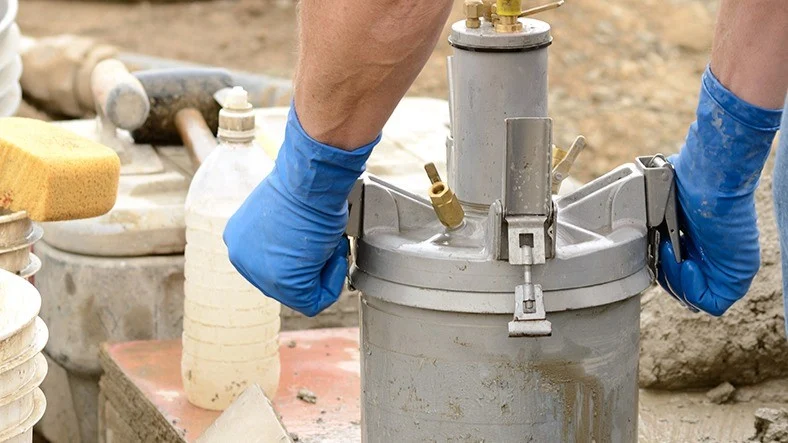
| Pressure method | CSA A23.2-4C in Canada; ASTM C231 in US practice | Normal-weight aggregate — the default on nearly every Calgary pour | Requires a calibrated meter; aggregate correction factor must be determined for the specific aggregate |
| Volumetric method | ASTM C173 | Lightweight, porous or highly absorptive aggregate | Slower, more operator-dependent, more agitation required |
The pressure meter works by applying a known pressure to a sealed, consolidated sample and reading how much the volume compresses — air compresses, water and solids essentially do not. It is fast, repeatable and, in competent hands, reliable.
The failure modes are mundane, and they are what produce mystery readings:
- Meter not calibrated, or calibrated against a different aggregate
- Aggregate correction factor assumed rather than determined
- Incomplete consolidation of the sample, which reads as air that is not really entrained air
- Dirty rim or damaged gasket, so the seal leaks under pressure
- Sample allowed to sit before testing — air content changes with time and agitation
None of these are exotic. All of them have sent a good load away from a Calgary site.
Why the pump changes the number
Here is the single most useful fact in this article: a sample taken at the end of a pump boom can read dramatically lower than the same concrete read at the truck chute.
NRMCA’s guidance on air loss in pumped concrete is blunt about the magnitude — a sample obtained from a pump with the boom in a vertical orientation may have a measured air content less than half of a sample obtained at the truck chute.
The mechanism is a pressure story. In a vertical downward section of pipe, if the weight of the concrete exceeds the frictional resistance and the column breaks from continuous flow, the vacuum at the upper end expands the air bubbles. When those enlarged bubbles reach an elbow in the boom, or strike a horizontal surface, they collapse. Air that was a well-distributed microscopic system arrives as considerably less air.
CSA A23.1 flags the same effect directly, noting that air contents measured after pumping or slip forming may be significantly lower than those measured at the end of the chute.
What to do about it:
- Flatten the boom where you can. A boom in a horizontal orientation generally will not cause significant air loss; more horizontal configurations lose less air. This is a placement decision with a durability consequence, and it belongs to whoever is directing the pump.
- Test where the argument will be. Sampling the discharge alongside the pump represents the most critical boom configuration. If the specification governs at the point of placement, that is where the meter goes.
- Sample after 2–3 cubic yards have gone through the line on the first load, and never at the beginning or the end of the concrete moving through the pump line.
- Tell your supplier the pour is pumped, and how. Boom height and configuration are mix design inputs, not logistics trivia.
That last point is the whole reason we ask about placement method when a job is booked. A mix batched for a chute pour and a mix batched for a 30-metre vertical drop are not the same order, even when the spec line is identical. Our line pump service and our batching are planned together for exactly this reason.
Temperature, timing and the rest of the fresh-property picture
Air content does not sit still. It drifts with time, agitation, temperature and admixture interactions, which is why the test is a snapshot with a short shelf life.
A few practical relationships:
- Warmer concrete generally holds less air for the same admixture dose. On hot mix concrete placed in July, expect the plant to adjust dosage rather than assume the same recipe holds.
- Extended mixing loses air. A truck that has been turning in traffic for 90 minutes is not the concrete that left the plant.
- Retempering with water affects the air system, on top of what it does to the water-cementing materials ratio.
- Some water reducers and superplasticizers interact with the air system, in both directions. That is a mix design question, not a field fix.
Air is also one leg of a three-legged stool, measured alongside slump and concrete temperature and read together — a slump result that surprises you and an air result that surprises you usually share a cause. If slump testing is the part of the routine your crew is least confident about, our slump test guide covers the method properly.
Frequently asked questions
What air content should exterior concrete have in Calgary? For concrete exposed to freezing and thawing — Category 1 in CSA A23.1 — the range depends on aggregate size: 6–9% for 10 mm, 5–8% for 14–20 mm, and 4–7% for 28–40 mm. With the 14–20 mm aggregate used on most local flatwork, 5–8% is the working answer.
What is the tolerance on air content? ±1.5% on the air content as ordered or specified, which is the tolerance applied in North American acceptance testing practice and written into provincial transportation specifications.
Where is the air content sample taken? CSA A23.1 sets the requirement at the point of discharge from the delivery equipment unless the specification says otherwise. For truck discharge, the sample is taken from the chute after roughly 0.20 m³ has been discharged. For pumped concrete, agree in advance whether the governing point is the truck or the end of the hose.
Why did my air content drop after pumping? Pressure changes in the boom expand air bubbles, and those enlarged bubbles collapse at elbows or on impact. With a vertical boom orientation, the measured air can be less than half the value at the chute. A more horizontal boom configuration reduces the loss.
Is more air always better for durability? No. Air above the specified range costs compressive strength — roughly 5% of strength per percentage point of air — without adding durability once the air-void system is adequate. The goal is the specified range, not the highest reading.
What is the difference between entrained and entrapped air? Entrained air is a deliberate system of small, closely spaced, stable bubbles that protects the paste from freeze-thaw damage. Entrapped air is larger, irregular voids left by inadequate consolidation. The first is designed in; the second is a placing defect.
Getting the air right before the truck leaves the plant
The field test is a verification, not a design. By the time a technician is filling a bowl on your slab, the decisions that determine the result — exposure category, aggregate size, admixture dosage, placement method — were made hours earlier.
Tell us the exposure, the aggregate you want, and how the concrete is going into the forms, and we will batch to the category the job actually needs. If you are still working out which exposure class governs, start with our guide to CSA A23.1 exposure classes; if strength and air are being traded against each other on your spec, our PSI strength guide explains what you are giving up.
For exterior work where air content is the durability decision, see flatwork concrete in Calgary, or read how our volumetric mixers work if you want air adjusted on site rather than guessed at the plant.
Sources
- Canadian Farm Builders Association, Guidelines for Concrete Specifications (CSA A23.1 air content categories and point-of-discharge requirement): https://cfba.ca/pdf/CFBA-Concrete.pdf
- NRMCA, CIP 21 — Loss of Air Content in Pumped Concrete: https://www.nrmca.org/wp-content/uploads/2021/01/21pr.pdf
- NRMCA, CIP 41 — Acceptance Testing of Concrete: https://www.nrmca.org/wp-content/uploads/2021/01/41pr.pdf
- NRMCA, Criteria for Freeze-Thaw Resistant Concrete Mixtures: https://www.nrmca.org/wp-content/uploads/2020/06/08.pdf