
Mixing water does not have to be drinkable, but it does have to be qualified. ASTM C1602/C1602M accepts potable water without testing and accepts non-potable water — well water, dugout water, water hauled in a tank, water recovered from plant operations — provided it passes two performance tests and, where specified, a set of chemical limits.
That distinction matters more here than in most markets. A volumetric pour on a rural site in central or southern Alberta is often batched with whatever water is available at the property, and the question “can we use the well?” comes up on the phone before the truck rolls. It has a defensible answer, and it is not “no.”
This article sets out what the standard actually requires, which numbers are mandatory and which are optional, and how to qualify a water source before it goes into a mix.
What counts as mixing water in the first place
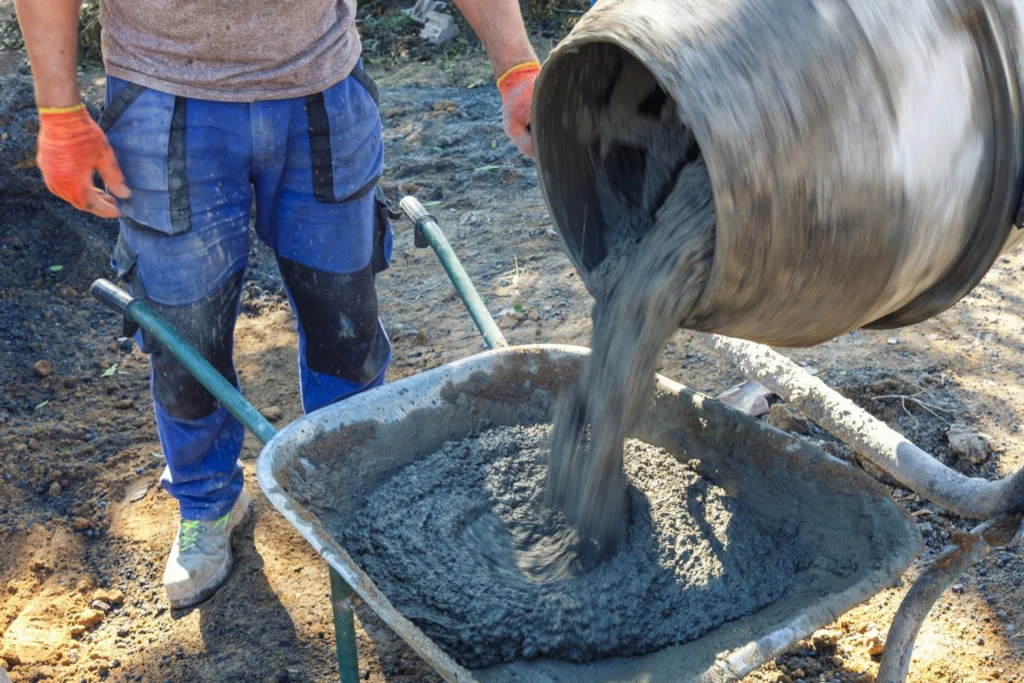
Mixing water is not just what comes out of the meter at the plant. It is every bit of water in the batch.
Under ASTM C1602, the mixing water in a batch is the sum of:
- batch water added at the plant or at the mixer
- ice, where ice is used for temperature control
- free moisture carried on the aggregates
- water added by the truck operator at the jobsite
- water introduced by chemical admixtures
This is the first thing that trips people up. Aggregate moisture is usually the largest uncontrolled water source in a batch, and on a volumetric mixer proportioning at the site, it is being corrected continuously rather than measured once. Water quality and water quantity are two separate problems with the same units, and they need to be tracked separately. We have written about the quantity side — what happens when water is added at the jobsite — in our guide on adding water to concrete on site. This article is about the water itself.
The two tests that decide it
Any non-potable source has to prove it does not hurt strength and does not shift set time. Those are the mandatory performance requirements, and the thresholds are specific.
| Requirement | Limit under ASTM C1602 | Test basis |
|---|---|---|
| Compressive strength, minimum % of control at 7 days | 90% | Mortar cubes made with the candidate water vs. control |
| Time of set, deviation from control | From 1:00 early to 1:30 later | Same comparison, expressed as hours:minutes |
Read plainly: mortar made with the questionable water must reach at least 90 percent of the 7-day strength of mortar made with the control water, and its setting time must fall between one hour earlier and one and a half hours later than the control.
That second window is wider than people expect, and it is asymmetric on purpose — water that retards a mix by an hour is a nuisance, water that accelerates it by an hour is a placing problem. In Alberta the accelerating direction is the one to watch on a warm-weather pour, because it stacks on top of everything else already shortening the working window.
Both tests are comparative. There is no absolute pass mark; the candidate water is always measured against a control made with water known to be acceptable. That means qualification is a lab exercise with a lead time, not something decided at the tailgate.
The chemical limits, and why they are optional
The chemical limits in ASTM C1602 are optional limits for combined mixing water. They apply when the specification invokes them — which, for reinforced and prestressed work, it frequently should.
| Parameter | Limit (ppm) | Test method |
|---|---|---|
| Chloride as Cl⁻ — prestressed concrete | 500 | ASTM C114 |
| Chloride as Cl⁻ — other reinforced concrete | 1,000 | ASTM C114 |
| Sulfate as SO₄ | 3,000 | ASTM C114 |
| Alkalis as (Na₂O + 0.658 K₂O) | 600 | ASTM C114 |
| Total solids by mass | 50,000 | ASTM C1603 |
A few things are worth drawing out of that table.
The chloride limit is the one that bites. It is tighter for prestressed concrete and bridge decks than for other reinforced concrete, for the obvious reason — chloride drives corrosion of embedded steel, and a prestressing strand has far less tolerance for section loss than a piece of 15M bar. If the water source is anywhere near a road, a stockpile of de-icing salt, or an oilfield produced-water line, chloride is the first thing to test.
The alkali limit connects to a durability problem we have written about before. Alkalis in the mixing water add to the total alkali loading of the concrete, which is one half of the alkali-aggregate reaction equation. On a project where the aggregate has any reactivity history, the mixing water is not a rounding error.
Total solids at 50,000 ppm is a large number. Five percent solids by mass is a lot of suspended and dissolved material — it is a limit aimed at water recovered from concrete production operations, not at a clean well. A rural well that is hard, mineral-heavy and tastes bad is usually nowhere near this threshold.
Note that these are limits on combined mixing water — the total of all the water sources listed earlier, not the batch water alone. Where water from concrete production operations is being reused, the density of that water is monitored with a hydrometer so its solids contribution can be accounted for continuously.
Qualifying a rural water source: the practical sequence
Here is how this runs on an actual Alberta project when the water is coming from the property rather than from a municipal line.
- Identify every water source in the batch, not just the obvious one. If the mix is being batched on site from a tank filled at the farm well, that is the source. If a water truck is topping up from somewhere else, that is a second source and it has to be qualified too.
- Ask what the water has been near. Produced water, slough or dugout water with heavy organics, water downstream of a feedlot, or anything drawn near a salt storage area all warrant testing before anything else.
- Pull a representative sample and get it tested. Chemical analysis to ASTM C114 for chloride, sulfate and alkalis; total solids to ASTM C1603. This is a lab turnaround — build it into the schedule, not the pour day.
- Run the comparative mortar testing for 7-day strength and time of set if the source is non-potable and the specification requires performance qualification.
- Document it on the project record. The batch ticket should be traceable to a qualified water source. What appears on the ticket and why it matters is covered in our breakdown of the numbers on a concrete batch ticket.
- Re-test if the source changes. A well in spring runoff is not the same water it was in August.
The honest summary: most clean Alberta well water is fine. The failures we see are not ordinary hard water — they are water with a story attached, usually involving salt, organics or an industrial neighbour.
Where this intersects with exposure class and durability
Mixing water quality is a durability input, not just a strength input, and it should be read alongside the exposure class the project is specified to.
A C-XL or C-1 exposure class slab — an exterior structure in a freeze-thaw environment with de-icing chemicals, which describes a great deal of what gets poured in this province — is already fighting chloride ingress from the surface. Starting that concrete with mixing water near the 1,000 ppm chloride ceiling spends part of the durability budget before the slab is placed. It is legal under the standard and it is still a poor trade on a structure that has to last.
The exposure classes and what each one demands are set out in our guide to CSA A23.1 exposure classes. The point for this discussion is narrow: the more aggressive the exposure class, the less appetite there should be for a marginal water source, even a compliant one.
The same logic applies in reverse. For a non-reinforced fill, a rural approach slab or unreinforced mass work, the chemical limits are frequently not invoked at all, and the performance tests alone are a sensible bar.
What water quality is not
Three clarifications, because these get conflated on site:
It is not the same as adding water at the jobsite. Jobsite water addition is a mix-proportioning question — it changes the water-cementing materials ratio and therefore the strength. Water quality is about what is dissolved in the water regardless of how much goes in. A truck can be rejected for one and not the other. Our article on reasons to reject a concrete truck deals with the field-acceptance side of this.
It is not a reason to insist on potable water. ASTM C1602 explicitly permits potable and non-potable water. A specification that demands potable mixing water on a remote site with no potable supply is specifying a logistics cost, not a durability outcome, and it is worth challenging at the pre-construction meeting.
It is not something a slump test will reveal. Nothing in field testing catches a chloride problem. Air content, slump and temperature all pass with contaminated water. The only thing that catches it is testing the water.
Getting it settled before the pour
The pattern worth adopting is simple: on any site where the water is not coming from a municipal line, treat the water as a submittal item with a lead time, the same way you would treat a mix design.
That is particularly true for rural and remote work, where the water source is frequently the one material on the project nobody has specified. Omega Ready Mix batches on site across rural Alberta, and the water conversation is one we would rather have during planning than on the morning of the pour — see our rural projects capability for how on-site batching handles remote supply.
If you have a source you are unsure about, the useful first step is a water sample and a phone call, not a guess.
FAQ
Can I use well water to mix concrete? Usually yes. ASTM C1602 permits non-potable water, including well water, provided it meets the performance requirements — at least 90 percent of the control mortar’s 7-day compressive strength, and a set time between one hour early and one and a half hours late relative to the control. Where the specification invokes them, the optional chemical limits also apply.
Does mixing water have to be drinkable? No. Potable water is accepted without testing, but the standard explicitly allows non-potable sources that have been qualified.
What is the chloride limit for mixing water? Under the optional chemical limits of ASTM C1602, 500 ppm for prestressed concrete and bridge decks, and 1,000 ppm for other reinforced concrete, tested to ASTM C114.
Can dugout or slough water be used? It has to be tested. Surface water carries organics and suspended solids that can affect set time, and the only way to know is the comparative mortar testing. It is not automatically disqualified, but it is the category most likely to fail.
What about water recovered from washing out trucks? Water from concrete production operations is addressed by the standard and is permitted within the total solids limit of 50,000 ppm by mass, with density monitored using a hydrometer so its contribution can be tracked.
How long does it take to qualify a water source? Chemical analysis is relatively quick; the comparative testing includes 7-day compressive strength, so plan on a minimum of one to two weeks from sampling to a documented answer.
Sources
- ASTM C1602/C1602M, Standard Specification for Mixing Water Used in the Production of Hydraulic Cement Concrete, overview — https://www.wje.com/expertise/laboratories/testing-standards/astm-c1602
- “ASTM C1602 conserves resources,” Beton Consulting Engineers — https://www.betonconsultingeng.com/astm-c1602-conserves-resources/
- NRMCA TIP 10, Mixing Water Quality for Concrete — https://www.nrmca.org/wp-content/uploads/2020/04/Tip10w.pdf
- American Concrete Institute FAQ, “Can you use any source of water as mixing water?” — https://www.concrete.org/frequentlyaskedquestions.aspx?faqid=703