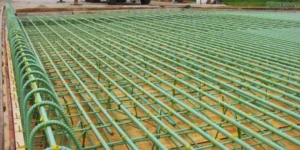

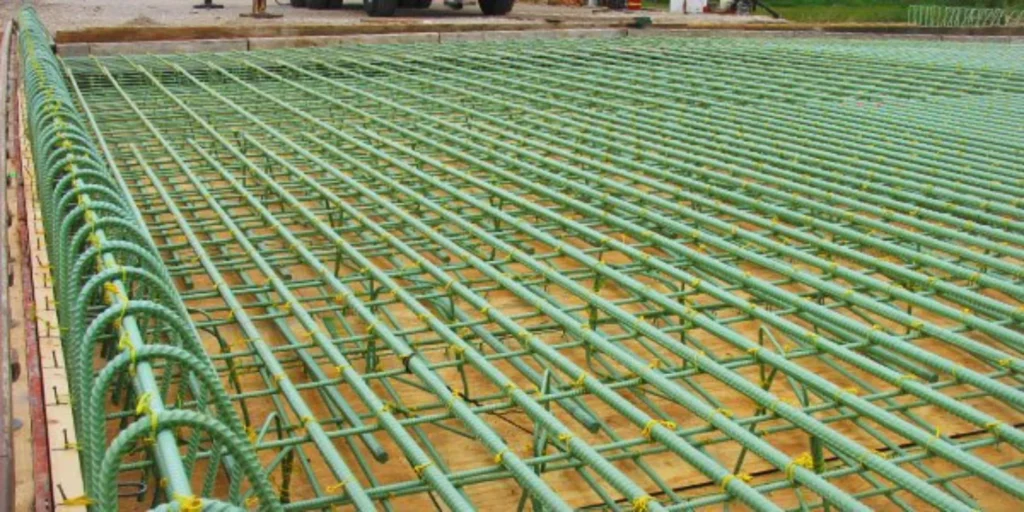
Epoxy coating on reinforcing steel is not a product you buy. It is an allowance you spend. The coater delivers a bar within a film thickness band with almost no damage on it; by the time that bar is embedded, the coating has been slung, stacked, stored in daylight, tied, walked on, vibrated against and possibly cut. Every handoff between the plant and the pour spends part of the allowance.
That is why a line reading “epoxy-coated reinforcement to ASTM A775” is not a specification. It names the coating and omits the four things that decide whether the coating is still doing anything: the film thickness, the damage limit and what it is measured against, what counts as a legitimate patch, and what the site may touch the bar with.
Here is what two readable public documents require, where they disagree, and how to write the line so the allowance survives to the pour.
Which standard your bar is coated to, and why it changes what you may do with it
Three ASTM specifications cover epoxy coating on reinforcement, and they are not interchangeable:
| Specification | What it covers | Typical coating colour |
|---|---|---|
| ASTM A775 | Epoxy-coated steel reinforcing bars — coated straight, then fabricated | Green |
| ASTM A934 | Epoxy-coated prefabricated reinforcing bars — bent first, then coated | Purple or grey |
| ASTM A884 | Epoxy-coated steel wire and welded wire reinforcement; Type 1 coatings meet A775 Annex A1, Type 2 meet A934 | — |
The practical consequence is a field rule worth putting on the drawings: only green A775 bars should be bent after coating. A934 bar is coated after it is bent, and the coating is not qualified to be bent again. A crew that straightens or re-bends a purple bar has not committed a cosmetic error.
ASTM D3963 is the fourth number in the set, and it is the one most specifications forget to call up: it governs fabrication and jobsite handling, which is where the allowance is actually spent. All four are paywalled standards — we name them and take the numbers below from two public documents that reproduce them.
The film thickness number, and who is allowed to apply it
Alberta Transportation’s bridge specification gives both halves of the plant requirement in two sentences. Preparation and coating are to ASTM A775 as modified by OPSS 1442, with the coating material itself to OPSS 1443, and the base steel to CSA G30.18M Grade 400.
The thickness requirement is explicit: film thickness of the coating, after curing, shall be 175 µm to 300 µm (7 to 12 mils).
And the applicator is not open: coating applicators must hold CRSI Voluntary Certification for fusion-bonded epoxy coating applicator plants, with proof submitted to the Consultant. That is a submittal item, not a trust exercise. If your specification names a coating standard but no applicator certification and no thickness band, you have specified a colour.
The damage allowance, and the two different five per cents
This is the number that matters most on site, and it is the one where the two documents genuinely differ. Both say “5 per cent.” They measure it against different things.
| Source | The limit | Measured against |
|---|---|---|
| Alberta Transportation, Section 5 | Replace the bar if patching exceeds 5 per cent | the bar’s surface area |
| ASTM D3963, as published by the Epoxy Interest Group | Total bar surface area covered by patching material shall not exceed 5 per cent | any given 1 ft (0.3 m) section |
| Epoxy Interest Group, rejection threshold | Bars may be rejected with more than 2 per cent of area damaged | any given 1 ft section |
Those are not the same test. A bar with all of its damage concentrated in one foot can pass a whole-bar average and fail a per-foot limit; a bar with light damage spread end to end can do the reverse. We are not going to average them or declare one correct. The project specification governs, and if it quotes “5 per cent” without naming the denominator, that is the ambiguity to resolve at submittal review — because the inspector and the fabricator will not resolve it the same way on their own.
One more honesty note: the Epoxy Interest Group’s guide is itself inconsistent about consequence, saying in one place that bars with more than 2 per cent damage “may be rejected” and in its inspection section that they “should be replaced.” Plan on the stricter reading and get the project answer in writing.
Sheared and saw-cut ends are excluded from the damage and patching calculations. They are repaired under their own rule, below.
What a legitimate patch is
A patch is a specified material applied in a specified condition, not a touch-up. Both documents converge:
- Use a two-part epoxy approved by the coating manufacturer, mixed and applied per its instructions and within its pot life. Patch material conforms to Annex A2 of A775 or A934. Spray-can repair materials are not recommended.
- Remove contaminants and damaged coating first, and remove any rust immediately before patching — wire-brushing is the published method.
- Patching extends onto the sound original coating by 25 mm, or as the manufacturer recommends.
- Patch dry film thickness is the same band as the coating: 175 µm to 300 µm.
- Field cutting, where the Consultant accepts it, is by shearing or saw cutting, and sheared or sawed ends are repaired under the same requirements. Flame cutting is prohibited.
- Some coatings need up to 8 hours to cure before concrete is placed against them. That is a schedule item, not a detail.
The eight-hour figure is the one that quietly breaks pour days. A repair done the morning of a placement is not necessarily cured when the truck arrives.
The storage clocks
Alberta Transportation puts two clocks on coated steel sitting on your site, and both are enforceable dates rather than good practice:
- On-site storage shall not exceed 120 days.
- Daylight exposure is limited to 30 days. Beyond that, cover the steel with opaque polyethylene sheeting or equivalent.
The Epoxy Interest Group’s handling guidance matches the 30-day outdoor limit and adds the reason the cover must be opaque rather than merely present: it should minimise condensation. It also asks that coated steel sit on timber cribbing or similar — never directly on the ground — and that coated and uncoated steel be stored separately.
Both clocks start when the steel arrives, not when the pour is scheduled. Where the foundation sequence slips twice, the 120 days is the constraint nobody wrote on the schedule.
What is allowed to touch the bar
Every item below is a published requirement, and every one of them is a decision made by somebody who is not reading the specification. Put them on the drawings.
Lifting and moving. Lift with non-metallic slings and use spreaders for bundles; nylon or padded slings, never bare chains or cables. Use a spreader bar or strong-back with multiple pickup points to minimise sag, and prevent bar-to-bar abrasion. Bars must not be dropped or dragged — at no time should coated steel be dragged, including across formwork. Unload as close to the placement point as practical, and oil forms before the steel goes on them.
Supports. Permitted spacers are plastic chairs, precast concrete supports, galvanized metal, or epoxy-coated metal; the handling guidance puts it as non-conductive supports meeting CRSI Class 1A. Precast supports are required on all exposed faces of curbs, medians and barriers, with compressive strength at least that of the placed concrete. Metal chairs are not allowed on exposed or finished surfaces, and any metal chair protruding through hardened concrete is cut back at least 25 mm with the hole filled. Tack welding is prohibited.
Ties. Tie wire for epoxy-coated reinforcing shall be plastic coated — typically 16.5 gauge or heavier, black annealed, PVC-coated. A bare tie wire is a deliberate electrical connection through the coating you paid for.
The pour is part of the coating specification
This is the section most specifications omit entirely, and it is where a compliant delivery becomes a non-compliant placement:
- Use plastic-headed vibrators. Steel heads damage coatings.
- Fit concrete pumps with an “S” bend to prevent free fall onto the coating.
- Minimise traffic on placed steel, and do not drag hoses or unprotected couplers across it.
- Do not weld placement-equipment stands or rails to the coated steel.
- Where bars are partially cast and left exposed for long periods — a construction joint waiting on the next phase — protect them from UV, salts and condensation, for example by wrapping.
If you are already specifying coated bar because the structure sees de-icing salt, the last item is not optional. An exposed dowel bar waiting through a Calgary winter is sitting in exactly the exposure the coating was bought for, with none of the concrete around it.
Where the allowance actually gets spent
Ranked by what causes submittal and inspection problems, rather than by what the standards emphasise:
- Handling at delivery and relocation — dragging and single-point lifting, because nobody told the crew the load was different.
- Bending A934 bar on site, or re-bending any coated bar without documented engineer permission.
- Bare tie wire and metal chairs, substituted because the coated ones ran out.
- Cut ends left unrepaired, where a bar was shortened to fit.
- Storage overrun, where the 30-day daylight clock expires before anyone covers the stack.
None of those is a coating defect. All are specification defects that showed up as coating defects.
How to write the line
- Name the coating specification and the bar condition: A775 for straight bar coated then fabricated, A934 for prefabricated bar coated after bending.
- Call up ASTM D3963 for fabrication and jobsite handling, explicitly.
- State the film thickness band after curing, and require applicator certification with the submittal.
- State the damage and patching limits and the denominator — whole bar, or per 1 ft section.
- Name the patch material and the minimum cure before placement.
- Put plastic-coated tie wire, non-conductive supports, plastic-headed vibrators and a pump S-bend in the placement section, not the reinforcement section.
- State the storage limits and who covers the steel.
FAQ
Can epoxy-coated bar be bent on site? Only green A775 bar should be bent after coating, and site bending is done only with the engineer’s documented permission and at ambient temperature. A934 prefabricated bar is coated after bending and is not qualified for it.
How much coating damage is allowed? Both sources give 5 per cent for patched area, but Alberta Transportation measures it against the bar’s surface area while ASTM D3963 measures it in any 1 ft section, and the Epoxy Interest Group sets a separate rejection threshold at 2 per cent damage in any 1 ft section. Resolve the denominator in your specification.
What is the required coating thickness? 175 µm to 300 µm (7 to 12 mils) after curing, and patch repairs are held to the same band.
Do cut ends count toward the damage limit? They are excluded from the damage and patching calculations, but still must be repaired with the approved two-part epoxy. Flame cutting is not permitted.
Does coated bar change the concrete order? Not the mix itself. It changes the placement method — plastic-headed vibrators, a pump S-bend, and restricted traffic on the steel — and those belong in the placement specification.
Where this article stops
This is a specification-and-handling article. It does not cover cover depth, bar spacing, lap lengths or development, and it gives no design values for coated bar, including any bond or development modification — those come from your structural engineer and the governing design standard. It does not reproduce the text of ASTM A775, A934, A884, D3963 or CSA G30.18, all paywalled; the numbers above are from a public owner’s specification and a public industry guide, and the project specification governs where they differ. It also does not rank corrosion-protection strategies against each other — for that, see corrosion-inhibiting admixtures, and for the exposure class that drives the decision, the CSA A23.1 exposure classes.
Send us the specification before the steel is ordered
Coated reinforcement is a decision that lands on three parties — the detailer, the placing crew and whoever supplies and places the concrete around it — and the allowance is spent by all three. If you are specifying it for an Alberta pour with de-icing salt exposure, the placement requirements belong in the documents before the first load is scheduled, not at the pre-pour walk.
Send us your project details — pour date, mix type, PSI, volume — and our team will get back to you within 1 business hour with a quote and delivery slot. If the reinforcement choice itself is still open, start with our guide to fibre, rebar and wire mesh, and bring the specification to the mix conversation at custom mixed concrete in Calgary.
Sources
- Alberta Transportation — Specifications for Bridge Construction, Section 5, Reinforcing Steel — ASTM A775 as modified by OPSS 1442, OPSS 1443 coating material, CSA G30.18M Grade 400, film thickness 175–300 µm, CRSI applicator certification, handling and slings, 120-day site storage and 30-day daylight limits, 5 per cent patching limit, patch material and 25 mm overlap, supports, plastic-coated tie wire, tack welding prohibition
- Epoxy Interest Group (CRSI) — Inspector’s Guide for Epoxy-Coated Reinforcing Steel — A775, A934 and A884 scopes, ASTM D3963 damage and patching limits, 2 per cent rejection threshold, patch material and cure time, lifting and storage practice, CRSI Class 1A supports, coated tie wire, plastic-headed vibrators and pump S-bend
- ASPIRE — Purple Epoxy-Coated Reinforcement: Q and A — the distinction between coated-then-fabricated and prefabricated-then-coated bar, and the colour convention that signals it