
A compressive strength failure announces itself in 28 days. An aggregate failure announces itself in year seven, as a map of rust-stained popouts across a bridge deck that met every cylinder requirement in the specification. The cylinders were never testing the stone. They were testing the paste.
Aggregate occupies roughly two-thirds to three-quarters of the volume of a concrete mix, and nothing in a slump cone, an air meter or a cylinder break looks at whether the particles themselves will survive the climate. That job belongs to a separate family of tests, run on the pit rather than the pour, and most of them appear in a specification as a single line and a number. This is what those numbers mean, and why three Canadian public owners write three different ones for the same test.
What these tests are actually for
Aggregate quality testing answers a different question than mix testing. Strength tests ask whether the paste will reach the design number. Durability tests on aggregate ask whether individual particles will break down in place — by freezing, by absorbing water, by abrading, or by being soft, weathered or reactive rock to begin with.
The failure modes are specific and they look nothing like a low break. A frost-susceptible particle near the surface absorbs water, freezes, and spalls a conical popout out of a finished slab. A shale or weathered particle softens and leaves a void. An ironstone particle rusts and stains. None of these are mix problems, and none of them can be fixed by adding cement.
Canadian practice separates these into a small set of standard methods, each cited by number: petrographic examination (CSA A23.2-15A), unconfined freeze-thaw (CSA A23.2-24A), magnesium sulphate soundness (CSA A23.2-9A), Micro-Deval abrasion (CSA A23.2-23A for coarse and A23.2-29A for fine), Los Angeles abrasion and impact (A23.2-16A and A23.2-17A), absorption and relative density (A23.2-6A and A23.2-12A), clay lumps and low-density material (A23.2-3A and A23.2-4A), flat and elongated particles (A23.2-13A), and organic impurities in fine aggregate (A23.2-7A). The acceptance limits for most of them live in Table 12 of CSA A23.1, which is why a specification can call up a dozen tests in one sentence by referencing that table.
Why the petrographic number is the one the specification names
Of all of these, the petrographic number is the test most often written out explicitly with its own limit rather than left to the referenced table — and it is the one worth understanding first, because it is not a loss measurement at all.
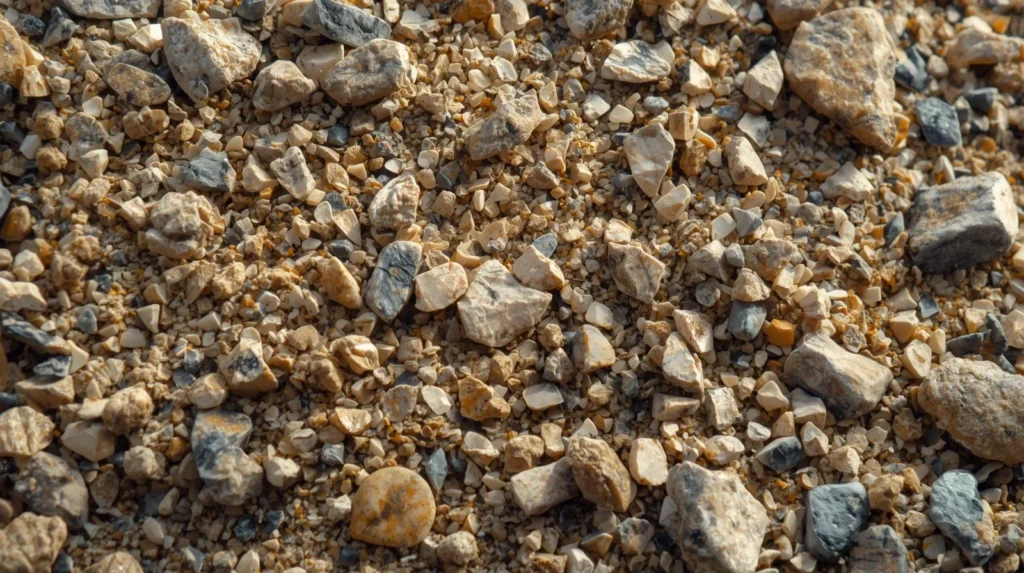
A petrographer examines the coarse aggregate particle by particle, classifies each by rock type and condition, and assigns a weighting factor based on how that material is expected to perform. Good, sound rock carries a factor of 1. Progressively more deleterious material carries higher factors. The weighted sum produces a single index: a perfectly sound aggregate scores 100, and the number climbs as weathered, soft or reactive particles accumulate in the sample.
That is why the limits cluster just above 100. Alberta Transportation’s bridge specification requires, for its high-performance concrete classes, that “the (weighted) petrographic number shall not exceed 130, and the ironstone content shall not exceed 0.8%.” Nova Scotia sets a maximum of 125 for coarse aggregate in exposure classes C-1, C-2, F-1, C-XL, A-XL, A-1 and A-2, and 140 for all other classes. Manitoba sets 125 for exposure classes C-XL and C-1, and 140 for everything else.
The pattern is the useful part. Two of the three owners use exactly the same pair of numbers — 125 for the severe exposure classes, 140 for the rest — which tells you the 125/140 split is close to common Canadian practice rather than one province’s preference. If you are writing a specification for Calgary flatwork or a parkade deck and you are not sure what to put beside the petrographic number, those are the figures the industry is already using. If your exposure class is one of the aggressive ones, the number tightens. Our breakdown of the CSA A23.1 exposure classes covers which class your element actually falls into.
Where the three owners disagree, and what that tells you
The petrographic number is the point of agreement. Almost everything else is not.
| Property | Alberta Transportation (bridge) | Nova Scotia | Manitoba |
|---|---|---|---|
| Weighted petrographic number | 130 max (HPC classes) | 125 / 140 by exposure class | 125 / 140 by exposure class |
| Coarse aggregate absorption | Not stated | 2% max | 3% max |
| Los Angeles abrasion loss | Cited, no limit stated | Cited, no limit stated | 28% max |
| Flat and elongated particles | 10% max at 4:1 | 20% max (per CSA A23.1 Table 12) | ASTM D 4791 cited, no limit |
| Ironstone | 0.8% max | Not stated | 1% max combined with shale, chert, mica |
| Shale | Covered under combined limit | Not stated | 0.5% max |
Read that table as a warning about how the numbers travel. A 2% absorption ceiling and a 3% absorption ceiling are a meaningful difference in which pits can supply the job. A 10% flat-and-elongated limit at a 4:1 ratio is a materially tighter screen than 20%. None of these is a national rule, and none of them is implied by simply citing CSA A23.1.
That is the practical point for anyone writing or pricing an Alberta specification: the standard supplies the test method, the project specification supplies the limit, and the limit is what decides whether local aggregate qualifies. Citing the method without the number leaves the question open, and it tends to get answered at the worst possible moment.
The soundness test is the weakest link, and freeze-thaw can replace it
Magnesium sulphate soundness is the oldest of these tests and the one most likely to mislead. A national review of aggregate testing prepared for the Canadian airfield pavement technical group is blunt about it: soundness has “poor multi-laboratory precision” and “inadequate correlation with field performance,” and the ASTM version of the fine aggregate test publishes no precision data at all.
There is a documented way around it. That same review notes that CSA permits the magnesium sulphate requirement for coarse aggregate in concrete to be waived where the unconfined freeze-thaw loss does not exceed 6%. In other words, a direct measurement of frost resistance can stand in for an indirect, poorly reproducible proxy for it.
This matters in Calgary more than it does almost anywhere else in the country. Unconfined freeze-thaw is the test that actually simulates what this climate does to a particle, and research cited in that review found Micro-Deval combined with freeze-thaw to be the most reliable combination for predicting field performance of coarse aggregate in concrete. If you are specifying for a surface that will see freeze-thaw cycling and de-icing chemicals, the freeze-thaw loss is the number with the most predictive value in the whole set — and it is frequently left to the referenced table and never discussed.
What the Micro-Deval test does that the others do not
Micro-Deval is a wet abrasion test, and the “wet” is the whole point. Where the Los Angeles test tumbles dry aggregate with steel spheres and measures mostly impact resistance, Micro-Deval soaks the sample first and runs it in water, which is far closer to how aggregate degrades in service.
The coarse aggregate procedure uses a 195 mm jar with 5 kg of 9.5 mm steel balls, rotated for two hours, with the loss measured on a 1.2 mm sieve. The fine aggregate procedure takes a 500 g subsample from a washed and dried 700 g sample, runs it with 1,250 g of steel balls for 15 minutes, and measures loss on a 0.075 mm sieve.
Two features make it attractive. It correlates well with soundness while giving better precision, and it turns around in two days instead of ten. For concrete aggregate specifically, the review records Ontario’s limits at 20% maximum loss for coarse and 15% for fine. Those figures are agency practice rather than a national requirement, and the report they come from is a review of the method rather than a current standard, so treat them as a reference point for drafting and confirm the limit against your own project specification.
What this means when you order concrete in Calgary
Three things follow from all of this for anyone buying concrete here.
First, aggregate quality is settled at the pit, not at the truck. By the time a mix is batched, the petrographic number and the freeze-thaw loss of that aggregate are historical facts. If your specification needs a limit met, it needs to be stated before a source is approved.
Second, name the limit, not just the method. “Aggregate shall conform to CSA A23.1” leaves every number in this article unresolved. If the element is a severe exposure class, say 125 and say which test produced it.
Third, know which test your number came from. Petrographic number, freeze-thaw loss, soundness loss and Micro-Deval loss are four different measurements with four different reliabilities, and they are not interchangeable even though they all claim to describe durability. Reactivity is a separate question again, handled by its own pair of tests — see our note on alkali-aggregate reaction — and the proportioning question of how coarse and fine aggregate are blended is covered in combined aggregate gradation.
Send us your project details — pour date, mix type, PSI, volume — and our team will get back to you within 1 business hour with a quote and delivery slot. If you have a specification with aggregate limits written into it, send that too; see custom mixed concrete in Calgary for how a spec-driven mix is handled, or read how it works for the ordering sequence.
FAQ
What is a good petrographic number? A perfectly sound aggregate scores 100, and the limits sit just above it. Canadian public owners commonly use 125 for severe exposure classes and 140 for the rest, with Alberta Transportation requiring 130 or less for its high-performance concrete classes. Higher numbers mean more weathered, soft or deleterious material in the sample.
Can the magnesium sulphate soundness test be skipped? In some cases, yes. A national review of these methods records that CSA permits the magnesium sulphate requirement for coarse concrete aggregate to be waived where unconfined freeze-thaw loss does not exceed 6%. Whether that applies to your job depends on the specification you are working to.
Why does Micro-Deval get preferred over Los Angeles abrasion for concrete? Micro-Deval runs wet, which is closer to field conditions, and it has better precision than soundness while taking two days instead of ten. Los Angeles abrasion measures impact resistance on dry aggregate, which is a different property.
Does the concrete supplier choose the aggregate limits? No. The test methods come from CSA A23.2 and the acceptance limits come from the project specification, usually by reference to Table 12 of CSA A23.1 or by stating a number directly. The supplier’s job is to source aggregate that meets the limits you have written.
Which test matters most in Calgary? Unconfined freeze-thaw loss, for anything exposed to freeze-thaw cycling and de-icing chemicals. It measures the failure mechanism this climate actually produces, rather than inferring it from a chemical proxy.
Will any of this show up on a batch ticket? No. Aggregate durability results belong to the source approval package for the pit, not to the delivery of a single load. Ask for them before the source is accepted.
Sources
- Alberta Transportation, Specifications for Bridge Construction, Section 4 — Cast-in-Place Concrete
- Nova Scotia Public Works, Section 7 — Cast in Place Concrete
- Manitoba Infrastructure, Specification 1030 — Structural Concrete
- Canadian Airfield Pavement Technical Group, Report ATR-024 — A Review and Evaluation of the Micro-Deval Test