
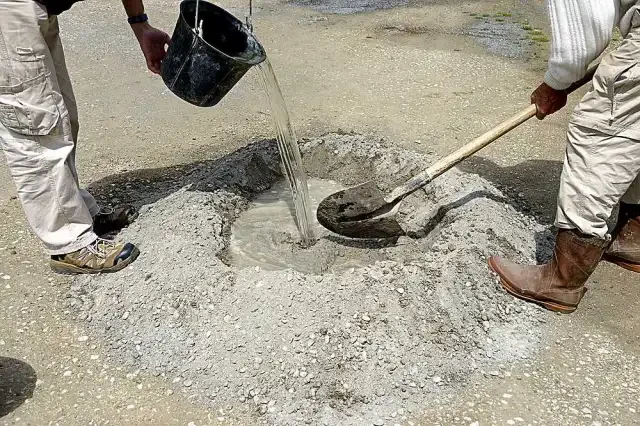
Water may be added to a load on site, but only inside a narrow set of conditions: the specified slump and the specified water-to-cementing-materials ratio must not be exceeded, the drum must turn at least 30 more revolutions at mixing speed afterward, more than a small portion of the load must not already be discharged, and every litre must be measured and recorded on the delivery ticket. Outside those conditions, what is being added is not an adjustment. It is a change to the mix design, made in a yard truck, by whoever is standing closest to the chute.
This comes up on nearly every Calgary pour. The load arrives stiffer than the crew wants, the finishers are three metres away with a screed, and somebody asks for “just a bit of water.” What follows is what the standard actually says, what the water does to the concrete, and what to do instead when the mix is genuinely too stiff to place.
What CSA A23.1 permits
The governing clause in Canada is CSA A23.1, Clause 18.4.3.1, covering jobsite addition of water. Its requirements are procedural, and each one exists for a reason.
| Requirement | What it means at the chute |
|---|---|
| Water must not push the mix past the specified slump or the specified w/cm | The two ceilings are independent. Hitting either one ends the conversation. |
| 30 or more revolutions of the drum at mixing speed after water is added | Water sitting on top of a load is not mixed concrete. Uniformity has to be restored before discharge. |
| No water after more than a small portion of the load is discharged | Once concrete is on the ground, the remainder cannot be brought back to a uniform, verifiable mix. |
| Discharge should begin within 60 minutes of the batch time shown on the delivery ticket | Time and temperature are already consuming slump. Water is being used to buy back something that was lost to elapsed time. |
| All water added on site must be measured and recorded on the delivery ticket | The ticket is the record of what was placed. Unrecorded water makes the ticket wrong. |
NRMCA’s guidance adds a practical threshold for the discharge limit: no water addition once more than about 0.2 m³ (¼ cu. yd.) has been discharged. It also notes that where the drum turns at 20 rpm or more, roughly 10 revolutions will achieve what 30 revolutions do at lower speed — but 30 is the number to hold people to unless someone is counting drum speed.
One more clause matters more than all of them. Concrete Saskatchewan puts it plainly: if the purchaser requests additional water in excess of the design mix, the purchaser assumes responsibility for the resulting concrete quality. The moment water is requested on site, the strength result stops being the supplier’s problem and becomes the buyer’s.
What the water actually does
The useful rule of thumb: roughly 5 litres of water per cubic metre raises slump by about 25 mm. That is why a small amount of water produces a visible, immediate change at the chute — and why it is so easy to overshoot.
The reason it is not free is the water-to-cementing-materials ratio. Worked example, round numbers: take a 32 MPa mix with 340 kg/m³ of cementing materials batched at w/cm 0.45. That mix carries about 153 litres of water per cubic metre. Add 15 litres — three centimetres of slump, barely a minute of conversation — and the water is now 168 litres, for a w/cm of about 0.49.
Why that matters: CSA A23.1 Table 2 caps w/cm by exposure class, and the caps are hard limits, not targets. C-2 exposure — the class that covers most exterior flatwork exposed to chlorides and freeze-thaw, including driveways and parkade decks — is capped at w/cm 0.45 with 32 MPa at 28 days. F-1 is capped at 0.50 with 30 MPa at 28 days. C-1 is 0.40 with 35 MPa within 56 days. The standard’s own language is unambiguous: the water-to-cementitious materials ratio shall not be exceeded for a given class of exposure.
So the example above did not just lose some strength. It delivered a C-2 slab that no longer meets C-2. In Calgary, where the same slab will see de-icing salt off a vehicle and repeated freeze-thaw cycling every winter, the durability consequence outlives the strength one by decades. Higher w/cm means a more permeable paste, and permeability is what lets chlorides and water reach the steel and the pore structure. The cylinder break is the symptom people notice; the scaling driveway four winters later is the actual bill.
Why the load arrived stiff in the first place
Before adding anything, it is worth naming the cause — because most of them have a better remedy than water.
- Elapsed time. Cement hydration starts at batching, not at the chute. Traffic, an early truck waiting on a late crew, a formwork problem: all of it is consuming slump.
- Ambient temperature. Hot mix concrete placed on a 28°C Calgary afternoon loses slump measurably faster than the same mix at 12°C. A chinook in February can do the same thing in the middle of what everyone is treating as a winter pour.
- Wind and low humidity. Alberta’s dry air pulls surface moisture out of an exposed load fast.
- Aggregate moisture variation. A drier stockpile than the batch assumed changes the delivered slump, which is one of several things a batch ticket will tell you if you read it.
- The mix was specified stiff on purpose. A low-slump mix for a slope, a curb, or a slip-formed section is not a mistake to be corrected at the chute.
Placement crews also sometimes want water for a reason the standard cannot address: the mix is right and the crew is short-handed. Water is not a substitute for labour. It is a substitute for durability.
Better ways to get workability
Every one of these gets you placeable concrete without moving the w/cm.
- Water reducers and mid-range water reducers. A Type A or Type F admixture increases slump at a constant water content. This is precisely the problem they exist to solve — our guide to concrete admixture types on an Alberta pour covers what each type actually guarantees.
- Specify the slump you need at the point of placement, not at the plant. If the crew needs 120 mm at the screed, that is the number to order, with delivery time accounted for.
- Batch on site. A volumetric mixer meters cement, aggregate, water and admixture at the truck and mixes at the point of placement, so slump is set where the concrete lands rather than adjusted after a drive across the city. That is the whole premise of how volumetric delivery works — and the reason retempering is not part of the conversation.
- Fix the queue, not the concrete. Staggered delivery times, a pump in position before the first truck, and a crew sized for the pour will do more for placeability than any admixture.
- Re-test before you decide. Slump is a measurement, not an opinion formed by looking at a chute. Sample per CSA A23.2-5C — not from the first or last 10 per cent of the load — and run it. Our guide to concrete slump tests walks through the procedure.
If water is going to be added anyway
Sometimes the answer really is a measured, authorized water addition inside the limits. Do it properly.
- Settle who authorizes it before the pour, at the pre-pour meeting — the contractor’s representative, the engineer of record, or the testing agency, named in advance. Both NRMCA and Concrete Saskatchewan point to a preconstruction meeting for exactly this.
- Check the batch ticket first. The ticket shows batched water and how much of the design water is still available before the specified w/cm is reached. If the answer is zero, the answer is zero. Our breakdown of the numbers on a concrete batch ticket shows where to find it.
- Measure the water. Truck water tanks are metered for this reason. “About half a hose” is not a quantity.
- Record it on the ticket, with the amount and who requested it.
- Turn the drum 30 revolutions at mixing speed, then re-test slump and air before discharge continues.
- Do not add water after the load has started going down, beyond a nominal amount at the very beginning.
If those conditions cannot be met, the load either goes in as it is or it goes back. That decision belongs to the contractor, and it is worth knowing in advance what the legitimate reasons to reject a concrete truck actually are.
Frequently asked questions
Can you legally add water to a ready-mix truck on site in Canada? Yes, within CSA A23.1 Clause 18.4.3.1: the specified slump and w/cm must not be exceeded, at least 30 drum revolutions at mixing speed must follow, no water may be added after more than a small portion of the load has discharged, and the amount must be measured and recorded on the delivery ticket.
How much does water raise slump? About 25 mm of slump per 5 litres of water per cubic metre, as a rule of thumb. The exact response varies with mix design, temperature and how much time has already elapsed.
Who is responsible if strength results come back low after water was added? The purchaser. Concrete Saskatchewan states that where the purchaser requests water in excess of the design mix, the purchaser assumes responsibility for the resulting concrete quality.
Why 30 revolutions? Added water does not distribute itself. Without re-mixing at mixing speed, the load discharges non-uniformly — wet at one point, unchanged at another — and no test result from it represents the concrete in the forms.
Is adding water worse in winter or summer? Both, differently. In hot or chinook conditions, water masks a slump loss that will continue after placement. In cold weather, the extra water raises the free water available to freeze before the concrete develops strength, and it extends the time to finishing on a schedule that is already tight.
What about adding water to a volumetric mixer? It is a different situation, because the mix is proportioned at the point of placement. Water content is set as the concrete is produced rather than corrected after the fact — which is why the slump the crew asked for is the slump that arrives.
The short version
Water is the cheapest thing on the truck and the most expensive thing you can add to it. CSA A23.1 permits a measured, recorded, re-mixed addition inside the specified slump and w/cm. Everything past that line buys twenty minutes of easier placing and spends thirty years of durability on a Calgary slab that will see salt and freeze-thaw for all of them.
If your crew is regularly asking for water at the chute, the mix, the delivery timing, or the admixture package needs adjusting — not the load. Talk to us about how on-site volumetric batching works and we will spec the slump for where the concrete is going, not where it started.
Sources
- NRMCA, CIP 26 — Jobsite Addition of Water: https://www.concreteanswers.org/CIPs/CIP26.htm
- Concrete Saskatchewan, Technical Tip 24 — Jobsite Addition of Water (CSA A23.1 Clause 18.4.3.1): https://concretesask.org/images/Resources/ConcreteTechnicalTips/eNews_TECH_Tip_24_-_Jobsite_Addition_of_Water.pdf
- RMCAO, TS03 — Classes of Exposure (CSA A23.1 Table 2 requirements): https://www.rmcao.org/wp-content/uploads/2025/01/TS03-Classes-of-Exposure-2025-1.pdf